13 Is anyone among you suffering? Let
him pray. Is anyone cheerful? Let him
sing psalms. 14 Is anyone among you sick?
Let him call for the elders of the church,
and let them pray over him, anointing him
with oil in the name of the Lord. 15 And
the prayer of faith will save the sick, and
the Lord will raise him up. And if he has
committed sins, he will be forgiven.
“suffering” (kakopatheō) = afflicted, to undergo
hardship, suffer trouble
“pray” (proseuchomai) = petition God, to
earnestly implore God
Sabeans killed 500 oxen, 500
asses & all your servants
Fire from heaven killed 700 sheep
& all your servants
Chaldeans killed 3000 oxen & all
your servants
Dessert storm killed your 7 sons &
3 daughters
Job 1:20–21 Then Job arose, tore his robe,
and shaved his head; and he fell to the ground
and worshiped. 21 And he said: “Naked I came
from my mother’s womb, and naked shall I
return there. The LORD gave, and the LORD has
taken away; blessed be the name of the LORD.”
“cheerful” (euthymeō) = happy, merry, to be
delighted
“sing psalms” (psallō) = sing praise
“sick” (astheneō) = be weak, ill or incapacitated,
feeble, powerless, destitute
of strength
“call” (proskaleō) = send for,
summon, invite
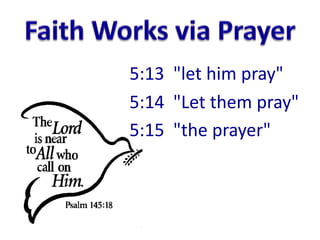
5:13 "let him pray"
5:14 "Let them pray"
5:15 "the prayer"
• suffering (5:13a) "afflicted?"
• successful (5:13b) "is any merry?"
• sick (5:14) "is any sick?”
• sinning (5:15) "have committed sin?"
• spiritual (5:17) "a righteous man…"
Use of astheneō in the New Testament:
• Translated “sick” 19x.
• 14x refers to emotional or spiritual weakness.
2 Corinthians 12:10 Therefore I take pleasure in
infirmities, in reproaches, in needs, in persecutions,
in distresses, for Christ’s sake. For when I am weak,
then I am strong.
A. This is not a prerogative, but a requirement.
B. This was the practice of the early church.
“Let him call for the elders of the church”
• Justin Martyr (100-165 AD)
• Irenaeus (125-203 AD)
• Tertullian (155-222 AD)
• Galen (129-200 AD)
“Let him call for the elders of the church”
• THE ELDERS' IDENTITY:
Interchangeable terms – "elder," "bishop,”
"overseers," "shepherd," & “pastor” (Phil. 1:1;
1 Tim. 3:1-6; Titus 1).
• THE ELDERS' RESPONSIBILITY:
Heb 13:17 "who watch for your souls”
Acts 6 "prayer and the ministry of the Word of
God”
852 AD “Sacrament of Extreme Unction”
Best Practice: Holistic Healing
Isaiah 6
Seraphim’ declare “Holy, Holy, Holy”
‫ק‬ֹ‫ד‬ֶ‫שׁ‬
“wholeness” – integration, integrity
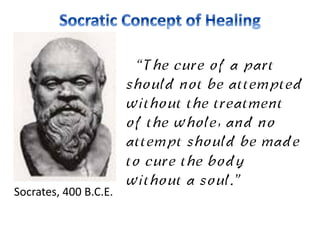
“The cure of a part
should not be attempted
without the treatment
of the whole, and no
attempt should be made
to cure the body
without a soul.”
Socrates, 400 B.C.E.
This implies that not only was physical
health prayed for but spiritual health.
Illnesses should be a reminder of sin
since sin brought it into the world.
"The body is often the instrument of sins, and
therefore the object of diseases.”
• Miriam's jealousy of Moses led to leprosy
(Num. 12)
• Israelites' idolatry and sexual immorality when
they were led astray by the Moabites led to a
plague that killed thousands of people (Num.
25:8-9; 1 Cor. 10:8)
• David's pride in numbering his army led to a
plague in the land (I Chron. 21)
• Herod's self-exaltation and acceptance of the
people's worship led to his death by worms
(Acts 12:22-23).
• Inappropriate Emphasis on the physical
rather than on the spiritual welfare of
the sick.
• Mistaken Interpretation of Isaiah 53:5,
concluding that the atonement of Christ
on the cross is the basis of all physical
healing.
Isaiah 53:5 But He was wounded for our
transgressions. He was bruised for our
iniquities; the chastisement for our peace
was upon Him. And by His stripes we are
healed.
Isaiah 53:4 Surely, He has borne our griefs
and carried our sorrows: Yet we esteemed
Him stricken, smitten by God, and afflicted.
Matthew 8:17 …that it might be fulfilled
which was spoken by Isaiah the prophet
saying: “He Himself took our infirmities and
bore our sicknesses.”
I Peter 2:24 …who Himself bore our sins in
His own body on the tree that we, having
died to sins might live for righteousness - by
whose stripes you were healed.
1. "Pray over him”
2. "Anointing him with oil"
• The sick were not the ones commanded
to pray.
• The effectiveness contingent on the faith
of the elders.
• This was not a short flippant prayer:
They were to pray "over" him
• Simon Peter never mentions this practice
of anointing with oil.
• Paul never mentions this practice of
anointing with oil.
• John never mentions this practice of
anointing with oil.
• No other New Testament writer mentions
this practice.
• Why didn’t Paul advise Timothy to have
himself anointed with oil for his stomach
problems? (I Tim. 5:23)
• Why didn’t Paul anoint Trophimus with oil?
(2 Tim 4:20 “Erastus remained at Corinth,
but Trophimus I left sick in Miletus”)
• Why didn’t Paul anoint Epaphroditus? (Phil.
2:26-27)
1. The anointing was medicinal.
2. The anointing was spiritual or symbolic. The
oil represents the joy, gladness and grace that
comes from the Holy Spirit (cf. Ps. 23:5; 45:7;
133:2; Eccl. 9:8; I John 2:20).
3. An Act of Consecration.
4. Some miracles were associated with some sort
of action
• Naaman to wash in Jordan 7 times (cf. II Kings 5)
• Jesus Himself used His own saliva, some mud and
the Pool of Siloam to heal a blind man (cf. John
9:7)
• Paul’s handkerchiefs and aprons were used to
heal the sick (cf. Acts 19:11-12)
1. "Prayer of Faith shall SAVE THE SICK”
2. "The Lord shall RAISE HIM UP”
3. "Sins shall be FORGIVEN”
941-729-6600
941-981-5387
http://faithbiblechurchefc.com
http://TRUTHtransforms.com
sanctitas@aol.com

Praying for the Sick

  • 4.
    13 Is anyoneamong you suffering? Let him pray. Is anyone cheerful? Let him sing psalms. 14 Is anyone among you sick? Let him call for the elders of the church, and let them pray over him, anointing him with oil in the name of the Lord. 15 And the prayer of faith will save the sick, and the Lord will raise him up. And if he has committed sins, he will be forgiven.
  • 5.
    “suffering” (kakopatheō) =afflicted, to undergo hardship, suffer trouble “pray” (proseuchomai) = petition God, to earnestly implore God
  • 6.
    Sabeans killed 500oxen, 500 asses & all your servants Fire from heaven killed 700 sheep & all your servants Chaldeans killed 3000 oxen & all your servants Dessert storm killed your 7 sons & 3 daughters
  • 7.
    Job 1:20–21 ThenJob arose, tore his robe, and shaved his head; and he fell to the ground and worshiped. 21 And he said: “Naked I came from my mother’s womb, and naked shall I return there. The LORD gave, and the LORD has taken away; blessed be the name of the LORD.”
  • 8.
    “cheerful” (euthymeō) =happy, merry, to be delighted “sing psalms” (psallō) = sing praise
  • 9.
    “sick” (astheneō) =be weak, ill or incapacitated, feeble, powerless, destitute of strength “call” (proskaleō) = send for, summon, invite
  • 10.
    5:13 "let himpray" 5:14 "Let them pray" 5:15 "the prayer"
  • 11.
    • suffering (5:13a)"afflicted?" • successful (5:13b) "is any merry?" • sick (5:14) "is any sick?” • sinning (5:15) "have committed sin?" • spiritual (5:17) "a righteous man…"
  • 12.
    Use of astheneōin the New Testament: • Translated “sick” 19x. • 14x refers to emotional or spiritual weakness. 2 Corinthians 12:10 Therefore I take pleasure in infirmities, in reproaches, in needs, in persecutions, in distresses, for Christ’s sake. For when I am weak, then I am strong.
  • 13.
    A. This isnot a prerogative, but a requirement. B. This was the practice of the early church. “Let him call for the elders of the church”
  • 14.
    • Justin Martyr(100-165 AD) • Irenaeus (125-203 AD) • Tertullian (155-222 AD) • Galen (129-200 AD) “Let him call for the elders of the church”
  • 15.
    • THE ELDERS'IDENTITY: Interchangeable terms – "elder," "bishop,” "overseers," "shepherd," & “pastor” (Phil. 1:1; 1 Tim. 3:1-6; Titus 1). • THE ELDERS' RESPONSIBILITY: Heb 13:17 "who watch for your souls” Acts 6 "prayer and the ministry of the Word of God” 852 AD “Sacrament of Extreme Unction”
  • 16.
    Best Practice: HolisticHealing Isaiah 6 Seraphim’ declare “Holy, Holy, Holy” ‫ק‬ֹ‫ד‬ֶ‫שׁ‬ “wholeness” – integration, integrity
  • 18.
    “The cure ofa part should not be attempted without the treatment of the whole, and no attempt should be made to cure the body without a soul.” Socrates, 400 B.C.E.
  • 19.
    This implies thatnot only was physical health prayed for but spiritual health. Illnesses should be a reminder of sin since sin brought it into the world. "The body is often the instrument of sins, and therefore the object of diseases.”
  • 20.
    • Miriam's jealousyof Moses led to leprosy (Num. 12) • Israelites' idolatry and sexual immorality when they were led astray by the Moabites led to a plague that killed thousands of people (Num. 25:8-9; 1 Cor. 10:8) • David's pride in numbering his army led to a plague in the land (I Chron. 21) • Herod's self-exaltation and acceptance of the people's worship led to his death by worms (Acts 12:22-23).
  • 21.
    • Inappropriate Emphasison the physical rather than on the spiritual welfare of the sick. • Mistaken Interpretation of Isaiah 53:5, concluding that the atonement of Christ on the cross is the basis of all physical healing.
  • 22.
    Isaiah 53:5 ButHe was wounded for our transgressions. He was bruised for our iniquities; the chastisement for our peace was upon Him. And by His stripes we are healed. Isaiah 53:4 Surely, He has borne our griefs and carried our sorrows: Yet we esteemed Him stricken, smitten by God, and afflicted.
  • 23.
    Matthew 8:17 …thatit might be fulfilled which was spoken by Isaiah the prophet saying: “He Himself took our infirmities and bore our sicknesses.” I Peter 2:24 …who Himself bore our sins in His own body on the tree that we, having died to sins might live for righteousness - by whose stripes you were healed.
  • 24.
    1. "Pray overhim” 2. "Anointing him with oil" • The sick were not the ones commanded to pray. • The effectiveness contingent on the faith of the elders. • This was not a short flippant prayer: They were to pray "over" him
  • 25.
    • Simon Peternever mentions this practice of anointing with oil. • Paul never mentions this practice of anointing with oil. • John never mentions this practice of anointing with oil. • No other New Testament writer mentions this practice.
  • 26.
    • Why didn’tPaul advise Timothy to have himself anointed with oil for his stomach problems? (I Tim. 5:23) • Why didn’t Paul anoint Trophimus with oil? (2 Tim 4:20 “Erastus remained at Corinth, but Trophimus I left sick in Miletus”) • Why didn’t Paul anoint Epaphroditus? (Phil. 2:26-27)
  • 27.
    1. The anointingwas medicinal. 2. The anointing was spiritual or symbolic. The oil represents the joy, gladness and grace that comes from the Holy Spirit (cf. Ps. 23:5; 45:7; 133:2; Eccl. 9:8; I John 2:20). 3. An Act of Consecration.
  • 28.
    4. Some miracleswere associated with some sort of action • Naaman to wash in Jordan 7 times (cf. II Kings 5) • Jesus Himself used His own saliva, some mud and the Pool of Siloam to heal a blind man (cf. John 9:7) • Paul’s handkerchiefs and aprons were used to heal the sick (cf. Acts 19:11-12)
  • 29.
    1. "Prayer ofFaith shall SAVE THE SICK” 2. "The Lord shall RAISE HIM UP” 3. "Sins shall be FORGIVEN”
  • 32.