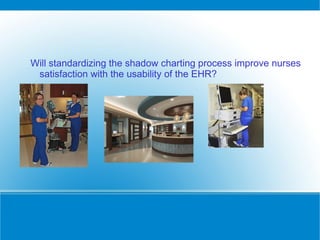
Will standardizing the shadow charting process improve nurses
 satisfaction with the usability of the EHR?
Scope

 This project integrated nursing science, computer science, and
  information science to manage and communicate data,
  information, knowledge, and wisdom in nursing practice (ANA,
  2008).
 The scope of this project is to identify if standardization of a
  process used to support nurses use of the EHR will improve
  their satisfaction with its usability.
 “......such a change can be brought about by improving
  perceptions regarding the system, specifically perception of the
  ease of system use and its usability in routine practice. Tailoring
  interventions that are geared toward understanding nurses’
  perceptions will promote adoption (Staggers, 2008).”
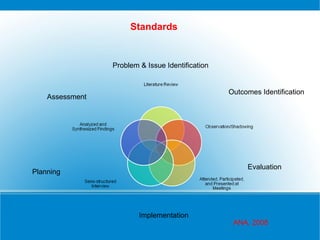
Standards


                 Problem & Issue Identification


                                                  Outcomes Identification
    Assessment


                                                       Evaluation
Planning


                         Implementation
                                                   ANA, 2008
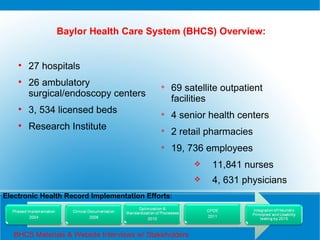
Baylor Health Care System (BHCS) Overview:


    
        27 hospitals
    
        26 ambulatory                        
                                                 69 satellite outpatient
        surgical/endoscopy centers
                                                 facilities
    
        3, 534 licensed beds                 
                                                 4 senior health centers
    
        Research Institute                   
                                                 2 retail pharmacies
                                             
                                                 19, 736 employees
                                                            11,841 nurses
                                                            4, 631 physicians
Electronic Health Record Implementation Efforts:


   BHCS Materials & Website Interviews w/ Stakeholders
Shadow Charting Process Overview:
                                 Overview
Part of the optimization effort used in the testing phase
of the change request process.

Tests for usability, workflow impact, and education/
training needs prior to implementation of enhancements
to the EHR.

Data generated is used to make recommendations to
Business Information Systems (BIS) to improve design.

Completing this process is the responsibility of the
Informatics Resource Nurses (IRNs).


                              BHCS Materials & Interviews w/ Stakeholders
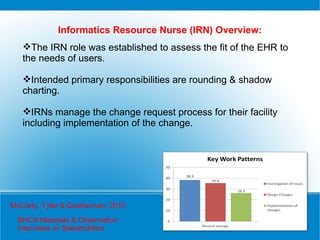
Informatics Resource Nurse (IRN) Overview:
   The IRN role was established to assess the fit of the EHR to
   the needs of users.

   Intended primary responsibilities are rounding & shadow
   charting.

   IRNs manage the change request process for their facility
   including implementation of the change.


McCarty, Tyler & Quarterman, 2010

  BHCS Materials & Observation,
  Interviews w/ Stakeholders
Working Relationships of Optimizing Entities   :


McCarty, Tyler & Quarterman, 2010
Problem:

 The IRN role and processes, including shadow charting, have
  not been operationalised with variations at each site.
 With variations at each site the data integrity from the shadow
  charting process is compromised.
 Introduction of enhancements to the EHR using this process
  have negatively impacted users and workflow.
 A poor design adds time to the completion of work rather than
  making it more efficient (Alexander & Staggers, 2009).
 Per Chris McCarty up to 99% of communications currently
  resulting from this process are ineffective and do not reflect the
  BHCS enterprise model.
                                    McCarty, Tyler & Quarterman, 2010
                                  Observation, Interviews w/ Stakeholders
Interactive Sociotechnical Analysis (ISTA) Theory
Four key features of ISTA:
• The importance of examining actual uses of HIT (“HIT-in-use”),
rather than uses that were planned or envisioned by designers or
managers.
• The impact on HIT use of technical and physical settings of work.
• Users’ renegotiation and reinterpretation of HIT features.
• Interaction and interdependence among social and technical
systems and recursive relations among sociotechnical
subcomponents.

                 Harrison, Koppel & Bar Lev, 2007
Interactive Sociotechnical Analysis (ISTA) Theory
The five interaction types are:
1 New HIT changes existing social system.
2 Technical & physical infrastructures mediate HIT use—
  Interaction of new HIT with existing technical and physical
  conditions affects HIT-in-use.
3 Social system mediates HIT use—Interaction of new HIT with the
  social system affects HIT-in-use.
4 HIT-in-use changes social system—Interaction of new HIT with
  the social system affects HIT-in-use, which then further changes
  the social system.
5 HIT-social system interactions engender HIT redesign—
  Interaction of new HIT with the social system affects HIT-in-use,
  which then leads to changes in HIT properties.
                                        Harrison, Koppel & Bar Lev, 2007
Application of Theory to IRN role & Shadow Charting Process
1. Examination of actual use-IRNs are positioned to interact
   directly with clinical users. Shadow Charting examines
   actual use.
2. Observation and Shadowing allow the IRN to take in to
   account the technical and physical setting in use by nurses.
3. IRNs assess how nurses work around the current system,
   and how they might work around the change.
4. The sociotechnical components: IRNs determine current
   methods of communication and how change will affect those
   methods.


                                       Harrison, Koppel & Bar Lev, 2007
Literature Review
 Technography/Ethnography for the study of social–technical
  configurations(Jansen & Vellema, 2011; Suchman, 1995).
 Shadowing...close following over a period of time to investigate
  people...everyday lives, not what their roles dictate(Quinlan,
  2008).
 Data grounded in actual events rather than reconstructions (focus
  group and interviewing)(Quinlan, 2008).
 Shadowing suitable to answer questions within complex
  interrelated processes (Quinlan, 2008).

 ...”the further removed we are from the work of others, the more
  simplified, often stereotyped, our view of their work
  becomes”(Suchman, 1995).
Literature Review
 Design of work environment linked to staff and patient safety,
  efficiency, staff satisfaction, and errors. Excessive cognitive
  workload.....(Battisto, Pak, Vander Wood & Pilcher, 2009).
 Complex Adaptive System. Until redesign ....... frustration,
  inefficiencies, and suboptimal performance, including error
  (Vardaman, Cornell & Clancy, 2012).
 Critical thinking requires time and control over workflow (Cornell,
  Riordan,Townsend-Gervis & Mobley, 2011).
 Safety items and hand off communication not incorporated into
  workflow or thinkflow causing workarounds; impede the flow of
  and easy accessibility of patient information (Sidebottom,
  Collins, Winden, Knuston & Britt, 2011; Staggers, Clark, Blaz &
  Kapsandoy, 2011).
Literature Review
                                                                         
Undesirable outcomes of HIT implementation flow from
sociotechnical interactions—the interplay between new HIT and the
organization’s existing social and technical systems including their
workflows, culture, social interactions, and technologies.” (Harrison,
Koppel & Bar Lev, 2007).

                                                                         
When members of a natural system “perceive collective (at some
level) versus individual benefits, they are more willing to participate in
and, thus, sustain organizational initiatives” (Winiecki, 2010, p. 36).
 (McCarty, Tyler & Quarterman, 2010).
Solutions that benefit many resonate in the “belief system” of the
IRN. Benefits to the collective whole should also be emphasized”


                                                                         
CD tests validity in the work environment...Ethnographic studies to
Shadow Charting Model
Receive Request
                                                                           IRN Reviews
to Shadow Chart                            IRN
                                                                             Request


                                             After discussion with
                    Return item to           Team Lead and IRN                                    Pair up with a buddy
                                                                              Is item                                     Document in test
                   design team with   No      peers is item ready    No                            and observe their
                                                                           ready to be      Yes                            environment.
                  recommendations.               to be shadow                                           workflow.
                                                                             shadow
                                                   charted?
                                                                            charted?


                                                                               YES


                                                                                                                           Have buddy look
                                                                                                                         over documentation
                                                                                                                         in test environment.


                                                     Send                 Review findings
                                                                                                                         Discuss the change
                                              recommendations              during team              Document and
                                                                                                                         and documentation
                                             to implement or not          meetings, with           analyze findings .
                                                                                                                           with the buddy.
                                              implement change              Team Lead.
Goals & Evaluation
                                    .

    Core group of IRNs are responsible for educating their peers
    and revising/updating the process as needed using
    measurable criteria (i.e. IRN and nurse satisfaction surveys).

    Assess nurse(s) and IRNs satisfaction with the shadow
    charting process immediately after process completion & 1
    month after implementation using a likert scale.

    Nurse(s) satisfaction with usability will be assessed pre and
    post implementation using a likert scale.

    Checklist for shadow charting process will be used to collect,
    track, and analyze data. Includes pre and post mapping of
    nurses workflow, and subjective comments from nurses.
References

American Nurses Association (2008). Nursing Informatics Scope & Standards of Practice.
Silver Spring, MD: Nursebooks.org

Alexander, G.A., & Staggers, N. (2009). A systematic review on the design of clinical
technology: Findings and recommendations for future research. Advances in Nursing Science,
32(3), 252-279.

Battisto,D., Pak, R., Vander Wood, M., & Pilcher, J. (2009). Using a task analysis to describe
nursing work in acute care patient environments. Journal of Nursing Administration, 42(12),
538-547.

Cornell, P., Riordan, M., Townsend-Gervis, M., & Mobley, R. (2011). Barriers to critical thinking:
Workflow interruptions and task switching among nurses. Journal of Nursing Administration,
41(10), 407-414.

Harrison, M., Koppel, R., & Bar Lev, S. (2007). Unintended consequences of information
technologies in health care – An interactive sociotechnical analysis. JAMA, 14, 542-549.

Jansen, K., & Vellema, S. (2010). What is technography?. NJAS Wageningen Journal of Life
Sciences, 57, 169-177.
References

 McCarty, C., Tyler, C., & Quarterman, S. (2010). Baylor Health Care System IRN
 Competency Based Needs Assessment Final Report. Unpublished manuscript.
 Optimization Education, BHCS, Dallas, TX.

 Narasimhadevara, A., Radhakrishnan, B. L., Leung, B., & Jayakumar, R. (2008). On
 designing a usable interactive system to support transplant nursing. Journal of Biomedical
 Informatics, 41, 137-151.

Quinlan, E. (2008). Conspicuous invisibility: Shadowing as a data collection strategy.
Qualitative Inquiry, 14(8), 1480-1499.

Sidebottom, A.C., Collins, B., Winden, T., Knusten, A., & Britt, H.(2011) Reactions of nurses
to the use of electronic health record alert features in an inpatient setting. CIN: Computers,
Informatics, Nursing, 1-9.

Staggers, N., Clark, L., Blaz, J., & Kapsandoy, S. (2011). Why patient summaries in
electronic health records do not provide the cognitive support necessary for nurses’ handoffs
on medical and surgical units: Insights from interviews and observations. Health Informatics
Journal, 17(3), 209-223.
References

Staggers, N., Weir, C., & Pfansalkar, S. (2008). Patient safety and health information
technology: Role of Critical Elements of the Electronic Health Record. In R. Hughes
(Ed.), Patient Safety & Quality: an Evidence-based Handbook for Nurses (chapter 47).
AHRQ Publication No. 07-. Rockville, MD: Agency for Healthcare Research and
Quality. E-pub 4/08. Available at:
http://www.ahrq.gov/qual/nurseshdbk/docs/StaggersN_PSHIT.pdf. Published,
04/15/2008.

Suchman, L. (1995). Making work visible. Communication of the ACM, 38(9), 56-64.

Vardaman, J.M., Cornell, P.T., & Clancy, T.(2012). Complexity of change in nurse
workflows. Journal of Nursing Administration, 39(2), 78-82.

Practicum Project Shadow Charting

  • 1.
    Will standardizing theshadow charting process improve nurses satisfaction with the usability of the EHR?
  • 2.
    Scope  This projectintegrated nursing science, computer science, and information science to manage and communicate data, information, knowledge, and wisdom in nursing practice (ANA, 2008).  The scope of this project is to identify if standardization of a process used to support nurses use of the EHR will improve their satisfaction with its usability.  “......such a change can be brought about by improving perceptions regarding the system, specifically perception of the ease of system use and its usability in routine practice. Tailoring interventions that are geared toward understanding nurses’ perceptions will promote adoption (Staggers, 2008).”
  • 3.
    Standards Problem & Issue Identification Outcomes Identification Assessment Evaluation Planning Implementation ANA, 2008
  • 4.
    Baylor Health CareSystem (BHCS) Overview:  27 hospitals  26 ambulatory  69 satellite outpatient surgical/endoscopy centers facilities  3, 534 licensed beds  4 senior health centers  Research Institute  2 retail pharmacies  19, 736 employees  11,841 nurses  4, 631 physicians Electronic Health Record Implementation Efforts: BHCS Materials & Website Interviews w/ Stakeholders
  • 5.
    Shadow Charting ProcessOverview: Overview Part of the optimization effort used in the testing phase of the change request process. Tests for usability, workflow impact, and education/ training needs prior to implementation of enhancements to the EHR. Data generated is used to make recommendations to Business Information Systems (BIS) to improve design. Completing this process is the responsibility of the Informatics Resource Nurses (IRNs). BHCS Materials & Interviews w/ Stakeholders
  • 6.
    Informatics Resource Nurse(IRN) Overview: The IRN role was established to assess the fit of the EHR to the needs of users. Intended primary responsibilities are rounding & shadow charting. IRNs manage the change request process for their facility including implementation of the change. McCarty, Tyler & Quarterman, 2010 BHCS Materials & Observation, Interviews w/ Stakeholders
  • 7.
    Working Relationships ofOptimizing Entities : McCarty, Tyler & Quarterman, 2010
  • 8.
    Problem:  The IRNrole and processes, including shadow charting, have not been operationalised with variations at each site.  With variations at each site the data integrity from the shadow charting process is compromised.  Introduction of enhancements to the EHR using this process have negatively impacted users and workflow.  A poor design adds time to the completion of work rather than making it more efficient (Alexander & Staggers, 2009).  Per Chris McCarty up to 99% of communications currently resulting from this process are ineffective and do not reflect the BHCS enterprise model. McCarty, Tyler & Quarterman, 2010 Observation, Interviews w/ Stakeholders
  • 9.
    Interactive Sociotechnical Analysis(ISTA) Theory Four key features of ISTA: • The importance of examining actual uses of HIT (“HIT-in-use”), rather than uses that were planned or envisioned by designers or managers. • The impact on HIT use of technical and physical settings of work. • Users’ renegotiation and reinterpretation of HIT features. • Interaction and interdependence among social and technical systems and recursive relations among sociotechnical subcomponents. Harrison, Koppel & Bar Lev, 2007
  • 10.
    Interactive Sociotechnical Analysis(ISTA) Theory The five interaction types are: 1 New HIT changes existing social system. 2 Technical & physical infrastructures mediate HIT use— Interaction of new HIT with existing technical and physical conditions affects HIT-in-use. 3 Social system mediates HIT use—Interaction of new HIT with the social system affects HIT-in-use. 4 HIT-in-use changes social system—Interaction of new HIT with the social system affects HIT-in-use, which then further changes the social system. 5 HIT-social system interactions engender HIT redesign— Interaction of new HIT with the social system affects HIT-in-use, which then leads to changes in HIT properties. Harrison, Koppel & Bar Lev, 2007
  • 11.
    Application of Theoryto IRN role & Shadow Charting Process 1. Examination of actual use-IRNs are positioned to interact directly with clinical users. Shadow Charting examines actual use. 2. Observation and Shadowing allow the IRN to take in to account the technical and physical setting in use by nurses. 3. IRNs assess how nurses work around the current system, and how they might work around the change. 4. The sociotechnical components: IRNs determine current methods of communication and how change will affect those methods. Harrison, Koppel & Bar Lev, 2007
  • 12.
    Literature Review  Technography/Ethnographyfor the study of social–technical configurations(Jansen & Vellema, 2011; Suchman, 1995).  Shadowing...close following over a period of time to investigate people...everyday lives, not what their roles dictate(Quinlan, 2008).  Data grounded in actual events rather than reconstructions (focus group and interviewing)(Quinlan, 2008).  Shadowing suitable to answer questions within complex interrelated processes (Quinlan, 2008).  ...”the further removed we are from the work of others, the more simplified, often stereotyped, our view of their work becomes”(Suchman, 1995).
  • 13.
    Literature Review  Designof work environment linked to staff and patient safety, efficiency, staff satisfaction, and errors. Excessive cognitive workload.....(Battisto, Pak, Vander Wood & Pilcher, 2009).  Complex Adaptive System. Until redesign ....... frustration, inefficiencies, and suboptimal performance, including error (Vardaman, Cornell & Clancy, 2012).  Critical thinking requires time and control over workflow (Cornell, Riordan,Townsend-Gervis & Mobley, 2011).  Safety items and hand off communication not incorporated into workflow or thinkflow causing workarounds; impede the flow of and easy accessibility of patient information (Sidebottom, Collins, Winden, Knuston & Britt, 2011; Staggers, Clark, Blaz & Kapsandoy, 2011).
  • 14.
    Literature Review  Undesirable outcomes of HIT implementation flow from sociotechnical interactions—the interplay between new HIT and the organization’s existing social and technical systems including their workflows, culture, social interactions, and technologies.” (Harrison, Koppel & Bar Lev, 2007).  When members of a natural system “perceive collective (at some level) versus individual benefits, they are more willing to participate in and, thus, sustain organizational initiatives” (Winiecki, 2010, p. 36). (McCarty, Tyler & Quarterman, 2010). Solutions that benefit many resonate in the “belief system” of the IRN. Benefits to the collective whole should also be emphasized”  CD tests validity in the work environment...Ethnographic studies to
  • 15.
    Shadow Charting Model ReceiveRequest IRN Reviews to Shadow Chart IRN Request After discussion with Return item to Team Lead and IRN Pair up with a buddy Is item Document in test design team with No peers is item ready No and observe their ready to be Yes environment. recommendations. to be shadow workflow. shadow charted? charted? YES Have buddy look over documentation in test environment. Send Review findings Discuss the change recommendations during team Document and and documentation to implement or not meetings, with analyze findings . with the buddy. implement change Team Lead.
  • 16.
    Goals & Evaluation .  Core group of IRNs are responsible for educating their peers and revising/updating the process as needed using measurable criteria (i.e. IRN and nurse satisfaction surveys).  Assess nurse(s) and IRNs satisfaction with the shadow charting process immediately after process completion & 1 month after implementation using a likert scale.  Nurse(s) satisfaction with usability will be assessed pre and post implementation using a likert scale.  Checklist for shadow charting process will be used to collect, track, and analyze data. Includes pre and post mapping of nurses workflow, and subjective comments from nurses.
  • 17.
    References American Nurses Association(2008). Nursing Informatics Scope & Standards of Practice. Silver Spring, MD: Nursebooks.org Alexander, G.A., & Staggers, N. (2009). A systematic review on the design of clinical technology: Findings and recommendations for future research. Advances in Nursing Science, 32(3), 252-279. Battisto,D., Pak, R., Vander Wood, M., & Pilcher, J. (2009). Using a task analysis to describe nursing work in acute care patient environments. Journal of Nursing Administration, 42(12), 538-547. Cornell, P., Riordan, M., Townsend-Gervis, M., & Mobley, R. (2011). Barriers to critical thinking: Workflow interruptions and task switching among nurses. Journal of Nursing Administration, 41(10), 407-414. Harrison, M., Koppel, R., & Bar Lev, S. (2007). Unintended consequences of information technologies in health care – An interactive sociotechnical analysis. JAMA, 14, 542-549. Jansen, K., & Vellema, S. (2010). What is technography?. NJAS Wageningen Journal of Life Sciences, 57, 169-177.
  • 18.
    References McCarty, C.,Tyler, C., & Quarterman, S. (2010). Baylor Health Care System IRN Competency Based Needs Assessment Final Report. Unpublished manuscript. Optimization Education, BHCS, Dallas, TX. Narasimhadevara, A., Radhakrishnan, B. L., Leung, B., & Jayakumar, R. (2008). On designing a usable interactive system to support transplant nursing. Journal of Biomedical Informatics, 41, 137-151. Quinlan, E. (2008). Conspicuous invisibility: Shadowing as a data collection strategy. Qualitative Inquiry, 14(8), 1480-1499. Sidebottom, A.C., Collins, B., Winden, T., Knusten, A., & Britt, H.(2011) Reactions of nurses to the use of electronic health record alert features in an inpatient setting. CIN: Computers, Informatics, Nursing, 1-9. Staggers, N., Clark, L., Blaz, J., & Kapsandoy, S. (2011). Why patient summaries in electronic health records do not provide the cognitive support necessary for nurses’ handoffs on medical and surgical units: Insights from interviews and observations. Health Informatics Journal, 17(3), 209-223.
  • 19.
    References Staggers, N., Weir,C., & Pfansalkar, S. (2008). Patient safety and health information technology: Role of Critical Elements of the Electronic Health Record. In R. Hughes (Ed.), Patient Safety & Quality: an Evidence-based Handbook for Nurses (chapter 47). AHRQ Publication No. 07-. Rockville, MD: Agency for Healthcare Research and Quality. E-pub 4/08. Available at: http://www.ahrq.gov/qual/nurseshdbk/docs/StaggersN_PSHIT.pdf. Published, 04/15/2008. Suchman, L. (1995). Making work visible. Communication of the ACM, 38(9), 56-64. Vardaman, J.M., Cornell, P.T., & Clancy, T.(2012). Complexity of change in nurse workflows. Journal of Nursing Administration, 39(2), 78-82.