PR: What to Do When the Public Does Most of the Relating

              John H. Bell
              Managing Director/Executive Creative Director
              360° Digital Influence
              Ogilvy Public Relations Worldwide
              john.bell@ogilvypr.com


John heads up Ogilvy PR’s
global digital practice,
                                    Public Relations Is Changing
360° Digital Influence,
designed to manage brands
                                    You’ve probably heard about it. It goes something
at a time when anyone can           like this:
be an influencer and we
are all influenced in new           The consumer is in charge. Trust in media falls.
ways. John, and the Digital         Trust in word of mouth rises. Now there’s traditional
Influence team that he
works with in EMEA, have            media, new media and consumer-generated
completed projects                  media. Media explodes. Every day, 50,000 blogs
for clients as diverse as
Lenovo, Unilever, Intel and         are created and social networks connect millions
Save the Children.                  from China to Charing Cross. People are watching
                                    less TV. Reading fewer newspapers. And Internet
                                    usage grows. Now there are traditional influencers
                                    and new influencers. One’s a business leader in
                                    NYC. The other is a momblogger in New Mexico.
Contact:
                                    Conversation is more important than messaging.
John H. Bell
Managing Director/                  And search engines change the game.
Executive Creative Director
360° Digital Influence
Ogilvy Public Relations Worldwide
Tel: 202 729 4166
john.bell@ogilvypr.com

                                                                                 page  of 0
PR: What to Do When the Public Does Most of the Relating (continued)


                              Hype or Truth?

                              The truth is that our definition of “media” has
                              exploded. Our idea of “influencers” has expanded.
                              And effective communications has as much to do
                              with building relationships through conversations
                              and word of mouth as it does with marketing
                              campaigns and message delivery.


                              How do we create effective communications
                              programs when peer-to-peer recommendations
                              are the new form of “earned media”?


                              The Rise of Digital Word of Mouth
                              If most word of mouth activity occurs offline (80%)—at the pub,
                              on the Metro, in the checkout line—then why focus on digital
                              word of mouth? What happens online doesn’t stay online. Online
                              discussions about sustainable energy, the stresses of being a
                              parent, candidates for election, and even the right car to buy
                              bleed over into our daily terrestrial lives. They also fuel traditional
                              media as journalists seek story angles and “the voice of the
                              people” online every day.

                              In the online world, word of mouth gets amplified, channeled
                              and, ultimately, measured. The conversations are not all about
                              consumer brands, and there is plenty of discussion around B2B
                              products and services, issue advocacy, and public affairs and
                              across most areas of interest from health to technology.

                              The explosive growth of social networks, blogs, virtual
                              communities, product review wikis—all create more access to
                              conversations both for people as well as brands. We can now
                              listen to what customers are saying, and we can engage them in
                              conversation through cost-effective, nonintrusive means. We can
                              build positive relationships with customers and constituents that
                              lead to loyalty and advocacy.


                                                                                            page  of 0
PR: What to Do When the Public Does Most of the Relating (continued)


                              Some say that word of mouth has impact only in “mature” mass
                              media markets like Europe and North America—places where
                              there is a decline in trust in media at the same time there are
                              new ways for individuals to communicate online. Not true. Word
                              of mouth will be just as relevant in emerging media markets like
                              China, India and Russia. Places where there are other reasons for
                              conditional trust in societal institutions.

                              We’ve discovered1 four principles to building successful digital
                              programs that amplify word of mouth to influence people positively.


                              1. Listen First
                              Seems obvious. We hear about the value of listening to customers
                              every day. It is common sense. Still, many organizations find it
                              hard to do this outside the research function. Listening used to be
                              focus groups and surveys. Now, it happens in real time every day.

                              We start every program by finding the conversations going on
                              out there in blogs, message boards, social networks and review
                              sites. We pay attention not just to what people are saying and
                              how they say it but also to those who appear influential in a
                              conversation. We use both syndicated monitoring tools and
                              a clever combination of existing Web 2.0 applications to find
                              conversations and influencers.

                              Case In Point:
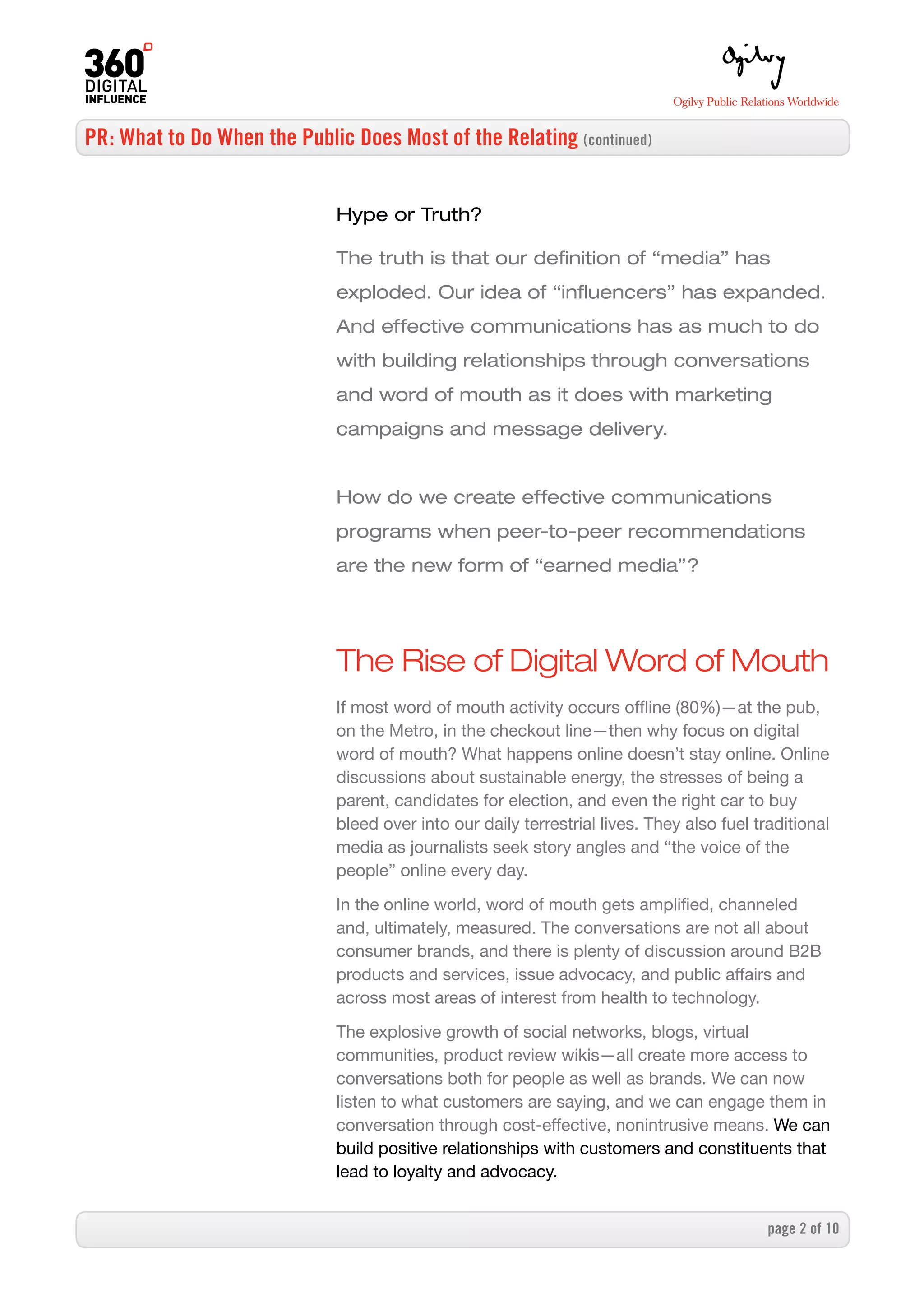
                              How can bloggers and marketers work together? We wanted
                              to find out how Ogilvy could work authentically with bloggers
                              on behalf of our clients. We did something radical. The Belgium
                              and Dutch team led the way by inviting some of them over for a
                              picnic. Actually it was a “Blogstorm” and was attended by some
                              of the most influential bloggers in the Netherlands. A full day of
                              activities uncovered the best ways for marketers and bloggers
                              to work together through both paid and earned media—lessons
                              useful across Europe. And we built long-term relationships based
                              on our willingness to listen and learn.


                              1
                                  In the three years that we have been developing digital influence programs, we
                                  have learned a lot from actually deploying programs. We’ve discovered these
                                  principles from both our successes and our failures.


                                                                                                     page  of 0
PR: What to Do When the Public Does Most of the Relating (continued)


                              Case In Point:
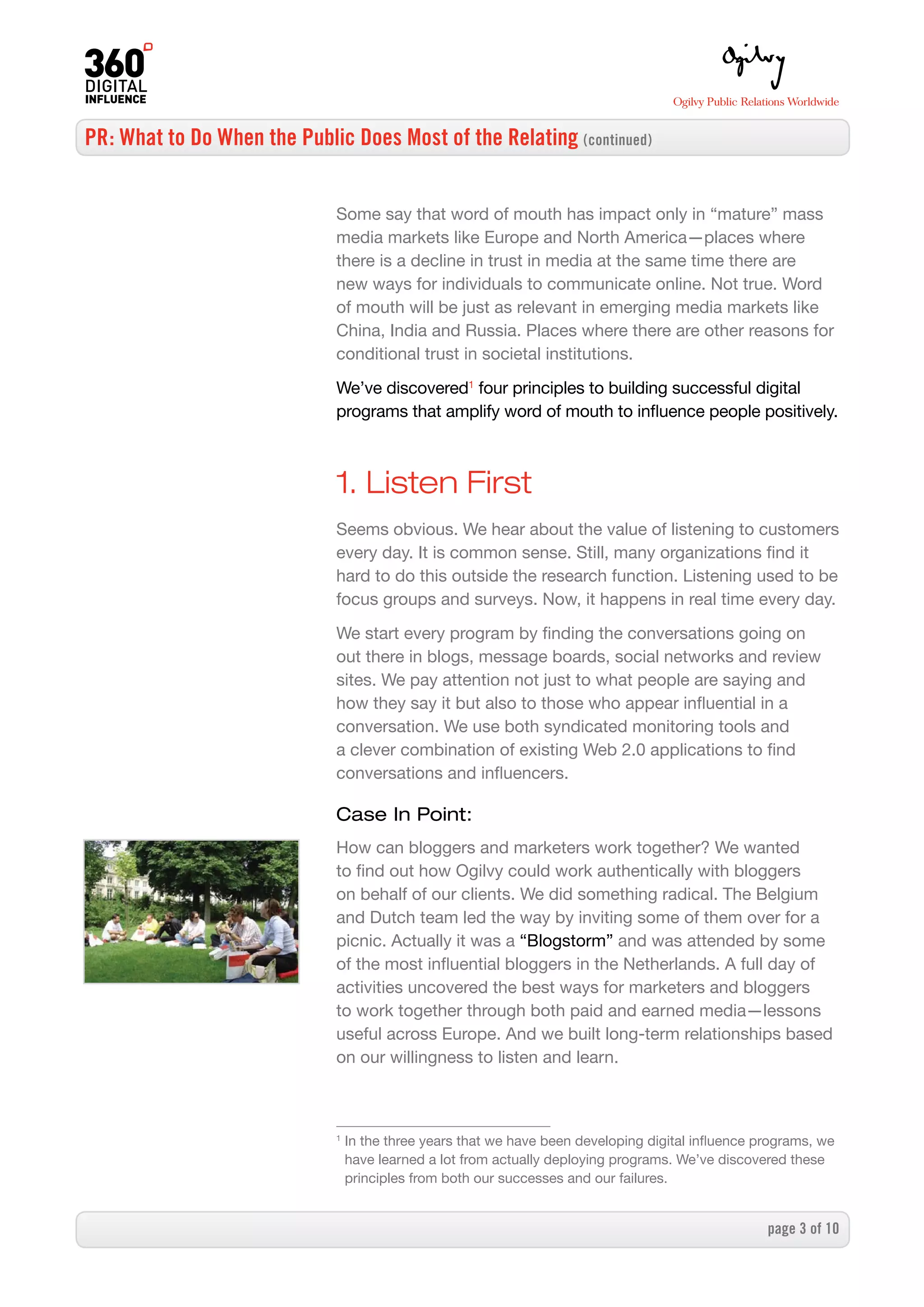
                              Through comprehensive monitoring of consumer-generated media
                              (cgm) on pandemic flu for the Department of Health and Human
                              Services (HHS) in the U.S. federal government, we connected with
                              a community of pro-am (professional and amateur) people who
                              self-identify as “flubies” and part of “flublogia.” They later became
                              important allies in helping raise awareness and relevancy of the
                              threat and, as we launched the first blog (blog.pandemicflu.gov)
                              from HHS, of the Secretary himself.


                              2. Offer Deepening Ways To
                              Engage With People
                              Engagement is the “search for the 21st century gross rating points.”
                              So says The Advertising Research Foundation (www.thearf.org).
                              “Engagement” means interaction, participation and spending time
                              with a brand or issue. Engagement goes where impressions and
                              media hits cannot easily go—toward loyalty and advocacy.

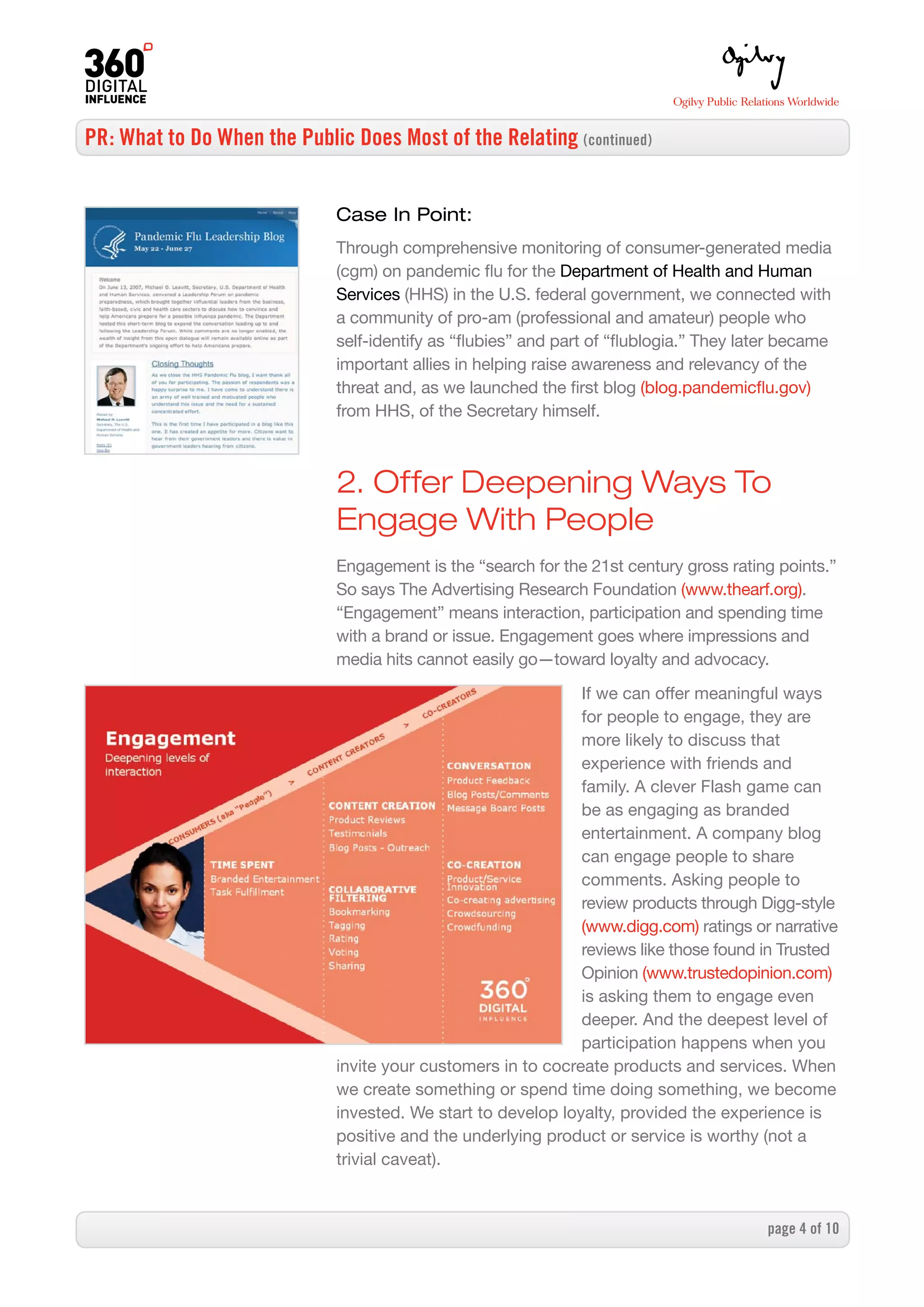
                                                               If we can offer meaningful ways
                                                               for people to engage, they are
                                                               more likely to discuss that
                                                               experience with friends and
                                                               family. A clever Flash game can
                                                               be as engaging as branded
                                                               entertainment. A company blog
                                                               can engage people to share
                                                               comments. Asking people to
                                                               review products through Digg-style
                                                               (www.digg.com) ratings or narrative
                                                               reviews like those found in Trusted
                                                               Opinion (www.trustedopinion.com)
                                                               is asking them to engage even
                                                               deeper. And the deepest level of
                                                               participation happens when you
                              invite your customers in to cocreate products and services. When
                              we create something or spend time doing something, we become
                              invested. We start to develop loyalty, provided the experience is
                              positive and the underlying product or service is worthy (not a
                              trivial caveat).


                                                                                          page  of 0
PR: What to Do When the Public Does Most of the Relating (continued)


                              Content creation is not a fringe activity. Due to simplified
                              publishing platforms like Typepad or those inside Facebook and
                              because of the new simplicity behind Web 2.0 design aesthetic,
                              people can create content infinitely more easily today.

                              • One half of online users are readers or creators of social media2

                              • 30% of online users have created content by updating Web
                                pages or blogs, posted comments or contributed to forums

                              • 75% of online consumers ages 18–24 “use” user-generated
                                content, and 84% of them are content creators

                              Case In Point:
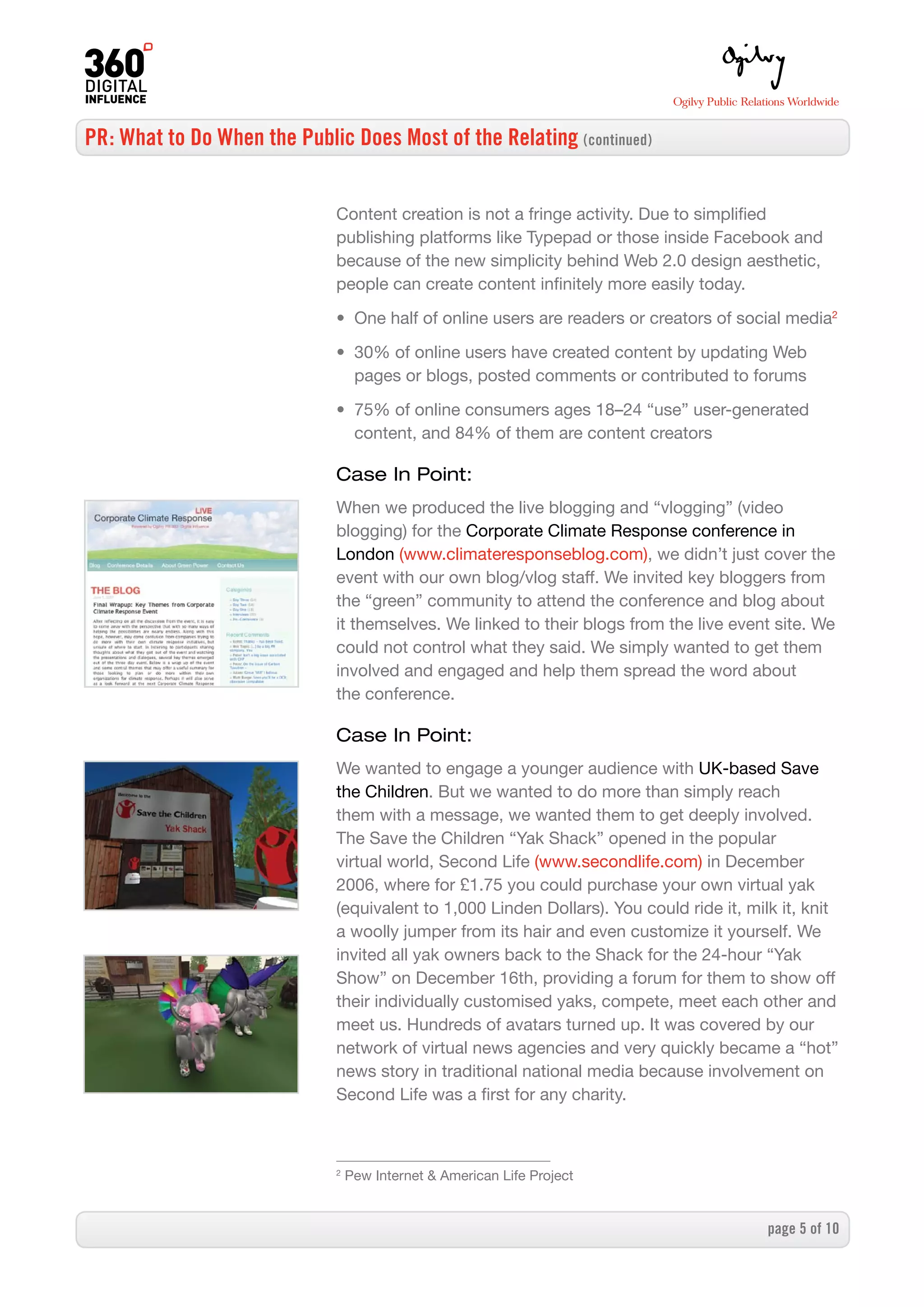
                              When we produced the live blogging and “vlogging” (video
                              blogging) for the Corporate Climate Response conference in
                              London (www.climateresponseblog.com), we didn’t just cover the
                              event with our own blog/vlog staff. We invited key bloggers from
                              the “green” community to attend the conference and blog about
                              it themselves. We linked to their blogs from the live event site. We
                              could not control what they said. We simply wanted to get them
                              involved and engaged and help them spread the word about
                              the conference.

                              Case In Point:
                              We wanted to engage a younger audience with UK-based Save
                              the Children. But we wanted to do more than simply reach
                              them with a message, we wanted them to get deeply involved.
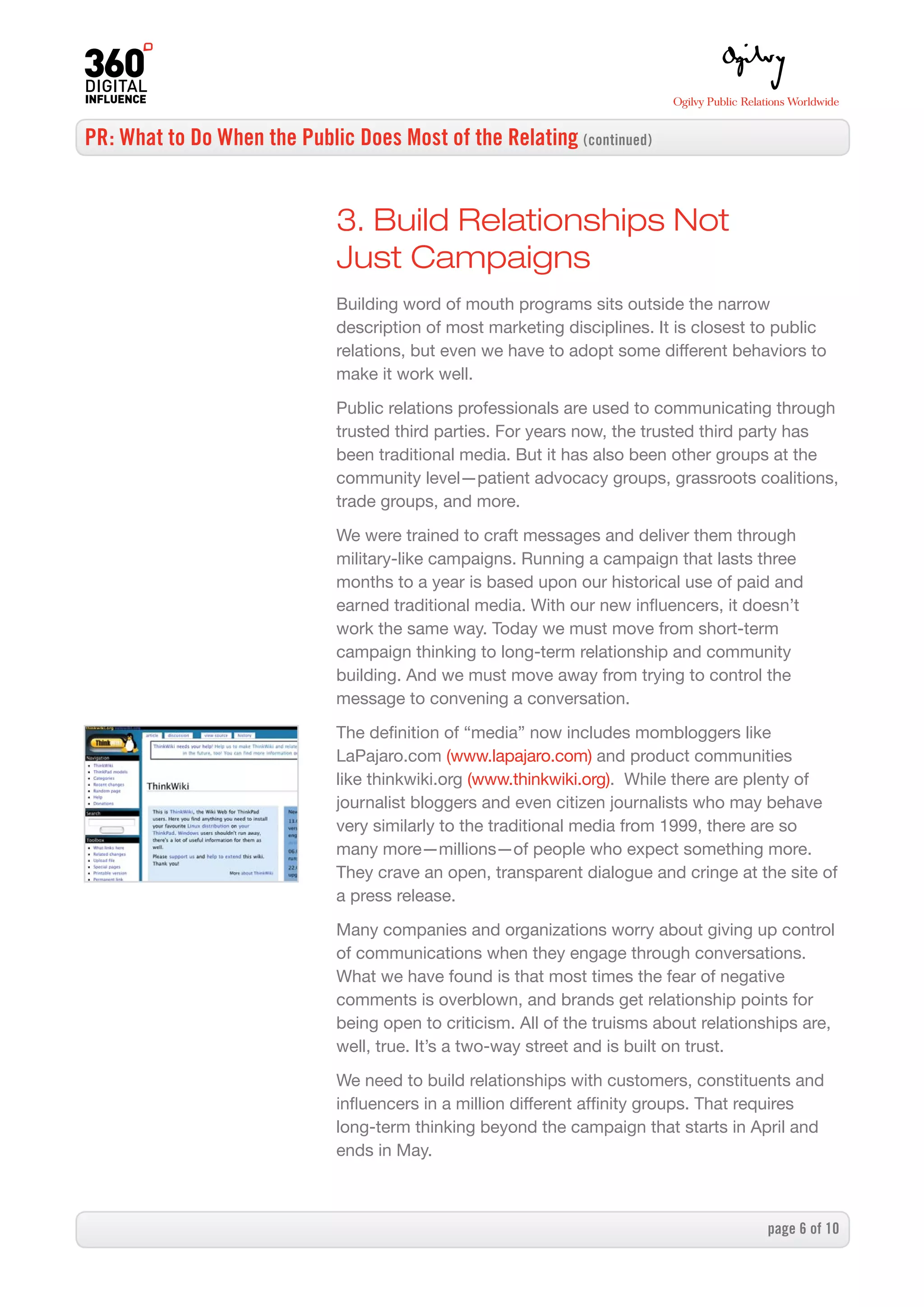
                              The Save the Children “Yak Shack” opened in the popular
                              virtual world, Second Life (www.secondlife.com) in December
                              2006, where for £1.75 you could purchase your own virtual yak
                              (equivalent to 1,000 Linden Dollars). You could ride it, milk it, knit
                              a woolly jumper from its hair and even customize it yourself. We
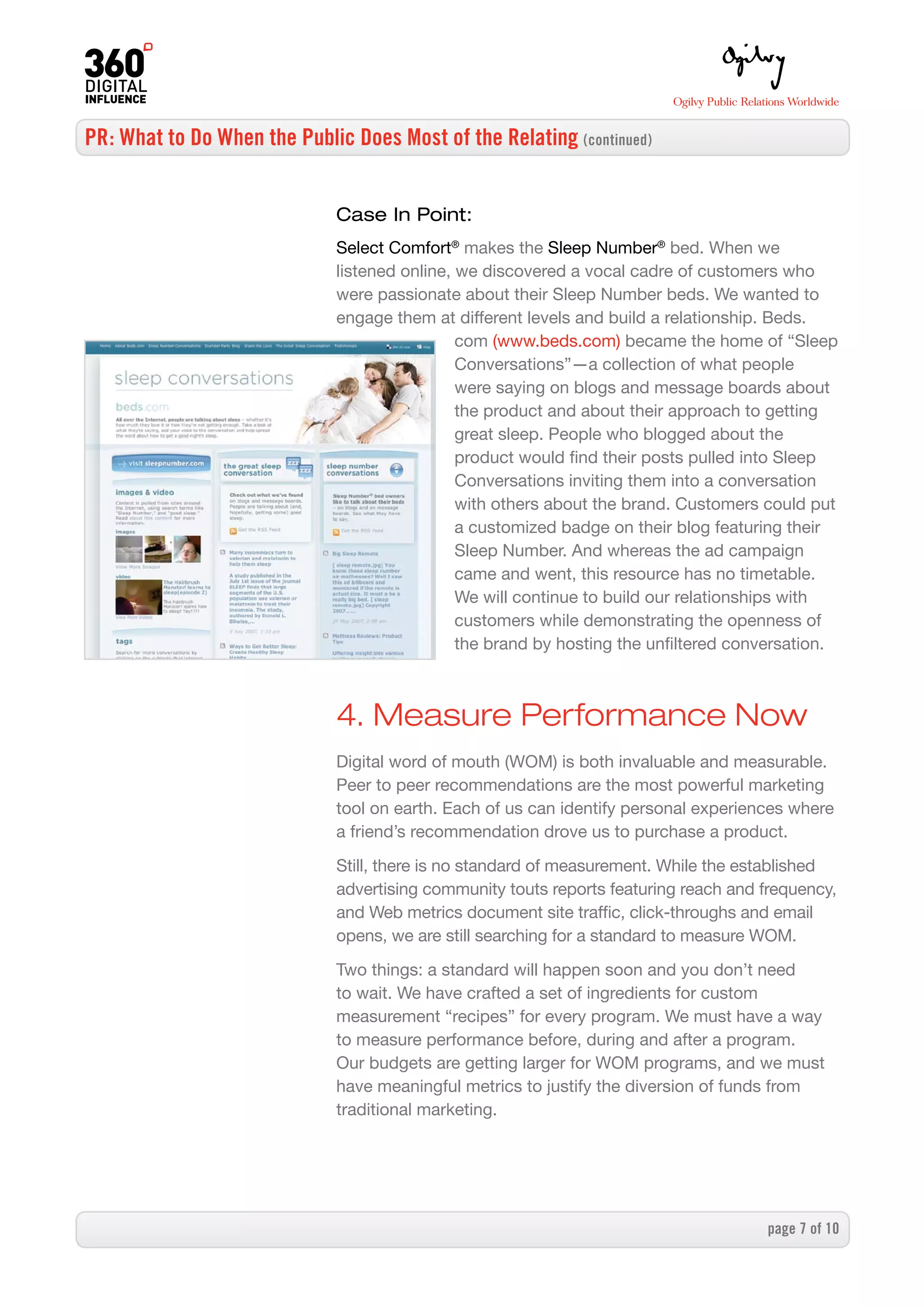
                              invited all yak owners back to the Shack for the 24-hour “Yak
                              Show” on December 16th, providing a forum for them to show off
                              their individually customised yaks, compete, meet each other and
                              meet us. Hundreds of avatars turned up. It was covered by our
                              network of virtual news agencies and very quickly became a “hot”
                              news story in traditional national media because involvement on
                              Second Life was a first for any charity.


                              2
                                  Pew Internet  American Life Project


                                                                                          page  of 0
PR: What to Do When the Public Does Most of the Relating (continued)


                              3. Build Relationships Not
                              Just Campaigns
                              Building word of mouth programs sits outside the narrow
                              description of most marketing disciplines. It is closest to public
                              relations, but even we have to adopt some different behaviors to
                              make it work well.

                              Public relations professionals are used to communicating through
                              trusted third parties. For years now, the trusted third party has
                              been traditional media. But it has also been other groups at the
                              community level—patient advocacy groups, grassroots coalitions,
                              trade groups, and more.
                              We were trained to craft messages and deliver them through
                              military-like campaigns. Running a campaign that lasts three
                              months to a year is based upon our historical use of paid and
                              earned traditional media. With our new influencers, it doesn’t
                              work the same way. Today we must move from short-term
                              campaign thinking to long-term relationship and community
                              building. And we must move away from trying to control the
                              message to convening a conversation.

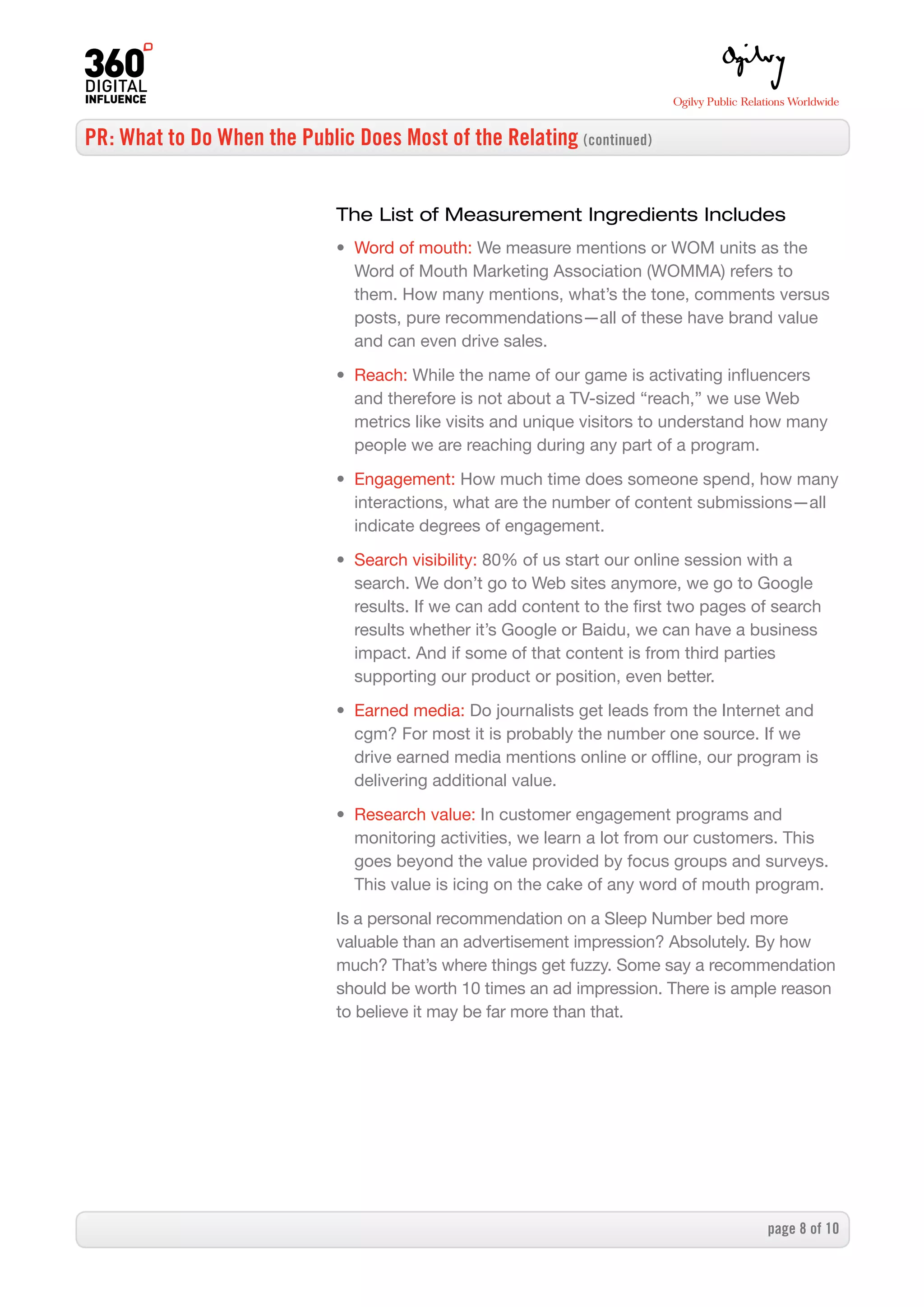
                              The definition of “media” now includes mombloggers like
                              LaPajaro.com (www.lapajaro.com) and product communities
                              like thinkwiki.org (www.thinkwiki.org). While there are plenty of
                              journalist bloggers and even citizen journalists who may behave
                              very similarly to the traditional media from 1999, there are so
                              many more—millions—of people who expect something more.
                              They crave an open, transparent dialogue and cringe at the site of
                              a press release.

                              Many companies and organizations worry about giving up control
                              of communications when they engage through conversations.
                              What we have found is that most times the fear of negative
                              comments is overblown, and brands get relationship points for
                              being open to criticism. All of the truisms about relationships are,
                              well, true. It’s a two-way street and is built on trust.

                              We need to build relationships with customers, constituents and
                              influencers in a million different affinity groups. That requires
                              long-term thinking beyond the campaign that starts in April and
                              ends in May.


                                                                                        page  of 0
PR: What to Do When the Public Does Most of the Relating (continued)


                              Case In Point:
                              Select Comfort® makes the Sleep Number® bed. When we
                              listened online, we discovered a vocal cadre of customers who
                              were passionate about their Sleep Number beds. We wanted to
                              engage them at different levels and build a relationship. Beds.
                                               com (www.beds.com) became the home of “Sleep
                                               Conversations”—a collection of what people
                                               were saying on blogs and message boards about
                                               the product and about their approach to getting
                                               great sleep. People who blogged about the
                                               product would find their posts pulled into Sleep
                                               Conversations inviting them into a conversation
                                               with others about the brand. Customers could put
                                               a customized badge on their blog featuring their
                                               Sleep Number. And whereas the ad campaign
                                               came and went, this resource has no timetable.
                                               We will continue to build our relationships with
                                               customers while demonstrating the openness of
                                               the brand by hosting the unfiltered conversation.


                              4. Measure Performance Now
                              Digital word of mouth (WOM) is both invaluable and measurable.
                              Peer to peer recommendations are the most powerful marketing
                              tool on earth. Each of us can identify personal experiences where
                              a friend’s recommendation drove us to purchase a product.

                              Still, there is no standard of measurement. While the established
                              advertising community touts reports featuring reach and frequency,
                              and Web metrics document site traffic, click-throughs and email
                              opens, we are still searching for a standard to measure WOM.

                              Two things: a standard will happen soon and you don’t need
                              to wait. We have crafted a set of ingredients for custom
                              measurement “recipes” for every program. We must have a way
                              to measure performance before, during and after a program.
                              Our budgets are getting larger for WOM programs, and we must
                              have meaningful metrics to justify the diversion of funds from
                              traditional marketing.


                                                                                      page  of 0
PR: What to Do When the Public Does Most of the Relating (continued)


                              The List of Measurement Ingredients Includes
                              • Word of mouth: We measure mentions or WOM units as the
                                Word of Mouth Marketing Association (WOMMA) refers to
                                them. How many mentions, what’s the tone, comments versus
                                posts, pure recommendations—all of these have brand value
                                and can even drive sales.

                              • Reach: While the name of our game is activating influencers
                                and therefore is not about a TV-sized “reach,” we use Web
                                metrics like visits and unique visitors to understand how many
                                people we are reaching during any part of a program.

                              • Engagement: How much time does someone spend, how many
                                interactions, what are the number of content submissions—all
                                indicate degrees of engagement.

                              • Search visibility: 80% of us start our online session with a
                                search. We don’t go to Web sites anymore, we go to Google
                                results. If we can add content to the first two pages of search
                                results whether it’s Google or Baidu, we can have a business
                                impact. And if some of that content is from third parties
                                supporting our product or position, even better.

                              • Earned media: Do journalists get leads from the Internet and
                                cgm? For most it is probably the number one source. If we
                                drive earned media mentions online or offline, our program is
                                delivering additional value.

                              • Research value: In customer engagement programs and
                                monitoring activities, we learn a lot from our customers. This
                                goes beyond the value provided by focus groups and surveys.
                                This value is icing on the cake of any word of mouth program.

                              Is a personal recommendation on a Sleep Number bed more
                              valuable than an advertisement impression? Absolutely. By how
                              much? That’s where things get fuzzy. Some say a recommendation
                              should be worth 10 times an ad impression. There is ample reason
                              to believe it may be far more than that.


                                                                                       page  of 0
PR: What to Do When the Public Does Most of the Relating (continued)


                              We will create a simple standard for measuring word of mouth. The
                              Word of Mouth Marketing Association (WOMMA) is on it. Another
                              emerging model, the Net Promoter Score (www.netpromoter.com),
                              is being adopted by CMOs in major corporations right now. It asks a
                              single question—“Would you recommend us?”—and from there can
                              factor a meaningful score on the overall performance of a company.

                              You can create a measurement recipe today that can guide
                              strategy and help make budget decisions on where your
                              marketing and communication dollars can be spent. The return
                              on investment of word of mouth is too obvious to put off.


                              What is 360° Digital Influence?
                              We created an organized way of planning and deploying digital
                              word of mouth programs that effectively reach client business
                              objectives at a time when anyone can be an influencer and
                              technology has made the world flatter. For each client, we design
                              a complete digital strategy that uses social media, influencer
                              marketing and word of mouth to build stronger bonds with
                              customers and constituents.

                              And we had to do it globally. These changes are happening
                              throughout our clients in Europe, Asia, South America and in
                              North America. It’s just happening differently in different markets.
                              We created a new public relations practice: 360° Digital Influence.

                              Part Digital PR consultancy, part Web 2.0 design-and-build
                              studio, we learn from doing. Because we execute what we plan,
                              we become better planners. And as members of the WOMMA
                              (www.womma.org), we are evangelists for the rising power of one
                              person’s recommendation to another.


                                                                                         page  of 0
PR: What to Do When the Public Does Most of the Relating (continued)


                              Public Relations Is Changing
                              You’ve probably heard about it. It goes something
                              like this:
                              The value of press releases sink while personal outreach soars.
                              Regulated industries like pharmaceuticals launch product blogs
                              (e.g. alliconnect (www.alliconnect.com)) to build relationships. The
                              World Bank turns from crafting the message to helping its staff
                              communicate via social media (PSDblog (psdblog.worldbank.org)).
                              MySpace changes the music business just as Joost (www.joost.com)
                              and broadband video changes how we “watch.” Mobile
                              communications explode with 3G and bigger bandwidth. And
                              cocreation and crowdsourcing are the new innovations from the
                              outside in for Fortune 500 companies (www.ideastorm.com).
                              Conversation is the new “control,” and our job is to make it happen.

                              Now, it gets interesting. Stay tuned…


                                                                                      page 0 of 0

Pr when the public does most of the relating by john bell

  • 1.
    PR: What toDo When the Public Does Most of the Relating John H. Bell Managing Director/Executive Creative Director 360° Digital Influence Ogilvy Public Relations Worldwide john.bell@ogilvypr.com John heads up Ogilvy PR’s global digital practice, Public Relations Is Changing 360° Digital Influence, designed to manage brands You’ve probably heard about it. It goes something at a time when anyone can like this: be an influencer and we are all influenced in new The consumer is in charge. Trust in media falls. ways. John, and the Digital Trust in word of mouth rises. Now there’s traditional Influence team that he works with in EMEA, have media, new media and consumer-generated completed projects media. Media explodes. Every day, 50,000 blogs for clients as diverse as Lenovo, Unilever, Intel and are created and social networks connect millions Save the Children. from China to Charing Cross. People are watching less TV. Reading fewer newspapers. And Internet usage grows. Now there are traditional influencers and new influencers. One’s a business leader in NYC. The other is a momblogger in New Mexico. Contact: Conversation is more important than messaging. John H. Bell Managing Director/ And search engines change the game. Executive Creative Director 360° Digital Influence Ogilvy Public Relations Worldwide Tel: 202 729 4166 john.bell@ogilvypr.com page of 0
  • 2.
    PR: What toDo When the Public Does Most of the Relating (continued) Hype or Truth? The truth is that our definition of “media” has exploded. Our idea of “influencers” has expanded. And effective communications has as much to do with building relationships through conversations and word of mouth as it does with marketing campaigns and message delivery. How do we create effective communications programs when peer-to-peer recommendations are the new form of “earned media”? The Rise of Digital Word of Mouth If most word of mouth activity occurs offline (80%)—at the pub, on the Metro, in the checkout line—then why focus on digital word of mouth? What happens online doesn’t stay online. Online discussions about sustainable energy, the stresses of being a parent, candidates for election, and even the right car to buy bleed over into our daily terrestrial lives. They also fuel traditional media as journalists seek story angles and “the voice of the people” online every day. In the online world, word of mouth gets amplified, channeled and, ultimately, measured. The conversations are not all about consumer brands, and there is plenty of discussion around B2B products and services, issue advocacy, and public affairs and across most areas of interest from health to technology. The explosive growth of social networks, blogs, virtual communities, product review wikis—all create more access to conversations both for people as well as brands. We can now listen to what customers are saying, and we can engage them in conversation through cost-effective, nonintrusive means. We can build positive relationships with customers and constituents that lead to loyalty and advocacy. page of 0
  • 3.
    PR: What toDo When the Public Does Most of the Relating (continued) Some say that word of mouth has impact only in “mature” mass media markets like Europe and North America—places where there is a decline in trust in media at the same time there are new ways for individuals to communicate online. Not true. Word of mouth will be just as relevant in emerging media markets like China, India and Russia. Places where there are other reasons for conditional trust in societal institutions. We’ve discovered1 four principles to building successful digital programs that amplify word of mouth to influence people positively. 1. Listen First Seems obvious. We hear about the value of listening to customers every day. It is common sense. Still, many organizations find it hard to do this outside the research function. Listening used to be focus groups and surveys. Now, it happens in real time every day. We start every program by finding the conversations going on out there in blogs, message boards, social networks and review sites. We pay attention not just to what people are saying and how they say it but also to those who appear influential in a conversation. We use both syndicated monitoring tools and a clever combination of existing Web 2.0 applications to find conversations and influencers. Case In Point: How can bloggers and marketers work together? We wanted to find out how Ogilvy could work authentically with bloggers on behalf of our clients. We did something radical. The Belgium and Dutch team led the way by inviting some of them over for a picnic. Actually it was a “Blogstorm” and was attended by some of the most influential bloggers in the Netherlands. A full day of activities uncovered the best ways for marketers and bloggers to work together through both paid and earned media—lessons useful across Europe. And we built long-term relationships based on our willingness to listen and learn. 1 In the three years that we have been developing digital influence programs, we have learned a lot from actually deploying programs. We’ve discovered these principles from both our successes and our failures. page of 0
  • 4.
    PR: What toDo When the Public Does Most of the Relating (continued) Case In Point: Through comprehensive monitoring of consumer-generated media (cgm) on pandemic flu for the Department of Health and Human Services (HHS) in the U.S. federal government, we connected with a community of pro-am (professional and amateur) people who self-identify as “flubies” and part of “flublogia.” They later became important allies in helping raise awareness and relevancy of the threat and, as we launched the first blog (blog.pandemicflu.gov) from HHS, of the Secretary himself. 2. Offer Deepening Ways To Engage With People Engagement is the “search for the 21st century gross rating points.” So says The Advertising Research Foundation (www.thearf.org). “Engagement” means interaction, participation and spending time with a brand or issue. Engagement goes where impressions and media hits cannot easily go—toward loyalty and advocacy. If we can offer meaningful ways for people to engage, they are more likely to discuss that experience with friends and family. A clever Flash game can be as engaging as branded entertainment. A company blog can engage people to share comments. Asking people to review products through Digg-style (www.digg.com) ratings or narrative reviews like those found in Trusted Opinion (www.trustedopinion.com) is asking them to engage even deeper. And the deepest level of participation happens when you invite your customers in to cocreate products and services. When we create something or spend time doing something, we become invested. We start to develop loyalty, provided the experience is positive and the underlying product or service is worthy (not a trivial caveat). page of 0
  • 5.
    PR: What toDo When the Public Does Most of the Relating (continued) Content creation is not a fringe activity. Due to simplified publishing platforms like Typepad or those inside Facebook and because of the new simplicity behind Web 2.0 design aesthetic, people can create content infinitely more easily today. • One half of online users are readers or creators of social media2 • 30% of online users have created content by updating Web pages or blogs, posted comments or contributed to forums • 75% of online consumers ages 18–24 “use” user-generated content, and 84% of them are content creators Case In Point: When we produced the live blogging and “vlogging” (video blogging) for the Corporate Climate Response conference in London (www.climateresponseblog.com), we didn’t just cover the event with our own blog/vlog staff. We invited key bloggers from the “green” community to attend the conference and blog about it themselves. We linked to their blogs from the live event site. We could not control what they said. We simply wanted to get them involved and engaged and help them spread the word about the conference. Case In Point: We wanted to engage a younger audience with UK-based Save the Children. But we wanted to do more than simply reach them with a message, we wanted them to get deeply involved. The Save the Children “Yak Shack” opened in the popular virtual world, Second Life (www.secondlife.com) in December 2006, where for £1.75 you could purchase your own virtual yak (equivalent to 1,000 Linden Dollars). You could ride it, milk it, knit a woolly jumper from its hair and even customize it yourself. We invited all yak owners back to the Shack for the 24-hour “Yak Show” on December 16th, providing a forum for them to show off their individually customised yaks, compete, meet each other and meet us. Hundreds of avatars turned up. It was covered by our network of virtual news agencies and very quickly became a “hot” news story in traditional national media because involvement on Second Life was a first for any charity. 2 Pew Internet American Life Project page of 0
  • 6.
    PR: What toDo When the Public Does Most of the Relating (continued) 3. Build Relationships Not Just Campaigns Building word of mouth programs sits outside the narrow description of most marketing disciplines. It is closest to public relations, but even we have to adopt some different behaviors to make it work well. Public relations professionals are used to communicating through trusted third parties. For years now, the trusted third party has been traditional media. But it has also been other groups at the community level—patient advocacy groups, grassroots coalitions, trade groups, and more. We were trained to craft messages and deliver them through military-like campaigns. Running a campaign that lasts three months to a year is based upon our historical use of paid and earned traditional media. With our new influencers, it doesn’t work the same way. Today we must move from short-term campaign thinking to long-term relationship and community building. And we must move away from trying to control the message to convening a conversation. The definition of “media” now includes mombloggers like LaPajaro.com (www.lapajaro.com) and product communities like thinkwiki.org (www.thinkwiki.org). While there are plenty of journalist bloggers and even citizen journalists who may behave very similarly to the traditional media from 1999, there are so many more—millions—of people who expect something more. They crave an open, transparent dialogue and cringe at the site of a press release. Many companies and organizations worry about giving up control of communications when they engage through conversations. What we have found is that most times the fear of negative comments is overblown, and brands get relationship points for being open to criticism. All of the truisms about relationships are, well, true. It’s a two-way street and is built on trust. We need to build relationships with customers, constituents and influencers in a million different affinity groups. That requires long-term thinking beyond the campaign that starts in April and ends in May. page of 0
  • 7.
    PR: What toDo When the Public Does Most of the Relating (continued) Case In Point: Select Comfort® makes the Sleep Number® bed. When we listened online, we discovered a vocal cadre of customers who were passionate about their Sleep Number beds. We wanted to engage them at different levels and build a relationship. Beds. com (www.beds.com) became the home of “Sleep Conversations”—a collection of what people were saying on blogs and message boards about the product and about their approach to getting great sleep. People who blogged about the product would find their posts pulled into Sleep Conversations inviting them into a conversation with others about the brand. Customers could put a customized badge on their blog featuring their Sleep Number. And whereas the ad campaign came and went, this resource has no timetable. We will continue to build our relationships with customers while demonstrating the openness of the brand by hosting the unfiltered conversation. 4. Measure Performance Now Digital word of mouth (WOM) is both invaluable and measurable. Peer to peer recommendations are the most powerful marketing tool on earth. Each of us can identify personal experiences where a friend’s recommendation drove us to purchase a product. Still, there is no standard of measurement. While the established advertising community touts reports featuring reach and frequency, and Web metrics document site traffic, click-throughs and email opens, we are still searching for a standard to measure WOM. Two things: a standard will happen soon and you don’t need to wait. We have crafted a set of ingredients for custom measurement “recipes” for every program. We must have a way to measure performance before, during and after a program. Our budgets are getting larger for WOM programs, and we must have meaningful metrics to justify the diversion of funds from traditional marketing. page of 0
  • 8.
    PR: What toDo When the Public Does Most of the Relating (continued) The List of Measurement Ingredients Includes • Word of mouth: We measure mentions or WOM units as the Word of Mouth Marketing Association (WOMMA) refers to them. How many mentions, what’s the tone, comments versus posts, pure recommendations—all of these have brand value and can even drive sales. • Reach: While the name of our game is activating influencers and therefore is not about a TV-sized “reach,” we use Web metrics like visits and unique visitors to understand how many people we are reaching during any part of a program. • Engagement: How much time does someone spend, how many interactions, what are the number of content submissions—all indicate degrees of engagement. • Search visibility: 80% of us start our online session with a search. We don’t go to Web sites anymore, we go to Google results. If we can add content to the first two pages of search results whether it’s Google or Baidu, we can have a business impact. And if some of that content is from third parties supporting our product or position, even better. • Earned media: Do journalists get leads from the Internet and cgm? For most it is probably the number one source. If we drive earned media mentions online or offline, our program is delivering additional value. • Research value: In customer engagement programs and monitoring activities, we learn a lot from our customers. This goes beyond the value provided by focus groups and surveys. This value is icing on the cake of any word of mouth program. Is a personal recommendation on a Sleep Number bed more valuable than an advertisement impression? Absolutely. By how much? That’s where things get fuzzy. Some say a recommendation should be worth 10 times an ad impression. There is ample reason to believe it may be far more than that. page of 0
  • 9.
    PR: What toDo When the Public Does Most of the Relating (continued) We will create a simple standard for measuring word of mouth. The Word of Mouth Marketing Association (WOMMA) is on it. Another emerging model, the Net Promoter Score (www.netpromoter.com), is being adopted by CMOs in major corporations right now. It asks a single question—“Would you recommend us?”—and from there can factor a meaningful score on the overall performance of a company. You can create a measurement recipe today that can guide strategy and help make budget decisions on where your marketing and communication dollars can be spent. The return on investment of word of mouth is too obvious to put off. What is 360° Digital Influence? We created an organized way of planning and deploying digital word of mouth programs that effectively reach client business objectives at a time when anyone can be an influencer and technology has made the world flatter. For each client, we design a complete digital strategy that uses social media, influencer marketing and word of mouth to build stronger bonds with customers and constituents. And we had to do it globally. These changes are happening throughout our clients in Europe, Asia, South America and in North America. It’s just happening differently in different markets. We created a new public relations practice: 360° Digital Influence. Part Digital PR consultancy, part Web 2.0 design-and-build studio, we learn from doing. Because we execute what we plan, we become better planners. And as members of the WOMMA (www.womma.org), we are evangelists for the rising power of one person’s recommendation to another. page of 0
  • 10.
    PR: What toDo When the Public Does Most of the Relating (continued) Public Relations Is Changing You’ve probably heard about it. It goes something like this: The value of press releases sink while personal outreach soars. Regulated industries like pharmaceuticals launch product blogs (e.g. alliconnect (www.alliconnect.com)) to build relationships. The World Bank turns from crafting the message to helping its staff communicate via social media (PSDblog (psdblog.worldbank.org)). MySpace changes the music business just as Joost (www.joost.com) and broadband video changes how we “watch.” Mobile communications explode with 3G and bigger bandwidth. And cocreation and crowdsourcing are the new innovations from the outside in for Fortune 500 companies (www.ideastorm.com). Conversation is the new “control,” and our job is to make it happen. Now, it gets interesting. Stay tuned… page 0 of 0