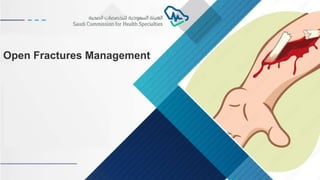
Open Fractures Management
Learning Objectives
• At the end of this lecture, you will be able to know :
1 What is the open Fractures
2 Epidemiology and etiology
3 Classification
4 Goals of Treatment
Definition
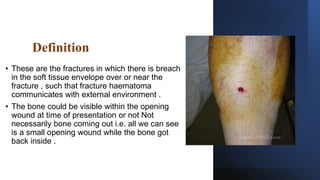
• These are the fractures in which there is breach
in the soft tissue envelope over or near the
fracture , such that fracture haematoma
communicates with external environment .
• The bone could be visible within the opening
wound at time of presentation or not Not
necessarily bone coming out i.e. all we can see
is a small opening wound while the bone got
back inside .
Epidemiology
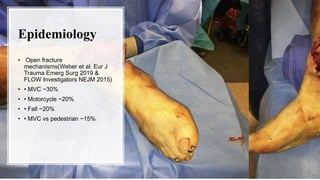
• Open fracture
mechanisms(Weber et al. Eur J
Trauma Emerg Surg 2019 &
FLOW Investigators NEJM 2015)
• • MVC ~30%
• • Motorcycle ~20%
• • Fall ~20%
• • MVC vs pedestrian ~15%
Etiology:
• Open fracture usually requires higher injury.
• Not always high energy (e.g. a 90-year-old thin osteoporotic lady with very delicate skin
who just got trippedshe might easily break her bone and since her skin is not elastic the
result will be an open fracture).
• Sometimes it can be missed.
• Commonly occurs in bones with minimal soft tissue coverage. e.g. anterior part of Tibia
Usually higher energy is required in deep bones. e.g. Femur, usually with this high energy look
for other injuries.
Goal of treatment
• 1. preserve life
• 2. preserve limb
• 3. preserve function Also .... ( Prevent infection - Fracture stabilization - Soft tissue coverage for
other injuries)
Open Fracture Algorithm:
If you are in an emergency and a patient comes to you with an open fracture, this is
what you have to do:
1. Assess and stabilize the patient, ATLS principles. Saving life before saving limb
2. Assess the condition of the soft tissue and bone to help grade the open fracture.
3. Manage the wound locally.
4. IV antibiotics.
5. Tetanus status.
6. Stabilize the fracture.
Open Fracture Algorithm:
1. Assess and stabilize the patient, ATLS principles:
a. If polytrauma case, apply ATLS principles.
b. If isolated injury, take brief history about the following:
-Mechanism and circumstances of injury. What happen? how? is there any other injuries?
-Time since injury. The management differs between an open fracture since 1 hour and an
open fracture since 12 hours
-Past Medical/Surgical History/Allergy/Drugs/ Smoking.
-Tetanus vaccination status
AMPLE is a quick history
A: allergy
M: medication
P: past med/surgicalL: last meal
E: event surrounding the injury
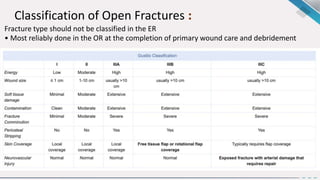
Classification of Open Fractures :
Fracture type should not be classified in the ER
• Most reliably done in the OR at the completion of primary wound care and debridement
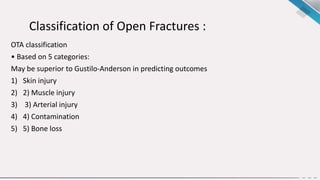
Classification of Open Fractures :
OTA classification
• Based on 5 categories:
May be superior to Gustilo-Anderson in predicting outcomes
1) Skin injury
2) 2) Muscle injury
3) 3) Arterial injury
4) 4) Contamination
5) 5) Bone loss
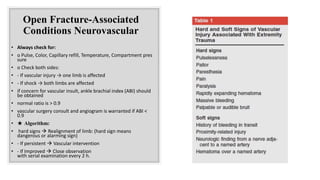
Open Fracture-Associated
Conditions Neurovascular
• Always check for:
• o Pulse, Color, Capillary refill, Temperature, Compartment pres
sure
• o Check both sides:
• - If vascular injury → one limb is affected
• - If shock → both limbs are affected
• if concern for vascular insult, ankle brachial index (ABI) should
be obtained
• normal ratio is > 0.9
• vascular surgery consult and angiogram is warranted if ABI <
0.9
• ★ Algorithm:
• hard signs  Realignment of limb: (hard sign means
dangerous or alarming sign)
• - If persistent  Vascular intervention
• - If Improved  Close observation
with serial examination every 2 h.
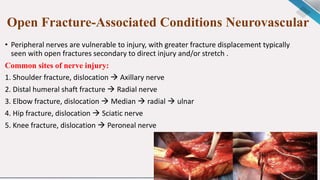
Open Fracture-Associated Conditions Neurovascular
• Peripheral nerves are vulnerable to injury, with greater fracture displacement typically
seen with open fractures secondary to direct injury and/or stretch .
Common sites of nerve injury:
1. Shoulder fracture, dislocation  Axillary nerve
2. Distal humeral shaft fracture  Radial nerve
3. Elbow fracture, dislocation  Median  radial  ulnar
4. Hip fracture, dislocation  Sciatic nerve
5. Knee fracture, dislocation  Peroneal nerve
Open Fracture Algorithm:
Manage the wound locally:
the management are divided to 3 parts, locally, antibiotics and in OR
 Extremity stabilization & dressing:
 Take a picture to documentation or to show it to your colleagues, so you don't need to reopen the
woundevery time another doctor wants to examine it to avoid contamination.
• remove gross debris from wound, do not remove any bone fragments
• place sterile saline-soaked dressing on wound
• little evidence to support aggressive irrigation or irrigation with antiseptic solution in the ED, as this can push debris further into wound, No culture swabs in ER.
• splint, brace, or traction for temporary stabilization
• decreases pain, minimizes soft tissue trauma, and prevents disruption of clots
Open Fracture Algorithm:
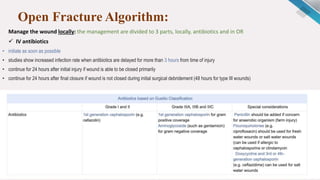
Manage the wound locally: the management are divided to 3 parts, locally, antibiotics and in OR
 IV antibiotics
• initiate as soon as possible
• studies show increased infection rate when antibiotics are delayed for more than 3 hours from time of injury
• continue for 24 hours after initial injury if wound is able to be closed primarily
• continue for 24 hours after final closure if wound is not closed during initial surgical debridement (48 hours for type III wounds)
Open Fracture Algorithm:
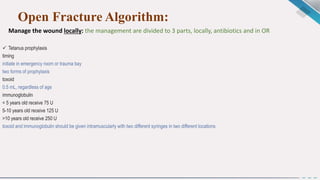
Manage the wound locally: the management are divided to 3 parts, locally, antibiotics and in OR
 Tetanus prophylaxis
timing
initiate in emergency room or trauma bay
two forms of prophylaxis
toxoid
0.5 mL, regardless of age
immunoglobulin
< 5 years old receive 75 U
5-10 years old receive 125 U
>10 years old receive 250 U
toxoid and immunoglobulin should be given intramuscularly with two different syringes in two different locations
Open Fracture Algorithm:
• In the OR:
o Extend wound if necessary. If it was a small wound, we need to extend until we can reach the bone.
o Thorough irrigation.
o Debride all necrotic tissue.
o Remove bone fragments without soft tissue attachment, because it’s dead bone
o Usually requires second look or more every 48-72 hours.
o Generally, do not close open wounds on first look. Don't close it surgically, only cover it, and then put
external fixation
• Fracture management:
o Generally, avoid internal fixation (plate and screw).
• Generally external fixator is used
o femur and tibia fractures can usually be treated immediately with IM nail except severe injuries and
contamination (studies showed it is ok to use internal fixation in these cases)
o Observe for compartment syndrome post-operatively.
Open Fracture Algorithm:
• In the OR:
o Extend wound if necessary. If it was a small wound, we need to extend until we can reach the bone.
o Thorough irrigation.
o Debride all necrotic tissue.
o Remove bone fragments without soft tissue attachment, because it’s dead bone
o Usually requires second look or more every 48-72 hours.
o Generally, do not close open wounds on first look. Don't close it surgically, only cover it, and then put
external fixation
• Fracture management:
o Generally, avoid internal fixation (plate and screw).
• Generally external fixator is used
o femur and tibia fractures can usually be treated immediately with IM nail except severe injuries and
contamination (studies showed it is ok to use internal fixation in these cases)
o Observe for compartment syndrome post-operatively.
Open Fracture Algorithm:
(Irrigation and debridement)
 timing
recent meta-analysis (GOLIATH study) have recommended debridement within 24 hours to minimize risk of infection for type III fractures within 12 hours for type IIIB open tibia
fractures
staged debridement and irrigation (perform every 24 to 48 hours as needed)
 technique
 incision
extend wound proximally and distally in line with extremity to adequate expose open fracture
 irrigation
o low-pressure bulb irrigation vs. high-pressure pulse lavage
studies have shown that low pressure bulb irrigation is less expensive than high pressure pulse lavage and has no difference in infection rates or union rates
o saline vs. saline with castile soap vs. antibiotic solution
studies have shown that saline with castile soap had decreased primary wound healing problems when compared to antibiotic solutions
on average, 3L of saline are used for each successive Gustilo type (i.e 9L for type III)
 debridement :
thorough debridement of devitalized tissue is critical to prevent deep infection
bony fragments without soft tissue attachments should be removed
Open Fracture Algorithm:
• In the OR:
 temporary fracture stabilization
o technique
 performed at the time of initial debridement
 external fixation is temporary initial treatment of choice for majority of high energy open fractures of the lower extremity
 local antibiotic administration
indications
o significantly contaminated wounds with large soft tissue defects
large bony defects
 soft tissue coverage
o timing
 early soft tissue coverage or wound closure is ideal
timing of flap coverage for open tibial fractures remains controversial, < 7 days is desired
increased risk of infection beyond 7 days
odds of infection increase by 16% for each day beyond day 7
Open Fracture Algorithm:
• In the OR:
• Definitive reconstruction and fracture fixation
 no critical bone defect
open reduction and internal fixation or intramedullary treatment depending on fracture location and morphology
 critical bone defect
technique
 Masquelet technique ("induced-membrane" technique)
2 stage technique
1st stage: I&D, cement spacer and temporizing fixation
2nd stage: placement of bone graft into "induced membrane" and definitive fixation
 distraction osteogenesis
 vascularized bone flap/transfer
Complication :
Ppt sghj.pptx

Ppt sghj.pptx

  • 1.
  • 2.
    Learning Objectives • Atthe end of this lecture, you will be able to know : 1 What is the open Fractures 2 Epidemiology and etiology 3 Classification 4 Goals of Treatment
  • 3.
    Definition • These arethe fractures in which there is breach in the soft tissue envelope over or near the fracture , such that fracture haematoma communicates with external environment . • The bone could be visible within the opening wound at time of presentation or not Not necessarily bone coming out i.e. all we can see is a small opening wound while the bone got back inside .
  • 4.
    Epidemiology • Open fracture mechanisms(Weberet al. Eur J Trauma Emerg Surg 2019 & FLOW Investigators NEJM 2015) • • MVC ~30% • • Motorcycle ~20% • • Fall ~20% • • MVC vs pedestrian ~15%
  • 5.
    Etiology: • Open fractureusually requires higher injury. • Not always high energy (e.g. a 90-year-old thin osteoporotic lady with very delicate skin who just got trippedshe might easily break her bone and since her skin is not elastic the result will be an open fracture). • Sometimes it can be missed. • Commonly occurs in bones with minimal soft tissue coverage. e.g. anterior part of Tibia Usually higher energy is required in deep bones. e.g. Femur, usually with this high energy look for other injuries.
  • 6.
    Goal of treatment •1. preserve life • 2. preserve limb • 3. preserve function Also .... ( Prevent infection - Fracture stabilization - Soft tissue coverage for other injuries)
  • 7.
    Open Fracture Algorithm: Ifyou are in an emergency and a patient comes to you with an open fracture, this is what you have to do: 1. Assess and stabilize the patient, ATLS principles. Saving life before saving limb 2. Assess the condition of the soft tissue and bone to help grade the open fracture. 3. Manage the wound locally. 4. IV antibiotics. 5. Tetanus status. 6. Stabilize the fracture.
  • 8.
    Open Fracture Algorithm: 1.Assess and stabilize the patient, ATLS principles: a. If polytrauma case, apply ATLS principles. b. If isolated injury, take brief history about the following: -Mechanism and circumstances of injury. What happen? how? is there any other injuries? -Time since injury. The management differs between an open fracture since 1 hour and an open fracture since 12 hours -Past Medical/Surgical History/Allergy/Drugs/ Smoking. -Tetanus vaccination status AMPLE is a quick history A: allergy M: medication P: past med/surgicalL: last meal E: event surrounding the injury
  • 9.
    Classification of OpenFractures : Fracture type should not be classified in the ER • Most reliably done in the OR at the completion of primary wound care and debridement
  • 10.
    Classification of OpenFractures : OTA classification • Based on 5 categories: May be superior to Gustilo-Anderson in predicting outcomes 1) Skin injury 2) 2) Muscle injury 3) 3) Arterial injury 4) 4) Contamination 5) 5) Bone loss
  • 11.
    Open Fracture-Associated Conditions Neurovascular •Always check for: • o Pulse, Color, Capillary refill, Temperature, Compartment pres sure • o Check both sides: • - If vascular injury → one limb is affected • - If shock → both limbs are affected • if concern for vascular insult, ankle brachial index (ABI) should be obtained • normal ratio is > 0.9 • vascular surgery consult and angiogram is warranted if ABI < 0.9 • ★ Algorithm: • hard signs  Realignment of limb: (hard sign means dangerous or alarming sign) • - If persistent  Vascular intervention • - If Improved  Close observation with serial examination every 2 h.
  • 12.
    Open Fracture-Associated ConditionsNeurovascular • Peripheral nerves are vulnerable to injury, with greater fracture displacement typically seen with open fractures secondary to direct injury and/or stretch . Common sites of nerve injury: 1. Shoulder fracture, dislocation  Axillary nerve 2. Distal humeral shaft fracture  Radial nerve 3. Elbow fracture, dislocation  Median  radial  ulnar 4. Hip fracture, dislocation  Sciatic nerve 5. Knee fracture, dislocation  Peroneal nerve
  • 13.
    Open Fracture Algorithm: Managethe wound locally: the management are divided to 3 parts, locally, antibiotics and in OR  Extremity stabilization & dressing:  Take a picture to documentation or to show it to your colleagues, so you don't need to reopen the woundevery time another doctor wants to examine it to avoid contamination. • remove gross debris from wound, do not remove any bone fragments • place sterile saline-soaked dressing on wound • little evidence to support aggressive irrigation or irrigation with antiseptic solution in the ED, as this can push debris further into wound, No culture swabs in ER. • splint, brace, or traction for temporary stabilization • decreases pain, minimizes soft tissue trauma, and prevents disruption of clots
  • 14.
    Open Fracture Algorithm: Managethe wound locally: the management are divided to 3 parts, locally, antibiotics and in OR  IV antibiotics • initiate as soon as possible • studies show increased infection rate when antibiotics are delayed for more than 3 hours from time of injury • continue for 24 hours after initial injury if wound is able to be closed primarily • continue for 24 hours after final closure if wound is not closed during initial surgical debridement (48 hours for type III wounds)
  • 15.
    Open Fracture Algorithm: Managethe wound locally: the management are divided to 3 parts, locally, antibiotics and in OR  Tetanus prophylaxis timing initiate in emergency room or trauma bay two forms of prophylaxis toxoid 0.5 mL, regardless of age immunoglobulin < 5 years old receive 75 U 5-10 years old receive 125 U >10 years old receive 250 U toxoid and immunoglobulin should be given intramuscularly with two different syringes in two different locations
  • 16.
    Open Fracture Algorithm: •In the OR: o Extend wound if necessary. If it was a small wound, we need to extend until we can reach the bone. o Thorough irrigation. o Debride all necrotic tissue. o Remove bone fragments without soft tissue attachment, because it’s dead bone o Usually requires second look or more every 48-72 hours. o Generally, do not close open wounds on first look. Don't close it surgically, only cover it, and then put external fixation • Fracture management: o Generally, avoid internal fixation (plate and screw). • Generally external fixator is used o femur and tibia fractures can usually be treated immediately with IM nail except severe injuries and contamination (studies showed it is ok to use internal fixation in these cases) o Observe for compartment syndrome post-operatively.
  • 17.
    Open Fracture Algorithm: •In the OR: o Extend wound if necessary. If it was a small wound, we need to extend until we can reach the bone. o Thorough irrigation. o Debride all necrotic tissue. o Remove bone fragments without soft tissue attachment, because it’s dead bone o Usually requires second look or more every 48-72 hours. o Generally, do not close open wounds on first look. Don't close it surgically, only cover it, and then put external fixation • Fracture management: o Generally, avoid internal fixation (plate and screw). • Generally external fixator is used o femur and tibia fractures can usually be treated immediately with IM nail except severe injuries and contamination (studies showed it is ok to use internal fixation in these cases) o Observe for compartment syndrome post-operatively.
  • 18.
    Open Fracture Algorithm: (Irrigationand debridement)  timing recent meta-analysis (GOLIATH study) have recommended debridement within 24 hours to minimize risk of infection for type III fractures within 12 hours for type IIIB open tibia fractures staged debridement and irrigation (perform every 24 to 48 hours as needed)  technique  incision extend wound proximally and distally in line with extremity to adequate expose open fracture  irrigation o low-pressure bulb irrigation vs. high-pressure pulse lavage studies have shown that low pressure bulb irrigation is less expensive than high pressure pulse lavage and has no difference in infection rates or union rates o saline vs. saline with castile soap vs. antibiotic solution studies have shown that saline with castile soap had decreased primary wound healing problems when compared to antibiotic solutions on average, 3L of saline are used for each successive Gustilo type (i.e 9L for type III)  debridement : thorough debridement of devitalized tissue is critical to prevent deep infection bony fragments without soft tissue attachments should be removed
  • 19.
    Open Fracture Algorithm: •In the OR:  temporary fracture stabilization o technique  performed at the time of initial debridement  external fixation is temporary initial treatment of choice for majority of high energy open fractures of the lower extremity  local antibiotic administration indications o significantly contaminated wounds with large soft tissue defects large bony defects  soft tissue coverage o timing  early soft tissue coverage or wound closure is ideal timing of flap coverage for open tibial fractures remains controversial, < 7 days is desired increased risk of infection beyond 7 days odds of infection increase by 16% for each day beyond day 7
  • 20.
    Open Fracture Algorithm: •In the OR: • Definitive reconstruction and fracture fixation  no critical bone defect open reduction and internal fixation or intramedullary treatment depending on fracture location and morphology  critical bone defect technique  Masquelet technique ("induced-membrane" technique) 2 stage technique 1st stage: I&D, cement spacer and temporizing fixation 2nd stage: placement of bone graft into "induced membrane" and definitive fixation  distraction osteogenesis  vascularized bone flap/transfer
  • 21.