z
E.M.G. YADAVA WOMEN’S COLLEGE, MADURAI – 625 014.
(An Autonomous Institution – Affiliated to Madurai Kamaraj University)
Re-accredited (3rd Cycle) with Grade A+ and CGPA 3.51 by NAAC
TOPIC: Raman spectroscopy
By
Mrs. P.Revathi,
Department of physics,
z
Raman spectroscopy
• Scattering of light
• Rayleigh Scattering
• Raman Scattering
• Stokes and antistokes Radiation
• Raman spectroscopy
z
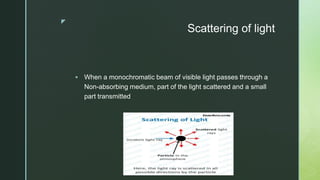
Scattering of light
 When a monochromatic beam of visible light passes through a
Non-absorbing medium, part of the light scattered and a small
part transmitted
z
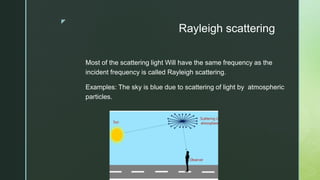
Rayleigh scattering
Most of the scattering light Will have the same frequency as the
incident frequency is called Rayleigh scattering.
Examples: The sky is blue due to scattering of light by atmospheric
particles.
z
Raman scattering
In addition certain discrete frequencies above and below that of the
incident beam Will be scattered. This is known as Raman
scattering.
z
Stokes and Antistokes radiation
 Radiation scattered with a frequency lower than that of the
incident beam is called Stokes radiation.
 Radiation scattered with a frequency higher than that of the
incident beam is called antistokes radiation.
z
z
Raman spectroscopy
 The spectral method developed by the Raman scattering or
Raman effect is known as Raman spectroscopy.
 This spectroscopic technique is used in condensed matter to
study about vibrational, rotational And other low frequency mode
in a system.
z
References
 Barnwell C. N.Mc.cash.E.M, Fundamentals of Molecular Spectroscopy ,
Tata McGraw-Hill, New Delhi, fourth edition, 2011.
 P.S.Sindhu, Fundamentals of Molecular Spectroscopy, New age
International Publishers, second edition, January 2011.
 N.H.Colthup, L. H. Daly, S. E. Wimberley Introduction to Infrared and
Raman Spectroscopy, Third edition.
 Smith & G. Dent, Modern Raman Spectroscopy: A Practical Approach 1st
ed. , Wiley (2005)
z
Thank you

Ppt. raman spectroscopy

  • 1.
    z E.M.G. YADAVA WOMEN’SCOLLEGE, MADURAI – 625 014. (An Autonomous Institution – Affiliated to Madurai Kamaraj University) Re-accredited (3rd Cycle) with Grade A+ and CGPA 3.51 by NAAC TOPIC: Raman spectroscopy By Mrs. P.Revathi, Department of physics,
  • 2.
    z Raman spectroscopy • Scatteringof light • Rayleigh Scattering • Raman Scattering • Stokes and antistokes Radiation • Raman spectroscopy
  • 3.
    z Scattering of light When a monochromatic beam of visible light passes through a Non-absorbing medium, part of the light scattered and a small part transmitted
  • 4.
    z Rayleigh scattering Most ofthe scattering light Will have the same frequency as the incident frequency is called Rayleigh scattering. Examples: The sky is blue due to scattering of light by atmospheric particles.
  • 5.
    z Raman scattering In additioncertain discrete frequencies above and below that of the incident beam Will be scattered. This is known as Raman scattering.
  • 6.
    z Stokes and Antistokesradiation  Radiation scattered with a frequency lower than that of the incident beam is called Stokes radiation.  Radiation scattered with a frequency higher than that of the incident beam is called antistokes radiation.
  • 7.
  • 8.
    z Raman spectroscopy  Thespectral method developed by the Raman scattering or Raman effect is known as Raman spectroscopy.  This spectroscopic technique is used in condensed matter to study about vibrational, rotational And other low frequency mode in a system.
  • 9.
    z References  Barnwell C.N.Mc.cash.E.M, Fundamentals of Molecular Spectroscopy , Tata McGraw-Hill, New Delhi, fourth edition, 2011.  P.S.Sindhu, Fundamentals of Molecular Spectroscopy, New age International Publishers, second edition, January 2011.  N.H.Colthup, L. H. Daly, S. E. Wimberley Introduction to Infrared and Raman Spectroscopy, Third edition.  Smith & G. Dent, Modern Raman Spectroscopy: A Practical Approach 1st ed. , Wiley (2005)
  • 10.