3.1 Gravity, weightand mass
• In this topic you will:
• • understand that the force of gravity acts between objects
• • learn about what affects the strength of the force of gravity
• on an object
• • practise using the correct terms ‘weight’ and ‘mass’.
• Work individually to answer these questions.
• 1 Describe how gravity affects an object such as
• a textbook.
• 2 Copy and complete this sentence by choosing the correct word from the list.
• length mass volume weight
• The newton, N, is a unit of …………………
• 3 Copy and complete this sentence. The kilogram, kg, is a unit of …………………
3.
Gravity
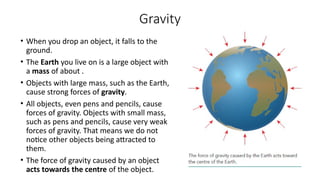
• When youdrop an object, it falls to the
ground.
• The Earth you live on is a large object with
a mass of about .
• Objects with large mass, such as the Earth,
cause strong forces of gravity.
• All objects, even pens and pencils, cause
forces of gravity. Objects with small mass,
such as pens and pencils, cause very weak
forces of gravity. That means we do not
notice other objects being attracted to
them.
• The force of gravity caused by an object
acts towards the centre of the object.
4.
Gravity
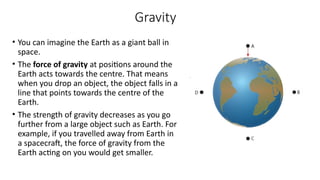
• You canimagine the Earth as a giant ball in
space.
• The force of gravity at positions around the
Earth acts towards the centre. That means
when you drop an object, the object falls in a
line that points towards the centre of the
Earth.
• The strength of gravity decreases as you go
further from a large object such as Earth. For
example, if you travelled away from Earth in
a spacecraft, the force of gravity from the
Earth acting on you would get smaller.
5.
Weight
• The forceof gravity on an object is called its
weight.
• It is difficult to lift a heavy object because gravity
is pulling it towards the centre of the Earth. By
lifting, you are pulling against gravity.
• Weight is a force and it is measured in newtons,
N.
• The weight of an apple is about 1 N. That means
gravity from the Earth is pulling on the apple
with a force of 1 N. You need to apply a force of
1 N to hold the apple.
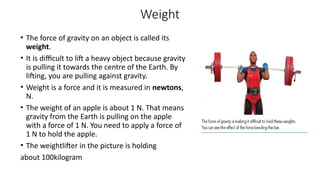
• The weightlifter in the picture is holding
about 100kilogram
6.
The contact force
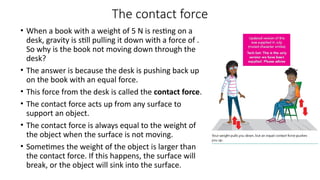
•When a book with a weight of 5 N is resting on a
desk, gravity is still pulling it down with a force of .
So why is the book not moving down through the
desk?
• The answer is because the desk is pushing back up
on the book with an equal force.
• This force from the desk is called the contact force.
• The contact force acts up from any surface to
support an object.
• The contact force is always equal to the weight of
the object when the surface is not moving.
• Sometimes the weight of the object is larger than
the contact force. If this happens, the surface will
break, or the object will sink into the surface.
7.
Weight and mass
•Weight is the force of gravity on an object.
• It is measured in newtons, N.
• Mass is the quantity of matter in an object.
• It is measured in kilograms, kg.
• On Earth, the force of gravity is 10 N on
every 1 kg of mass.
• Writing this as an equation:
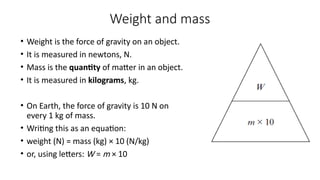
• weight (N) = mass (kg) × 10 (N/kg)
• or, using letters: W = m × 10
8.
Weight and mass
•As 10 N acts on 1 kg, you say this as ‘10 newtons per kilogram’, or 10
N/kg. For example, if a person has a mass of 45 kg, their weight on Earth
is
45 × 10 = 450 N.
• You can use the equation to calculate mass if you know the weight. For
example, a computer games console has a weight of 28 N.
• The mass of the console is
• = 28/10
• = 2.8 kg.
9.
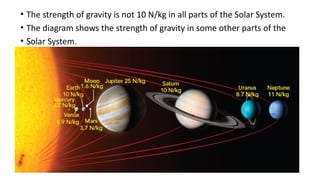
• The strengthof gravity is not 10 N/kg in all parts of the Solar System.
• The diagram shows the strength of gravity in some other parts of the
• Solar System.
10.
Weight and mass
•The weight of an object changes when the strength of gravity changes.
• If you want to calculate your weight somewhere other than Earth, you
• can use the same equation but you must change the number 10 to the
• value of the strength of gravity wherever you are calculating it.
• The mass of an object does not change.
11.
3.2 Formation ofthe Solar System
• In this topic you will:
• • learn about how scientists think the Solar System was formed
• • think about objects in space growing larger and increasing in mass
• • understand that as these objects increase in mass, their gravity increases
• • understand that as their gravity increases, they can attract even more mass.
• Choose one correct answer to each question.
• 1 An object causes a strong force of gravity. What must the object have?
large size large mass small size small mass
• 2 Which of these objects has the largest mass in the Solar System?
Earth Jupiter Sun Neptune
• 3 Which of these objects is at the centre of the Solar System?
Earth Moon Mercury Sun
12.
Where did theSolar System come from?
• When the Solar System formed, there were no people to observe how it
was made. Observe means to watch something happening. So how do
we know what happened?
• Scientists can try to solve a problem like this in two different ways.
• • They can look for evidence, in the form of facts from observations or
experiments to support their theory, and then try to explain what they
have found.
• • They can think of a testable theory, called an hypothesis, and then
look for evidence to support the hypothesis.
Facts about theSolar System
• Here are some facts about the Solar System:
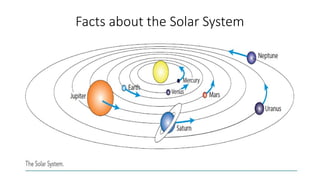
• • All the planets in the Solar System follow a path or orbit around the Sun in
the same direction.
• • The Sun and all the planets (except Venus and Uranus) spin on their axes
(singular: axis) in the same direction.
• • Most of the moons of the planets orbit their planets in the same direction
as the planets rotate around the Sun.
• • The direction of spin of the Sun and the planets (except Venus and Uranus)
is the same as the direction in which the planets orbit the Sun.
• • All the planets orbit the Sun in the same plane. Objects that are in the same
plane could all be placed on the same flat surface, just like all the objects on a
desk. That means the Solar System looks flat.
• Scientists can use these facts as evidence.
15.
Watching the birthof stars
• Scientists can see distant stars forming
• in other parts of space. These stars are
being formed from clouds of dust and
gas.
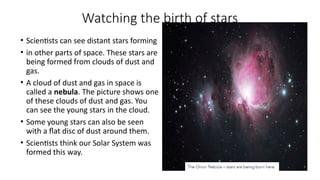
• A cloud of dust and gas in space is
called a nebula. The picture shows one
of these clouds of dust and gas. You
can see the young stars in the cloud.
• Some young stars can also be seen
with a flat disc of dust around them.
• Scientists think our Solar System was
formed this way.
16.
Using models
• Scientistscannot observe a star or Solar System forming in an experiment.
• Instead they use computers to create models. A model is a way of
representing something that is difficult to observe directly.
• The scientists put many of the known laws of physics into a computer
program. Then the computer uses this information to predict what will
happen, starting with a cloud of dust and gas.
• The result is a prediction that a star will form, surrounded by planets.
17.
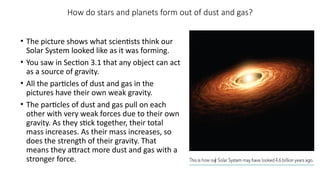
How do starsand planets form out of dust and gas?
• The picture shows what scientists think our
Solar System looked like as it was forming.
• You saw in Section 3.1 that any object can act
as a source of gravity.
• All the particles of dust and gas in the
pictures have their own weak gravity.
• The particles of dust and gas pull on each
other with very weak forces due to their own
gravity. As they stick together, their total
mass increases. As their mass increases, so
does the strength of their gravity. That
means they attract more dust and gas with a
stronger force.
18.
How do starsand planets form out of dust and gas?
• This starts to form a small ball.
• Gradually, this ball gets bigger.
• If the ball gets beyond a certain size, it will get hot enough to become a star.
Otherwise it will become a planet.
• Most of the facts about the Solar System support or agree with this hypothesis.
• The fact that Venus spins on its axis in the opposite way to all the other planets
seems to contradict this hypothesis. Contradict is the opposite of support – it
means to go against something.
• Scientists think the planet Jupiter almost reached the size to be a star.
• It takes millions of years to form a star or a planet.
19.
3.3 Movement inspace
• In this topic you will:
• • learn about what keeps the planets in orbit around the Sun
• • understand why planets move at different speeds
• • discover why objects moving in space do not slow down as they do on
Earth.
• 1 Write the names of the planets in order, starting with the one that is
closest to the Sun.
• 2 Name the object that orbits the Earth and not the Sun.
20.
The Sun andits gravity
• In Section 3.1 you saw that objects with more mass have more gravity.
• The Sun is the object with the largest mass in the Solar System.
• The mass of the Sun is 27 times greater than the mass of the Earth. In fact, the
mass of the Sun is more than the mass of all the other planets added together!
• The strength of gravity on Earth is 10N/kg. On the Sun it is 270N/kg.
• The Sun’s gravity is 27 times stronger than the Earth’s gravity.
• It holds all the planets in their orbits. The Sun’s gravity gets weaker as the
distance from the Sun increases.
• The planet Neptune is 30 times further from the Sun than Earth is.
• The mass of Neptune is about 17 times the mass of Earth. So although the
Sun’s gravity gets weaker, it is strong enough to hold Neptune in orbit.
21.
Orbits of planets
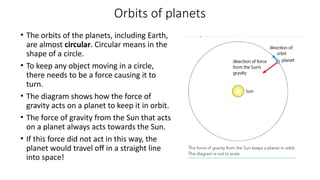
•The orbits of the planets, including Earth,
are almost circular. Circular means in the
shape of a circle.
• To keep any object moving in a circle,
there needs to be a force causing it to
turn.
• The diagram shows how the force of
gravity acts on a planet to keep it in orbit.
• The force of gravity from the Sun that acts
on a planet always acts towards the Sun.
• If this force did not act in this way, the
planet would travel off in a straight line
into space!
22.
Orbits of planets
•Mercury, which is the closest planet to the Sun, has the strongest pull
from the Sun’s gravity.
• This causes Mercury to orbit with the highest speed of all the planets.
• The average speed of Mercury around the Sun is 170 000 km/h! The
• average speed of the Earth around the Sun is about 100 000 km/h.
23.
Speed in space
•On Earth, all objects that move have forces acting on them to slow them
down.
• Air resistance is one of those forces.
• It is caused by a moving object having to push against the particles in the
air.
• Air resistance acts in the opposite direction to movement.
• The faster an object moves, the greater the air resistance on the object.
24.
Speed in space
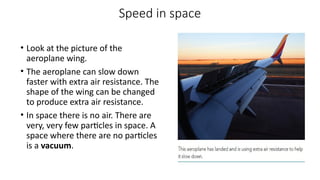
•Look at the picture of the
aeroplane wing.
• The aeroplane can slow down
faster with extra air resistance. The
shape of the wing can be changed
to produce extra air resistance.
• In space there is no air. There are
very, very few particles in space. A
space where there are no particles
is a vacuum.
25.
Speed in space
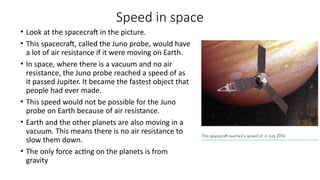
•Look at the spacecraft in the picture.
• This spacecraft, called the Juno probe, would have
a lot of air resistance if it were moving on Earth.
• In space, where there is a vacuum and no air
resistance, the Juno probe reached a speed of as
it passed Jupiter. It became the fastest object that
people had ever made.
• This speed would not be possible for the Juno
probe on Earth because of air resistance.
• Earth and the other planets are also moving in a
vacuum. This means there is no air resistance to
slow them down.
• The only force acting on the planets is from
gravity
26.
3.4 Tides
• Inthis topic you will:
• • find out what tides are
• • learn about tidal forces and where they come from
• • discover how tidal forces affect the oceans and the land.
• Work in groups to answer these questions.
• 1 Which object has the strongest gravity in the Solar System?
• 2 What large object orbits the Earth?
• 3 What force keeps the object that orbits the earth in its orbit?
27.
What are tides?
•In some parts of the world, the depth of the ocean changes by several
• metres during the day.
• The depth is the distance from the surface of the water to the bottom of
the ocean.
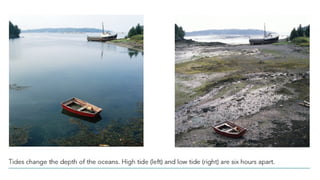
• The picture below shows the same place at two different times. The
pictures were taken six hours apart.
• This change in depth of the water is called a tide.
29.
What are tides?
•The difference in depth of the water between high and low tides is the
tidal range.
• The largest tidal range in the world is 16.3 m in the Bay of Fundy in
Canada.
• Some of the smallest tidal ranges in the world are less than in the
Caribbean and Mediterranean seas.
• Tides also cause the land to change in height through the day! This is
called earth tide. The tidal range due to earth tide is about 30 cm
• High tides are about 12 hours apart. Low tides are also about 12 hours
apart. The time between high and low tide is six hours.
30.
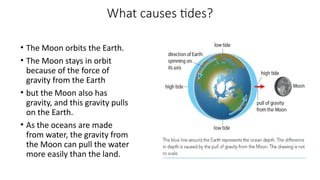
What causes tides?
•The Moon orbits the Earth.
• The Moon stays in orbit
because of the force of
gravity from the Earth
• but the Moon also has
gravity, and this gravity pulls
on the Earth.
• As the oceans are made
from water, the gravity from
the Moon can pull the water
more easily than the land.
31.
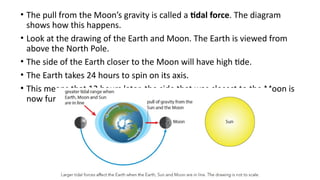
• The pullfrom the Moon’s gravity is called a tidal force. The diagram
shows how this happens.
• Look at the drawing of the Earth and Moon. The Earth is viewed from
above the North Pole.
• The side of the Earth closer to the Moon will have high tide.
• The Earth takes 24 hours to spin on its axis.
• This means that 12 hours later, the side that was closest to the Moon is
now furthest away.
32.
• You cansee from the drawing that the side furthest away also has a high
tide.
• This is why the time between high tides is 12 hours.
• The Sun also produces a tidal force on Earth, but this is weaker as the
Sun is further away than the Moon.
• When the Sun and the Moon are in line with Earth, this produces a
larger tidal force.
• The next drawing shows how this happens.
33.
Effects of tides
•Some harbours can only be used at certain times of the day.
• If the water in the harbour is not deep enough, boats cannot move
safely. Harbours are places where boats and ships can load and unload
passengers and cargo.
• In weather with strong winds, coastal areas are more likely to have
flooding at times of high tides. Coastal areas are parts of the land that
are close to the oceans.
• The flow of water in and out of some coastal areas can be dangerous for
• small boats.
34.
Effects of tides
•In some places, tides affect food chains, including the human food
chain.
• For example, at low tide birds can eat some types of shellfish when they
are not covered with water. Some types of fish move to find food
according to tides in coastal areas.
• Volcano eruptions have been linked with earth tides. By studying Earth
tides, scientists may be able to predict when a volcano will become
dangerous.
• Earthquakes may also be linked with earth tides. Movement of water
with tides can be used to generate electricity.



![Coronary heart diseṁḥṁṣhyxase[CHD] (1).pptx](https://cdn.slidesharecdn.com/ss_thumbnails/coronaryheartdiseasechd1-240415172747-bea8086f-thumbnail.jpg?width=640&height=640&fit=bounds)


![ANIMAL_CELL_,_TISSUE_AND_ORGAN_CULTURE[1].pptx](https://cdn.slidesharecdn.com/ss_thumbnails/animalcelltissueandorganculture1-260204172026-4462b440-thumbnail.jpg?width=640&height=640&fit=bounds)
![Polymer [ बहुलक ] Chemistry Notes PDF - Irfanullah Mehar - JJ Sir Chemistry.pdf](https://cdn.slidesharecdn.com/ss_thumbnails/polymerchemistrynotespdf-irfanullahmehar-jjsirchemistry-260210172118-3f9b37f7-thumbnail.jpg?width=640&height=640&fit=bounds)


