ONLINE IDE (CODE EDITOR)
SUBMITTED BY – DHIRAJ TAYE
GUIDE – MR. SURENDRA MEHRA
PROJECT – “ONLINE IDE (CODE EDITOR)”
Table of context
 ABOUT THE PROJECT  DISADVANTAGES
 MAJOR REQUIREMENTS  PROEJECT
SCREENSHOTS
 ADVANTAGES  CONCLUSION
ABOUT THE PROJECT
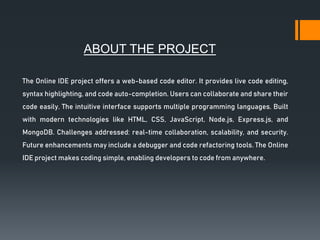
The Online IDE project offers a web-based code editor. It provides live code editing,
syntax highlighting, and code auto-completion. Users can collaborate and share their
code easily. The intuitive interface supports multiple programming languages. Built
with modern technologies like HTML, CSS, JavaScript, Node.js, Express.js, and
MongoDB. Challenges addressed: real-time collaboration, scalability, and security.
Future enhancements may include a debugger and code refactoring tools. The Online
IDE project makes coding simple, enabling developers to code from anywhere.
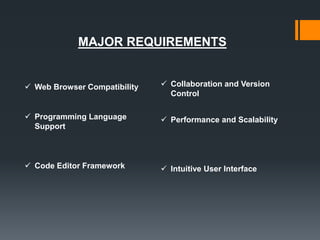
MAJOR REQUIREMENTS
 Web Browser Compatibility  Collaboration and Version
Control
 Programming Language
Support
 Performance and Scalability
 Code Editor Framework  Intuitive User Interface
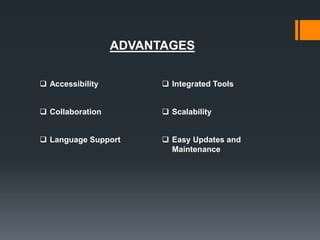
ADVANTAGES
 Accessibility  Integrated Tools
 Collaboration  Scalability
 Language Support  Easy Updates and
Maintenance
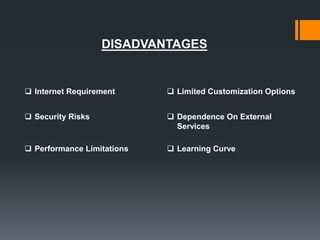
DISADVANTAGES
 Internet Requirement  Limited Customization Options
 Security Risks  Dependence On External
Services
 Performance Limitations  Learning Curve
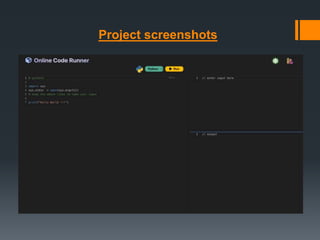
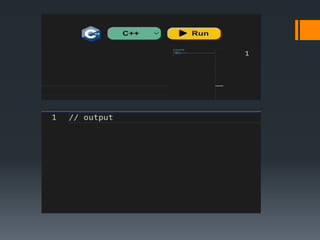
Project screenshots
CONCLUSION
In conclusion, the Online IDE (Code Editor) project brings significant
advantages to developers, including increased accessibility, seamless
collaboration, and enhanced flexibility. By providing a web-based interface,
developers can access and work on their code from anywhere, facilitating
remote work and improving productivity. The real-time collaboration
features enable multiple developers to work together on the same codebase
simultaneously, promoting effective teamwork and efficient code sharing.
Moreover, the support for multiple programming languages caters to
developers' diverse needs and preferences, allowing them to work with their
preferred language of choice.

ppt on Online IDE.pptx

  • 1.
    ONLINE IDE (CODEEDITOR) SUBMITTED BY – DHIRAJ TAYE GUIDE – MR. SURENDRA MEHRA PROJECT – “ONLINE IDE (CODE EDITOR)”
  • 2.
    Table of context ABOUT THE PROJECT  DISADVANTAGES  MAJOR REQUIREMENTS  PROEJECT SCREENSHOTS  ADVANTAGES  CONCLUSION
  • 3.
    ABOUT THE PROJECT TheOnline IDE project offers a web-based code editor. It provides live code editing, syntax highlighting, and code auto-completion. Users can collaborate and share their code easily. The intuitive interface supports multiple programming languages. Built with modern technologies like HTML, CSS, JavaScript, Node.js, Express.js, and MongoDB. Challenges addressed: real-time collaboration, scalability, and security. Future enhancements may include a debugger and code refactoring tools. The Online IDE project makes coding simple, enabling developers to code from anywhere.
  • 4.
    MAJOR REQUIREMENTS  WebBrowser Compatibility  Collaboration and Version Control  Programming Language Support  Performance and Scalability  Code Editor Framework  Intuitive User Interface
  • 5.
    ADVANTAGES  Accessibility Integrated Tools  Collaboration  Scalability  Language Support  Easy Updates and Maintenance
  • 6.
    DISADVANTAGES  Internet Requirement Limited Customization Options  Security Risks  Dependence On External Services  Performance Limitations  Learning Curve
  • 7.
  • 9.
    CONCLUSION In conclusion, theOnline IDE (Code Editor) project brings significant advantages to developers, including increased accessibility, seamless collaboration, and enhanced flexibility. By providing a web-based interface, developers can access and work on their code from anywhere, facilitating remote work and improving productivity. The real-time collaboration features enable multiple developers to work together on the same codebase simultaneously, promoting effective teamwork and efficient code sharing. Moreover, the support for multiple programming languages caters to developers' diverse needs and preferences, allowing them to work with their preferred language of choice.