How Financial Literacy and
Sustainability Perception
Impact on SMEs
Performance
Erlynda Y Kasim
STIE Ekuitas Bandung
Background
01
Background
• Sustainability is a concept developed by the United Nations
which states that we can fulifill the needs today by ensuring that
that the future generations can also meet their needs (Borowy,
2013)
• On the other hand, the SMES sector is a large contributor to
GDP. In 2018, SMEs contributed 57.8% to the increase in GDP. But
SMEs still far behind to compete to the Internasional SMEs
market related to the Sustainability matters.
• It is important for SMEs to maintain their business in the long
term. So the SMEs should be ballance between economy, social
and environment matters to sustain in the long term.
Research Goal
●From the discussion above, the formulation of this further
research problem is to assess how financial literacy ,
sustainability perception SMEs influence SMEs performance.
●Another problem is that there is in progress og development for
standard of SMEs sustainability reports, so an initial concept
model is needed for the stages of implementing the sustainability
concept in SMEs. This research findings will also suggest the basic
concept for future research to design model of sustainability
report for SMEs
Literature review
02
Financial Literacy
● The Association of Chartered Certified Accountants (2014) in (Aribawa, 2016)
believes that the concept of financial literacy includes knowledge of financial
concepts, the ability to understand communication regarding financial concepts,
skills in managing personal/company finances and the ability to make financial
decisions in certain situations.
● In PISA 2012: Financial Literacy Assessment Framework (OECD INFE, 2012) it is
written that financial literacy is a factor that is a pillar for future economic growth
and financial stability (OECD, 2022).
● Good financial literacy will increase the sustainability of SMES businesses
because business owners understand how to manage their business so that
strategies are decided appropriately (Muraga & John, 2015).
● It can be concluded that financial literacy is the understanding of company
human resources in operating and managing finances for company decision
making.
Sustainability
● It is meeting the needs of the present by ensuring that future generations can
meet their needs (WCED, 1987).
● (Massa & Scappini, 2015) states that sustainability has three pillars in the
concept of sustainability, namely economic, social and environmental.
● In companies, the concept of sustainability changes the company's paradigm
from profit oriented to sustainability oriented in order to increase value for
stakeholders.
● Sustainability reports are a form of company responsibility towards
stakeholders in implementing sustainable development in the 3'Ps .
● Sustainability is the concept of fulfilling business in a sustainable manner by
paying attention to economic, social and environmental factors to increase
stakeholder satisfaction
Company Performance
● Company performance is a critical aspect of any business, and it is the primary
goal from an economic perspective to achieve business continuity.
● The ability of a company to generate optimal profits is essential for its growth
and sustainability.
● Small and medium-sized enterprises (SMEs) play a significant role in the
economy, and their ability to generate profits is crucial for their survival and
growth
● Companies that adopt sustainable practices can reduce costs, increase
efficiency, and improve their reputation, which can lead to increased revenue
and profits. Research has shown that companies that implement sustainability
principles are more likely to generate greater profits in the future.
● A study by Vijfvinkel, Bouman, and Hessels (2011) found that companies that
adopt sustainable practices are more likely to achieve long-term success and
generate higher profits than those that do not
● However, it is important to note that company performance is not solely based
on economic factors. Social and environmental factors also play a crucial role in
determining a company's success and sustainability
Sustainability Reporting GRI
● A sustainability report is a comprehensive document that provides
information on a company's performance in economic, environmental,
and social aspects over a specific period.
● The report is a tool for companies to communicate their sustainability
efforts and achievements to stakeholders, including investors,
customers, employees, and the wider community (GRI, 2021).
● The Global Reporting Initiative (GRI) is a leading proponent of
sustainability reporting for companies worldwide.
● The GRI standard provides a framework for companies to report on
their sustainability performance in a consistent and transparent
manner.
● The standard consists of four main standards, namely GRI 100, GRI
200, GRI 300, and GRI 400.
Financial literacy is the knowledge of a business actor that determines the sustainability of
the business (Anggraeni, 2016) the indicators are:
● Understanding of accounting
● Ability to manage finances
● Understanding loan applications
● Savings are guaranteed by the government
● Simple and compound interest
● Calculation of loan interest
● Inflation
Sustainability is activities related to the economy, environment and social carried out by a
company (GRI, 2020). The indicators are:
● Economics
● Social
● Environment
Company performance (Artawinata, 2020) , the indicators are :
● Workforce Growth
● Growth Market Growth
● Sales Growth
● Improved Goods Quality
Hypotesis
● Financial Litreracy is the factor affect the company
Performance in SMEs
● Understanding the concept of Sustainability Coincept
affect the Company Performance in SMEs.
● Financial Literacy and Understanding the concept of
Sustainability Coincept affect the Company
Performance in SMEs simultaneously.
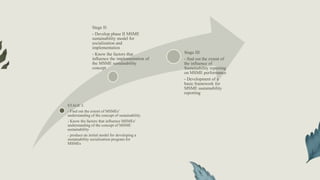
STAGE I:
- Find out the extent of MSMEs'
understanding of the concept of sustainability
- Know the factors that influence MSMEs'
understanding of the concept of MSME
sustainability
- produce an initial model for developing a
sustainability socialization program for
MSMEs
Stage II:
- Develop phase II MSME
sustainability model for
socialization and
implementation
- Know the factors that
influence the implementation of
the MSME sustainability
concept
Stage III
- find out the extent of
the influence of
Sustainability reporting
on MSME performance
- Development of a
basic framework for
MSME sustainability
reporting
Research Methods
03
Population and Sample
● The population is Bandung City SMEs. Researchers divide SMEs into six
sectors according to the type of business. the sampling technique uses
random sampling .
● The number of samples used was 30 SMEs.
Data analysis method
● The collected questionnaires will be tested first using validity and reliability
tests. Next, to test the hypothesis, the researcher used the t test and F test
using Linear Regression Analysis, which previously had to pass the Classical
Assumption Test first. This classic assumption test consists of the normality
test, multicollinearity test and heteroscedasticity test.
Results and Discussion
04
Reliability and Validity Test
A good value for a reliability test is measured using the Cronbach's Alpha
value of Reliability Test Results > 0.6. In the research testing of 14
statement items, the value for all statement items was reliable or
trustworthy, because the test results showed a value of 0.714 > 0.6. The
data also pass the validity test
Classic Assumption Test
This test is carried out to show whether the data we have is normally
distributed. In this study all data was normally distributed because the sig
value was > 0.05. The data has passed the tests for multicollinearity,
heteroscedasticity, and autocorrelation. Therefore, the data has passed the
classical assumption tests and can proceed to the process of multiple linear
regression testing
T-test
The results show that variable Financial Literacy has siginificant impact on
SMEs performance where the Sig 0.000 < 0.05. This results in line with the previous
research conducted by (Aribawa, 2016); (Rahayu & Musdholifah, 2017);
(Anggraeni, 2016); (Jianmu & Kulathuna, 2019); (Frimpong, 2022)
The test results for Variable Sustainability has significant impact on SMEs
performance (where Sig 0.000 < 0.05) and this resulits is in line with previous
research (Vijfvinkel, et.al (2011), Kurniawan (2017). Caputo, et.al (2018)
Results
• The results show that financial literacy affect company performance of
SMEs. This is in line with research conducted by (Aribawa, 2016); (Rahayu &
Musdholifah, 2017); (Anggraeni, 2016); (Jianmu & Kulathuna, 2019), that the
factors of financial literacy, influence the sustainability of SMEs.
• The research also shows that Sustainability influence the company
performance of SMEs. This results also in line with research conducted by
Vijfvinkel, et.al (2011), Kurniawan (2017) and Caputo, et.al (2018) stated that
there is an influence between sustainability on company performance of
SMEs.
F-test
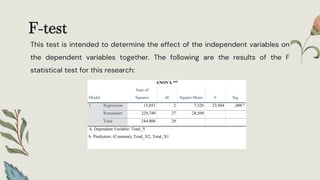
This test is intended to determine the effect of the independent variables on
the dependent variables together. The following are the results of the F
statistical test for this research:
ANOVA and
Model
Sum of
Squares df Square Mean F Sig.
1 Regression 15,051 2 7,526 23,884 ,000 b
Remainder 229,749 27 28,509
Total 244,800 29
A. Dependent Variable: Total_Y
b. Predictors: (Constant), Total_X2, Total_X1
F-test
Based on the results of the F test, it can be seen that the sig value is sig 0.000
<0.05, so based on the test criteria it can be concluded that the independent
variables (financial literacy and understanding of sustainability ) together have
a significant effect on the dependent variable (UMKM performance).
This means that financial literacy and sustainability influence the performance
of SMEs simultaneosly. This is in line with research conducted by (Aribawa,
2016); (Rahayu & Musdholifah, 2017); (Anggraeni, 2016); (Jianmu & Kulathuna,
2019), that the factors of financial literacy, business sustainability,
performance, financial management, knowledge of business managers
influence the sustainability of SMEs
Discussion
Financial Literacy
The research questionnaire was distributed to 30 respondents who are SMEs
in the food and beverage sector. The results of the questionnaire showed that
average score of 77% SMEs understood financial literacy.
Understanding Sustainability
Understanding sustainability is closely related to business continuity into the
next period. The results of the questionnaire show that average score 77%
SMEs understand sustainability in their business activities.
SMES performance
SMES performance can be influenced by financial literacy and understanding
of sustainability in business activities. The performance of SMEs will improve if
business actors can understand how important education regarding financial
literacy and sustainability is. The results of the questionnaire showed that
average score of SMEs performance is 79%.
Conclusions and Suggestions
05
Conclusions
• Average score of understanding financial literacy in SMEs are catogrized good criteria
which is 77%.
• Average score of understanding Sustainability Cocept in SMEs are catogrized good criteria
which is 77%.
• Average score of SMEs Economy performance is 79% in SMEs are catogrized good
criteria.
• Financial literacy has a positive significantr effect on the performance of SMEs with a
significance level of sig 0.000 < 0.05.
• Understanding sustainability has a positive significant effect on the performance of SMEs
with a significance level of sig 0.000 < 0.05.
• Simultaneous testing of financial literacy and understanding sustainability shows that both
variables have a significant effect on the performance of SMEs with a significance level of
0.000 < 0.05.
Suggestions
Based on the research results and conclusions, the researcher provides suggestions for
consideration, namely:
• Based on the descriptive analysis, financial literacy is included in the quite good category,
however, the business financial recording indicator gets the lowest score. For this reason,
some improvements are still needed in financial literacy of SMEs.
• The SMEs need to do some innovation regarding that the business product development
get the lowest score
• For further research, the researcher can use bigger size of SMEs and different (varety)
industries.
Thank You

PPT Conference Undip.pptx

  • 1.
    How Financial Literacyand Sustainability Perception Impact on SMEs Performance Erlynda Y Kasim STIE Ekuitas Bandung
  • 2.
  • 3.
    Background • Sustainability isa concept developed by the United Nations which states that we can fulifill the needs today by ensuring that that the future generations can also meet their needs (Borowy, 2013) • On the other hand, the SMES sector is a large contributor to GDP. In 2018, SMEs contributed 57.8% to the increase in GDP. But SMEs still far behind to compete to the Internasional SMEs market related to the Sustainability matters. • It is important for SMEs to maintain their business in the long term. So the SMEs should be ballance between economy, social and environment matters to sustain in the long term.
  • 4.
    Research Goal ●From thediscussion above, the formulation of this further research problem is to assess how financial literacy , sustainability perception SMEs influence SMEs performance. ●Another problem is that there is in progress og development for standard of SMEs sustainability reports, so an initial concept model is needed for the stages of implementing the sustainability concept in SMEs. This research findings will also suggest the basic concept for future research to design model of sustainability report for SMEs
  • 5.
  • 6.
    Financial Literacy ● TheAssociation of Chartered Certified Accountants (2014) in (Aribawa, 2016) believes that the concept of financial literacy includes knowledge of financial concepts, the ability to understand communication regarding financial concepts, skills in managing personal/company finances and the ability to make financial decisions in certain situations. ● In PISA 2012: Financial Literacy Assessment Framework (OECD INFE, 2012) it is written that financial literacy is a factor that is a pillar for future economic growth and financial stability (OECD, 2022). ● Good financial literacy will increase the sustainability of SMES businesses because business owners understand how to manage their business so that strategies are decided appropriately (Muraga & John, 2015). ● It can be concluded that financial literacy is the understanding of company human resources in operating and managing finances for company decision making.
  • 7.
    Sustainability ● It ismeeting the needs of the present by ensuring that future generations can meet their needs (WCED, 1987). ● (Massa & Scappini, 2015) states that sustainability has three pillars in the concept of sustainability, namely economic, social and environmental. ● In companies, the concept of sustainability changes the company's paradigm from profit oriented to sustainability oriented in order to increase value for stakeholders. ● Sustainability reports are a form of company responsibility towards stakeholders in implementing sustainable development in the 3'Ps . ● Sustainability is the concept of fulfilling business in a sustainable manner by paying attention to economic, social and environmental factors to increase stakeholder satisfaction
  • 8.
    Company Performance ● Companyperformance is a critical aspect of any business, and it is the primary goal from an economic perspective to achieve business continuity. ● The ability of a company to generate optimal profits is essential for its growth and sustainability. ● Small and medium-sized enterprises (SMEs) play a significant role in the economy, and their ability to generate profits is crucial for their survival and growth ● Companies that adopt sustainable practices can reduce costs, increase efficiency, and improve their reputation, which can lead to increased revenue and profits. Research has shown that companies that implement sustainability principles are more likely to generate greater profits in the future. ● A study by Vijfvinkel, Bouman, and Hessels (2011) found that companies that adopt sustainable practices are more likely to achieve long-term success and generate higher profits than those that do not ● However, it is important to note that company performance is not solely based on economic factors. Social and environmental factors also play a crucial role in determining a company's success and sustainability
  • 9.
    Sustainability Reporting GRI ●A sustainability report is a comprehensive document that provides information on a company's performance in economic, environmental, and social aspects over a specific period. ● The report is a tool for companies to communicate their sustainability efforts and achievements to stakeholders, including investors, customers, employees, and the wider community (GRI, 2021). ● The Global Reporting Initiative (GRI) is a leading proponent of sustainability reporting for companies worldwide. ● The GRI standard provides a framework for companies to report on their sustainability performance in a consistent and transparent manner. ● The standard consists of four main standards, namely GRI 100, GRI 200, GRI 300, and GRI 400.
  • 10.
    Financial literacy isthe knowledge of a business actor that determines the sustainability of the business (Anggraeni, 2016) the indicators are: ● Understanding of accounting ● Ability to manage finances ● Understanding loan applications ● Savings are guaranteed by the government ● Simple and compound interest ● Calculation of loan interest ● Inflation Sustainability is activities related to the economy, environment and social carried out by a company (GRI, 2020). The indicators are: ● Economics ● Social ● Environment Company performance (Artawinata, 2020) , the indicators are : ● Workforce Growth ● Growth Market Growth ● Sales Growth ● Improved Goods Quality
  • 11.
    Hypotesis ● Financial Litreracyis the factor affect the company Performance in SMEs ● Understanding the concept of Sustainability Coincept affect the Company Performance in SMEs. ● Financial Literacy and Understanding the concept of Sustainability Coincept affect the Company Performance in SMEs simultaneously.
  • 12.
    STAGE I: - Findout the extent of MSMEs' understanding of the concept of sustainability - Know the factors that influence MSMEs' understanding of the concept of MSME sustainability - produce an initial model for developing a sustainability socialization program for MSMEs Stage II: - Develop phase II MSME sustainability model for socialization and implementation - Know the factors that influence the implementation of the MSME sustainability concept Stage III - find out the extent of the influence of Sustainability reporting on MSME performance - Development of a basic framework for MSME sustainability reporting
  • 13.
  • 14.
    Population and Sample ●The population is Bandung City SMEs. Researchers divide SMEs into six sectors according to the type of business. the sampling technique uses random sampling . ● The number of samples used was 30 SMEs. Data analysis method ● The collected questionnaires will be tested first using validity and reliability tests. Next, to test the hypothesis, the researcher used the t test and F test using Linear Regression Analysis, which previously had to pass the Classical Assumption Test first. This classic assumption test consists of the normality test, multicollinearity test and heteroscedasticity test.
  • 15.
  • 16.
    Reliability and ValidityTest A good value for a reliability test is measured using the Cronbach's Alpha value of Reliability Test Results > 0.6. In the research testing of 14 statement items, the value for all statement items was reliable or trustworthy, because the test results showed a value of 0.714 > 0.6. The data also pass the validity test
  • 17.
    Classic Assumption Test Thistest is carried out to show whether the data we have is normally distributed. In this study all data was normally distributed because the sig value was > 0.05. The data has passed the tests for multicollinearity, heteroscedasticity, and autocorrelation. Therefore, the data has passed the classical assumption tests and can proceed to the process of multiple linear regression testing
  • 18.
    T-test The results showthat variable Financial Literacy has siginificant impact on SMEs performance where the Sig 0.000 < 0.05. This results in line with the previous research conducted by (Aribawa, 2016); (Rahayu & Musdholifah, 2017); (Anggraeni, 2016); (Jianmu & Kulathuna, 2019); (Frimpong, 2022) The test results for Variable Sustainability has significant impact on SMEs performance (where Sig 0.000 < 0.05) and this resulits is in line with previous research (Vijfvinkel, et.al (2011), Kurniawan (2017). Caputo, et.al (2018)
  • 19.
    Results • The resultsshow that financial literacy affect company performance of SMEs. This is in line with research conducted by (Aribawa, 2016); (Rahayu & Musdholifah, 2017); (Anggraeni, 2016); (Jianmu & Kulathuna, 2019), that the factors of financial literacy, influence the sustainability of SMEs. • The research also shows that Sustainability influence the company performance of SMEs. This results also in line with research conducted by Vijfvinkel, et.al (2011), Kurniawan (2017) and Caputo, et.al (2018) stated that there is an influence between sustainability on company performance of SMEs.
  • 20.
    F-test This test isintended to determine the effect of the independent variables on the dependent variables together. The following are the results of the F statistical test for this research: ANOVA and Model Sum of Squares df Square Mean F Sig. 1 Regression 15,051 2 7,526 23,884 ,000 b Remainder 229,749 27 28,509 Total 244,800 29 A. Dependent Variable: Total_Y b. Predictors: (Constant), Total_X2, Total_X1
  • 21.
    F-test Based on theresults of the F test, it can be seen that the sig value is sig 0.000 <0.05, so based on the test criteria it can be concluded that the independent variables (financial literacy and understanding of sustainability ) together have a significant effect on the dependent variable (UMKM performance). This means that financial literacy and sustainability influence the performance of SMEs simultaneosly. This is in line with research conducted by (Aribawa, 2016); (Rahayu & Musdholifah, 2017); (Anggraeni, 2016); (Jianmu & Kulathuna, 2019), that the factors of financial literacy, business sustainability, performance, financial management, knowledge of business managers influence the sustainability of SMEs
  • 22.
    Discussion Financial Literacy The researchquestionnaire was distributed to 30 respondents who are SMEs in the food and beverage sector. The results of the questionnaire showed that average score of 77% SMEs understood financial literacy. Understanding Sustainability Understanding sustainability is closely related to business continuity into the next period. The results of the questionnaire show that average score 77% SMEs understand sustainability in their business activities. SMES performance SMES performance can be influenced by financial literacy and understanding of sustainability in business activities. The performance of SMEs will improve if business actors can understand how important education regarding financial literacy and sustainability is. The results of the questionnaire showed that average score of SMEs performance is 79%.
  • 23.
  • 24.
    Conclusions • Average scoreof understanding financial literacy in SMEs are catogrized good criteria which is 77%. • Average score of understanding Sustainability Cocept in SMEs are catogrized good criteria which is 77%. • Average score of SMEs Economy performance is 79% in SMEs are catogrized good criteria. • Financial literacy has a positive significantr effect on the performance of SMEs with a significance level of sig 0.000 < 0.05. • Understanding sustainability has a positive significant effect on the performance of SMEs with a significance level of sig 0.000 < 0.05. • Simultaneous testing of financial literacy and understanding sustainability shows that both variables have a significant effect on the performance of SMEs with a significance level of 0.000 < 0.05.
  • 25.
    Suggestions Based on theresearch results and conclusions, the researcher provides suggestions for consideration, namely: • Based on the descriptive analysis, financial literacy is included in the quite good category, however, the business financial recording indicator gets the lowest score. For this reason, some improvements are still needed in financial literacy of SMEs. • The SMEs need to do some innovation regarding that the business product development get the lowest score • For further research, the researcher can use bigger size of SMEs and different (varety) industries.
  • 26.