PPF
or
ELSS Mutual Funds
Where to invest for Tax Planning for FY 2019-20
How to save Tax for FY 2019-20?
Before Tax Planning it is important to know how much tax one need to pay on his income.
For that one need to know how much tax rate applicable to him.
Income Tax Slabs for FY 2019 - 20
General Public Senior Citizens Very Senior Citizens
Income Tax Slab Tax Income Tax Slab Tax Income Tax Slab Tax
Up to Rs.2.5 Lakhs Nil Up to Rs.3 Lakhs Nil Up to Rs.5 Lakhs Nil
Rs.2.5 - 5 lakhs 5% Rs.3 - 5 Lakhs 5% Rs.5 - 10 lakhs 20%
Rs.5 - 10 lakhs 20% Rs.5 - 10 lakhs 20% Above 10 Lakhs 30%
Above 10 Lakhs 30% Above 10 Lakhs 30%
# Health & Education Cess of 4%
# Tax Rebate up to Rs. 12,500 for Taxable Income up to Rs. 5 lakhs u/s 87A (Only for
Financial Year 2019 - 20)
# Variable Surcharge rates applicable on Taxable Income of 50 Lakh & above
You can save your taxes by investing in Tax – saving instrument under Section 80C.
Section 80C
• Maximum amount you can invest under Section 80C is Rs.1,50,000/-.
• You have various investment options like Public Provident Fund (PPF), Tax
Saving Bank FD, National Savings Certificate (NSC), Life Insurance Policies,
ELSS Mutual Funds.
• Employee Provident fund (EPF) deducted every month from the Salary
would be shown as investment under this section.
• Other than investment options, even your expenses like Principal Payment of
your Home Loan, Children Tuition fees is also allowable as deduction under
this section
We can divide investment options available under Section 80C into 2 categories
1. Investment Options with market linked returns
2. Investment Options with Fixed or Guaranteed Returns
Lets look at the chart
While choosing one of these investment options for tax saving purpose, you need to take one
more thing into consideration. Are Maturity benefits from these investment options also TAX
Free?
Out of all the investment options available only EPF, PPF, Life Insurance Policies & NPS will
give you tax free returns at the time of maturity. EPF is mandatorily deducted from the salary, &
it is part of the retirement benefits of an employee. NPS is also pension product & mandatory for
Central Government employees. But NPS invest in mix of Equities, Government & Corporate
Bonds. Though ELSS is now subject to Long Term Capital Gain (LTCG) Tax, it invests money in
equity where returns potential are higher than any other asset class. So here we will further
analyze PPF, ELSS mutual funds only as they invest only in debt & equities respectively.
Why not the Life insurance policies. Many people buy life insurance policies thinking it is
offering benefits of tax saving, safe & guaranteed returns. But returns from these policies are
usually low when adjusted for inflation. Also these policies do not offer adequate risk cover in
case of untimely death of policy holder.
One should not mix insurance with investments. Insurance policy should be taken only for
protection purpose. One must buy Term Insurance as this is purest form of life insurance policy
& provides high amount for risk coverage at a very low premium.
Now we left with 2 options, ELSS Mutual Funds & PPF. ELSS offers you market linked returns,
whereas PPF gives you fixed guaranteed returns on your investments. Here we have compared
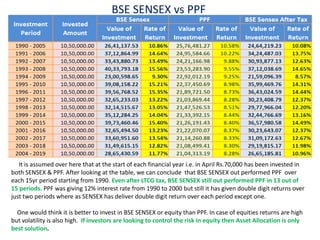
returns of BSE SENSEX with PPF returns from 1990. Let’s look at the below table.
BSE SENSEX vs PPF
It is assumed over here that at the start of each financial year i.e. in April Rs.70,000 has been invested in
both SENSEX & PPF. After looking at the table, we can conclude that BSE SENSEX out performed PPF over
each 15yr period starting from 1990. Even after LTCG tax, BSE SENSEX still out performed PPF in 13 out of
15 periods. PPF was giving 12% interest rate from 1990 to 2000 but still it has given double digit returns over
just two periods where as SENSEX has deliver double digit return over each period except one.
One would think it is better to invest in BSE SENSEX or equity than PPF. In case of equities returns are high
but volatility is also high. If investors are looking to control the risk in equity then Asset Allocation is only
best solution.
What is Asset Allocation?
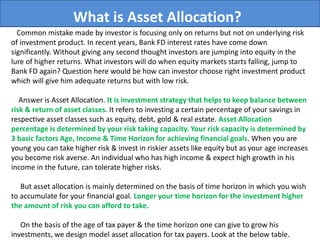
Common mistake made by investor is focusing only on returns but not on underlying risk
of investment product. In recent years, Bank FD interest rates have come down
significantly. Without giving any second thought investors are jumping into equity in the
lure of higher returns. What investors will do when equity markets starts falling, jump to
Bank FD again? Question here would be how can investor choose right investment product
which will give him adequate returns but with low risk.
Answer is Asset Allocation. It is investment strategy that helps to keep balance between
risk & return of asset classes. It refers to investing a certain percentage of your savings in
respective asset classes such as equity, debt, gold & real estate. Asset Allocation
percentage is determined by your risk taking capacity. Your risk capacity is determined by
3 basic factors Age, Income & Time Horizon for achieving financial goals. When you are
young you can take higher risk & invest in riskier assets like equity but as your age increases
you become risk averse. An individual who has high income & expect high growth in his
income in the future, can tolerate higher risks.
But asset allocation is mainly determined on the basis of time horizon in which you wish
to accumulate for your financial goal. Longer your time horizon for the investment higher
the amount of risk you can afford to take.
On the basis of the age of tax payer & the time horizon one can give to grow his
investments, we design model asset allocation for tax payers. Look at the below table.
It is assumed here that, individual has bought Term life insurance policy at very young age
& he will pay low premium on his policy throughout. If that individual would take Term
policy later in his life , he has to pay comparatively high premium. In that case he can adjust
his allocation between EPF/ PPF & ELSS according to his risk taking capacity.
So this is ideal asset allocation as it has not only kept risk balance between EPF/PPF &
ELSS but also gives the financial protection to your portfolio in the form of Term life
insurance. This is ideal investment since it is not only giving you the benefit of tax saving, &
financial protection but also inflation adjusted real returns which helps to create wealth.
Lets take example of, a 30yr old person who starts investing his money according to
Model Asset Allocation for his retirement. We assume Equity will deliver return of 9.5% p.a.
& Debt portfolio will give 6% p.a. throughout. Look at the below table where we have
compare returns of Asset Allocation with Equity or Debt only portfolios.
If you look at the chart you can easily figure out; though Asset Allocation portfolio (AA) has given lesser
returns than Equity only portfolio, Debt corpus of AA is just short of 3 Lakh of Debt only portfolio. This is
when AA portfolio actually paid 3.24 Lakh as LTCG tax on withdrawal from Equity corpus.
So AA Portfolio has best of both the worlds. It has stability of Debt portfolio plus additional Equity
corpus to give necessary capital appreciation to the portfolio which would help to generate inflation
beating returns in the future.
If you still think Equity only portfolio is better than AA portfolio, then imagine situation of sudden
downfall in the markets by 20%. Continuing with our current example, Equity only portfolio would come
down by 40 Lakh ( 2.04 Cr x 20%) where as AA portfolio would come down by only 8.39 Lakh ( 41.98 L x
20%).
So please remember Asset Allocation will always be second best but more importantly it
will give you downside protection which Equity only portfolio never ever able to give you.
So before making investment in tax saving option
Identify your Risk taking Capacity
Determine your Asset Allocation among Asset Classes
Maintain discipline of investing through out investing years
CREATES WEALTH
1
2
3
4

PPF or ELSS Mutual Funds

  • 1.
    PPF or ELSS Mutual Funds Whereto invest for Tax Planning for FY 2019-20
  • 2.
    How to saveTax for FY 2019-20? Before Tax Planning it is important to know how much tax one need to pay on his income. For that one need to know how much tax rate applicable to him. Income Tax Slabs for FY 2019 - 20 General Public Senior Citizens Very Senior Citizens Income Tax Slab Tax Income Tax Slab Tax Income Tax Slab Tax Up to Rs.2.5 Lakhs Nil Up to Rs.3 Lakhs Nil Up to Rs.5 Lakhs Nil Rs.2.5 - 5 lakhs 5% Rs.3 - 5 Lakhs 5% Rs.5 - 10 lakhs 20% Rs.5 - 10 lakhs 20% Rs.5 - 10 lakhs 20% Above 10 Lakhs 30% Above 10 Lakhs 30% Above 10 Lakhs 30% # Health & Education Cess of 4% # Tax Rebate up to Rs. 12,500 for Taxable Income up to Rs. 5 lakhs u/s 87A (Only for Financial Year 2019 - 20) # Variable Surcharge rates applicable on Taxable Income of 50 Lakh & above
  • 3.
    You can saveyour taxes by investing in Tax – saving instrument under Section 80C. Section 80C • Maximum amount you can invest under Section 80C is Rs.1,50,000/-. • You have various investment options like Public Provident Fund (PPF), Tax Saving Bank FD, National Savings Certificate (NSC), Life Insurance Policies, ELSS Mutual Funds. • Employee Provident fund (EPF) deducted every month from the Salary would be shown as investment under this section. • Other than investment options, even your expenses like Principal Payment of your Home Loan, Children Tuition fees is also allowable as deduction under this section We can divide investment options available under Section 80C into 2 categories 1. Investment Options with market linked returns 2. Investment Options with Fixed or Guaranteed Returns Lets look at the chart
  • 5.
    While choosing oneof these investment options for tax saving purpose, you need to take one more thing into consideration. Are Maturity benefits from these investment options also TAX Free? Out of all the investment options available only EPF, PPF, Life Insurance Policies & NPS will give you tax free returns at the time of maturity. EPF is mandatorily deducted from the salary, & it is part of the retirement benefits of an employee. NPS is also pension product & mandatory for Central Government employees. But NPS invest in mix of Equities, Government & Corporate Bonds. Though ELSS is now subject to Long Term Capital Gain (LTCG) Tax, it invests money in equity where returns potential are higher than any other asset class. So here we will further analyze PPF, ELSS mutual funds only as they invest only in debt & equities respectively. Why not the Life insurance policies. Many people buy life insurance policies thinking it is offering benefits of tax saving, safe & guaranteed returns. But returns from these policies are usually low when adjusted for inflation. Also these policies do not offer adequate risk cover in case of untimely death of policy holder. One should not mix insurance with investments. Insurance policy should be taken only for protection purpose. One must buy Term Insurance as this is purest form of life insurance policy & provides high amount for risk coverage at a very low premium. Now we left with 2 options, ELSS Mutual Funds & PPF. ELSS offers you market linked returns, whereas PPF gives you fixed guaranteed returns on your investments. Here we have compared returns of BSE SENSEX with PPF returns from 1990. Let’s look at the below table.
  • 6.
    BSE SENSEX vsPPF It is assumed over here that at the start of each financial year i.e. in April Rs.70,000 has been invested in both SENSEX & PPF. After looking at the table, we can conclude that BSE SENSEX out performed PPF over each 15yr period starting from 1990. Even after LTCG tax, BSE SENSEX still out performed PPF in 13 out of 15 periods. PPF was giving 12% interest rate from 1990 to 2000 but still it has given double digit returns over just two periods where as SENSEX has deliver double digit return over each period except one. One would think it is better to invest in BSE SENSEX or equity than PPF. In case of equities returns are high but volatility is also high. If investors are looking to control the risk in equity then Asset Allocation is only best solution.
  • 7.
    What is AssetAllocation? Common mistake made by investor is focusing only on returns but not on underlying risk of investment product. In recent years, Bank FD interest rates have come down significantly. Without giving any second thought investors are jumping into equity in the lure of higher returns. What investors will do when equity markets starts falling, jump to Bank FD again? Question here would be how can investor choose right investment product which will give him adequate returns but with low risk. Answer is Asset Allocation. It is investment strategy that helps to keep balance between risk & return of asset classes. It refers to investing a certain percentage of your savings in respective asset classes such as equity, debt, gold & real estate. Asset Allocation percentage is determined by your risk taking capacity. Your risk capacity is determined by 3 basic factors Age, Income & Time Horizon for achieving financial goals. When you are young you can take higher risk & invest in riskier assets like equity but as your age increases you become risk averse. An individual who has high income & expect high growth in his income in the future, can tolerate higher risks. But asset allocation is mainly determined on the basis of time horizon in which you wish to accumulate for your financial goal. Longer your time horizon for the investment higher the amount of risk you can afford to take. On the basis of the age of tax payer & the time horizon one can give to grow his investments, we design model asset allocation for tax payers. Look at the below table.
  • 8.
    It is assumedhere that, individual has bought Term life insurance policy at very young age & he will pay low premium on his policy throughout. If that individual would take Term policy later in his life , he has to pay comparatively high premium. In that case he can adjust his allocation between EPF/ PPF & ELSS according to his risk taking capacity. So this is ideal asset allocation as it has not only kept risk balance between EPF/PPF & ELSS but also gives the financial protection to your portfolio in the form of Term life insurance. This is ideal investment since it is not only giving you the benefit of tax saving, & financial protection but also inflation adjusted real returns which helps to create wealth. Lets take example of, a 30yr old person who starts investing his money according to Model Asset Allocation for his retirement. We assume Equity will deliver return of 9.5% p.a. & Debt portfolio will give 6% p.a. throughout. Look at the below table where we have compare returns of Asset Allocation with Equity or Debt only portfolios.
  • 10.
    If you lookat the chart you can easily figure out; though Asset Allocation portfolio (AA) has given lesser returns than Equity only portfolio, Debt corpus of AA is just short of 3 Lakh of Debt only portfolio. This is when AA portfolio actually paid 3.24 Lakh as LTCG tax on withdrawal from Equity corpus. So AA Portfolio has best of both the worlds. It has stability of Debt portfolio plus additional Equity corpus to give necessary capital appreciation to the portfolio which would help to generate inflation beating returns in the future. If you still think Equity only portfolio is better than AA portfolio, then imagine situation of sudden downfall in the markets by 20%. Continuing with our current example, Equity only portfolio would come down by 40 Lakh ( 2.04 Cr x 20%) where as AA portfolio would come down by only 8.39 Lakh ( 41.98 L x 20%). So please remember Asset Allocation will always be second best but more importantly it will give you downside protection which Equity only portfolio never ever able to give you.
  • 11.
    So before makinginvestment in tax saving option Identify your Risk taking Capacity Determine your Asset Allocation among Asset Classes Maintain discipline of investing through out investing years CREATES WEALTH 1 2 3 4