PRODUCTION PLANNING
AND CONTROL
IE8693
UNIT I
INTRODUCTION
 Objectives and benefits of planning and
control-Functions of production control-
Types of production- job- batch and
continuous-Product development and
design-Marketing aspect - Functional
aspects- Operational aspect-Durability and
dependability aspect aesthetic aspect. Profit
consideration- Standardization, Simplification
& specialization- Break even analysis-
Economics of a new design.
Production
 Production system is basically a conversion
system where the raw materials are converted
into useful or marketable products. It
consists of numerous sub-components or
sub-systems, all of which interact in pursuing
the objectives.
 The efficiency of production is stated in terms
of its ability to produce the products with
required quantity and specified quality at
predetermined cost at predetermined time
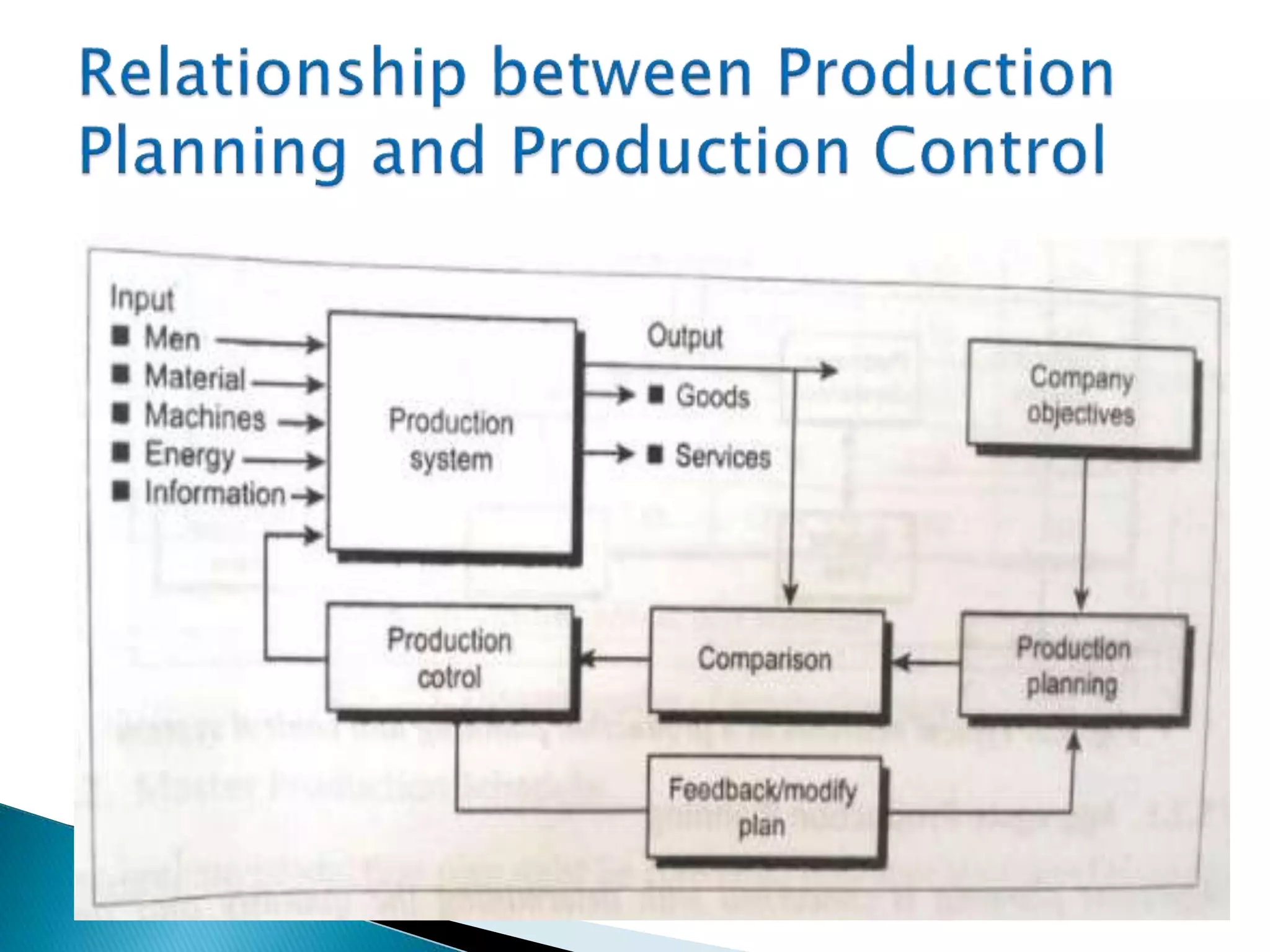
 Production planning and control(PPC) is aimed at
achieving the efficient utilisation of resources
(material, men, facility, etc) in the manufacturing
organisation through planning, coordinating and
control of production activities that transform the
raw material into finished products in a most
optimal manner
 PPC department issues directions to production
department1) what to produce, 2) how many to
produce,3) when to produce, 4) What resources
are required for production, 5) how to coordinate
different resources of the system, and 6) how to
control the deviation from the set plan.
Definition:-
PPC may be defined as the direction and
coordination of the organisation’s materials
and physical facilities towards the attainment
of pre-specified goals in the most efficient
way.
"Production planning and control is the co-
ordination of series of functions according to a
plan which will economically utilize the plant
facilities and regulate the orderly movement of
goods through the entire manufacturing cycle
from the procurement of all materials to the
shipping of finished goods at a predetermined
rate."
-CHARLES A. KOEPKE
 PPC consists of two major activities-
production planning and production control
PPC =production planning + production control
 To design a production system to meet due
date consistent with minimum cost and
quality standard
 To systematically plan the production
activities to achieve high production
efficiency
 To decide the nature and magnitude of
different input factors to produce the output
 To ensure maximum utilisation of all
resources
 To ensure production of quality products
 To coordinate the different resources such as
labour, materials, machines.etc. Effectively
and economically
 To maintain optimum inventory levels
 To maintain flexibility in manufacturing
operations
 To coordinate production activities of various
departments
 To plan for plant capacities for future
requirements
 To establish targets and checking them
against performance
 To ensure smooth flow of materials
eliminating bottlenecks, if any in production
 To ensure effective cost reduction and cost
control
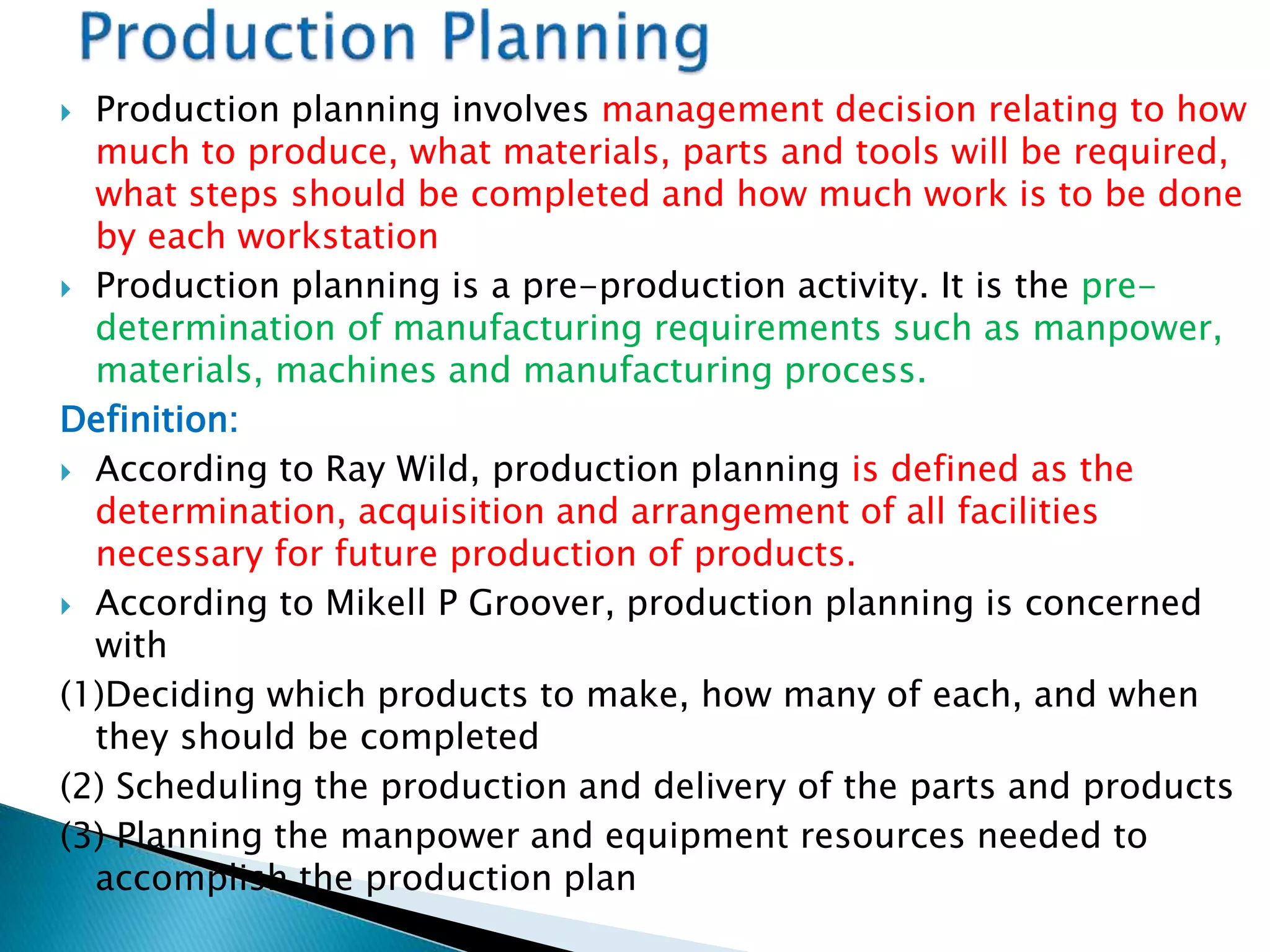
 Production planning involves management decision relating to how
much to produce, what materials, parts and tools will be required,
what steps should be completed and how much work is to be done
by each workstation
 Production planning is a pre-production activity. It is the pre-
determination of manufacturing requirements such as manpower,
materials, machines and manufacturing process.
Definition:
 According to Ray Wild, production planning is defined as the
determination, acquisition and arrangement of all facilities
necessary for future production of products.
 According to Mikell P Groover, production planning is concerned
with
(1)Deciding which products to make, how many of each, and when
they should be completed
(2) Scheduling the production and delivery of the parts and products
(3) Planning the manpower and equipment resources needed to
accomplish the production plan
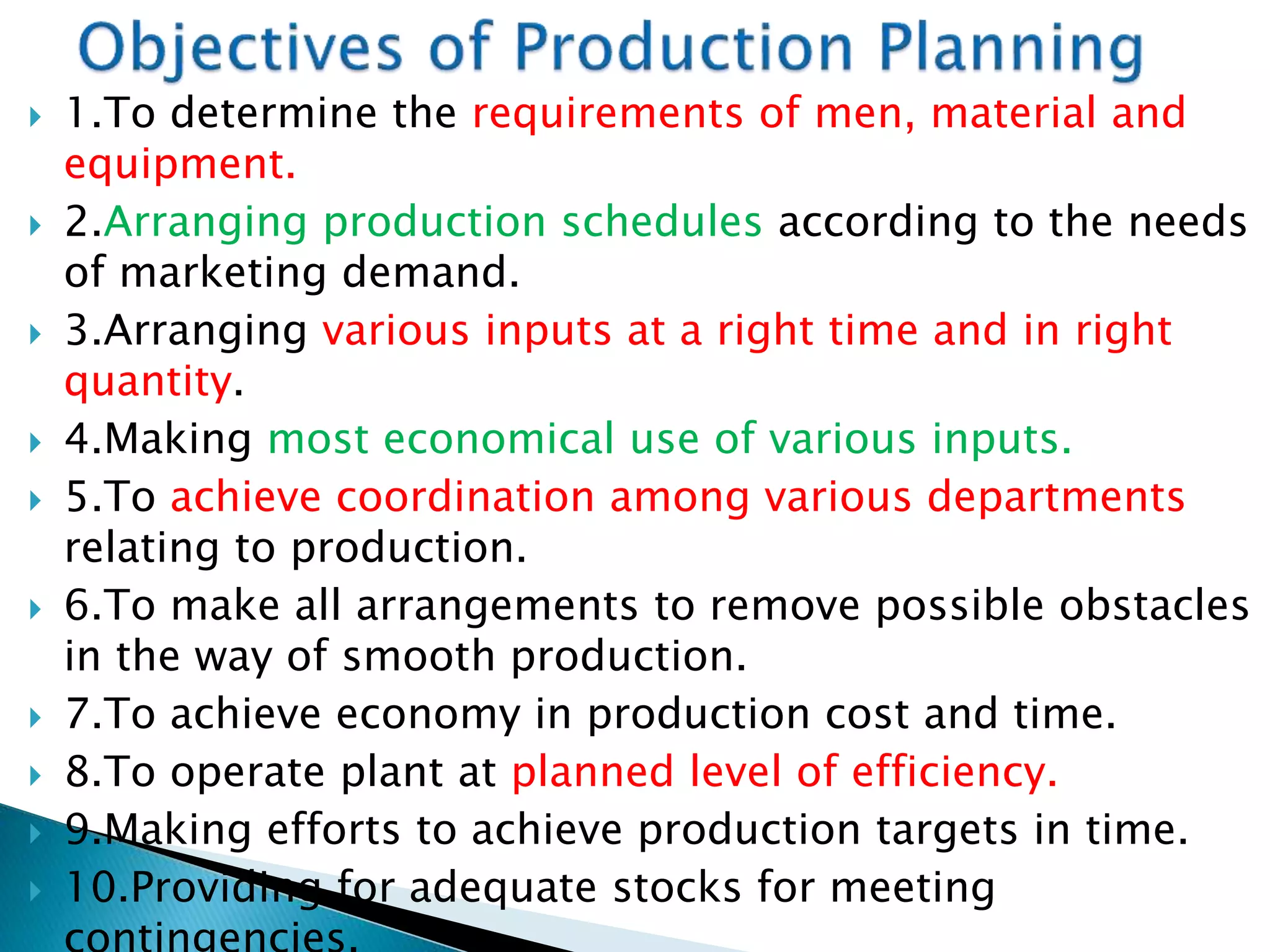
 1.To determine the requirements of men, material and
equipment.
 2.Arranging production schedules according to the needs
of marketing demand.
 3.Arranging various inputs at a right time and in right
quantity.
 4.Making most economical use of various inputs.
 5.To achieve coordination among various departments
relating to production.
 6.To make all arrangements to remove possible obstacles
in the way of smooth production.
 7.To achieve economy in production cost and time.
 8.To operate plant at planned level of efficiency.
 9.Making efforts to achieve production targets in time.
 10.Providing for adequate stocks for meeting
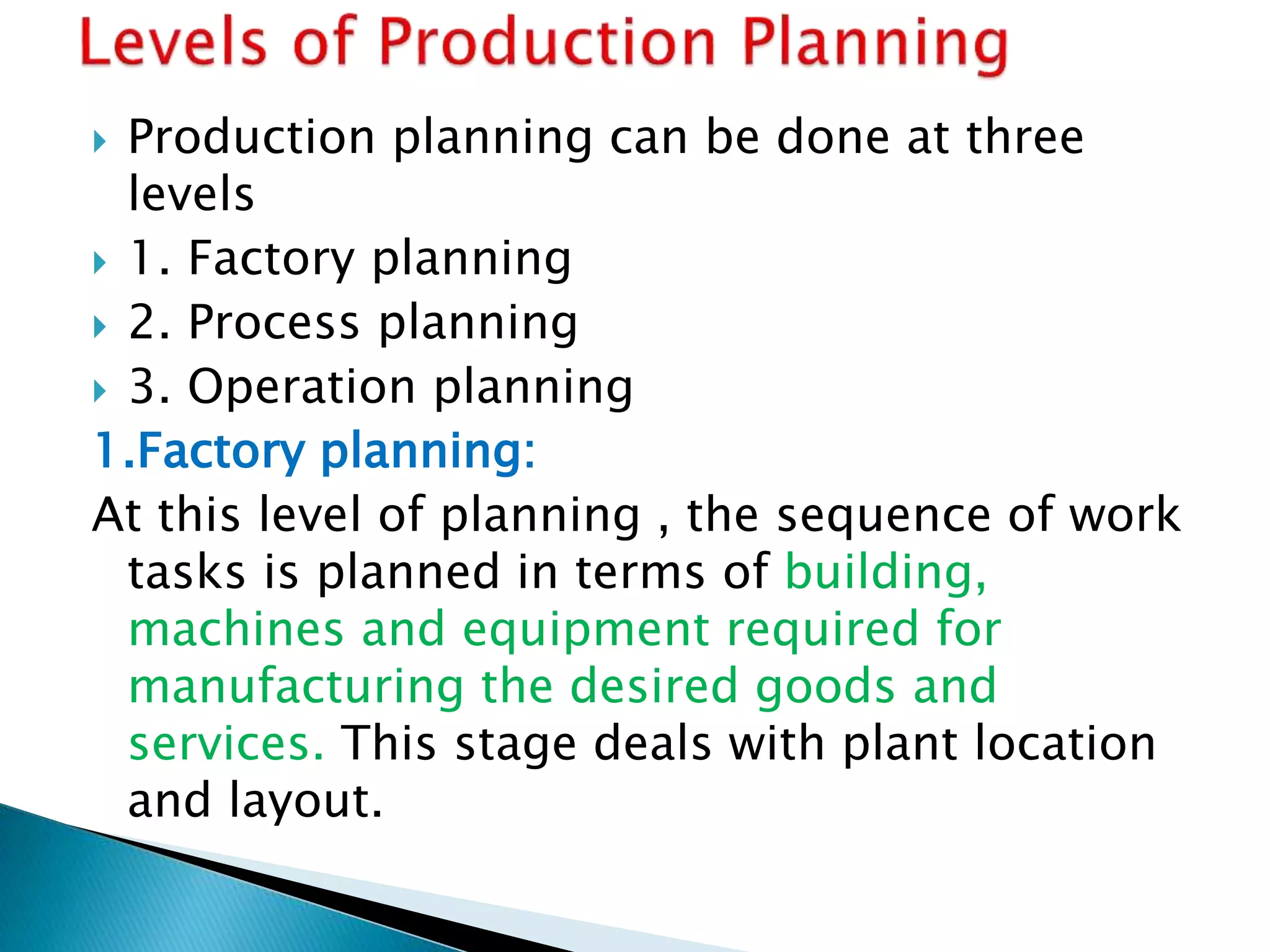
 Production planning can be done at three
levels
 1. Factory planning
 2. Process planning
 3. Operation planning
1.Factory planning:
At this level of planning , the sequence of work
tasks is planned in terms of building,
machines and equipment required for
manufacturing the desired goods and
services. This stage deals with plant location
and layout.
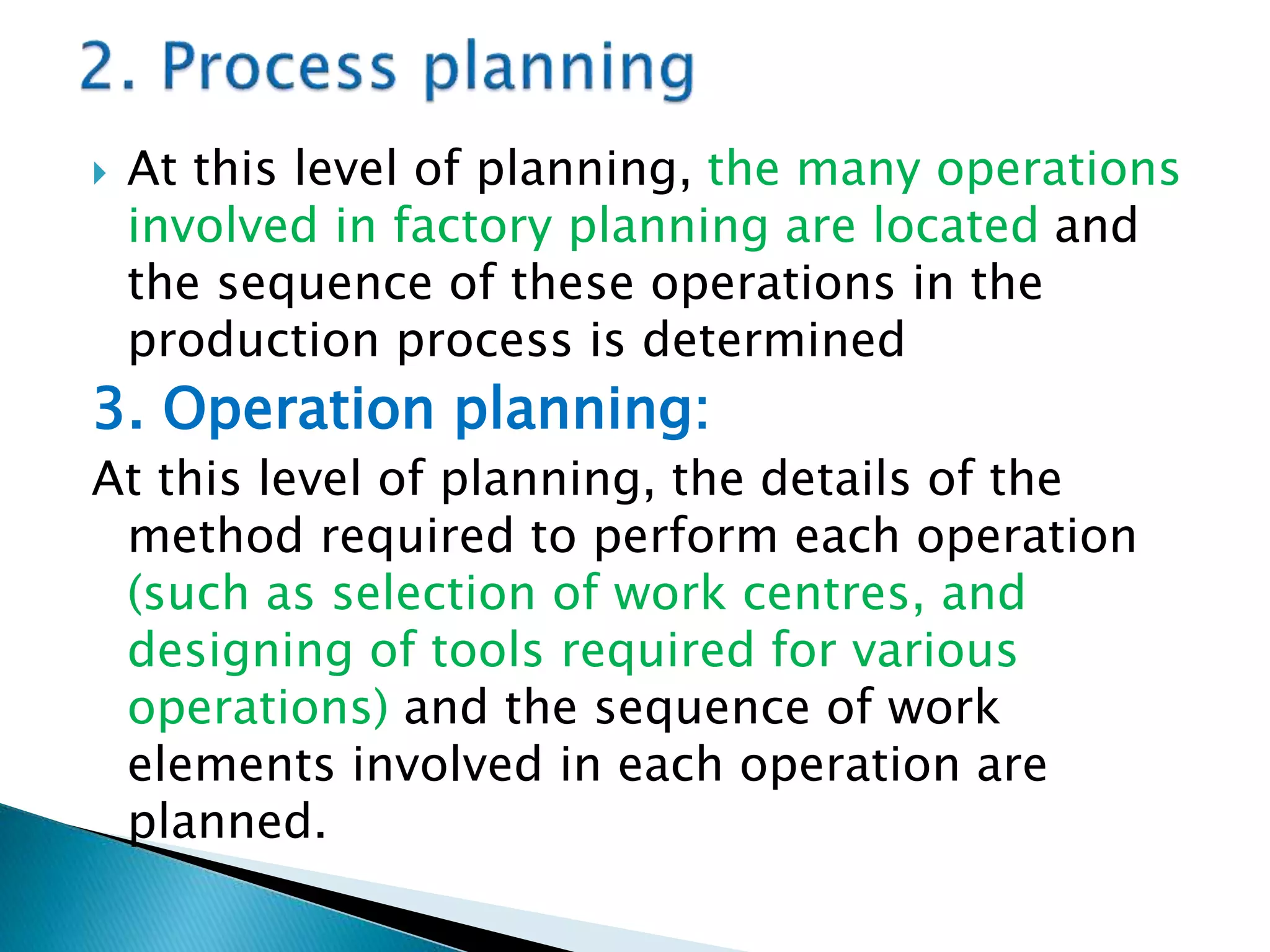
 At this level of planning, the many operations
involved in factory planning are located and
the sequence of these operations in the
production process is determined
3. Operation planning:
At this level of planning, the details of the
method required to perform each operation
(such as selection of work centres, and
designing of tools required for various
operations) and the sequence of work
elements involved in each operation are
planned.
 The production planning procedures varies
from company to company. Three important
factors determining production planning
procedures are
 1. Volume of production
 2. Nature of production processes, and
 3. Nature of operations
Production control tries to take corrective action to
match the planned and actual production. Thus
production control reviews the progress of the work
and takes corrective steps in order to ensure the
programmed production takes place.
Definition:-
“ Production control refers to ensuring that all which
occurs is in accordance with the rules established
and instructions issued.”
-HENRY FAYOL
 The production control involves
implementation of production plans by
coordinating different activities. It seeks to
ensure that production operations and actual
performance occur according to planned
operations and performance.
The three essential steps in control process are
 1. Initiating the production
 2. progressing
 3. Corrective action based upon the feedback
and reporting back to the production
planning
1.To implement production plans by issuing orders
to the right persons through the proper channels
2.To ensure that various inputs like men, machine,
materials etc. are available in the required quantity
and quality.
3.Making efforts to adhere to the production schedules.
4.To ensure that goods are produced according to the
prescribed standards and quality norms.
5.To undertake the best and most economic production
policies.
6.To introduce a proper system of quality control.
7.To ensure rapid turnover of production and minimizing
of inventories of raw materials and finished products.
Production control functions vary from
organisation to organisation. However, the
following three factors generally determine
the production control procedure in an
organisation
 1. Nature of production
 2. Complexity of operations and
 3. Magnitude of operations
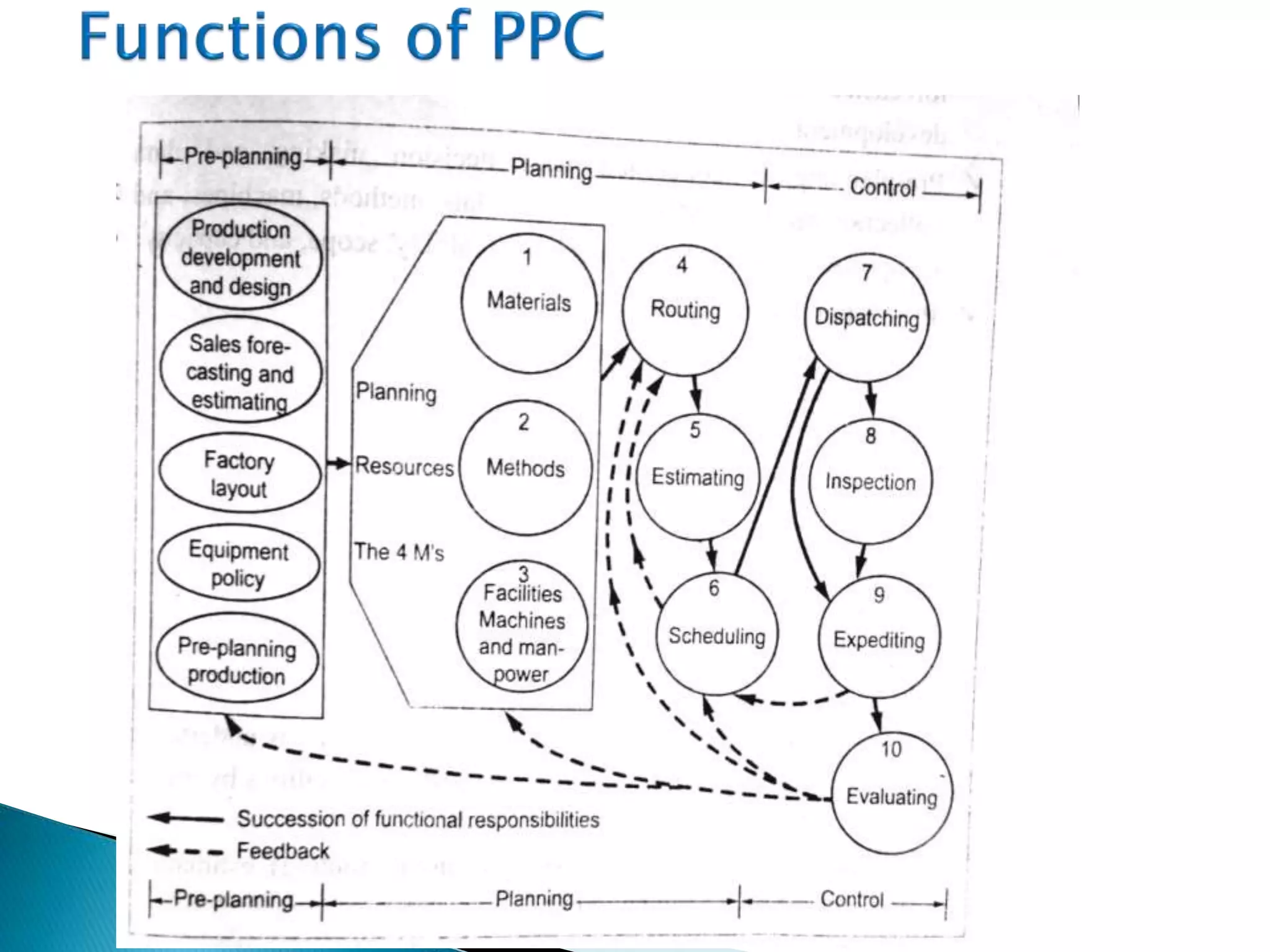
 1.Pre-planning phase
 2. Planning phase
 3. Control phase
1. Pre-planning phase:
Pre-planning is a macro-level planning, and deals
with analysis of data and is an outline of the
basic planning policy based on forecasted
demand, market analysis and product design
and development
Pre-planning is concerned with decision making
and data collection on the ‘4 M’s ie, on
materials, methods, machines and manpower,
mainly with respect to availability, scope and
capacity
 1.Product development and design
 2. Process design
 3. Work-station design
 4. Sales forecasting
 5. estimating
 6. factory layout and location
 7. Equipment policy
 8. Pre-planning production
 During this phase, through analysis of the 4
M’s is undertaken to select the appropriate
materials, methods and facilities.
 This analysis is followed by process planning,
estimating and scheduling
 Two aspects of planning (1) short-term
planning and (2) long-term planning are
considered during this phase
 The final phase of PPC is control phase. This
stage involves dispatching, inspection,
expediting and evaluation
 Control of inventories, control of scrap, analysis
of work-in-process and control of
transportation are essential links of this phase
 The control phase provides the main sources of
feedback information to ensure necessary
corrective actions. Therefore effective
communication systems are prerequisites to
efficient control of production control
 Finally evaluation takes place to complete the
production planning and control cycle.
1.Material Planning:
 For efficient production planning system, raw
materials, standard parts and semi-finished
products and assemblies must be available at
the required time and place
 Material planning function also covers
fixation of materials standard, batch
quantities, delivery dates, standardisation
and reduction of varieties, procurement of
parts and raw materials and inspection of
materials and finished parts.
2. Methods Planning:
The method planning function identifies the alternate
methods of manufacturing, evaluates them and
selects the best method compatible with a given set
of circumstances and facilities
3. Machines and Equipment(Facility Planning):
The facility planning function is concerned with
procurement of machines and equipments and
specification of standard tools, design and
manufacture of special tools i.e , jigs and fixtures etc
Thus this function is mainly concerned with the detailed
analysis of available production facilities, equipment
down time, maintenance policy procedure and
schedules.
4. Process planning(Routing):
Process planning also known as routing, is the process
of determining the sequence of operations to be
performed in the production process.
The routing function determines
What work (operations) will be done on a product
Where (on which machine/department) these
operations will be performed
How these operations will be performed
In which sequence the job(from raw materials stage to
finished good stage) will move in the plant.
Route sheet:
A route sheet is a document, providing
information and instructions for converting the
raw materials into finished parts or products. It
defines each step of the production operation
and lays down the precise path or route through
which the product will flow during the
conversion process.
Main functions of routing:
 To fix the path of travel giving due consideration
to layout.
 To break down the operations into elements so as
to define each operation
5.Estimating:
Once the production orders, the overall
methods and the detailed route sheets are
available, then the next activity is to estimate
the operations time for each operations.
This function involves the extensive use of
operation analysis in conjunction with
methods and routing as well as work
measurement in order to set up performance
standards.
6.Scheduling and Loading:
Scheduling and loading is the assignment of
work to a facility with the specification of time
and sequence of operations
Scheduling is time phasing of loading
(i) Scheduling:
Scheduling involves fixing priorities for each
job and determining the starting time and
finishing time for each operation, the
starting dates and finishing dates for each
part, sub-assembly and final assembly.
 Scheduling lays down a time table for
production, indicating the total time required
for the manufacture of a product and also the
time required for carrying out the operation
for each part on each machine or equipment.
 Scheduling devices:
Three important scheduling techniques are
(i) Gantt charts (ii) CPM and PERT and(iii) the
run out approach
(ii) Loading
Loading also known as machine loading, is the
process of assigning specific jobs to
machines, men or work centres based on
relative priorities and capacity utilisation
Loading ensures maximum possible utilisation
of productive facilities and avoids
bottlenecks in production. It is important to
avoid both over-loading and under-loading
the facilities, so as to ensure maximum
utilisation of resources.
Loading Devices:
The machine loading charts such as Gantt
charts are used for the loading purpose
 7.Dispatching:
 Dispatching is the execution phase of planning
 Dispatching is the routine of setting production
activities in motion through the release of
orders (work order, shop order) and
instructions in accordance with previously
planned time schedules and ratings.
 It authorises the start of the production
operations by releasing materials, components,
tools, fixtures and instruction sheets to the
operator, and ensures that material movement
is carried out in accordance to the planned
routing sheets and schedules.
 Various functions /elements/duties of
dispatching are
 (i) Collecting and issuing to work centre, all the concerned
drawings, specifications, route sheets, material requisitions,
tool requisitions etc
 (ii) Issuing job orders authorising operations in accordance with
dates and times as indicated in schedules or machine loading
charts
 (iii) Obtaining inspection schedules and issuing them to the
inspection section
 (iv) Recording start and finish time of each job on each machine
or by each man
 (v) Issuing required materials(from stores), jigs, fixtures and
tools to the user department or worker
 (vi)Distributing machine loading and scheduling charts, route
sheets, identification tags to each production and inspection
stage.
 (vii) Returning jigs, fixtures and tools to stores after use
 8. Expediting (or Follow –up or Progressing):
 Expediting, also known as follow-up or
progressing, is a control function that keeps
track of the progress of work in accordance
with planned schedule.
 While dispatching initiates the execution of
production plans, expediting maintains the
production flow according to plan till the job is
completed
 This follow-up is to be done at every stage in
production cycle, i.e, follow-up of materials,
follow-up of work-in-process, and follow-up
of assembly.
The various activities /functions/duties of
expediting include
(i) Status reporting
(ii) Attending to bottlenecks or hold-ups in
production and removing the same
(iii) Controlling variations or deviations from
planned performance levels
(iv) Following up and monitoring progress of
work through all stages of production
(v) Co-ordinating with purchase, stores, tool
room and maintenance department
(vi) Modifying the production plans and re-plan if
necessary.
9.inspection and Testing:
Inspection and quality control is another major
function of production planning and control.
This ensures that the quality of the product
meets the specifications as ordered. Or decided
in product development and design stage.
The findings are of great significance in the
execution of current plans and during the
planning of future products as the limitations
of processes, method and man-power are
known. These limitations are analyzed with a
view to improve production methods/facilities.
10.Evaluation:
Evaluation function serves as a link between
control and future planning. Valuable
information regarding all the problems faced in
realizing the product starting from preplanning
to shipping stage is gathered in this process.
The information gathered can be used in
preplanning, Planning and control stages in
future manufacturing activities

PPC-Unit-1Godwin.ppt

  • 1.
  • 2.
    UNIT I INTRODUCTION  Objectivesand benefits of planning and control-Functions of production control- Types of production- job- batch and continuous-Product development and design-Marketing aspect - Functional aspects- Operational aspect-Durability and dependability aspect aesthetic aspect. Profit consideration- Standardization, Simplification & specialization- Break even analysis- Economics of a new design.
  • 3.
    Production  Production systemis basically a conversion system where the raw materials are converted into useful or marketable products. It consists of numerous sub-components or sub-systems, all of which interact in pursuing the objectives.  The efficiency of production is stated in terms of its ability to produce the products with required quantity and specified quality at predetermined cost at predetermined time
  • 4.
     Production planningand control(PPC) is aimed at achieving the efficient utilisation of resources (material, men, facility, etc) in the manufacturing organisation through planning, coordinating and control of production activities that transform the raw material into finished products in a most optimal manner  PPC department issues directions to production department1) what to produce, 2) how many to produce,3) when to produce, 4) What resources are required for production, 5) how to coordinate different resources of the system, and 6) how to control the deviation from the set plan.
  • 5.
    Definition:- PPC may bedefined as the direction and coordination of the organisation’s materials and physical facilities towards the attainment of pre-specified goals in the most efficient way. "Production planning and control is the co- ordination of series of functions according to a plan which will economically utilize the plant facilities and regulate the orderly movement of goods through the entire manufacturing cycle from the procurement of all materials to the shipping of finished goods at a predetermined rate." -CHARLES A. KOEPKE
  • 6.
     PPC consistsof two major activities- production planning and production control PPC =production planning + production control
  • 7.
     To designa production system to meet due date consistent with minimum cost and quality standard  To systematically plan the production activities to achieve high production efficiency  To decide the nature and magnitude of different input factors to produce the output  To ensure maximum utilisation of all resources  To ensure production of quality products  To coordinate the different resources such as labour, materials, machines.etc. Effectively and economically
  • 8.
     To maintainoptimum inventory levels  To maintain flexibility in manufacturing operations  To coordinate production activities of various departments  To plan for plant capacities for future requirements  To establish targets and checking them against performance  To ensure smooth flow of materials eliminating bottlenecks, if any in production  To ensure effective cost reduction and cost control
  • 9.
     Production planninginvolves management decision relating to how much to produce, what materials, parts and tools will be required, what steps should be completed and how much work is to be done by each workstation  Production planning is a pre-production activity. It is the pre- determination of manufacturing requirements such as manpower, materials, machines and manufacturing process. Definition:  According to Ray Wild, production planning is defined as the determination, acquisition and arrangement of all facilities necessary for future production of products.  According to Mikell P Groover, production planning is concerned with (1)Deciding which products to make, how many of each, and when they should be completed (2) Scheduling the production and delivery of the parts and products (3) Planning the manpower and equipment resources needed to accomplish the production plan
  • 10.
     1.To determinethe requirements of men, material and equipment.  2.Arranging production schedules according to the needs of marketing demand.  3.Arranging various inputs at a right time and in right quantity.  4.Making most economical use of various inputs.  5.To achieve coordination among various departments relating to production.  6.To make all arrangements to remove possible obstacles in the way of smooth production.  7.To achieve economy in production cost and time.  8.To operate plant at planned level of efficiency.  9.Making efforts to achieve production targets in time.  10.Providing for adequate stocks for meeting
  • 11.
     Production planningcan be done at three levels  1. Factory planning  2. Process planning  3. Operation planning 1.Factory planning: At this level of planning , the sequence of work tasks is planned in terms of building, machines and equipment required for manufacturing the desired goods and services. This stage deals with plant location and layout.
  • 12.
     At thislevel of planning, the many operations involved in factory planning are located and the sequence of these operations in the production process is determined 3. Operation planning: At this level of planning, the details of the method required to perform each operation (such as selection of work centres, and designing of tools required for various operations) and the sequence of work elements involved in each operation are planned.
  • 13.
     The productionplanning procedures varies from company to company. Three important factors determining production planning procedures are  1. Volume of production  2. Nature of production processes, and  3. Nature of operations
  • 14.
    Production control triesto take corrective action to match the planned and actual production. Thus production control reviews the progress of the work and takes corrective steps in order to ensure the programmed production takes place. Definition:- “ Production control refers to ensuring that all which occurs is in accordance with the rules established and instructions issued.” -HENRY FAYOL
  • 15.
     The productioncontrol involves implementation of production plans by coordinating different activities. It seeks to ensure that production operations and actual performance occur according to planned operations and performance. The three essential steps in control process are  1. Initiating the production  2. progressing  3. Corrective action based upon the feedback and reporting back to the production planning
  • 16.
    1.To implement productionplans by issuing orders to the right persons through the proper channels 2.To ensure that various inputs like men, machine, materials etc. are available in the required quantity and quality. 3.Making efforts to adhere to the production schedules. 4.To ensure that goods are produced according to the prescribed standards and quality norms. 5.To undertake the best and most economic production policies. 6.To introduce a proper system of quality control. 7.To ensure rapid turnover of production and minimizing of inventories of raw materials and finished products.
  • 17.
    Production control functionsvary from organisation to organisation. However, the following three factors generally determine the production control procedure in an organisation  1. Nature of production  2. Complexity of operations and  3. Magnitude of operations
  • 19.
     1.Pre-planning phase 2. Planning phase  3. Control phase 1. Pre-planning phase: Pre-planning is a macro-level planning, and deals with analysis of data and is an outline of the basic planning policy based on forecasted demand, market analysis and product design and development Pre-planning is concerned with decision making and data collection on the ‘4 M’s ie, on materials, methods, machines and manpower, mainly with respect to availability, scope and capacity
  • 20.
     1.Product developmentand design  2. Process design  3. Work-station design  4. Sales forecasting  5. estimating  6. factory layout and location  7. Equipment policy  8. Pre-planning production
  • 21.
     During thisphase, through analysis of the 4 M’s is undertaken to select the appropriate materials, methods and facilities.  This analysis is followed by process planning, estimating and scheduling  Two aspects of planning (1) short-term planning and (2) long-term planning are considered during this phase
  • 22.
     The finalphase of PPC is control phase. This stage involves dispatching, inspection, expediting and evaluation  Control of inventories, control of scrap, analysis of work-in-process and control of transportation are essential links of this phase  The control phase provides the main sources of feedback information to ensure necessary corrective actions. Therefore effective communication systems are prerequisites to efficient control of production control  Finally evaluation takes place to complete the production planning and control cycle.
  • 24.
    1.Material Planning:  Forefficient production planning system, raw materials, standard parts and semi-finished products and assemblies must be available at the required time and place  Material planning function also covers fixation of materials standard, batch quantities, delivery dates, standardisation and reduction of varieties, procurement of parts and raw materials and inspection of materials and finished parts.
  • 25.
    2. Methods Planning: Themethod planning function identifies the alternate methods of manufacturing, evaluates them and selects the best method compatible with a given set of circumstances and facilities 3. Machines and Equipment(Facility Planning): The facility planning function is concerned with procurement of machines and equipments and specification of standard tools, design and manufacture of special tools i.e , jigs and fixtures etc Thus this function is mainly concerned with the detailed analysis of available production facilities, equipment down time, maintenance policy procedure and schedules.
  • 26.
    4. Process planning(Routing): Processplanning also known as routing, is the process of determining the sequence of operations to be performed in the production process. The routing function determines What work (operations) will be done on a product Where (on which machine/department) these operations will be performed How these operations will be performed In which sequence the job(from raw materials stage to finished good stage) will move in the plant.
  • 27.
    Route sheet: A routesheet is a document, providing information and instructions for converting the raw materials into finished parts or products. It defines each step of the production operation and lays down the precise path or route through which the product will flow during the conversion process. Main functions of routing:  To fix the path of travel giving due consideration to layout.  To break down the operations into elements so as to define each operation
  • 28.
    5.Estimating: Once the productionorders, the overall methods and the detailed route sheets are available, then the next activity is to estimate the operations time for each operations. This function involves the extensive use of operation analysis in conjunction with methods and routing as well as work measurement in order to set up performance standards.
  • 29.
    6.Scheduling and Loading: Schedulingand loading is the assignment of work to a facility with the specification of time and sequence of operations Scheduling is time phasing of loading (i) Scheduling: Scheduling involves fixing priorities for each job and determining the starting time and finishing time for each operation, the starting dates and finishing dates for each part, sub-assembly and final assembly.
  • 30.
     Scheduling laysdown a time table for production, indicating the total time required for the manufacture of a product and also the time required for carrying out the operation for each part on each machine or equipment.  Scheduling devices: Three important scheduling techniques are (i) Gantt charts (ii) CPM and PERT and(iii) the run out approach
  • 31.
    (ii) Loading Loading alsoknown as machine loading, is the process of assigning specific jobs to machines, men or work centres based on relative priorities and capacity utilisation Loading ensures maximum possible utilisation of productive facilities and avoids bottlenecks in production. It is important to avoid both over-loading and under-loading the facilities, so as to ensure maximum utilisation of resources. Loading Devices: The machine loading charts such as Gantt charts are used for the loading purpose
  • 32.
     7.Dispatching:  Dispatchingis the execution phase of planning  Dispatching is the routine of setting production activities in motion through the release of orders (work order, shop order) and instructions in accordance with previously planned time schedules and ratings.  It authorises the start of the production operations by releasing materials, components, tools, fixtures and instruction sheets to the operator, and ensures that material movement is carried out in accordance to the planned routing sheets and schedules.
  • 33.
     Various functions/elements/duties of dispatching are  (i) Collecting and issuing to work centre, all the concerned drawings, specifications, route sheets, material requisitions, tool requisitions etc  (ii) Issuing job orders authorising operations in accordance with dates and times as indicated in schedules or machine loading charts  (iii) Obtaining inspection schedules and issuing them to the inspection section  (iv) Recording start and finish time of each job on each machine or by each man  (v) Issuing required materials(from stores), jigs, fixtures and tools to the user department or worker  (vi)Distributing machine loading and scheduling charts, route sheets, identification tags to each production and inspection stage.  (vii) Returning jigs, fixtures and tools to stores after use
  • 34.
     8. Expediting(or Follow –up or Progressing):  Expediting, also known as follow-up or progressing, is a control function that keeps track of the progress of work in accordance with planned schedule.  While dispatching initiates the execution of production plans, expediting maintains the production flow according to plan till the job is completed  This follow-up is to be done at every stage in production cycle, i.e, follow-up of materials, follow-up of work-in-process, and follow-up of assembly.
  • 35.
    The various activities/functions/duties of expediting include (i) Status reporting (ii) Attending to bottlenecks or hold-ups in production and removing the same (iii) Controlling variations or deviations from planned performance levels (iv) Following up and monitoring progress of work through all stages of production (v) Co-ordinating with purchase, stores, tool room and maintenance department (vi) Modifying the production plans and re-plan if necessary.
  • 36.
    9.inspection and Testing: Inspectionand quality control is another major function of production planning and control. This ensures that the quality of the product meets the specifications as ordered. Or decided in product development and design stage. The findings are of great significance in the execution of current plans and during the planning of future products as the limitations of processes, method and man-power are known. These limitations are analyzed with a view to improve production methods/facilities.
  • 37.
    10.Evaluation: Evaluation function servesas a link between control and future planning. Valuable information regarding all the problems faced in realizing the product starting from preplanning to shipping stage is gathered in this process. The information gathered can be used in preplanning, Planning and control stages in future manufacturing activities