1
PAKISTAN PENAL CODE 1860
OFFENCES AFFECTING THE
HUMAN BODY
ABDUL RAUF SHEIKH
INSPECTOR LEGAL
Police college sihala 2
Section 332. Hurt:
3
(1) Whoever causes pain, harm, disease, infianity or
injury to any person or impairs, disables or
dismembers any organ of the body or part thereof of
any person without causing his death, is said to cause
hurt.
(2) The following are the kinds of hurt :
(a) Itlaf-i-udw
(b) itlaf-i-salahiyyat-i-udw
(c) shajjah
(d) jurh and
(e) all kinds of other hurts.
4
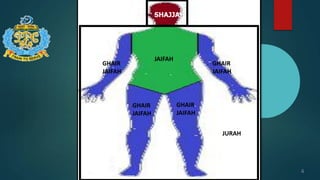
SHAJJAH
JURAH
JAIFAH
GHAIR
JAIFAH
GHAIR
JAIFAH
GHAIR
JAIFAH
GHAIR
JAIFAH
Section 333. Itlaf-i-udw:
5
Whoever dismembers, amputates, severs any limb or
organ of the body of another person is said to cause
Itlaf-i-udw.
Section 334. Punishment for
Itlaf-udw:
6
Whoever by doing any act with the intention of thereby
causing hurt to any person, or with the knowledge that he
is likely thereby to cause hurt to any person causes Itlaf-i-
udw of any person, shall, in consultation with the
authorized medical officer, be punished with qisas, and if
the qisas is not executable keeping in view the principles of
equality in accordance with the Injunctions of Islam, the
offender shall be liable to arsh and may also be punished
with imprisonment of either description for a term which
may extend to ten years as ta'zir.
Section 335. Itlaf-i-salahiyyat-
i-udw:
7
Whoever destroys or permanently impairs the
functioning, power or capacity of an organ of
the body of another person, or causes
permanent disfigurement is said to cause itlaf-i-
salahiyyat-i-udw.
Section 336. Punishment for
itlaf-i-salahiyyat-i-udw :
8
Whoever, by doing any act with the intention of causing hurt to
any person, or with the knowledge that he is likely to cause hurt
to any person, causes itlaf-i-salahiyyat-i-udw of any person,
shall, in consultation with the authorised medical officer, be
punished with qisas and if the qisas is not executable, keeping in
view the principles of equality in accordance with the Injunctions
of Islam, the offender shall be liable to arsh and may also be
punished with imprisonment of either description for a term
which may extend to ten years as taz’ir.
Section 336A. Hurt caused
by corrosive substance:
9
Whoever with the intention or knowingly
causes or attempts to cause hurt by
means of a corrosive substance which is
deleterious to human body when it is
swallowed, inhaled, comes into contact or
received into human body or otherwise
shall be said to cause hurt by corrosive
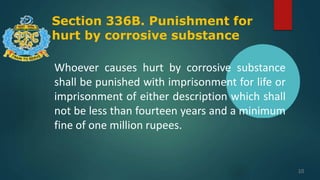
Section 336B. Punishment for
hurt by corrosive substance
10
Whoever causes hurt by corrosive substance
shall be punished with imprisonment for life or
imprisonment of either description which shall
not be less than fourteen years and a minimum
fine of one million rupees.
THANK
YOU
11
PAKISTAN PENAL CODE 1860
OFFENCES AFFECTING THE
HUMAN BODY
ABDUL RAUF SHEIKH
INSPECTOR LEGAL
Police college sihala 12
Section 337. Shajjah:
13
(1) Whoever causes, on the head or face of any
person, any hurt which does not amount to itlaf-i-udw
or itlaf-i-salahiyyat-i-udw, is said to cause shajjah.
(2) The following are the kinds of shaljah namely:-
(a) Shajjah-i-Khafifah
(b) Shalfah'i-mudihah
(c) Shajjah-i-hashimah
(d) Shajjah-i-munaqqilah
(e) Shaijah-i-ammah and
(f) Shajjah-i-damighah
(3) Whoever causes shajjah
Section 337. (Continued..)
14
(i) without exposing bone of the victim, is said to cause shajjah-i-
khafifah;
(ii) by exposing any bone of the victim without causing fracture, is
said to cause shajjah-imudihah;
(iii) by fracturing the bone of the victim, without dislocating it, is
said to cause shajjah-ihashimah;
(iv) by causing fracture of the bone of the victim and thereby the
bone is dislocated, is said to cause shajfah-i-munaqqilah;
(v) by causing fracture of the skull of the victim so that the wound
touches the membrane of the brain, is said to cause shajjah-i-
ammah;
(vi) by causing fracture of the skull of the victim and the wound
ruptures the membrane of the brain is said to cause shaijah-i-
damighah.
Section 337-A. Punishment
of shajjah :
15
Whoever, by doing any act with the intention of thereby causing hurt
to any person, or with the knowledge that he is likely thereby to
cause hurt to any person, causes--
(i) Shajjah-I-khafifah to any person, shall be liable to daman and
may also be punished with imprisonment of either description for a
term which may extend to two years as ta'zir, (ii) shajjah-i-mudihah
to any person, shall, in consultation with the authorised medical
officer, be punished with qisas, and if the, qisas is not executable
keeping in view the principles of equality, in accordance with the
Injunctions of Islam, the convict shall be liable to arsh which shall
be five percent of the diyat and may also be punished with
imprisonment of either description for a term which may extend to
five years as ta'zir,
Section 337-A. (Continued..)
16
(iii) shajjah-i-hashimah to any person, shall be liable to
arsh which shall be ten per cent of the diyat and may
also be punished with imprisonment of either description
for a term
which may extend to ten years as ta'zir,
(iv) shajiah-i-munaqqilah to any person, shall be liable to
arsh which shall be fifteen per cent of the diyat and may
also be punished with imprisonment of either description
for a term which may extend to ten years as ta 'zir,
Section 337-A. (Continued..)
17
(v) shajjah-i-ammah to any person, shall be liable to
arsh which shall be one-third of the diyat and may also
be punished with imprisonment of either description
for a term which may extend to ten years as ta'zir, and
(vi) shajjah-i-damighah to any person shall be liable to
arsh which shall be one-half of diyat and may also be
punished with imprisonment of either description for a
term which may extend to fourteen years as ta'zir.
THANK
YOU
18
PAKISTAN PENAL CODE 1860
OFFENCES AFFECTING THE
HUMAN BODY
ABDUL RAUF SHEIKH
INSPECTOR LEGAL
Police college sihala 19
Section 337-B. Jurh:
20
(1) Whoever causes on any part of the body of a
person, other than the head or face, a hurt which
leaves a mark of the wound, whether temporary or
permanent, is said to cause jurh.
(2) Jurh is of two kinds, namely:-
(a) Jaifah ; and
(b) Ghayr-jaifah
Section 337-C. Jaifah :
21
Whoever causes jurh in which the injury extends to
the body cavity of the trunk, is said to cause jaifah.
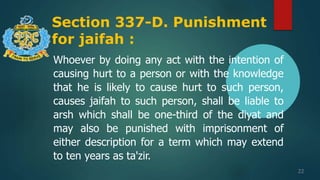
Section 337-D. Punishment
for jaifah :
22
Whoever by doing any act with the intention of
causing hurt to a person or with the knowledge
that he is likely to cause hurt to such person,
causes jaifah to such person, shall be liable to
arsh which shall be one-third of the diyat and
may also be punished with imprisonment of
either description for a term which may extend
to ten years as ta'zir.
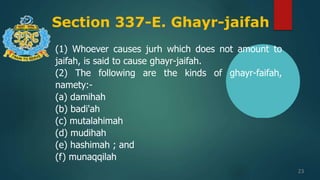
Section 337-E. Ghayr-jaifah
23
(1) Whoever causes jurh which does not amount to
jaifah, is said to cause ghayr-jaifah.
(2) The following are the kinds of ghayr-faifah,
namety:-
(a) damihah
(b) badi'ah
(c) mutalahimah
(d) mudihah
(e) hashimah ; and
(f) munaqqilah
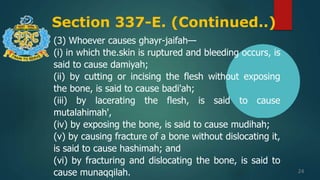
Section 337-E. (Continued..)
24
(3) Whoever causes ghayr-jaifah—
(i) in which the.skin is ruptured and bleeding occurs, is
said to cause damiyah;
(ii) by cutting or incising the flesh without exposing
the bone, is said to cause badi'ah;
(iii) by lacerating the flesh, is said to cause
mutalahimah',
(iv) by exposing the bone, is said to cause mudihah;
(v) by causing fracture of a bone without dislocating it,
is said to cause hashimah; and
(vi) by fracturing and dislocating the bone, is said to
cause munaqqilah.
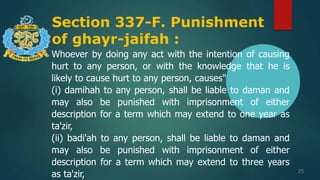
Section 337-F. Punishment
of ghayr-jaifah :
25
Whoever by doing any act with the intention of causing
hurt to any person, or with the knowledge that he is
likely to cause hurt to any person, causes"
(i) damihah to any person, shall be liable to daman and
may also be punished with imprisonment of either
description for a term which may extend to one year as
ta'zir,
(ii) badi'ah to any person, shall be liable to daman and
may also be punished with imprisonment of either
description for a term which may extend to three years
as ta'zir,
Section 337-F. (Continued..)
26
(iii) mutafahimah to any person, shall be liable to
daman and may also be punished with imprisonment
of either description for a term which may extend to
three years as ta'zir;
(iv) mudihah to any person, shall be liable to daman
and may also be punished with imprisonment of either
description for a term which may extend to five years
as ta'zir,
Section 337-F. (Continued..)
27
(v) hashimah to any person, shall be liable to daman
and may also be punished with imprisonment of either
description for a term which may extend to five years
as ta'zir, and
(vi) munaqqilah to any person, shall be liable to
daman and may also be punished with imprisonment
of either description for a term which may extend to
seven years as ta'zir.
THANK
YOU
28
PAKISTAN PENAL CODE 1860
OFFENCES AFFECTING THE
HUMAN BODY
ABDUL RAUF SHEIKH
INSPECTOR LEGAL
Police college sihala 29
Section 337-G. Punishment for
hurt by rash or negligent driving:
30
Whoever causes hurt by rash or negligent driving shall
be liable to arsh or daman specified for the kind of
hurt caused and may also be punished with
imprisonment of either description for a term which
may extend to five years as ta'zir.
Section 337-H. Punishment for
hurt by rash or negligent act:
31
(1) Whoever causes hurt by rash or negligent act, other than
rash or negligent driving, shall be liable to arsh or daman
specified for the kind of hurt caused and may also be punished
with imprisonment of either description for a term which may
extend to three years as ta'zir.
(2) Whoever does any act so rashly or negligently as to
endanger human life or the personal safety of other, shall be
punished with imprisonment of either-description for a term
which may extend to three months, or with fine, or with both.
Section 337-I. Punishment
for causing hurt by mistake
(khata):
32
(Whoever causes hurt by mistake (khata) shall be
liable to arsh or daman specified for the kind of hurt
caused.
Section 337-J. Causing hurt
by mean of a poison:
33
Whoever administers to. or causes to be taken by, any person,
any poison or any stupefying, intoxicating or unwholesome
drug, or such other thing with intent to cause hurt to such
person, or with intent to commit or to facilitate the commission
of an offence, or knowing it to be likely that he will thereby
cause hurt may, in addition to the punishment of arsh or daman
provided for the kind of hurt caused, be punished, having
regard to the nature of the hurt caused, with imprisonment of
either description for a term which may extend to ten years.
Section 337-K. Causing hurt to extort
confession, or to compel restoration
of property:
34
Whoever causes hurt for the purpose of extorting from the
sufferer or any person interested in the sufferer any .confession or
any information which may lead to the detection of any offence or
misconduct, or for the purpose of constraining the sufferer, or any
person interested in the Sufferer, to restore, or to cause the
restoration of, any property or valuable security or to satisfy any
claim or demand, or to give information which may lead to the
restoration of any property, or valuable security shall, in addition
to the punishment of qisas, arsh or daman, as the case may be,
provided for the kind of hurt caused, be punished, having regard
to the nature of the hurt caused, with imprisonment of either
description for a term which may extend to ten years as ta'zir.
Section 337-L. Punishment
for other hurt:
35
(1) Whoever causes hurt, not mentioned hereinbefore,
which endangers life or which causes the sufferer to
remain in severe bodily pain for twenty days or more
or renders him unable to follow his ordinary pursuits
for twenty days or more, shall be liable to daman and
also be punished with imprisonment of either
description for a term which may extend to seven
years.
Section 337-L. (Continued..)
36
(2) Whoever causes hurt not covered by sub-section
(1) shall be punished with imprisonment of either
description for a term which may extend to two years,
or with daman, or with both.
THANK
YOU
37
PAKISTAN PENAL CODE 1860
OFFENCES AFFECTING THE
HUMAN BODY
ABDUL RAUF SHEIKH
INSPECTOR LEGAL
Police college sihala 38
Section 337-M. Hurt not
liable to qisas:
39
Hurt shall not be liable to qisas in the following cases,
namely:--
(a) when the offender is a minor or insane: Provided that
he shall be liable to arsh and also to ta'zir to be
determined by the Court having regard to the age of
offender, circumstances of the case and the nature of
hurt caused;
(b) when an offender at the instance of the victim causes
hurt to him: Provided that the offender may be liable to
ta'zir provided for the kind of hurt caused by him;
Section 337-M. (Continued..)
40
(c) when the offender has caused itlaf-i-udw of a
physically imperfect organ of the victim and the
convict does not suffer from similar physical
imperfection of such organ:
Provided that the offender shall be liable to arsh and
may also be liable to ta'zir provided for the kind of
hurt caused by him; and
(d) when the organ of the offender liable to qisas is
missing:
Provided that the offender shall be liable to arsh and
may also be liable to ta'zir provided for the kind of
hurt caused by him.
Section 337-N. Cases in which
qisas for hurt shall not be enforced:
41
(1) The qisas for a hurt shall not be enforced in the following
cases, namely :-
(a) when the offender dies before execution of qisas;
(b) when the organ of the offender liable to qisas is lost before
the execution of qisas: Provided that offender shall be liable to
arsh, and may also be liable to ta'zir provided for the kind of hurt
caused by him;
(c) when the victim waives the qisas or compounds the offence
with badl-i-sufh; or (d) when the right of qisas devolves on the
person who cannot claim qisas against the offender under this
Chapter:
Section 337-N. (Continued..)
42
Provided that the offender shall be liable to arsh, if
there is any wali other than the offender, and if there
is no wali other than the offender he shall be liable to
ta'zir provided for the kind of hurt caused by him.
(2) Notwithstanding anything contained in this
Chapter, in all cases of hurt, the Court may, having
regard to the kind of hurt caused by him, in addition
to payment of arsh, award ta'zir to an offender who is
a previous convict, habitual or hardened, desperate or
dangerous criminal.
Section 337- 0. Wali In case of
hurt: In the case of hurt:
43
The wali shall be-
(a) the victim:
Provided that, if the victim is a minor or insane, his
right of qisas shall be exercised by his father or
paternal grand father, howhighsoever;
(b) the heirs of the victim, if the later dies before the
execution of qisas: and
(c) the Government, in the absence of the victim or
the heirs of the victim.
Section 337-P. Execution of
qisas for hurt:
44
(1) Qisas shall be executed in public by an authorised
medical officer who shall before such execution
examine the offender and take due care so as to
ensure that the execution of qisas does not cause the
death of the offender or exceed the hurt caused by
him to the victim.
Section 337-P. (Continued..)
45
(2) The wali shall be present at the time of execution
and if the wali or his representative is not present,
after having been informed of the date, time and place
by the Court an officer authorised by the Court in this
behalf shall give permission for the execution of qisas.
Section 337-P. (Continued..)
46
(3) If the convict is a woman who is pregnant, the
Court may, in consultation with an authorised medical
officer, postpone the execution of qisas upto a period
of two years after the birth of the child and during this
period she may be released on bail on furnishing of
security to the satisfaction of the Court or, if she is not
so released, shall be dealt with as if sentenced to
simple' imprisonment.
THANK
YOU
47
PAKISTAN PENAL CODE 1860
OFFENCES AFFECTING THE
HUMAN BODY
ABDUL RAUF SHEIKH
INSPECTOR LEGAL
Police college sihala 48
Section 337-Q. Arsh for
single organs:
49
The arsh for causing itlaf of an organ which Is
found singly in a human body shall be
equivalent to the value of diyat.
Section 337-R. Arsh for
organs in pairs :
50
The arsh .for causing itlaf of organs found in a human
body in pairs shall be equivalent to the value of diyat
and if itlaf is caused to one of such organs the amount
of arsh shall be one-half of the diyat:
Provided that, where the victim has only one such
organ or his other organ is missing or has already
'become incapacitated the arsh for causing itlaf of the
existing or capable organ shall be equal to the value of
diyat.
Section 337-S. Arsh for the
organs in quadruplicate:
51
(1)The arsh for causing itlaf of organs found in a
human body in a set of four shall be equal to—
(a) one-fourth of the diyat, if the itlaf is one of such
organs; ...
(b) one-half of the diyat, if the itlaf is of two of such
organs; .
(c) three-fourth of the diyat, if the itlaf is of three such
organs; and
(d) full diyat, if the itlaf is of all the four organs.
Section 337-T. Arsh for
fingers:
52
(1) The arsh for causing itlaf of a finger of a hand or
foot shall be one-tenth of the diyat.
(2) The arsh for causing itlaf of a joint of a finger shall
be one-thirteenth of the diyat: Provided that where
the itlaf is of a joint of a thumb, the arsh shall be one-
twentieth of the diyat.
Section 337-U. Arsh for teeth
53
(1) The arsh for causing itlaf of a tooth, other than a
milk tooth, shall be one-twentieth of the diyat.
Section 337-V. Arsh for hair:
54
(1) Whoever uproots;
(a) all the hair of the head, beard, moustaches
eyebrow, eyelashes or any other part of the body shall
be liable to arsh equal to diyat and may also be
punished with imprisonment of either description for a
term which may extend to three years as ta'zir,
(b) one. eyebrow shall be liable to arsh equal to one-
half of the diyat; and
(c) one eyelash, shall be liable to arsh equal to one
fourth of the diyat
Section 337-V. (Continued..)
55
(2) Where the hair of any part of the body of the
victim are forcibly removed by any process not
covered under sub section (1), the accused shall be
liable to daman and imprisonment of either description
which may extend to one year.
Section 337-W. Merger of
arsh :
56
(1) Where an accused more than one hurt, he shall be
liable to arsh specified for each hurt separately:
Provided that, where;
(a) hurt is caused to an organ, the accused shall be
liable to arsh for causing hurt to such organ and not
for arsh for causing hurt to any part of such organ and
(b) the wounds join together and form a single
wound, the accused shall be liable to arsh for one
wound.
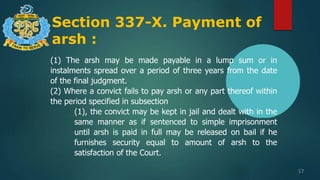
Section 337-X. Payment of
arsh :
57
(1) The arsh may be made payable in a lump sum or in
instalments spread over a period of three years from the date
of the final judgment.
(2) Where a convict fails to pay arsh or any part thereof within
the period specified in subsection
(1), the convict may be kept in jail and dealt with in the
same manner as if sentenced to simple imprisonment
until arsh is paid in full may be released on bail if he
furnishes security equal to amount of arsh to the
satisfaction of the Court.
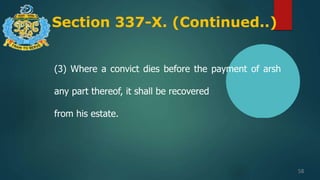
Section 337-X. (Continued..)
58
(3) Where a convict dies before the payment of arsh
any part thereof, it shall be recovered
from his estate.
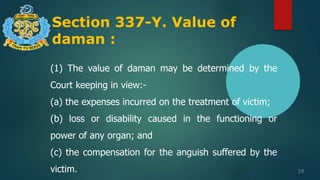
Section 337-Y. Value of
daman :
59
(1) The value of daman may be determined by the
Court keeping in view:-
(a) the expenses incurred on the treatment of victim;
(b) loss or disability caused in the functioning or
power of any organ; and
(c) the compensation for the anguish suffered by the
victim.
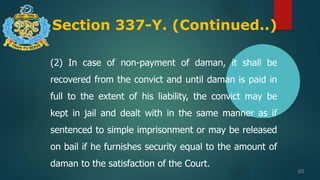
Section 337-Y. (Continued..)
60
(2) In case of non-payment of daman, it shall be
recovered from the convict and until daman is paid in
full to the extent of his liability, the convict may be
kept in jail and dealt with in the same manner as if
sentenced to simple imprisonment or may be released
on bail if he furnishes security equal to the amount of
daman to the satisfaction of the Court.
Section 337-Z. Disbursement
of arsh or daman:
61
The arsh or daman shall be payable to the victim or, if
the victim dies, to his heirs according to their
respective shares in inheritance.
THANK
YOU
62
PAKISTAN PENAL CODE 1860
OFFENCES AFFECTING THE
HUMAN BODY
ABDUL RAUF SHEIKH
INSPECTOR LEGAL
Police college sihala 63
Section 338. Isqat-i-Hamal:
64
Whoever causes woman with child whose organs have
not been formed, to miscarry, if such miscarriage is
not caused in good faith for the purpose of saving the
life of the woman, or providing necessary treatment to
her, is said to cause isqat-i-haml.
Section 338-A. Punishment
for Isqat-i-haml :
65
Whoever cause isqat-i-haml shall be liable to
punishment as ta'zir-
(a) with imprisonment of either description for a tern
which may extend to three years, if isqat-i-haml is
caused with the consent of the woman; or
(b) with imprisonment of either description for a term
which may extend to ten years, if isqat-i-haml is
caused without the consent of the woman:
Section 338-B. Isqat-i-janin :
66
Whoever causes a woman with child some of whose
limbs or organs have been formed to miscarry, if such
miscarriage is not caused in good faith for the purpose
of saving the life of the woman, is said to cause Isqat-
i-janin.
Explanation : A woman who causes herself to miscarry
is within the meaning of this section.
Section 338-C. Punishment
for Isqat-i-janin : :
67
Whoever causes isqat-i-ianin sha!l be liable to;
(a) one-twentieth of the diyat if the child is born dead;
(b) full diyat if the chitd is born alive but dies as a
result of any act of the offender; and
(c) imprisonment of either description for a term
which may extend to seven years as ta'zir:
Section 338-D. Confirmation of
sentence of death by way of qisas
or tazir, etc.:
68
A sentence of death awarded by way of qisas or ta'zir,
or a sentence of qisas awarded for causing hurt, shall
not be executed, unless it is confirmed by the High
Court.
Section 338-E. Waiver or
compounding of offences :
69
(1) Subject to the provisions of this Chapter and Section 345 of
the Code of. Criminal Procedure, 1898 (V of 1898), all offences
under this Chapter may be waived or compounded and the
provisions of Sections 309 and 310 shall, mutatis mutandis,
apply to the waiver or compounding of such offences:
Provided that, where an offence has been waived or
compounded, the Court may, in its discretion having regard to
the facts and circumstances of the case, acquit or award ta'zir
to the offender according to the nature of the offence.
Section 338-E. (Continued..)
70
(2) All questions relating to waiver or compounding of
an offence or awarding of punishment under Section
310, whether before or after the passing of any
sentence, shall be determined by trial Court:
Provided that where the sentence of qisas or any
other sentence is waived or compounded during the
pendency of an appeal, such questions may be
determined by the trial Court.
Section 338-F. Interpretation:
71
In the interpretation and application of the provisions
of this Chapter, and in respect of matter ancillary or
akin thereto, the Court shall be guided by the
Injunctions of Islam as laid down in the Holy Qur'an
and Sunnah.
Section 338-G. Rules :
72
The Government may, in consultation with the Council
of Islamic ideology, by notification in the official
Gazette, make such rutes as it may consider necessary
for carrying out the purposes of this Chapter.
Section 338-H. Saving:
73
Nothing in this Chapter, except Sections 309. 310 and
338-E. shall apply to cases pending before any Court
immediately before the commencement of the
Criminal Law (Second Amendment) Ordinance, 1990
(VII of 1990), or to the offences committed before
such commencement.
THANK
YOU
74
PAKISTAN PENAL CODE 1860
OFFENCES AFFECTING THE
HUMAN BODY
ABDUL RAUF SHEIKH
INSPECTOR LEGAL
Police college sihala 75
CHAPTER XVI-A
OF WRONGFUL RESTRAINT &
WRONGFUL CONFINEMENT
76
Section 339. Wrongful
restraint:
77
Whoever voluntarily obstructs any person so as to
prevent that person from proceeding in any direction
in which that person has a right to proceed, is said
wrongfully to restrain that person.
Section 340. Wrongful
confinement:
78
Whoever wrongfully restrains any person in such a
manner as 10 prevent that person from proceeding
beyond certain circumscribing limits, is said
"wrongfully to confine" that person.
Section 341. Punishment for
wrongful restraint:
79
Whoever wrongfully restrains any person, shall be
punished with simple imprisonment for a term, which
may extend to one month, or with fine, which may
extend to five hundred rupees or with both.
Section 342. Punishment for
wrongful confinement:
80
Whoever wrongfully confines any person,shall be
punished with imprisonment of either description for, a
term, which may extend to one year, or with fine
which may extend to one thousand rupees or with
both.
Section 343. Wrongful confinement
for three or more days:
81
Whoever wrongfully confines any person, for three
days or more, shall be punished with imprisonment of
either description for a term, which may extend to two
years, or with fine, or with both.
Section 344. Wrongful
confinement for ten or more days:
82
Whoever wrongfully confines any person for ten days
or more, shall be punished with imprisonment of
either description for a term, which may extend to
three years, and shall also be liable to fine.
Section 345. Wrongful confinement of
person for whose liberation writ, has
been issued:
83
Whoever keeps any person in wrongful confinement,
knowing that a writ for the liberation of that person
has been duly issued, shall be punished with
imprisonment of either description for a term which
may extend to two years, in addition to any term of
imprisonment to which he may be liable under any
other section of this Chapter.
Section 346. Wrongful
confinement in secret:
84
Whoever wrongfully confines any person in such manner as to
indicate an intention that the confinement of such person may
not be known to any person interested in the person so
confined, or to any public servant, or that the place of such
confinement may not be known to or discovered by any such
person of public servant as hereinbefore mentioned, shall be
punished with imprisonment of either description for a term
which may extend to two years in addition to any other
punishment to which he may be liable for such wrongful
confinement.
Section 347. Wrongful confinement to
extort property or constrain to illegal
act:
85
Whoever wrongfully confines any person for the purpose of
extorting from the person confined, or from any person
interested in the person confined, any property or valuable
security or of constraining the person confined or any
person interested in such person to do anything illegal or
to give any information which may facilitate the
commission of an offence, shall be punished with
imprisonment of either description for a term which may
extend to three years, and shall also be liable to fine.
Section 348. Wrongful confinement to extort
confession or compel restoration of
property:illegal act:
86
Whoever wrongfully confines any person for the purpose of
extorting from the person confined or any person interested in
the person confined any confession or any information which
may lead to the detection of an offence or misconduct, or for
the purpose of constraining the person confined or any person
interested in the person confined to restore or to cause the
restoration of any property or valuable security or to satisfy any
claim or demand, or to give information which may lead to the
restoration of any property or valuable security, shall be
punished with imprisonment of either description for a term
which may extend to three years and shall also be liable to fine.
THANK
YOU
87
PAKISTAN PENAL CODE 1860
OFFENCES AFFECTING THE
HUMAN BODY
ABDUL RAUF SHEIKH
INSPECTOR LEGAL
Police college sihala 88
Of Criminal Force and Assault
Section 349. Force:
89
A person is said to use force to another if he causes
motion, change of motion, or cessation of motion to
that other or if he causes to any substance such
motion, or change of motion, or cessation of motion
as brings that substance into contact with any part of
that other's body, or with anything which that other is
wearing or carrying, or with anything so situated that
such contact affects that other's sense of feeling:
Section 349. Force:
(Continued..)
90
provided that the person causing the motion, or change of motion,
or cessation of motion, causes that motion, change of motion, or
cessation of motion in one of the three ways hereinafter described:
First: By his own bodily power.
Secondly: By disposing any substance in such a manner that the
motion or change or cessation of motion takes place without any
further act on his part, or on the part of any other person.
Thirdly: By inducing any animal to move, to change its motion, or to
cease to move.
Section 350. Criminal force:
91
Whoever intentionally uses force to any person,
without that person's consent, in order to the
committing of any offence, or intending by the use of
such force to cause or knowing it to be likely that by
the use of such force he wilt cause injury, fear or
annoyance to the person to whom the force is used, is
said to use criminal force to that other.
Section 351. Assault:
92
Whoever makes any gesture, or any preparation
intending or knowing it to be likely that such gesture
or preparation will-cause any person present to
apprehend that he who makes that gesture or
preparation it about to use .of criminal force to that
person, is said to commit an assault.
Section 352. Punishment for
assault or criminal force
otherwise than on grave
provocation :
93
Whoever assaults or uses criminal force to any person
otherwise than on grave and sudden provocation
given by that, person, shall be punished with
imprisonment of either description for a term which
may extend to three months, or with fine which may
extend to five hundred rupees, or with both.
Section 353. Assault or criminal
force to deter public servant from
discharge of his duty:
94
Whoever assaults or uses criminal force to any person
being a public servant in the execution of his duty as
such public servant, or with intent to prevent or deter
that person from discharging his duty as such public
servant, or in consequence of anything done or
attempted to be done by such person in the lawful
discharge of his duty as such public servant, shall be
punished with imprisonment of either description for a
term which may extend to two years, or with fine or
with both.
Section 354. Assault or criminal
force to woman with intent to
outrage her modesty:
95
Whoever assaults or uses criminal force to any
woman, intending to outrage or knowing it to be likely
that he will thereby outrage her modesty, shall be
punished with imprisonment of either description for a
term which may extend to two years or with fine, or
with both.
Section 354-A. Assault or use
of criminal force to woman and
stripping her of her clothes:
96
Whoever assaults or use criminal force to any woman
and strips her of her clothes and in that condition,
exposes her to the public view, shall be punished with
death or with imprisonment for life, and shall also be
liable to fine.
Section 355. Assault or criminal force
with intent to dishonour person,
otherwise than on grave provocation:
97
Whoever assaults or uses criminal force to any person,
intending thereby to dishonour that person, otherwise
than on grave and sudden provocation given by that
person, shall be punished with imprisonment of either
description for a term which may extend to two years,
or with fine, or with both.
Section 356. Assault or criminal
force in attempt to commit theft of
property carried by a person::
98
Whoever assaults or uses criminal force to any person
in attempting to commit theft on any property which
that person is then wearing or carrying shall be
punished with imprisonment of either description for a
term which may extend to two years, or with fine, or
with both.
Section 357. Assault or
criminal force in attempting
wrongfully to confine person:
99
Whoever assaults or uses criminal force to any person,
in attempting wrongfully to confine that person, shall
be punished with imprisonment of either description
for a term which may extend to one year or with fine
which may extend to one thousand rupees, or with
both.
Section 358. Assault or criminal
force on grave provocation :
100
Whoever assaults or uses criminal force to any person
on grave and sudden provocation given by that
person, shall be punished with simple imprisonment
for a term which may extend to one month or with
fine which may extend to two hundred rupees, or with
both.
THANK
YOU
101
PAKISTAN PENAL CODE 1860
OFFENCES AFFECTING THE
HUMAN BODY
ABDUL RAUF SHEIKH
INSPECTOR LEGAL
Police college sihala 102
Of Kidnapping, Abduction, Slavery
and Forced Labour
103
Section 359. Kidnapping:
104
Kidnapping is of two kinds: Kidnapping from
Pakistan and kidnapping from lawful
guardianship.
Section 360. Kidnapping from
Pakistan, etc.:
105
Whoever conveys any person beyond the limits of
Pakistan without the consent of that person, or of
some person legally authorised to consent on behalf of
that person is said to kidnap that person from
Pakistan.
Section
361. Kidnapping from lawful
guardianship:
106
Whoever takes or entices any minor under fourteen
years of age if a male, or under sixteen years of age if
a female, or any person of unsound mind, out of the
keeping of the lawful guardian of such minor or
person of unsound mind, without the consent of such
guardian, said to kidnap such minor or person from
lawful guardianship.
Section 362. Abduction:
107
Whoever by force compels, or by any deceitful means
induces, any person to go from any place, is said to
abduct that person.
Section 363. Punishment for
kidnapping:
108
Whoever kidnaps any person from Pakistan or from
lawful guardianship, shall be punished with
imprisonment of either description for a term which
may extend to seven years, and shall also be liable to
fine.
Section 364. Kidnapping or
abducting in order to murder:
109
Whoever kidnaps or abducts any person in order that
such person may be murdered or may be so disposed
of as to be put in danger of being murdered, shall be
punished with imprisonment for life or rigorous
imprisonment for a term which may extend to ten
years and shall also be liable to fine,
Section 364-A. Kidnapping or
abducting a person under the age of
fourteen:
110
Whoever kidnaps or abducts any person under the
i[age of fourteen] in order that such person may be
murdered or subjected to grievous hurt, or slavery, or
to the lust of any person or may be so disposed of as
to be put in danger of being murdered or subjected to
grievous hurt, or slavery, or to the lust of any person
shall be punished with death or with imprisonment for
life or with rigorous imprisonment for a term which
may extend to fourteen years and shall not be less
than seven years.
Section 365. Kidnapping or
abducting with intent secretly and
wrongfully to confine person:
111
Whoever kidnaps or abducts any person with intent to
cause that person to be secretly and wrongfully
confined, shall be punished with imprisonment of
either description for a term which may extend to
seven years, and shall also be liable to fine-
Section 365-A. Kidnapping or
abducting for extorting property,
valuable security, etc.:
112
Whoever kidnaps or abducts any person for the
purpose of extorting from the person kidnapped or
abducted, or from any person interested in the person
kidnapped or abducted any property, whether movable
or immovable, or valuable security, or to compel any
person to comply with any other demand, whether in
cash or otherwise, for obtaining release of the person
kidnapped or abducted, shall be punished with death
or imprisonment for life and shall also be liable to
forfeiture of property.
Section 366. Kidnapping,
abducting or inducing woman
to compel her marriage, etc.:
113
[Rep. by the Offence of Zina (Enforcement of
Hudood) Ordinance, Vfl of 1979, S. 19.]
Section 366-A. Procuration of
minor girl:
114
Whoever by any means whatsoever, induces any
minor girl under the age of eighteen years to go from
any place or to do any act with intent that such girl
may be, or knowing that it is likely that she will be,
forced or seduced to illicit intercourse with another
person shall be punishable with imprisonment which
may extend to ten years and shall also be liable to
fine.
Section 366-B. Importation of
girl from foreign country :
115
Whoever imports into Pakistan from any country
outside Pakistan any girl under the age of twenty-one
years with intent that she may be, or knowing it to be
likely that she will be, forced or seduced to illicit
intercourse with another person, shall be punishable
with imprisonment which may extend to ten years and
shall also be liable to fine.
THANK
YOU
116

ppc murder 33.pptx

  • 1.
  • 2.
    PAKISTAN PENAL CODE1860 OFFENCES AFFECTING THE HUMAN BODY ABDUL RAUF SHEIKH INSPECTOR LEGAL Police college sihala 2
  • 3.
    Section 332. Hurt: 3 (1)Whoever causes pain, harm, disease, infianity or injury to any person or impairs, disables or dismembers any organ of the body or part thereof of any person without causing his death, is said to cause hurt. (2) The following are the kinds of hurt : (a) Itlaf-i-udw (b) itlaf-i-salahiyyat-i-udw (c) shajjah (d) jurh and (e) all kinds of other hurts.
  • 4.
  • 5.
    Section 333. Itlaf-i-udw: 5 Whoeverdismembers, amputates, severs any limb or organ of the body of another person is said to cause Itlaf-i-udw.
  • 6.
    Section 334. Punishmentfor Itlaf-udw: 6 Whoever by doing any act with the intention of thereby causing hurt to any person, or with the knowledge that he is likely thereby to cause hurt to any person causes Itlaf-i- udw of any person, shall, in consultation with the authorized medical officer, be punished with qisas, and if the qisas is not executable keeping in view the principles of equality in accordance with the Injunctions of Islam, the offender shall be liable to arsh and may also be punished with imprisonment of either description for a term which may extend to ten years as ta'zir.
  • 7.
    Section 335. Itlaf-i-salahiyyat- i-udw: 7 Whoeverdestroys or permanently impairs the functioning, power or capacity of an organ of the body of another person, or causes permanent disfigurement is said to cause itlaf-i- salahiyyat-i-udw.
  • 8.
    Section 336. Punishmentfor itlaf-i-salahiyyat-i-udw : 8 Whoever, by doing any act with the intention of causing hurt to any person, or with the knowledge that he is likely to cause hurt to any person, causes itlaf-i-salahiyyat-i-udw of any person, shall, in consultation with the authorised medical officer, be punished with qisas and if the qisas is not executable, keeping in view the principles of equality in accordance with the Injunctions of Islam, the offender shall be liable to arsh and may also be punished with imprisonment of either description for a term which may extend to ten years as taz’ir.
  • 9.
    Section 336A. Hurtcaused by corrosive substance: 9 Whoever with the intention or knowingly causes or attempts to cause hurt by means of a corrosive substance which is deleterious to human body when it is swallowed, inhaled, comes into contact or received into human body or otherwise shall be said to cause hurt by corrosive
  • 10.
    Section 336B. Punishmentfor hurt by corrosive substance 10 Whoever causes hurt by corrosive substance shall be punished with imprisonment for life or imprisonment of either description which shall not be less than fourteen years and a minimum fine of one million rupees.
  • 11.
  • 12.
    PAKISTAN PENAL CODE1860 OFFENCES AFFECTING THE HUMAN BODY ABDUL RAUF SHEIKH INSPECTOR LEGAL Police college sihala 12
  • 13.
    Section 337. Shajjah: 13 (1)Whoever causes, on the head or face of any person, any hurt which does not amount to itlaf-i-udw or itlaf-i-salahiyyat-i-udw, is said to cause shajjah. (2) The following are the kinds of shaljah namely:- (a) Shajjah-i-Khafifah (b) Shalfah'i-mudihah (c) Shajjah-i-hashimah (d) Shajjah-i-munaqqilah (e) Shaijah-i-ammah and (f) Shajjah-i-damighah (3) Whoever causes shajjah
  • 14.
    Section 337. (Continued..) 14 (i)without exposing bone of the victim, is said to cause shajjah-i- khafifah; (ii) by exposing any bone of the victim without causing fracture, is said to cause shajjah-imudihah; (iii) by fracturing the bone of the victim, without dislocating it, is said to cause shajjah-ihashimah; (iv) by causing fracture of the bone of the victim and thereby the bone is dislocated, is said to cause shajfah-i-munaqqilah; (v) by causing fracture of the skull of the victim so that the wound touches the membrane of the brain, is said to cause shajjah-i- ammah; (vi) by causing fracture of the skull of the victim and the wound ruptures the membrane of the brain is said to cause shaijah-i- damighah.
  • 15.
    Section 337-A. Punishment ofshajjah : 15 Whoever, by doing any act with the intention of thereby causing hurt to any person, or with the knowledge that he is likely thereby to cause hurt to any person, causes-- (i) Shajjah-I-khafifah to any person, shall be liable to daman and may also be punished with imprisonment of either description for a term which may extend to two years as ta'zir, (ii) shajjah-i-mudihah to any person, shall, in consultation with the authorised medical officer, be punished with qisas, and if the, qisas is not executable keeping in view the principles of equality, in accordance with the Injunctions of Islam, the convict shall be liable to arsh which shall be five percent of the diyat and may also be punished with imprisonment of either description for a term which may extend to five years as ta'zir,
  • 16.
    Section 337-A. (Continued..) 16 (iii)shajjah-i-hashimah to any person, shall be liable to arsh which shall be ten per cent of the diyat and may also be punished with imprisonment of either description for a term which may extend to ten years as ta'zir, (iv) shajiah-i-munaqqilah to any person, shall be liable to arsh which shall be fifteen per cent of the diyat and may also be punished with imprisonment of either description for a term which may extend to ten years as ta 'zir,
  • 17.
    Section 337-A. (Continued..) 17 (v)shajjah-i-ammah to any person, shall be liable to arsh which shall be one-third of the diyat and may also be punished with imprisonment of either description for a term which may extend to ten years as ta'zir, and (vi) shajjah-i-damighah to any person shall be liable to arsh which shall be one-half of diyat and may also be punished with imprisonment of either description for a term which may extend to fourteen years as ta'zir.
  • 18.
  • 19.
    PAKISTAN PENAL CODE1860 OFFENCES AFFECTING THE HUMAN BODY ABDUL RAUF SHEIKH INSPECTOR LEGAL Police college sihala 19
  • 20.
    Section 337-B. Jurh: 20 (1)Whoever causes on any part of the body of a person, other than the head or face, a hurt which leaves a mark of the wound, whether temporary or permanent, is said to cause jurh. (2) Jurh is of two kinds, namely:- (a) Jaifah ; and (b) Ghayr-jaifah
  • 21.
    Section 337-C. Jaifah: 21 Whoever causes jurh in which the injury extends to the body cavity of the trunk, is said to cause jaifah.
  • 22.
    Section 337-D. Punishment forjaifah : 22 Whoever by doing any act with the intention of causing hurt to a person or with the knowledge that he is likely to cause hurt to such person, causes jaifah to such person, shall be liable to arsh which shall be one-third of the diyat and may also be punished with imprisonment of either description for a term which may extend to ten years as ta'zir.
  • 23.
    Section 337-E. Ghayr-jaifah 23 (1)Whoever causes jurh which does not amount to jaifah, is said to cause ghayr-jaifah. (2) The following are the kinds of ghayr-faifah, namety:- (a) damihah (b) badi'ah (c) mutalahimah (d) mudihah (e) hashimah ; and (f) munaqqilah
  • 24.
    Section 337-E. (Continued..) 24 (3)Whoever causes ghayr-jaifah— (i) in which the.skin is ruptured and bleeding occurs, is said to cause damiyah; (ii) by cutting or incising the flesh without exposing the bone, is said to cause badi'ah; (iii) by lacerating the flesh, is said to cause mutalahimah', (iv) by exposing the bone, is said to cause mudihah; (v) by causing fracture of a bone without dislocating it, is said to cause hashimah; and (vi) by fracturing and dislocating the bone, is said to cause munaqqilah.
  • 25.
    Section 337-F. Punishment ofghayr-jaifah : 25 Whoever by doing any act with the intention of causing hurt to any person, or with the knowledge that he is likely to cause hurt to any person, causes" (i) damihah to any person, shall be liable to daman and may also be punished with imprisonment of either description for a term which may extend to one year as ta'zir, (ii) badi'ah to any person, shall be liable to daman and may also be punished with imprisonment of either description for a term which may extend to three years as ta'zir,
  • 26.
    Section 337-F. (Continued..) 26 (iii)mutafahimah to any person, shall be liable to daman and may also be punished with imprisonment of either description for a term which may extend to three years as ta'zir; (iv) mudihah to any person, shall be liable to daman and may also be punished with imprisonment of either description for a term which may extend to five years as ta'zir,
  • 27.
    Section 337-F. (Continued..) 27 (v)hashimah to any person, shall be liable to daman and may also be punished with imprisonment of either description for a term which may extend to five years as ta'zir, and (vi) munaqqilah to any person, shall be liable to daman and may also be punished with imprisonment of either description for a term which may extend to seven years as ta'zir.
  • 28.
  • 29.
    PAKISTAN PENAL CODE1860 OFFENCES AFFECTING THE HUMAN BODY ABDUL RAUF SHEIKH INSPECTOR LEGAL Police college sihala 29
  • 30.
    Section 337-G. Punishmentfor hurt by rash or negligent driving: 30 Whoever causes hurt by rash or negligent driving shall be liable to arsh or daman specified for the kind of hurt caused and may also be punished with imprisonment of either description for a term which may extend to five years as ta'zir.
  • 31.
    Section 337-H. Punishmentfor hurt by rash or negligent act: 31 (1) Whoever causes hurt by rash or negligent act, other than rash or negligent driving, shall be liable to arsh or daman specified for the kind of hurt caused and may also be punished with imprisonment of either description for a term which may extend to three years as ta'zir. (2) Whoever does any act so rashly or negligently as to endanger human life or the personal safety of other, shall be punished with imprisonment of either-description for a term which may extend to three months, or with fine, or with both.
  • 32.
    Section 337-I. Punishment forcausing hurt by mistake (khata): 32 (Whoever causes hurt by mistake (khata) shall be liable to arsh or daman specified for the kind of hurt caused.
  • 33.
    Section 337-J. Causinghurt by mean of a poison: 33 Whoever administers to. or causes to be taken by, any person, any poison or any stupefying, intoxicating or unwholesome drug, or such other thing with intent to cause hurt to such person, or with intent to commit or to facilitate the commission of an offence, or knowing it to be likely that he will thereby cause hurt may, in addition to the punishment of arsh or daman provided for the kind of hurt caused, be punished, having regard to the nature of the hurt caused, with imprisonment of either description for a term which may extend to ten years.
  • 34.
    Section 337-K. Causinghurt to extort confession, or to compel restoration of property: 34 Whoever causes hurt for the purpose of extorting from the sufferer or any person interested in the sufferer any .confession or any information which may lead to the detection of any offence or misconduct, or for the purpose of constraining the sufferer, or any person interested in the Sufferer, to restore, or to cause the restoration of, any property or valuable security or to satisfy any claim or demand, or to give information which may lead to the restoration of any property, or valuable security shall, in addition to the punishment of qisas, arsh or daman, as the case may be, provided for the kind of hurt caused, be punished, having regard to the nature of the hurt caused, with imprisonment of either description for a term which may extend to ten years as ta'zir.
  • 35.
    Section 337-L. Punishment forother hurt: 35 (1) Whoever causes hurt, not mentioned hereinbefore, which endangers life or which causes the sufferer to remain in severe bodily pain for twenty days or more or renders him unable to follow his ordinary pursuits for twenty days or more, shall be liable to daman and also be punished with imprisonment of either description for a term which may extend to seven years.
  • 36.
    Section 337-L. (Continued..) 36 (2)Whoever causes hurt not covered by sub-section (1) shall be punished with imprisonment of either description for a term which may extend to two years, or with daman, or with both.
  • 37.
  • 38.
    PAKISTAN PENAL CODE1860 OFFENCES AFFECTING THE HUMAN BODY ABDUL RAUF SHEIKH INSPECTOR LEGAL Police college sihala 38
  • 39.
    Section 337-M. Hurtnot liable to qisas: 39 Hurt shall not be liable to qisas in the following cases, namely:-- (a) when the offender is a minor or insane: Provided that he shall be liable to arsh and also to ta'zir to be determined by the Court having regard to the age of offender, circumstances of the case and the nature of hurt caused; (b) when an offender at the instance of the victim causes hurt to him: Provided that the offender may be liable to ta'zir provided for the kind of hurt caused by him;
  • 40.
    Section 337-M. (Continued..) 40 (c)when the offender has caused itlaf-i-udw of a physically imperfect organ of the victim and the convict does not suffer from similar physical imperfection of such organ: Provided that the offender shall be liable to arsh and may also be liable to ta'zir provided for the kind of hurt caused by him; and (d) when the organ of the offender liable to qisas is missing: Provided that the offender shall be liable to arsh and may also be liable to ta'zir provided for the kind of hurt caused by him.
  • 41.
    Section 337-N. Casesin which qisas for hurt shall not be enforced: 41 (1) The qisas for a hurt shall not be enforced in the following cases, namely :- (a) when the offender dies before execution of qisas; (b) when the organ of the offender liable to qisas is lost before the execution of qisas: Provided that offender shall be liable to arsh, and may also be liable to ta'zir provided for the kind of hurt caused by him; (c) when the victim waives the qisas or compounds the offence with badl-i-sufh; or (d) when the right of qisas devolves on the person who cannot claim qisas against the offender under this Chapter:
  • 42.
    Section 337-N. (Continued..) 42 Providedthat the offender shall be liable to arsh, if there is any wali other than the offender, and if there is no wali other than the offender he shall be liable to ta'zir provided for the kind of hurt caused by him. (2) Notwithstanding anything contained in this Chapter, in all cases of hurt, the Court may, having regard to the kind of hurt caused by him, in addition to payment of arsh, award ta'zir to an offender who is a previous convict, habitual or hardened, desperate or dangerous criminal.
  • 43.
    Section 337- 0.Wali In case of hurt: In the case of hurt: 43 The wali shall be- (a) the victim: Provided that, if the victim is a minor or insane, his right of qisas shall be exercised by his father or paternal grand father, howhighsoever; (b) the heirs of the victim, if the later dies before the execution of qisas: and (c) the Government, in the absence of the victim or the heirs of the victim.
  • 44.
    Section 337-P. Executionof qisas for hurt: 44 (1) Qisas shall be executed in public by an authorised medical officer who shall before such execution examine the offender and take due care so as to ensure that the execution of qisas does not cause the death of the offender or exceed the hurt caused by him to the victim.
  • 45.
    Section 337-P. (Continued..) 45 (2)The wali shall be present at the time of execution and if the wali or his representative is not present, after having been informed of the date, time and place by the Court an officer authorised by the Court in this behalf shall give permission for the execution of qisas.
  • 46.
    Section 337-P. (Continued..) 46 (3)If the convict is a woman who is pregnant, the Court may, in consultation with an authorised medical officer, postpone the execution of qisas upto a period of two years after the birth of the child and during this period she may be released on bail on furnishing of security to the satisfaction of the Court or, if she is not so released, shall be dealt with as if sentenced to simple' imprisonment.

  • 47.
  • 48.
    PAKISTAN PENAL CODE1860 OFFENCES AFFECTING THE HUMAN BODY ABDUL RAUF SHEIKH INSPECTOR LEGAL Police college sihala 48
  • 49.
    Section 337-Q. Arshfor single organs: 49 The arsh for causing itlaf of an organ which Is found singly in a human body shall be equivalent to the value of diyat.
  • 50.
    Section 337-R. Arshfor organs in pairs : 50 The arsh .for causing itlaf of organs found in a human body in pairs shall be equivalent to the value of diyat and if itlaf is caused to one of such organs the amount of arsh shall be one-half of the diyat: Provided that, where the victim has only one such organ or his other organ is missing or has already 'become incapacitated the arsh for causing itlaf of the existing or capable organ shall be equal to the value of diyat.
  • 51.
    Section 337-S. Arshfor the organs in quadruplicate: 51 (1)The arsh for causing itlaf of organs found in a human body in a set of four shall be equal to— (a) one-fourth of the diyat, if the itlaf is one of such organs; ... (b) one-half of the diyat, if the itlaf is of two of such organs; . (c) three-fourth of the diyat, if the itlaf is of three such organs; and (d) full diyat, if the itlaf is of all the four organs.
  • 52.
    Section 337-T. Arshfor fingers: 52 (1) The arsh for causing itlaf of a finger of a hand or foot shall be one-tenth of the diyat. (2) The arsh for causing itlaf of a joint of a finger shall be one-thirteenth of the diyat: Provided that where the itlaf is of a joint of a thumb, the arsh shall be one- twentieth of the diyat.
  • 53.
    Section 337-U. Arshfor teeth 53 (1) The arsh for causing itlaf of a tooth, other than a milk tooth, shall be one-twentieth of the diyat.
  • 54.
    Section 337-V. Arshfor hair: 54 (1) Whoever uproots; (a) all the hair of the head, beard, moustaches eyebrow, eyelashes or any other part of the body shall be liable to arsh equal to diyat and may also be punished with imprisonment of either description for a term which may extend to three years as ta'zir, (b) one. eyebrow shall be liable to arsh equal to one- half of the diyat; and (c) one eyelash, shall be liable to arsh equal to one fourth of the diyat
  • 55.
    Section 337-V. (Continued..) 55 (2)Where the hair of any part of the body of the victim are forcibly removed by any process not covered under sub section (1), the accused shall be liable to daman and imprisonment of either description which may extend to one year.
  • 56.
    Section 337-W. Mergerof arsh : 56 (1) Where an accused more than one hurt, he shall be liable to arsh specified for each hurt separately: Provided that, where; (a) hurt is caused to an organ, the accused shall be liable to arsh for causing hurt to such organ and not for arsh for causing hurt to any part of such organ and (b) the wounds join together and form a single wound, the accused shall be liable to arsh for one wound.
  • 57.
    Section 337-X. Paymentof arsh : 57 (1) The arsh may be made payable in a lump sum or in instalments spread over a period of three years from the date of the final judgment. (2) Where a convict fails to pay arsh or any part thereof within the period specified in subsection (1), the convict may be kept in jail and dealt with in the same manner as if sentenced to simple imprisonment until arsh is paid in full may be released on bail if he furnishes security equal to amount of arsh to the satisfaction of the Court.
  • 58.
    Section 337-X. (Continued..) 58 (3)Where a convict dies before the payment of arsh any part thereof, it shall be recovered from his estate.
  • 59.
    Section 337-Y. Valueof daman : 59 (1) The value of daman may be determined by the Court keeping in view:- (a) the expenses incurred on the treatment of victim; (b) loss or disability caused in the functioning or power of any organ; and (c) the compensation for the anguish suffered by the victim.
  • 60.
    Section 337-Y. (Continued..) 60 (2)In case of non-payment of daman, it shall be recovered from the convict and until daman is paid in full to the extent of his liability, the convict may be kept in jail and dealt with in the same manner as if sentenced to simple imprisonment or may be released on bail if he furnishes security equal to the amount of daman to the satisfaction of the Court.
  • 61.
    Section 337-Z. Disbursement ofarsh or daman: 61 The arsh or daman shall be payable to the victim or, if the victim dies, to his heirs according to their respective shares in inheritance.
  • 62.
  • 63.
    PAKISTAN PENAL CODE1860 OFFENCES AFFECTING THE HUMAN BODY ABDUL RAUF SHEIKH INSPECTOR LEGAL Police college sihala 63
  • 64.
    Section 338. Isqat-i-Hamal: 64 Whoevercauses woman with child whose organs have not been formed, to miscarry, if such miscarriage is not caused in good faith for the purpose of saving the life of the woman, or providing necessary treatment to her, is said to cause isqat-i-haml.
  • 65.
    Section 338-A. Punishment forIsqat-i-haml : 65 Whoever cause isqat-i-haml shall be liable to punishment as ta'zir- (a) with imprisonment of either description for a tern which may extend to three years, if isqat-i-haml is caused with the consent of the woman; or (b) with imprisonment of either description for a term which may extend to ten years, if isqat-i-haml is caused without the consent of the woman:
  • 66.
    Section 338-B. Isqat-i-janin: 66 Whoever causes a woman with child some of whose limbs or organs have been formed to miscarry, if such miscarriage is not caused in good faith for the purpose of saving the life of the woman, is said to cause Isqat- i-janin. Explanation : A woman who causes herself to miscarry is within the meaning of this section.
  • 67.
    Section 338-C. Punishment forIsqat-i-janin : : 67 Whoever causes isqat-i-ianin sha!l be liable to; (a) one-twentieth of the diyat if the child is born dead; (b) full diyat if the chitd is born alive but dies as a result of any act of the offender; and (c) imprisonment of either description for a term which may extend to seven years as ta'zir:
  • 68.
    Section 338-D. Confirmationof sentence of death by way of qisas or tazir, etc.: 68 A sentence of death awarded by way of qisas or ta'zir, or a sentence of qisas awarded for causing hurt, shall not be executed, unless it is confirmed by the High Court.
  • 69.
    Section 338-E. Waiveror compounding of offences : 69 (1) Subject to the provisions of this Chapter and Section 345 of the Code of. Criminal Procedure, 1898 (V of 1898), all offences under this Chapter may be waived or compounded and the provisions of Sections 309 and 310 shall, mutatis mutandis, apply to the waiver or compounding of such offences: Provided that, where an offence has been waived or compounded, the Court may, in its discretion having regard to the facts and circumstances of the case, acquit or award ta'zir to the offender according to the nature of the offence.
  • 70.
    Section 338-E. (Continued..) 70 (2)All questions relating to waiver or compounding of an offence or awarding of punishment under Section 310, whether before or after the passing of any sentence, shall be determined by trial Court: Provided that where the sentence of qisas or any other sentence is waived or compounded during the pendency of an appeal, such questions may be determined by the trial Court.
  • 71.
    Section 338-F. Interpretation: 71 Inthe interpretation and application of the provisions of this Chapter, and in respect of matter ancillary or akin thereto, the Court shall be guided by the Injunctions of Islam as laid down in the Holy Qur'an and Sunnah.
  • 72.
    Section 338-G. Rules: 72 The Government may, in consultation with the Council of Islamic ideology, by notification in the official Gazette, make such rutes as it may consider necessary for carrying out the purposes of this Chapter.
  • 73.
    Section 338-H. Saving: 73 Nothingin this Chapter, except Sections 309. 310 and 338-E. shall apply to cases pending before any Court immediately before the commencement of the Criminal Law (Second Amendment) Ordinance, 1990 (VII of 1990), or to the offences committed before such commencement.
  • 74.
  • 75.
    PAKISTAN PENAL CODE1860 OFFENCES AFFECTING THE HUMAN BODY ABDUL RAUF SHEIKH INSPECTOR LEGAL Police college sihala 75
  • 76.
    CHAPTER XVI-A OF WRONGFULRESTRAINT & WRONGFUL CONFINEMENT 76
  • 77.
    Section 339. Wrongful restraint: 77 Whoevervoluntarily obstructs any person so as to prevent that person from proceeding in any direction in which that person has a right to proceed, is said wrongfully to restrain that person.
  • 78.
    Section 340. Wrongful confinement: 78 Whoeverwrongfully restrains any person in such a manner as 10 prevent that person from proceeding beyond certain circumscribing limits, is said "wrongfully to confine" that person.
  • 79.
    Section 341. Punishmentfor wrongful restraint: 79 Whoever wrongfully restrains any person, shall be punished with simple imprisonment for a term, which may extend to one month, or with fine, which may extend to five hundred rupees or with both.
  • 80.
    Section 342. Punishmentfor wrongful confinement: 80 Whoever wrongfully confines any person,shall be punished with imprisonment of either description for, a term, which may extend to one year, or with fine which may extend to one thousand rupees or with both.
  • 81.
    Section 343. Wrongfulconfinement for three or more days: 81 Whoever wrongfully confines any person, for three days or more, shall be punished with imprisonment of either description for a term, which may extend to two years, or with fine, or with both.
  • 82.
    Section 344. Wrongful confinementfor ten or more days: 82 Whoever wrongfully confines any person for ten days or more, shall be punished with imprisonment of either description for a term, which may extend to three years, and shall also be liable to fine.
  • 83.
    Section 345. Wrongfulconfinement of person for whose liberation writ, has been issued: 83 Whoever keeps any person in wrongful confinement, knowing that a writ for the liberation of that person has been duly issued, shall be punished with imprisonment of either description for a term which may extend to two years, in addition to any term of imprisonment to which he may be liable under any other section of this Chapter.
  • 84.
    Section 346. Wrongful confinementin secret: 84 Whoever wrongfully confines any person in such manner as to indicate an intention that the confinement of such person may not be known to any person interested in the person so confined, or to any public servant, or that the place of such confinement may not be known to or discovered by any such person of public servant as hereinbefore mentioned, shall be punished with imprisonment of either description for a term which may extend to two years in addition to any other punishment to which he may be liable for such wrongful confinement.
  • 85.
    Section 347. Wrongfulconfinement to extort property or constrain to illegal act: 85 Whoever wrongfully confines any person for the purpose of extorting from the person confined, or from any person interested in the person confined, any property or valuable security or of constraining the person confined or any person interested in such person to do anything illegal or to give any information which may facilitate the commission of an offence, shall be punished with imprisonment of either description for a term which may extend to three years, and shall also be liable to fine.
  • 86.
    Section 348. Wrongfulconfinement to extort confession or compel restoration of property:illegal act: 86 Whoever wrongfully confines any person for the purpose of extorting from the person confined or any person interested in the person confined any confession or any information which may lead to the detection of an offence or misconduct, or for the purpose of constraining the person confined or any person interested in the person confined to restore or to cause the restoration of any property or valuable security or to satisfy any claim or demand, or to give information which may lead to the restoration of any property or valuable security, shall be punished with imprisonment of either description for a term which may extend to three years and shall also be liable to fine.
  • 87.
  • 88.
    PAKISTAN PENAL CODE1860 OFFENCES AFFECTING THE HUMAN BODY ABDUL RAUF SHEIKH INSPECTOR LEGAL Police college sihala 88
  • 89.
    Of Criminal Forceand Assault Section 349. Force: 89 A person is said to use force to another if he causes motion, change of motion, or cessation of motion to that other or if he causes to any substance such motion, or change of motion, or cessation of motion as brings that substance into contact with any part of that other's body, or with anything which that other is wearing or carrying, or with anything so situated that such contact affects that other's sense of feeling:
  • 90.
    Section 349. Force: (Continued..) 90 providedthat the person causing the motion, or change of motion, or cessation of motion, causes that motion, change of motion, or cessation of motion in one of the three ways hereinafter described: First: By his own bodily power. Secondly: By disposing any substance in such a manner that the motion or change or cessation of motion takes place without any further act on his part, or on the part of any other person. Thirdly: By inducing any animal to move, to change its motion, or to cease to move.
  • 91.
    Section 350. Criminalforce: 91 Whoever intentionally uses force to any person, without that person's consent, in order to the committing of any offence, or intending by the use of such force to cause or knowing it to be likely that by the use of such force he wilt cause injury, fear or annoyance to the person to whom the force is used, is said to use criminal force to that other.
  • 92.
    Section 351. Assault: 92 Whoevermakes any gesture, or any preparation intending or knowing it to be likely that such gesture or preparation will-cause any person present to apprehend that he who makes that gesture or preparation it about to use .of criminal force to that person, is said to commit an assault.
  • 93.
    Section 352. Punishmentfor assault or criminal force otherwise than on grave provocation : 93 Whoever assaults or uses criminal force to any person otherwise than on grave and sudden provocation given by that, person, shall be punished with imprisonment of either description for a term which may extend to three months, or with fine which may extend to five hundred rupees, or with both.
  • 94.
    Section 353. Assaultor criminal force to deter public servant from discharge of his duty: 94 Whoever assaults or uses criminal force to any person being a public servant in the execution of his duty as such public servant, or with intent to prevent or deter that person from discharging his duty as such public servant, or in consequence of anything done or attempted to be done by such person in the lawful discharge of his duty as such public servant, shall be punished with imprisonment of either description for a term which may extend to two years, or with fine or with both.
  • 95.
    Section 354. Assaultor criminal force to woman with intent to outrage her modesty: 95 Whoever assaults or uses criminal force to any woman, intending to outrage or knowing it to be likely that he will thereby outrage her modesty, shall be punished with imprisonment of either description for a term which may extend to two years or with fine, or with both.
  • 96.
    Section 354-A. Assaultor use of criminal force to woman and stripping her of her clothes: 96 Whoever assaults or use criminal force to any woman and strips her of her clothes and in that condition, exposes her to the public view, shall be punished with death or with imprisonment for life, and shall also be liable to fine.
  • 97.
    Section 355. Assaultor criminal force with intent to dishonour person, otherwise than on grave provocation: 97 Whoever assaults or uses criminal force to any person, intending thereby to dishonour that person, otherwise than on grave and sudden provocation given by that person, shall be punished with imprisonment of either description for a term which may extend to two years, or with fine, or with both.
  • 98.
    Section 356. Assaultor criminal force in attempt to commit theft of property carried by a person:: 98 Whoever assaults or uses criminal force to any person in attempting to commit theft on any property which that person is then wearing or carrying shall be punished with imprisonment of either description for a term which may extend to two years, or with fine, or with both.
  • 99.
    Section 357. Assaultor criminal force in attempting wrongfully to confine person: 99 Whoever assaults or uses criminal force to any person, in attempting wrongfully to confine that person, shall be punished with imprisonment of either description for a term which may extend to one year or with fine which may extend to one thousand rupees, or with both.
  • 100.
    Section 358. Assaultor criminal force on grave provocation : 100 Whoever assaults or uses criminal force to any person on grave and sudden provocation given by that person, shall be punished with simple imprisonment for a term which may extend to one month or with fine which may extend to two hundred rupees, or with both.
  • 101.
  • 102.
    PAKISTAN PENAL CODE1860 OFFENCES AFFECTING THE HUMAN BODY ABDUL RAUF SHEIKH INSPECTOR LEGAL Police college sihala 102
  • 103.
    Of Kidnapping, Abduction,Slavery and Forced Labour 103
  • 104.
    Section 359. Kidnapping: 104 Kidnappingis of two kinds: Kidnapping from Pakistan and kidnapping from lawful guardianship.
  • 105.
    Section 360. Kidnappingfrom Pakistan, etc.: 105 Whoever conveys any person beyond the limits of Pakistan without the consent of that person, or of some person legally authorised to consent on behalf of that person is said to kidnap that person from Pakistan.
  • 106.
    Section 361. Kidnapping fromlawful guardianship: 106 Whoever takes or entices any minor under fourteen years of age if a male, or under sixteen years of age if a female, or any person of unsound mind, out of the keeping of the lawful guardian of such minor or person of unsound mind, without the consent of such guardian, said to kidnap such minor or person from lawful guardianship.
  • 107.
    Section 362. Abduction: 107 Whoeverby force compels, or by any deceitful means induces, any person to go from any place, is said to abduct that person.
  • 108.
    Section 363. Punishmentfor kidnapping: 108 Whoever kidnaps any person from Pakistan or from lawful guardianship, shall be punished with imprisonment of either description for a term which may extend to seven years, and shall also be liable to fine.
  • 109.
    Section 364. Kidnappingor abducting in order to murder: 109 Whoever kidnaps or abducts any person in order that such person may be murdered or may be so disposed of as to be put in danger of being murdered, shall be punished with imprisonment for life or rigorous imprisonment for a term which may extend to ten years and shall also be liable to fine,
  • 110.
    Section 364-A. Kidnappingor abducting a person under the age of fourteen: 110 Whoever kidnaps or abducts any person under the i[age of fourteen] in order that such person may be murdered or subjected to grievous hurt, or slavery, or to the lust of any person or may be so disposed of as to be put in danger of being murdered or subjected to grievous hurt, or slavery, or to the lust of any person shall be punished with death or with imprisonment for life or with rigorous imprisonment for a term which may extend to fourteen years and shall not be less than seven years.
  • 111.
    Section 365. Kidnappingor abducting with intent secretly and wrongfully to confine person: 111 Whoever kidnaps or abducts any person with intent to cause that person to be secretly and wrongfully confined, shall be punished with imprisonment of either description for a term which may extend to seven years, and shall also be liable to fine-
  • 112.
    Section 365-A. Kidnappingor abducting for extorting property, valuable security, etc.: 112 Whoever kidnaps or abducts any person for the purpose of extorting from the person kidnapped or abducted, or from any person interested in the person kidnapped or abducted any property, whether movable or immovable, or valuable security, or to compel any person to comply with any other demand, whether in cash or otherwise, for obtaining release of the person kidnapped or abducted, shall be punished with death or imprisonment for life and shall also be liable to forfeiture of property.
  • 113.
    Section 366. Kidnapping, abductingor inducing woman to compel her marriage, etc.: 113 [Rep. by the Offence of Zina (Enforcement of Hudood) Ordinance, Vfl of 1979, S. 19.]
  • 114.
    Section 366-A. Procurationof minor girl: 114 Whoever by any means whatsoever, induces any minor girl under the age of eighteen years to go from any place or to do any act with intent that such girl may be, or knowing that it is likely that she will be, forced or seduced to illicit intercourse with another person shall be punishable with imprisonment which may extend to ten years and shall also be liable to fine.
  • 115.
    Section 366-B. Importationof girl from foreign country : 115 Whoever imports into Pakistan from any country outside Pakistan any girl under the age of twenty-one years with intent that she may be, or knowing it to be likely that she will be, forced or seduced to illicit intercourse with another person, shall be punishable with imprisonment which may extend to ten years and shall also be liable to fine.
  • 116.