Human Resource
Management:
An Asian Perspective
(Second Edition)


 Chapter 4

 Job Analysis


 Gary Dessler and Chwee Huat Tan
 © 2009 Pearson Education South Asia Pte Ltd.
 All rights reserved.
After studying this chapter,
         you should be able to:
 1. Discuss the nature of job analysis (what it is and how
     it is used)
 2. Know how to collect job analysis information,
     including interview, questionnaire, observation and
     participant’s diary
 3. Write job descriptions, job summaries and job
     specifications
 4. Explain what job analysis is, what it means and how it
     is done in practice
 5. Explain what competence-based job analysis is
© 2009 Pearson Education South
Asia. All rights reserved.                                 4–2
The Nature of Job Analysis

  Job analysis
     – The procedure for determining the duties and skill
       requirements of a job and the kind of person who should be
       hired for it.
  Job description
     – A list of a job’s duties, responsibilities, reporting relationships,
       working conditions, and supervisory responsibilities—one
       product of a job analysis.
  Job specifications
     – A list of a job’s “human requirements,” that is, the requisite
       education, skills, personality, and so on—another product of a
       job analysis.
© 2009 Pearson Education South
Asia. All rights reserved.                                              4–3
The Nature of Job Analysis

  Type of information collected:
     –   Work activities
     –   Human behaviors
     –   Machines, tools, equipment, and work aids
     –   Performance standards
     –   Job context
     –   Human requirements


© 2009 Pearson Education South
Asia. All rights reserved.                           4–4
The Nature of Job Analysis


© 2009 Pearson Education South
Figure 4.1
Information Collected by HR Specialists
Asia. All rights reserved.                       4–5
Uses of Job Analysis
                    Information


© 2009 Pearson Education South
Figure 4.2
Uses of Job Analysis Information
Asia. All rights reserved.                 4–6
Uses of Job Analysis
         Information
  Recruitment and selection
     – Selection of people to recruit based on job
       requirements and human characteristics needed to
       perform these jobs
  Performance appraisal
     – Compares employees’ performance with standards
       which are derived from job analysis


© 2009 Pearson Education South
Asia. All rights reserved.                           4–7
Uses of Job Analysis
         Information
  Job evaluation / compensation
     – Estimate value of each job and its appropriate
       compensation based on job’s required skill,
       education level, safety hazard, level of responsibility
       etc.
     – Relative worth of job determined to group jobs into
       different classes
  Training requirements
     – Training requirements based on job and required
       skills which are listed in the job description
© 2009 Pearson Education South
Asia. All rights reserved.                                 4–8
Steps in Job Analysis

   Step 1:   Decide how you’ll use the
              information.
   Step 2:   Review relevant background
              information – organization chart/job
    description
   Step 3:   Select representative positions.
   Step 4:   Actually analyze the job.
   Step 5:   Verify the job analysis information.
   Step 6:      Develop a job description and job
                 specification.
© 2009 Pearson Education South
Asia. All rights reserved.                           4–9
Steps in Job Analysis

  Organization chart
     – A chart that shows the organization-wide distribution
       of work, with titles of each position and
       interconnecting lines that show who reports to and
       communicates to whom.
  Job specification
     – A list of a job’s “human requirements” i.e. the
       requisite education, skills, personality etc.


© 2009 Pearson Education South                           4–
Asia. All rights reserved.                               10
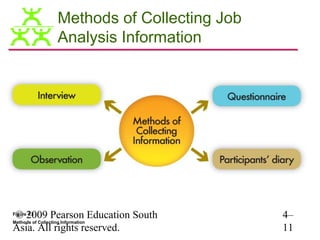
Methods of Collecting Job
                    Analysis Information


© 2009 Pearson Education South
Figure 4.3
                                                4–
Methods of Collecting Information
Asia. All rights reserved.                      11
Methods of Collecting Job Analysis
         Information: The Interview
  Information sources            Interview formats
    – Individual employees          – Structured
    – Groups of                       (Checklist)
      employees with                – Unstructured
      same job                    Advantages
    – Supervisors with              – Quick, direct way to
      knowledge of the job            find overlooked
                                      information.
                                  Disadvantages
                                    – Distorted information
© 2009 Pearson Education South                            4–
Asia. All rights reserved.                                12
Methods of Collecting Job Analysis
          Information: The Interview
  Interview Guidelines
     – The job analyst and supervisor should work together to
       identify the workers who know the job best.
     – Quickly establish rapport with the interviewee.
     – Follow a structured guide or checklist, one that lists open-
       ended questions and provides space for answers.
     – Ask the worker to list his or her duties in order of importance
       and frequency of occurrence.
     – After completing the interview, review and verify the data.


© 2009 Pearson Education South                                        4–
Asia. All rights reserved.                                            13
Methods of Collecting Job Analysis
         Information: Questionnaires
  Information source           Advantages
    – Have employees fill         – Quick and efficient
      out questionnaires to         way to gather
      describe their job-           information from
      related duties and            large numbers of
      responsibilities.             employees
  Questionnaire formats        Disadvantages
    – Structured checklists       – Expense and time
    – Opened-ended                  consumed in
      questions                     preparing and testing
                                    the questionnaire
© 2009 Pearson Education South                          4–
Asia. All rights reserved.                              14
Methods of Collecting Job Analysis
         Information: Observation
   Information source          Advantages
     – Observing and              – Provides first-hand
       noting the physical          information
       activities of              – Reduces distortion of
       employees as they            information
       go about their jobs      Disadvantages
                                  – Time consuming
                                  – Difficulty in capturing
                                    entire job cycle
                                  – Of little use if job
© 2009 Pearson Education South      involves a high level 4–
Asia. All rights reserved.          of mental activity 15
Methods of Collecting Job Analysis
         Information: Participant Diary
  Information source           Advantages
    – Workers keep a              – Produces a more
      chronological diary/          complete picture of the
      log of what they do           job
      and the time spent in       – Employee participation
      each activity             Disadvantages
                                  – Distortion of
                                    information
                                  – Depends upon
                                    employees to
                                    accurately recall their
© 2009 Pearson Education South      activities           4–
Asia. All rights reserved.                               16
Writing Job Descriptions

   A job description
      – A written statement of what the
        worker actually does, how he or she
        does it, and what the job’s working
        conditions are.


© 2009 Pearson Education South                4–
Asia. All rights reserved.                    17
Writing Job Descriptions

  Sections of a typical job description
     – Job identification
     – Job summary
     – Responsibilities and duties
     – Authority of incumbent
     – Standards of performance
     – Working conditions
     – Job specifications

© 2009 Pearson Education South             4–
Asia. All rights reserved.                 18
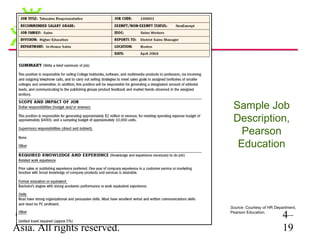
Sample Job
                                  Description,
                                    Pearson
                                   Education


                                 Source: Courtesy of HR Department,

© 2009 Pearson Education South   Pearson Education.
                                                            4–
Asia. All rights reserved.                                  19
Sample Job
                                 Description,
                                   Pearson
                                  Education
                                   (cont’d)


                                 Source: Courtesy of HR
                                   Department, Pearson
© 2009 Pearson Education South                 4–
                                             Education.


Asia. All rights reserved.                     20
The Job Description

  Job identification
     – Job title: name of job
     – Date: when the description was written
     – Prepared by: who wrote the description


  Job summary
     – Describes the general nature of the job
     – Lists the major functions or activities


© 2009 Pearson Education South                   4–
Asia. All rights reserved.                       21
The Job Description

   Relationships (chain of command)
     – Reports to: employee’s immediate supervisor
     – Supervises: employees that the job incumbent
       directly supervises
     – Works with: others with whom the job holder will
       be expected to work and come into contact with
       internally.
      – Outside the company: others with whom the job
        holder is expected to work and come into contact
        with externally.
© 2009 Pearson Education South                           4–
Asia. All rights reserved.                               22
The Job Description

  Responsibilities and duties
     – A listing of the job’s major responsibilities and
       duties (essential functions)
     – Defines limits of jobholder’s decision-making
       authority, direct supervision, and budgetary
       limitations.


© 2009 Pearson Education South                             4–
Asia. All rights reserved.                                 23
The Job Description

   Standards of Performance and Working
    Conditions
      – Lists standards the employee is expected to
        achieve under each of the job description’s main
        duties
      – Standards must be specific
      – Examples:


© 2009 Pearson Education South                             4–
Asia. All rights reserved.                                 24
Writing Job Specifications

   To show what kind of person to recruit and for
    what qualities that person should be tested on
   Either listed in a section of job description or
    in a separate document


© 2009 Pearson Education South                    4–
Asia. All rights reserved.                        25
Writing Job Specifications

   Specifications Based on Judgment
      – Self-created judgments (common sense)
      – Basic question: What does it take in terms of
        education, intelligence and training to do this job
        well?
   Specifications Based on Statistical Analysis
      – Attempts to determine statistically the relationship
        between a predictor or human trait and an
        indicator or criterion of job effectiveness.
      – Five-step procedure:
© 2009 Pearson Education South                                4–
Asia. All rights reserved.                                    26
Writing Job Specifications

                                           Analyze the job and decide how to measure job
                                           Analyze the job and decide how to measure job
                                                            performance
                                                            performance

                                        Select personal traits (like finger dexterity) that you
                                        Select personal traits (like finger dexterity) that you
                                          believe should predict successful performance
                                          believe should predict successful performance

                                                          Test candidates for these traits
                                                          Test candidates for these traits

                                               Measure these candidates’ subsequent job
                                               Measure these candidates’ subsequent job
                                                             performance
                                                             performance

                                           Statistically analyze relationship between the
                                           Statistically analyze relationship between the
                                         human trait (finger dexterity) and job performance
                                         human trait (finger dexterity) and job performance
© 2009 Pearson Education South
Figure 4.8
                                                                                             4–
Determining Job Specifications Through Statistical Analysis
Asia. All rights reserved.                                                                   27
Job Analysis in a “Jobless”
         World
  Job
     – Generally defined as “a set of closely related
       activities carried out for pay.”


© 2009 Pearson Education South                    4–
Asia. All rights reserved.                        28
Job Analysis in a “Jobless”
         World
   From Specialized to Enlarged Jobs
     – Job enlargement
         • Assigning workers additional same level
           activities, thus increasing the number of activities
           they perform.
     – Job enrichment
          • Redesigning jobs in a way that increases the
            opportunities for the worker to experience
            feelings of responsibility, achievement, growth,
            and recognition.
© 2009 Pearson Education South                              4–
Asia. All rights reserved.                                  29
Job Analysis in a “Jobless”
         World
     – Job rotation
        • Moving a trainee from department to department
          to broaden his or her experience and identify
          strong and weak points to prepare the person for
          an enhanced role with the company
        • Systematically moving workers from one job to
          another to enhance work team performance.


© 2009 Pearson Education South                         4–
Asia. All rights reserved.                             30
Job Analysis in a “Jobless”
         World
  Why Managers Are Dejobbing Their Companies
   Dejobbing                     External factors leading
     – Broadening the              to dejobbing.
       responsibilities of the      – Rapid product and
       company’s jobs                 technological change
     – Encouraging employee         – Global competition
       initiative.                  – Deregulation,
   Internal factors leading        – Political instability,
    to dejobbing                    – Demographic changes
     – Flatter organizations        – Rise of a service economy
     – Work teams
     – Re-engineering
© 2009 Pearson Education South                               4–
Asia. All rights reserved.                                   31
Job Analysis in a “Jobless”
         World
  Competencies
     – Demonstrable characteristics of a person that
       enable performance of a job.
  Competency-based job analysis
     – Describing a job in terms of the measurable,
       observable, behavioral competencies (knowledge,
       skills, and/or behaviors) an employee must exhibit
       to do a job well.


© 2009 Pearson Education South                          4–
Asia. All rights reserved.                              32
Job Analysis in a “Jobless”
                   World
     Why Use Competency Analysis?
             – Support HPWS
                  • Traditional job descriptions (with their lists of
                    specific duties) may actually backfire if a high-
                    performance work system is the goal.
                  • HPWS encourages employees to work in a self-
                    motivated manner.


© 2009 Pearson Education South
Figure 4.9
                                                                        4–
Encouraging Employees to Work in a Self-Motivated Way
Asia. All rights reserved.                                              33
Job Analysis in a “Jobless”
         World
  Why Use Competency Analysis? (cont’d)
     – Maintain a strategic focus
        • Describing the job in terms of the skills,
          knowledge, and competencies the worker needs
          is more strategic.
     – Measure performance
        • Measurable skills, knowledge, and competencies
          are the heart of any company’s performance
          management process.

© 2009 Pearson Education South                       4–
Asia. All rights reserved.                           34
Self-Managed Teams (SMT)
         in Asia
  A small group of workers with authority to
   manage their own work
  Set their own targets and schedule
  Inspect their own work
  Review performance as a group
  Allows workers to control their work
   arrangements and job conditions
  Requires technical and decision-making skills

© 2009 Pearson Education South                 4–
Asia. All rights reserved.                     35
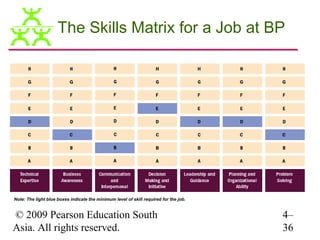
The Skills Matrix for a Job at BP


Note: The light blue boxes indicate the minimum level of skill required for the job.


© 2009 Pearson Education South                                                         4–
Asia. All rights reserved.                                                             36
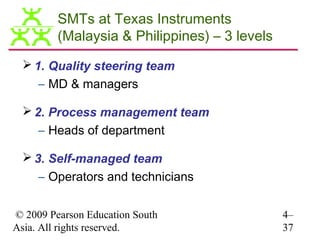
SMTs at Texas Instruments
         (Malaysia & Philippines) – 3 levels
  1. Quality steering team
     – MD & managers

  2. Process management team
     – Heads of department

  3. Self-managed team
     – Operators and technicians


© 2009 Pearson Education South                 4–
Asia. All rights reserved.                     37
SMT at Ritz Carlton
         (Singapore)
  Employees are authorized to spend up to a
   specific amount to please a dissatisfied guest.
  Credo:
     – Do everything you can to never lose a guest.
  SMTs recruit their co-workers, decide on work
   procedures, and handle their own budget.


© 2009 Pearson Education South                        4–
Asia. All rights reserved.                            38
SMT at Becton Dickinson Medical
         (Singapore) – 3 levels

  1. Steering team
     – Senior management to provide direction

  2. Resource team
     – Professionals to support process teams

  3. Process team
     – Employees to manufacture products or
       provide services
© 2009 Pearson Education South                  4–
Asia. All rights reserved.                      39
SMT at Becton Dickinson Medical
          (Singapore) – 3 levels

  The process team leader should:
     –   Coordinate activities
     –   Encourage participation
     –   Facilitate team decision-making
     –   Communicate performance targets


© 2009 Pearson Education South              4–
Asia. All rights reserved.                  40
SMT at Becton Dickinson Medical
         (Singapore) – 3 levels

  Role of team members
     – Understand team goals
     – Participate to solve problems, make
       decisions
     – Perform tasks to achieve standards
     – Monitor results


© 2009 Pearson Education South               4–
Asia. All rights reserved.                   41
SMT at Becton Dickinson Medical
          (Singapore) – 3 levels

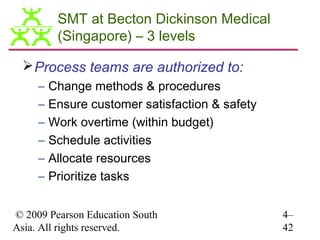
  Process teams are authorized to:
     –   Change methods & procedures
     –   Ensure customer satisfaction & safety
     –   Work overtime (within budget)
     –   Schedule activities
     –   Allocate resources
     –   Prioritize tasks


© 2009 Pearson Education South                   4–
Asia. All rights reserved.                       42

Powerpoint slides

  • 1.
    Human Resource Management: An AsianPerspective (Second Edition) Chapter 4 Job Analysis Gary Dessler and Chwee Huat Tan © 2009 Pearson Education South Asia Pte Ltd. All rights reserved.
  • 2.
    After studying thischapter, you should be able to: 1. Discuss the nature of job analysis (what it is and how it is used) 2. Know how to collect job analysis information, including interview, questionnaire, observation and participant’s diary 3. Write job descriptions, job summaries and job specifications 4. Explain what job analysis is, what it means and how it is done in practice 5. Explain what competence-based job analysis is © 2009 Pearson Education South Asia. All rights reserved. 4–2
  • 3.
    The Nature ofJob Analysis  Job analysis – The procedure for determining the duties and skill requirements of a job and the kind of person who should be hired for it.  Job description – A list of a job’s duties, responsibilities, reporting relationships, working conditions, and supervisory responsibilities—one product of a job analysis.  Job specifications – A list of a job’s “human requirements,” that is, the requisite education, skills, personality, and so on—another product of a job analysis. © 2009 Pearson Education South Asia. All rights reserved. 4–3
  • 4.
    The Nature ofJob Analysis  Type of information collected: – Work activities – Human behaviors – Machines, tools, equipment, and work aids – Performance standards – Job context – Human requirements © 2009 Pearson Education South Asia. All rights reserved. 4–4
  • 5.
    The Nature ofJob Analysis © 2009 Pearson Education South Figure 4.1 Information Collected by HR Specialists Asia. All rights reserved. 4–5
  • 6.
    Uses of JobAnalysis Information © 2009 Pearson Education South Figure 4.2 Uses of Job Analysis Information Asia. All rights reserved. 4–6
  • 7.
    Uses of JobAnalysis Information  Recruitment and selection – Selection of people to recruit based on job requirements and human characteristics needed to perform these jobs  Performance appraisal – Compares employees’ performance with standards which are derived from job analysis © 2009 Pearson Education South Asia. All rights reserved. 4–7
  • 8.
    Uses of JobAnalysis Information  Job evaluation / compensation – Estimate value of each job and its appropriate compensation based on job’s required skill, education level, safety hazard, level of responsibility etc. – Relative worth of job determined to group jobs into different classes  Training requirements – Training requirements based on job and required skills which are listed in the job description © 2009 Pearson Education South Asia. All rights reserved. 4–8
  • 9.
    Steps in JobAnalysis  Step 1: Decide how you’ll use the information.  Step 2: Review relevant background information – organization chart/job description  Step 3: Select representative positions.  Step 4: Actually analyze the job.  Step 5: Verify the job analysis information.  Step 6: Develop a job description and job specification. © 2009 Pearson Education South Asia. All rights reserved. 4–9
  • 10.
    Steps in JobAnalysis  Organization chart – A chart that shows the organization-wide distribution of work, with titles of each position and interconnecting lines that show who reports to and communicates to whom.  Job specification – A list of a job’s “human requirements” i.e. the requisite education, skills, personality etc. © 2009 Pearson Education South 4– Asia. All rights reserved. 10
  • 11.
    Methods of CollectingJob Analysis Information © 2009 Pearson Education South Figure 4.3 4– Methods of Collecting Information Asia. All rights reserved. 11
  • 12.
    Methods of CollectingJob Analysis Information: The Interview  Information sources  Interview formats – Individual employees – Structured – Groups of (Checklist) employees with – Unstructured same job  Advantages – Supervisors with – Quick, direct way to knowledge of the job find overlooked information.  Disadvantages – Distorted information © 2009 Pearson Education South 4– Asia. All rights reserved. 12
  • 13.
    Methods of CollectingJob Analysis Information: The Interview  Interview Guidelines – The job analyst and supervisor should work together to identify the workers who know the job best. – Quickly establish rapport with the interviewee. – Follow a structured guide or checklist, one that lists open- ended questions and provides space for answers. – Ask the worker to list his or her duties in order of importance and frequency of occurrence. – After completing the interview, review and verify the data. © 2009 Pearson Education South 4– Asia. All rights reserved. 13
  • 14.
    Methods of CollectingJob Analysis Information: Questionnaires  Information source  Advantages – Have employees fill – Quick and efficient out questionnaires to way to gather describe their job- information from related duties and large numbers of responsibilities. employees  Questionnaire formats  Disadvantages – Structured checklists – Expense and time – Opened-ended consumed in questions preparing and testing the questionnaire © 2009 Pearson Education South 4– Asia. All rights reserved. 14
  • 15.
    Methods of CollectingJob Analysis Information: Observation  Information source  Advantages – Observing and – Provides first-hand noting the physical information activities of – Reduces distortion of employees as they information go about their jobs  Disadvantages – Time consuming – Difficulty in capturing entire job cycle – Of little use if job © 2009 Pearson Education South involves a high level 4– Asia. All rights reserved. of mental activity 15
  • 16.
    Methods of CollectingJob Analysis Information: Participant Diary  Information source  Advantages – Workers keep a – Produces a more chronological diary/ complete picture of the log of what they do job and the time spent in – Employee participation each activity  Disadvantages – Distortion of information – Depends upon employees to accurately recall their © 2009 Pearson Education South activities 4– Asia. All rights reserved. 16
  • 17.
    Writing Job Descriptions  A job description – A written statement of what the worker actually does, how he or she does it, and what the job’s working conditions are. © 2009 Pearson Education South 4– Asia. All rights reserved. 17
  • 18.
    Writing Job Descriptions  Sections of a typical job description – Job identification – Job summary – Responsibilities and duties – Authority of incumbent – Standards of performance – Working conditions – Job specifications © 2009 Pearson Education South 4– Asia. All rights reserved. 18
  • 19.
    Sample Job Description, Pearson Education Source: Courtesy of HR Department, © 2009 Pearson Education South Pearson Education. 4– Asia. All rights reserved. 19
  • 20.
    Sample Job Description, Pearson Education (cont’d) Source: Courtesy of HR Department, Pearson © 2009 Pearson Education South 4– Education. Asia. All rights reserved. 20
  • 21.
    The Job Description  Job identification – Job title: name of job – Date: when the description was written – Prepared by: who wrote the description  Job summary – Describes the general nature of the job – Lists the major functions or activities © 2009 Pearson Education South 4– Asia. All rights reserved. 21
  • 22.
    The Job Description  Relationships (chain of command) – Reports to: employee’s immediate supervisor – Supervises: employees that the job incumbent directly supervises – Works with: others with whom the job holder will be expected to work and come into contact with internally. – Outside the company: others with whom the job holder is expected to work and come into contact with externally. © 2009 Pearson Education South 4– Asia. All rights reserved. 22
  • 23.
    The Job Description  Responsibilities and duties – A listing of the job’s major responsibilities and duties (essential functions) – Defines limits of jobholder’s decision-making authority, direct supervision, and budgetary limitations. © 2009 Pearson Education South 4– Asia. All rights reserved. 23
  • 24.
    The Job Description  Standards of Performance and Working Conditions – Lists standards the employee is expected to achieve under each of the job description’s main duties – Standards must be specific – Examples: © 2009 Pearson Education South 4– Asia. All rights reserved. 24
  • 25.
    Writing Job Specifications  To show what kind of person to recruit and for what qualities that person should be tested on  Either listed in a section of job description or in a separate document © 2009 Pearson Education South 4– Asia. All rights reserved. 25
  • 26.
    Writing Job Specifications  Specifications Based on Judgment – Self-created judgments (common sense) – Basic question: What does it take in terms of education, intelligence and training to do this job well?  Specifications Based on Statistical Analysis – Attempts to determine statistically the relationship between a predictor or human trait and an indicator or criterion of job effectiveness. – Five-step procedure: © 2009 Pearson Education South 4– Asia. All rights reserved. 26
  • 27.
    Writing Job Specifications Analyze the job and decide how to measure job Analyze the job and decide how to measure job performance performance Select personal traits (like finger dexterity) that you Select personal traits (like finger dexterity) that you believe should predict successful performance believe should predict successful performance Test candidates for these traits Test candidates for these traits Measure these candidates’ subsequent job Measure these candidates’ subsequent job performance performance Statistically analyze relationship between the Statistically analyze relationship between the human trait (finger dexterity) and job performance human trait (finger dexterity) and job performance © 2009 Pearson Education South Figure 4.8 4– Determining Job Specifications Through Statistical Analysis Asia. All rights reserved. 27
  • 28.
    Job Analysis ina “Jobless” World  Job – Generally defined as “a set of closely related activities carried out for pay.” © 2009 Pearson Education South 4– Asia. All rights reserved. 28
  • 29.
    Job Analysis ina “Jobless” World  From Specialized to Enlarged Jobs – Job enlargement • Assigning workers additional same level activities, thus increasing the number of activities they perform. – Job enrichment • Redesigning jobs in a way that increases the opportunities for the worker to experience feelings of responsibility, achievement, growth, and recognition. © 2009 Pearson Education South 4– Asia. All rights reserved. 29
  • 30.
    Job Analysis ina “Jobless” World – Job rotation • Moving a trainee from department to department to broaden his or her experience and identify strong and weak points to prepare the person for an enhanced role with the company • Systematically moving workers from one job to another to enhance work team performance. © 2009 Pearson Education South 4– Asia. All rights reserved. 30
  • 31.
    Job Analysis ina “Jobless” World Why Managers Are Dejobbing Their Companies  Dejobbing  External factors leading – Broadening the to dejobbing. responsibilities of the – Rapid product and company’s jobs technological change – Encouraging employee – Global competition initiative. – Deregulation,  Internal factors leading – Political instability, to dejobbing – Demographic changes – Flatter organizations – Rise of a service economy – Work teams – Re-engineering © 2009 Pearson Education South 4– Asia. All rights reserved. 31
  • 32.
    Job Analysis ina “Jobless” World  Competencies – Demonstrable characteristics of a person that enable performance of a job.  Competency-based job analysis – Describing a job in terms of the measurable, observable, behavioral competencies (knowledge, skills, and/or behaviors) an employee must exhibit to do a job well. © 2009 Pearson Education South 4– Asia. All rights reserved. 32
  • 33.
    Job Analysis ina “Jobless” World  Why Use Competency Analysis? – Support HPWS • Traditional job descriptions (with their lists of specific duties) may actually backfire if a high- performance work system is the goal. • HPWS encourages employees to work in a self- motivated manner. © 2009 Pearson Education South Figure 4.9 4– Encouraging Employees to Work in a Self-Motivated Way Asia. All rights reserved. 33
  • 34.
    Job Analysis ina “Jobless” World  Why Use Competency Analysis? (cont’d) – Maintain a strategic focus • Describing the job in terms of the skills, knowledge, and competencies the worker needs is more strategic. – Measure performance • Measurable skills, knowledge, and competencies are the heart of any company’s performance management process. © 2009 Pearson Education South 4– Asia. All rights reserved. 34
  • 35.
    Self-Managed Teams (SMT) in Asia  A small group of workers with authority to manage their own work  Set their own targets and schedule  Inspect their own work  Review performance as a group  Allows workers to control their work arrangements and job conditions  Requires technical and decision-making skills © 2009 Pearson Education South 4– Asia. All rights reserved. 35
  • 36.
    The Skills Matrixfor a Job at BP Note: The light blue boxes indicate the minimum level of skill required for the job. © 2009 Pearson Education South 4– Asia. All rights reserved. 36
  • 37.
    SMTs at TexasInstruments (Malaysia & Philippines) – 3 levels  1. Quality steering team – MD & managers  2. Process management team – Heads of department  3. Self-managed team – Operators and technicians © 2009 Pearson Education South 4– Asia. All rights reserved. 37
  • 38.
    SMT at RitzCarlton (Singapore)  Employees are authorized to spend up to a specific amount to please a dissatisfied guest.  Credo: – Do everything you can to never lose a guest.  SMTs recruit their co-workers, decide on work procedures, and handle their own budget. © 2009 Pearson Education South 4– Asia. All rights reserved. 38
  • 39.
    SMT at BectonDickinson Medical (Singapore) – 3 levels  1. Steering team – Senior management to provide direction  2. Resource team – Professionals to support process teams  3. Process team – Employees to manufacture products or provide services © 2009 Pearson Education South 4– Asia. All rights reserved. 39
  • 40.
    SMT at BectonDickinson Medical (Singapore) – 3 levels  The process team leader should: – Coordinate activities – Encourage participation – Facilitate team decision-making – Communicate performance targets © 2009 Pearson Education South 4– Asia. All rights reserved. 40
  • 41.
    SMT at BectonDickinson Medical (Singapore) – 3 levels  Role of team members – Understand team goals – Participate to solve problems, make decisions – Perform tasks to achieve standards – Monitor results © 2009 Pearson Education South 4– Asia. All rights reserved. 41
  • 42.
    SMT at BectonDickinson Medical (Singapore) – 3 levels  Process teams are authorized to: – Change methods & procedures – Ensure customer satisfaction & safety – Work overtime (within budget) – Schedule activities – Allocate resources – Prioritize tasks © 2009 Pearson Education South 4– Asia. All rights reserved. 42