Plot of a Story
Every time we read a story or watch a movie, we
always look forward for a very good plot.
Why?
It is because plot is the most important element of
the story. It shows the chronological order or
sequence of events, and in that sequence, we learn
better about the other elements of the story
specifically the characters and the setting. More
importantly, we also learn the moral of the story.
Plot of a Story
A plot is an essential element of a story that shows the sequence of events.
Each particular part reveals the character, setting, problem, and the moral. It is
basically the structure or organization of events that makes up a story. Plot has
six (6) elements: Exposition, Conflict, Rising Action, Climax, Falling Action, and
Resolution.
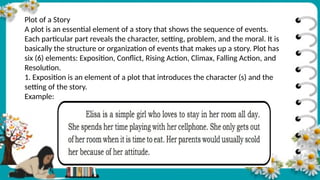
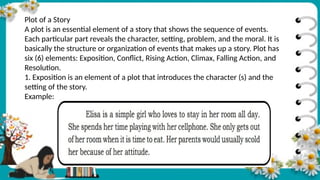
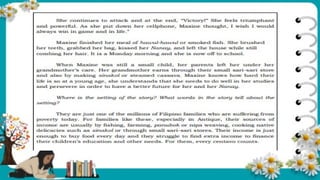
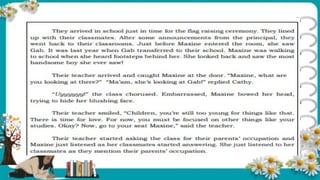
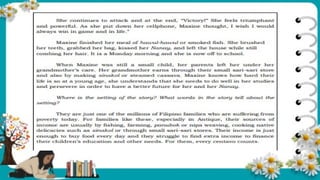
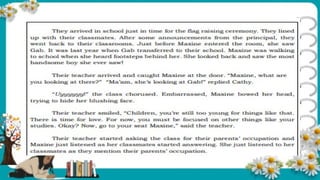
1. Exposition is an element of a plot that introduces the character (s) and the
setting of the story.
Example:
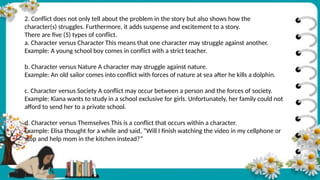
2. Conflict does not only tell about the problem in the story but also shows how the
character(s) struggles. Furthermore, it adds suspense and excitement to a story.
There are five (5) types of conflict.
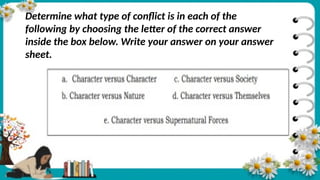
a. Character versus Character This means that one character may struggle against another.
Example: A young school boy comes in conflict with a strict teacher.
b. Character versus Nature A character may struggle against nature.
Example: An old sailor comes into conflict with forces of nature at sea after he kills a dolphin.
c. Character versus Society A conflict may occur between a person and the forces of society.
Example: Kiana wants to study in a school exclusive for girls. Unfortunately, her family could not
afford to send her to a private school.
d. Character versus Themselves This is a conflict that occurs within a character.
Example: Elisa thought for a while and said, “Will I finish watching the video in my cellphone or
stop and help mom in the kitchen instead?”
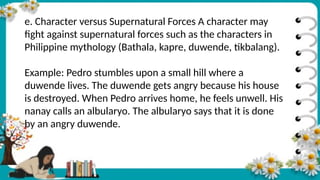
e. Character versus Supernatural Forces A character may
fight against supernatural forces such as the characters in
Philippine mythology (Bathala, kapre, duwende, tikbalang).
Example: Pedro stumbles upon a small hill where a
duwende lives. The duwende gets angry because his house
is destroyed. When Pedro arrives home, he feels unwell. His
nanay calls an albularyo. The albularyo says that it is done
by an angry duwende.
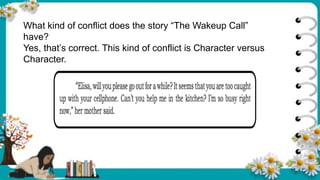
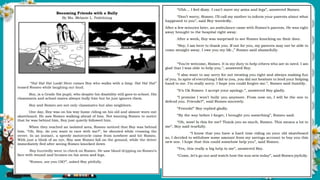
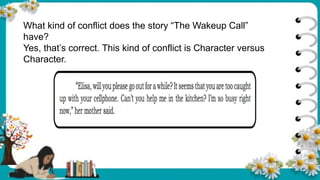
What kind of conflict does the story “The Wakeup Call”
have?
Yes, that’s correct. This kind of conflict is Character versus
Character.
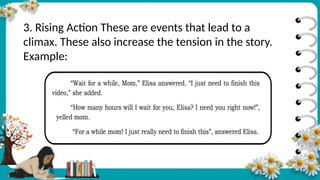
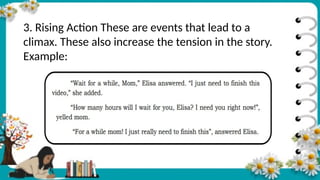
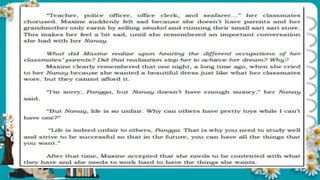
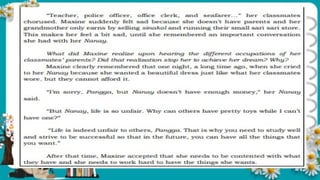
3. Rising Action These are events that lead to a
climax. These also increase the tension in the story.
Example:
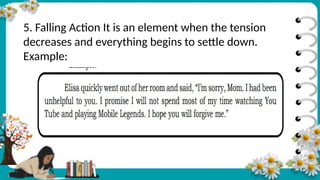
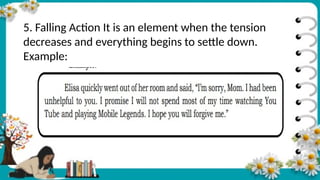
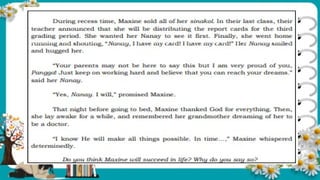
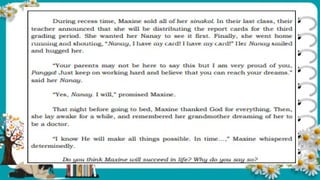
5. Falling Action It is an element when the tension
decreases and everything begins to settle down.
Example:
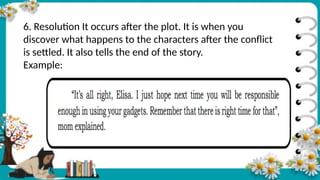
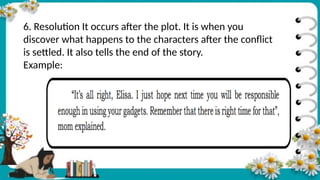
6. Resolution It occurs after the plot. It is when you
discover what happens to the characters after the conflict
is settled. It also tells the end of the story.
Example:
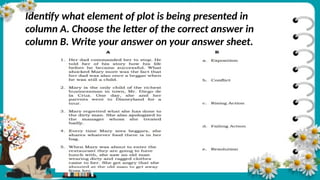
Identify what element of plot is being presented in
column A. Choose the letter of the correct answer in
column B. Write your answer on your answer sheet.
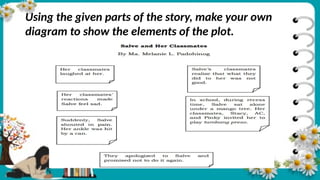
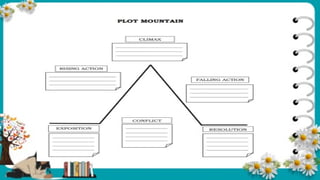
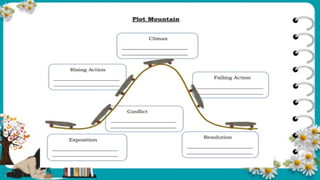
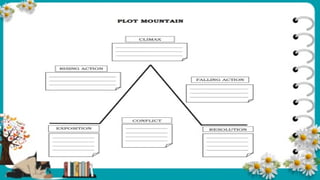
Using the given parts of the story, make your own
diagram to show the elements of the plot.
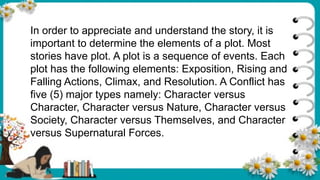
In order to appreciate and understand the story, it is
important to determine the elements of a plot. Most
stories have plot. A plot is a sequence of events. Each
plot has the following elements: Exposition, Rising and
Falling Actions, Climax, and Resolution. A Conflict has
five (5) major types namely: Character versus
Character, Character versus Nature, Character versus
Society, Character versus Themselves, and Character
versus Supernatural Forces.
Plot of a Story
What is a plot
of the story?
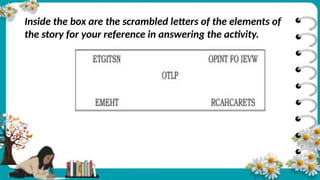
Inside the box are the scrambled letters of the elements of
the story for your reference in answering the activity.
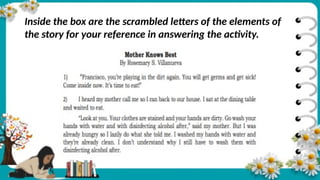
Inside the box are the scrambled letters of the elements of
the story for your reference in answering the activity.
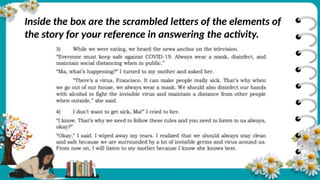
Inside the box are the scrambled letters of the elements of
the story for your reference in answering the activity.
Plot of a Story
A plot is an essential element of a story that shows the sequence of events.
Each particular part reveals the character, setting, problem, and the moral. It is
basically the structure or organization of events that makes up a story. Plot has
six (6) elements: Exposition, Conflict, Rising Action, Climax, Falling Action, and
Resolution.
1. Exposition is an element of a plot that introduces the character (s) and the
setting of the story.
Example:
2. Conflict does not only tell about the problem in the story but also shows how the
character(s) struggles. Furthermore, it adds suspense and excitement to a story.
There are five (5) types of conflict.
a. Character versus Character This means that one character may struggle against another.
Example: A young school boy comes in conflict with a strict teacher.
b. Character versus Nature A character may struggle against nature.
Example: An old sailor comes into conflict with forces of nature at sea after he kills a dolphin.
c. Character versus Society A conflict may occur between a person and the forces of society.
Example: Kiana wants to study in a school exclusive for girls. Unfortunately, her family could not
afford to send her to a private school.
d. Character versus Themselves This is a conflict that occurs within a character.
Example: Elisa thought for a while and said, “Will I finish watching the video in my cellphone or
stop and help mom in the kitchen instead?”
e. Character versus Supernatural Forces A character may
fight against supernatural forces such as the characters in
Philippine mythology (Bathala, kapre, duwende, tikbalang).
Example: Pedro stumbles upon a small hill where a
duwende lives. The duwende gets angry because his house
is destroyed. When Pedro arrives home, he feels unwell. His
nanay calls an albularyo. The albularyo says that it is done
by an angry duwende.
What kind of conflict does the story “The Wakeup Call”
have?
Yes, that’s correct. This kind of conflict is Character versus
Character.
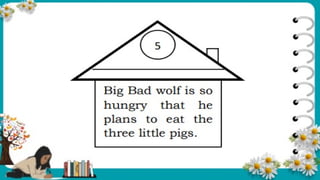
3. Rising Action These are events that lead to a
climax. These also increase the tension in the story.
Example:
5. Falling Action It is an element when the tension
decreases and everything begins to settle down.
Example:
6. Resolution It occurs after the plot. It is when you
discover what happens to the characters after the conflict
is settled. It also tells the end of the story.
Example:
Determine what type of conflict is in each of the
following by choosing the letter of the correct answer
inside the box below. Write your answer on your answer
sheet.
Determine what type of conflict is in each of the
following by choosing the letter of the correct answer
inside the box below. Write your answer on your answer
sheet.
1. Romeo teased Kian in front of their classmates.
2. Mang Kanoy encountered a mermaid while fishing in the
middle of the sea.
3. “Will I help Issa though she bullies me or I won’t lend a hand
to her?” said Mel to herself.
4. People of barangay Pagsubok experienced landslide after
they cut down trees a few months ago.
5. A thief is keeping himself hidden from the public after he stole
huge amount of money from a bank.
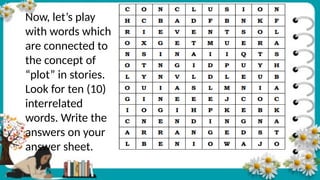
Now, let’s play
with words which
are connected to
the concept of
“plot” in stories.
Look for ten (10)
interrelated
words. Write the
answers on your
answer sheet.
In order to appreciate and understand the story, it is
important to determine the elements of a plot. Most
stories have plot. A plot is a sequence of events. Each
plot has the following elements: Exposition, Rising and
Falling Actions, Climax, and Resolution. A Conflict has
five (5) major types namely: Character versus
Character, Character versus Nature, Character versus
Society, Character versus Themselves, and Character
versus Supernatural Forces.
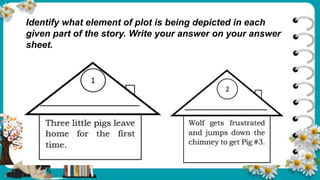
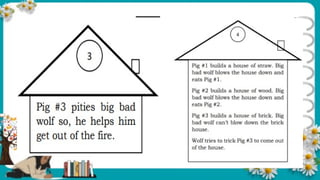
Identify what element of plot is being depicted in each
given part of the story. Write your answer on your answer
sheet.
Plot of a Story
What do you usually do after reading a
story that you like or dislike? Do you
answer the questions asked? Do you
talk about it with friends? Do you ask
them to read it, too?
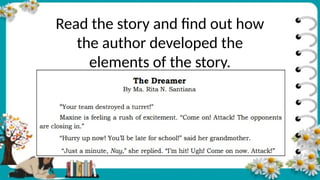
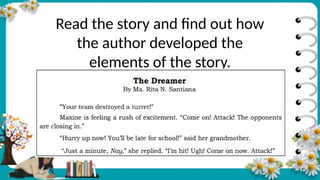
Read the story and find out how
the author developed the
elements of the story.
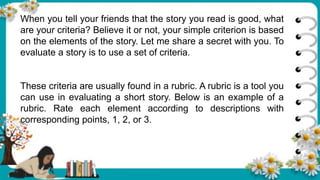
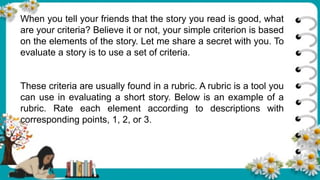
When you tell your friends that the story you read is good, what
are your criteria? Believe it or not, your simple criterion is based
on the elements of the story. Let me share a secret with you. To
evaluate a story is to use a set of criteria.
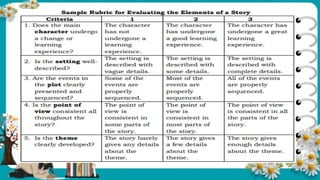
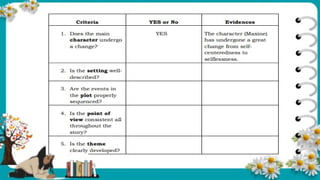
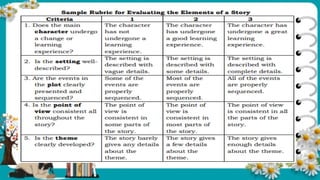
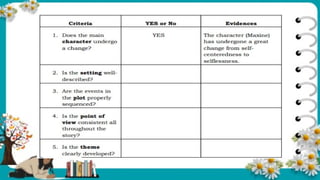
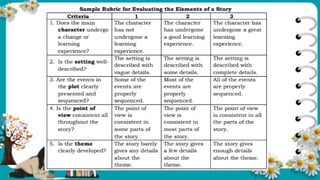
These criteria are usually found in a rubric. A rubric is a tool you
can use in evaluating a short story. Below is an example of a
rubric. Rate each element according to descriptions with
corresponding points, 1, 2, or 3.
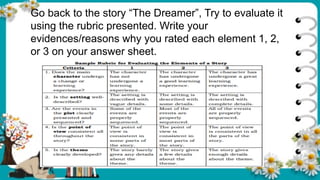
Go back to the story “The Dreamer”, Try to evaluate it
using the rubric presented. Write your
evidences/reasons why you rated each element 1, 2,
or 3 on your answer sheet.
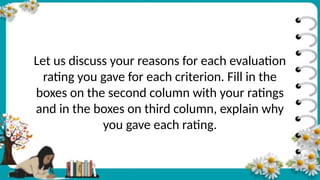
Let us discuss your reasons for each evaluation
rating you gave for each criterion. Fill in the
boxes on the second column with your ratings
and in the boxes on third column, explain why
you gave each rating.
Since you have learned the five elements of a story, you
can now easily identify them in a story. You can point out
the plot, where and when the setting is, who the characters
are, what the conflict of the story is, and what the overall
theme is. You have also evaluated a story using a rubric.
Having done that, did you find the rubric helpful in
evaluating the story?
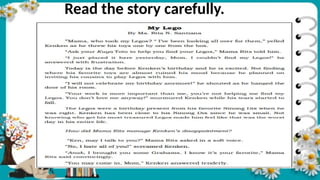
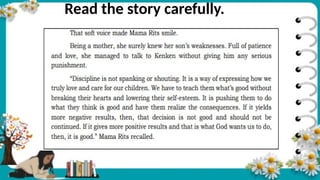
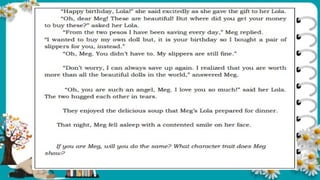
Read the story carefully.
1. Who is the main character of the story?
2. Where is the setting of the story?
3. Enumerate the important events in the
story.
4. From whose point of view is the story
written?
5. What is the theme of the story?
Plot of a Story
LET PUPILS
READ STORY
Read the story and find out how
the author developed the
elements of the story.
When you tell your friends that the story you read is good, what
are your criteria? Believe it or not, your simple criterion is based
on the elements of the story. Let me share a secret with you. To
evaluate a story is to use a set of criteria.
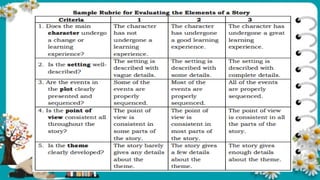
These criteria are usually found in a rubric. A rubric is a tool you
can use in evaluating a short story. Below is an example of a
rubric. Rate each element according to descriptions with
corresponding points, 1, 2, or 3.
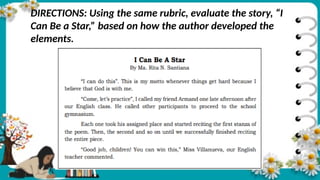
DIRECTIONS: Using the same rubric, evaluate the story, “I
Can Be a Star,” based on how the author developed the
elements.
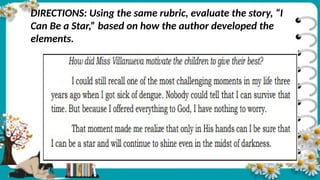
DIRECTIONS: Using the same rubric, evaluate the story, “I
Can Be a Star,” based on how the author developed the
elements.
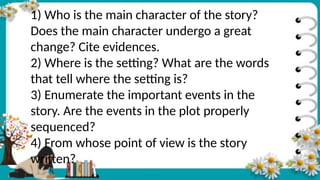
1) Who is the main character of the story?
Does the main character undergo a great
change? Cite evidences.
2) Where is the setting? What are the words
that tell where the setting is?
3) Enumerate the important events in the
story. Are the events in the plot properly
sequenced?
4) From whose point of view is the story
written?
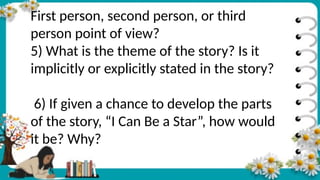
First person, second person, or third
person point of view?
5) What is the theme of the story? Is it
implicitly or explicitly stated in the story?
6) If given a chance to develop the parts
of the story, “I Can Be a Star”, how would
it be? Why?
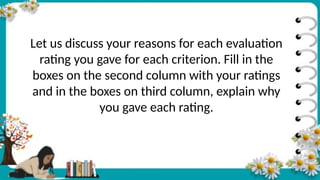
Let us discuss your reasons for each evaluation
rating you gave for each criterion. Fill in the
boxes on the second column with your ratings
and in the boxes on third column, explain why
you gave each rating.
Since you have learned the five elements of a story, you
can now easily identify them in a story. You can point out
the plot, where and when the setting is, who the characters
are, what the conflict of the story is, and what the overall
theme is. You have also evaluated a story using a rubric.
Having done that, did you find the rubric helpful in
evaluating the story?
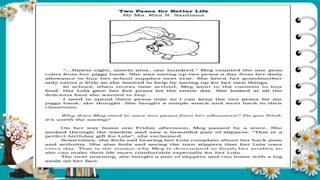
DIRECTIONS: Using the same rubric,
evaluate the story, “Two Pesos for
Better Life,” based on how the author
developed the elements.
POWERPOINT PRESENTATION ON STORY PLOT .pptx

POWERPOINT PRESENTATION ON STORY PLOT .pptx

  • 1.
    Plot of aStory
  • 2.
    Every time weread a story or watch a movie, we always look forward for a very good plot. Why? It is because plot is the most important element of the story. It shows the chronological order or sequence of events, and in that sequence, we learn better about the other elements of the story specifically the characters and the setting. More importantly, we also learn the moral of the story.
  • 3.
    Plot of aStory A plot is an essential element of a story that shows the sequence of events. Each particular part reveals the character, setting, problem, and the moral. It is basically the structure or organization of events that makes up a story. Plot has six (6) elements: Exposition, Conflict, Rising Action, Climax, Falling Action, and Resolution. 1. Exposition is an element of a plot that introduces the character (s) and the setting of the story. Example:
  • 4.
    2. Conflict doesnot only tell about the problem in the story but also shows how the character(s) struggles. Furthermore, it adds suspense and excitement to a story. There are five (5) types of conflict. a. Character versus Character This means that one character may struggle against another. Example: A young school boy comes in conflict with a strict teacher. b. Character versus Nature A character may struggle against nature. Example: An old sailor comes into conflict with forces of nature at sea after he kills a dolphin. c. Character versus Society A conflict may occur between a person and the forces of society. Example: Kiana wants to study in a school exclusive for girls. Unfortunately, her family could not afford to send her to a private school. d. Character versus Themselves This is a conflict that occurs within a character. Example: Elisa thought for a while and said, “Will I finish watching the video in my cellphone or stop and help mom in the kitchen instead?”
  • 5.
    e. Character versusSupernatural Forces A character may fight against supernatural forces such as the characters in Philippine mythology (Bathala, kapre, duwende, tikbalang). Example: Pedro stumbles upon a small hill where a duwende lives. The duwende gets angry because his house is destroyed. When Pedro arrives home, he feels unwell. His nanay calls an albularyo. The albularyo says that it is done by an angry duwende.
  • 6.
    What kind ofconflict does the story “The Wakeup Call” have? Yes, that’s correct. This kind of conflict is Character versus Character.
  • 7.
    3. Rising ActionThese are events that lead to a climax. These also increase the tension in the story. Example:
  • 8.
    5. Falling ActionIt is an element when the tension decreases and everything begins to settle down. Example:
  • 9.
    6. Resolution Itoccurs after the plot. It is when you discover what happens to the characters after the conflict is settled. It also tells the end of the story. Example:
  • 10.
    Identify what elementof plot is being presented in column A. Choose the letter of the correct answer in column B. Write your answer on your answer sheet.
  • 11.
    Using the givenparts of the story, make your own diagram to show the elements of the plot.
  • 13.
    In order toappreciate and understand the story, it is important to determine the elements of a plot. Most stories have plot. A plot is a sequence of events. Each plot has the following elements: Exposition, Rising and Falling Actions, Climax, and Resolution. A Conflict has five (5) major types namely: Character versus Character, Character versus Nature, Character versus Society, Character versus Themselves, and Character versus Supernatural Forces.
  • 16.
    Plot of aStory
  • 17.
    What is aplot of the story?
  • 18.
    Inside the boxare the scrambled letters of the elements of the story for your reference in answering the activity.
  • 19.
    Inside the boxare the scrambled letters of the elements of the story for your reference in answering the activity.
  • 20.
    Inside the boxare the scrambled letters of the elements of the story for your reference in answering the activity.
  • 21.
    Plot of aStory A plot is an essential element of a story that shows the sequence of events. Each particular part reveals the character, setting, problem, and the moral. It is basically the structure or organization of events that makes up a story. Plot has six (6) elements: Exposition, Conflict, Rising Action, Climax, Falling Action, and Resolution. 1. Exposition is an element of a plot that introduces the character (s) and the setting of the story. Example:
  • 22.
    2. Conflict doesnot only tell about the problem in the story but also shows how the character(s) struggles. Furthermore, it adds suspense and excitement to a story. There are five (5) types of conflict. a. Character versus Character This means that one character may struggle against another. Example: A young school boy comes in conflict with a strict teacher. b. Character versus Nature A character may struggle against nature. Example: An old sailor comes into conflict with forces of nature at sea after he kills a dolphin. c. Character versus Society A conflict may occur between a person and the forces of society. Example: Kiana wants to study in a school exclusive for girls. Unfortunately, her family could not afford to send her to a private school. d. Character versus Themselves This is a conflict that occurs within a character. Example: Elisa thought for a while and said, “Will I finish watching the video in my cellphone or stop and help mom in the kitchen instead?”
  • 23.
    e. Character versusSupernatural Forces A character may fight against supernatural forces such as the characters in Philippine mythology (Bathala, kapre, duwende, tikbalang). Example: Pedro stumbles upon a small hill where a duwende lives. The duwende gets angry because his house is destroyed. When Pedro arrives home, he feels unwell. His nanay calls an albularyo. The albularyo says that it is done by an angry duwende.
  • 24.
    What kind ofconflict does the story “The Wakeup Call” have? Yes, that’s correct. This kind of conflict is Character versus Character.
  • 25.
    3. Rising ActionThese are events that lead to a climax. These also increase the tension in the story. Example:
  • 26.
    5. Falling ActionIt is an element when the tension decreases and everything begins to settle down. Example:
  • 27.
    6. Resolution Itoccurs after the plot. It is when you discover what happens to the characters after the conflict is settled. It also tells the end of the story. Example:
  • 28.
    Determine what typeof conflict is in each of the following by choosing the letter of the correct answer inside the box below. Write your answer on your answer sheet.
  • 29.
    Determine what typeof conflict is in each of the following by choosing the letter of the correct answer inside the box below. Write your answer on your answer sheet. 1. Romeo teased Kian in front of their classmates. 2. Mang Kanoy encountered a mermaid while fishing in the middle of the sea. 3. “Will I help Issa though she bullies me or I won’t lend a hand to her?” said Mel to herself. 4. People of barangay Pagsubok experienced landslide after they cut down trees a few months ago. 5. A thief is keeping himself hidden from the public after he stole huge amount of money from a bank.
  • 30.
    Now, let’s play withwords which are connected to the concept of “plot” in stories. Look for ten (10) interrelated words. Write the answers on your answer sheet.
  • 32.
    In order toappreciate and understand the story, it is important to determine the elements of a plot. Most stories have plot. A plot is a sequence of events. Each plot has the following elements: Exposition, Rising and Falling Actions, Climax, and Resolution. A Conflict has five (5) major types namely: Character versus Character, Character versus Nature, Character versus Society, Character versus Themselves, and Character versus Supernatural Forces.
  • 33.
    Identify what elementof plot is being depicted in each given part of the story. Write your answer on your answer sheet.
  • 36.
    Plot of aStory
  • 37.
    What do youusually do after reading a story that you like or dislike? Do you answer the questions asked? Do you talk about it with friends? Do you ask them to read it, too?
  • 38.
    Read the storyand find out how the author developed the elements of the story.
  • 43.
    When you tellyour friends that the story you read is good, what are your criteria? Believe it or not, your simple criterion is based on the elements of the story. Let me share a secret with you. To evaluate a story is to use a set of criteria. These criteria are usually found in a rubric. A rubric is a tool you can use in evaluating a short story. Below is an example of a rubric. Rate each element according to descriptions with corresponding points, 1, 2, or 3.
  • 45.
    Go back tothe story “The Dreamer”, Try to evaluate it using the rubric presented. Write your evidences/reasons why you rated each element 1, 2, or 3 on your answer sheet.
  • 46.
    Let us discussyour reasons for each evaluation rating you gave for each criterion. Fill in the boxes on the second column with your ratings and in the boxes on third column, explain why you gave each rating.
  • 48.
    Since you havelearned the five elements of a story, you can now easily identify them in a story. You can point out the plot, where and when the setting is, who the characters are, what the conflict of the story is, and what the overall theme is. You have also evaluated a story using a rubric. Having done that, did you find the rubric helpful in evaluating the story?
  • 49.
    Read the storycarefully.
  • 50.
    Read the storycarefully.
  • 51.
    1. Who isthe main character of the story? 2. Where is the setting of the story? 3. Enumerate the important events in the story. 4. From whose point of view is the story written? 5. What is the theme of the story?
  • 52.
    Plot of aStory
  • 53.
  • 54.
    Read the storyand find out how the author developed the elements of the story.
  • 59.
    When you tellyour friends that the story you read is good, what are your criteria? Believe it or not, your simple criterion is based on the elements of the story. Let me share a secret with you. To evaluate a story is to use a set of criteria. These criteria are usually found in a rubric. A rubric is a tool you can use in evaluating a short story. Below is an example of a rubric. Rate each element according to descriptions with corresponding points, 1, 2, or 3.
  • 61.
    DIRECTIONS: Using thesame rubric, evaluate the story, “I Can Be a Star,” based on how the author developed the elements.
  • 62.
    DIRECTIONS: Using thesame rubric, evaluate the story, “I Can Be a Star,” based on how the author developed the elements.
  • 63.
    1) Who isthe main character of the story? Does the main character undergo a great change? Cite evidences. 2) Where is the setting? What are the words that tell where the setting is? 3) Enumerate the important events in the story. Are the events in the plot properly sequenced? 4) From whose point of view is the story written?
  • 64.
    First person, secondperson, or third person point of view? 5) What is the theme of the story? Is it implicitly or explicitly stated in the story? 6) If given a chance to develop the parts of the story, “I Can Be a Star”, how would it be? Why?
  • 66.
    Let us discussyour reasons for each evaluation rating you gave for each criterion. Fill in the boxes on the second column with your ratings and in the boxes on third column, explain why you gave each rating.
  • 68.
    Since you havelearned the five elements of a story, you can now easily identify them in a story. You can point out the plot, where and when the setting is, who the characters are, what the conflict of the story is, and what the overall theme is. You have also evaluated a story using a rubric. Having done that, did you find the rubric helpful in evaluating the story?
  • 69.
    DIRECTIONS: Using thesame rubric, evaluate the story, “Two Pesos for Better Life,” based on how the author developed the elements.