LAW OF CRIMESLAW OF CRIMES
  
ByBy
Dr.P.R.L.RAJAVENKATESANDr.P.R.L.RAJAVENKATESAN
Assistant Professor(Senior)Assistant Professor(Senior)
VIT Law SchoolVIT Law School
ChennaiChennai
INDIAN PENAL CODEINDIAN PENAL CODE
 Sec.1. Title and extent of operation of the CodeSec.1. Title and extent of operation of the Code
 Sec.2.Punishment of offences committed withinSec.2.Punishment of offences committed within
IndiaIndia
 Mobarak Ali v. State of Bombay,AIR 1957 SCMobarak Ali v. State of Bombay,AIR 1957 SC
857857
 Pakistani citizen staying at karachi made flasePakistani citizen staying at karachi made flase
representation and instructed to give money torepresentation and instructed to give money to
his agents for the purpose of importing tohis agents for the purpose of importing to
India . Actually rice did not supplied.India . Actually rice did not supplied.
INDIAN PENAL CODEINDIAN PENAL CODE
 Art.361 of the Constitution of IndiaArt.361 of the Constitution of India
 ““no criminal proceedings shall be institutedno criminal proceedings shall be instituted
against the president or governor of a state , inagainst the president or governor of a state , in
any court during his term of office”any court during his term of office”
 Statham v. Statham and the Gaekwad ofStatham v. Statham and the Gaekwad of
Baroda,(1912) IA 92.Baroda,(1912) IA 92.
 head of the state enjoyed all the attributes ofhead of the state enjoyed all the attributes of
sovereignty and so could not be prosecuted onsovereignty and so could not be prosecuted on
criminal charge of adultery.criminal charge of adultery.
INDIAN PENAL CODEINDIAN PENAL CODE
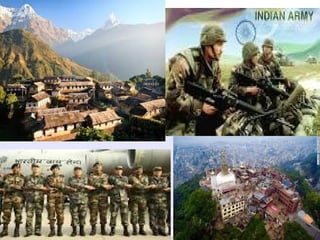
 Section.3.Punishment of offences committedSection.3.Punishment of offences committed
beyond, but which by law may be tried withinbeyond, but which by law may be tried within
,India. Extra territorial operation of the code.,India. Extra territorial operation of the code.
 Sec.4.Extension of the code to extra territorialSec.4.Extension of the code to extra territorial
jurisdictionjurisdiction
INDIAN PENAL CODEINDIAN PENAL CODE
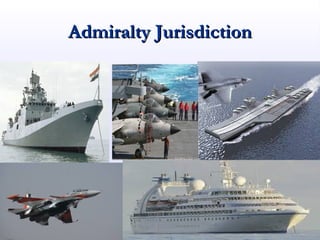
Admiralty JurisdictionAdmiralty Jurisdiction

Indian Penal CodeIndian Penal Code
 Sec.5.Certain Laws not to be affected by thisSec.5.Certain Laws not to be affected by this
Act.Act.
 Punishing mutiny and desertion ofPunishing mutiny and desertion of
officers,soldiers,sailors or airman in the serviceofficers,soldiers,sailors or airman in the service
of the government of india or the provision ofof the government of india or the provision of
any special or local law.any special or local law.
 Special law-Applicable to a particular part ofSpecial law-Applicable to a particular part of
indiaindia
 Local law-Particular part of indiaLocal law-Particular part of india
 Maharashtra Control of Organised Crimes ActMaharashtra Control of Organised Crimes Act
General ExplanationsGeneral Explanations
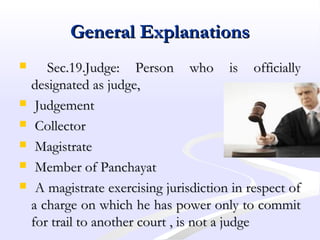
 Sec.19.Judge: Person who is officiallySec.19.Judge: Person who is officially
designated as judge,designated as judge,
 JudgementJudgement
 CollectorCollector
 MagistrateMagistrate
 Member of PanchayatMember of Panchayat
 A magistrate exercising jurisdiction in respect ofA magistrate exercising jurisdiction in respect of
a charge on which he has power only to commita charge on which he has power only to commit
for trail to another court , is not a judgefor trail to another court , is not a judge
General ExplanationsGeneral Explanations
 Abboy Naidu v Kannianppa Chettiar ,AIR 1929Abboy Naidu v Kannianppa Chettiar ,AIR 1929
Mad 175.Mad 175.
 The Madras High Court has defined the termThe Madras High Court has defined the term
‘legal proceeding’ as a proceeding regulated or‘legal proceeding’ as a proceeding regulated or
prescribed by law in which a judicial decision isprescribed by law in which a judicial decision is
accorded.accorded.
General ExplanationsGeneral Explanations
 Sec.20. “Court of Justice”Sec.20. “Court of Justice”
 Denote a judge who is empowered by law to actDenote a judge who is empowered by law to act
judicially alone, or a body of judges which isjudicially alone, or a body of judges which is
empowered by law to act judicially as a body, whenempowered by law to act judicially as a body, when
such judge or body of judges is acting judicially.such judge or body of judges is acting judicially.
 King palaceKing palace
 Court means a place where justice is judiciallyCourt means a place where justice is judicially
administeredadministered
 When a judge is merely performing administrativeWhen a judge is merely performing administrative
function he is not a court of justicefunction he is not a court of justice
General ExplanationsGeneral Explanations
 Section.22. “Movable property”Section.22. “Movable property”
 The word movable property are intended toThe word movable property are intended to
include corporeal property of every description ,include corporeal property of every description ,
except land and things attached to the earth orexcept land and things attached to the earth or
permanently fastened to anything which ispermanently fastened to anything which is
attached to earth.attached to earth.
Power point.07.08.2015

Power point.07.08.2015

  • 1.
    LAW OF CRIMESLAWOF CRIMES    ByBy Dr.P.R.L.RAJAVENKATESANDr.P.R.L.RAJAVENKATESAN Assistant Professor(Senior)Assistant Professor(Senior) VIT Law SchoolVIT Law School ChennaiChennai
  • 2.
    INDIAN PENAL CODEINDIANPENAL CODE  Sec.1. Title and extent of operation of the CodeSec.1. Title and extent of operation of the Code  Sec.2.Punishment of offences committed withinSec.2.Punishment of offences committed within IndiaIndia  Mobarak Ali v. State of Bombay,AIR 1957 SCMobarak Ali v. State of Bombay,AIR 1957 SC 857857  Pakistani citizen staying at karachi made flasePakistani citizen staying at karachi made flase representation and instructed to give money torepresentation and instructed to give money to his agents for the purpose of importing tohis agents for the purpose of importing to India . Actually rice did not supplied.India . Actually rice did not supplied.
  • 4.
    INDIAN PENAL CODEINDIANPENAL CODE  Art.361 of the Constitution of IndiaArt.361 of the Constitution of India  ““no criminal proceedings shall be institutedno criminal proceedings shall be instituted against the president or governor of a state , inagainst the president or governor of a state , in any court during his term of office”any court during his term of office”  Statham v. Statham and the Gaekwad ofStatham v. Statham and the Gaekwad of Baroda,(1912) IA 92.Baroda,(1912) IA 92.  head of the state enjoyed all the attributes ofhead of the state enjoyed all the attributes of sovereignty and so could not be prosecuted onsovereignty and so could not be prosecuted on criminal charge of adultery.criminal charge of adultery.
  • 6.
    INDIAN PENAL CODEINDIANPENAL CODE  Section.3.Punishment of offences committedSection.3.Punishment of offences committed beyond, but which by law may be tried withinbeyond, but which by law may be tried within ,India. Extra territorial operation of the code.,India. Extra territorial operation of the code.  Sec.4.Extension of the code to extra territorialSec.4.Extension of the code to extra territorial jurisdictionjurisdiction
  • 8.
  • 9.
  • 10.
    Indian Penal CodeIndianPenal Code  Sec.5.Certain Laws not to be affected by thisSec.5.Certain Laws not to be affected by this Act.Act.  Punishing mutiny and desertion ofPunishing mutiny and desertion of officers,soldiers,sailors or airman in the serviceofficers,soldiers,sailors or airman in the service of the government of india or the provision ofof the government of india or the provision of any special or local law.any special or local law.  Special law-Applicable to a particular part ofSpecial law-Applicable to a particular part of indiaindia  Local law-Particular part of indiaLocal law-Particular part of india  Maharashtra Control of Organised Crimes ActMaharashtra Control of Organised Crimes Act
  • 11.
    General ExplanationsGeneral Explanations Sec.19.Judge: Person who is officiallySec.19.Judge: Person who is officially designated as judge,designated as judge,  JudgementJudgement  CollectorCollector  MagistrateMagistrate  Member of PanchayatMember of Panchayat  A magistrate exercising jurisdiction in respect ofA magistrate exercising jurisdiction in respect of a charge on which he has power only to commita charge on which he has power only to commit for trail to another court , is not a judgefor trail to another court , is not a judge
  • 12.
    General ExplanationsGeneral Explanations Abboy Naidu v Kannianppa Chettiar ,AIR 1929Abboy Naidu v Kannianppa Chettiar ,AIR 1929 Mad 175.Mad 175.  The Madras High Court has defined the termThe Madras High Court has defined the term ‘legal proceeding’ as a proceeding regulated or‘legal proceeding’ as a proceeding regulated or prescribed by law in which a judicial decision isprescribed by law in which a judicial decision is accorded.accorded.
  • 13.
    General ExplanationsGeneral Explanations Sec.20. “Court of Justice”Sec.20. “Court of Justice”  Denote a judge who is empowered by law to actDenote a judge who is empowered by law to act judicially alone, or a body of judges which isjudicially alone, or a body of judges which is empowered by law to act judicially as a body, whenempowered by law to act judicially as a body, when such judge or body of judges is acting judicially.such judge or body of judges is acting judicially.  King palaceKing palace  Court means a place where justice is judiciallyCourt means a place where justice is judicially administeredadministered  When a judge is merely performing administrativeWhen a judge is merely performing administrative function he is not a court of justicefunction he is not a court of justice
  • 14.
    General ExplanationsGeneral Explanations Section.22. “Movable property”Section.22. “Movable property”  The word movable property are intended toThe word movable property are intended to include corporeal property of every description ,include corporeal property of every description , except land and things attached to the earth orexcept land and things attached to the earth or permanently fastened to anything which ispermanently fastened to anything which is attached to earth.attached to earth.