VINAY KUMAR
INDIAN JUDICIALSYSTEM
Indian polity is governed by three pillars: Legislature, Executive and
Judiciary.
Judiciary is the branch of government that interprets the law, settles
disputes and ensure justice. It is the watchdog of democracy and
guardian of the constitution.
Judicial magistrate firstclass (jmfc)
It is a judicial officer in the Indian legal system who holds authority to
presides over certain types of cases and matters within their jurisdiction.
The role of a JMFC is primarily associated with the lower judiciary and
involves handling a variety of legal proceedings.
5.
VINAY KUMAR
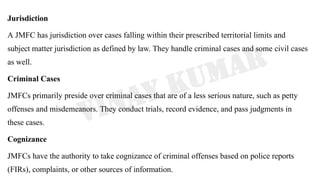
Jurisdiction
A JMFChas jurisdiction over cases falling within their prescribed territorial limits and
subject matter jurisdiction as defined by law. They handle criminal cases and some civil cases
as well.
Criminal Cases
JMFCs primarily preside over criminal cases that are of a less serious nature, such as petty
offenses and misdemeanors. They conduct trials, record evidence, and pass judgments in
these cases.
Cognizance
JMFCs have the authority to take cognizance of criminal offenses based on police reports
(FIRs), complaints, or other sources of information.
6.
VINAY KUMAR
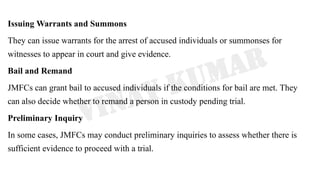
Issuing Warrantsand Summons
They can issue warrants for the arrest of accused individuals or summonses for
witnesses to appear in court and give evidence.
Bail and Remand
JMFCs can grant bail to accused individuals if the conditions for bail are met. They
can also decide whether to remand a person in custody pending trial.
Preliminary Inquiry
In some cases, JMFCs may conduct preliminary inquiries to assess whether there is
sufficient evidence to proceed with a trial.
7.
VINAY KUMAR
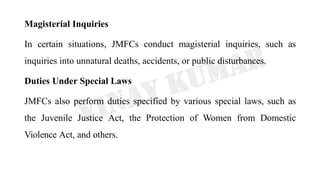
Magisterial Inquiries
Incertain situations, JMFCs conduct magisterial inquiries, such as
inquiries into unnatural deaths, accidents, or public disturbances.
Duties Under Special Laws
JMFCs also perform duties specified by various special laws, such as
the Juvenile Justice Act, the Protection of Women from Domestic
Violence Act, and others.
8.
VINAY KUMAR
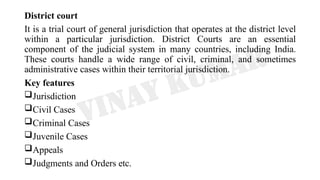
District court
Itis a trial court of general jurisdiction that operates at the district level
within a particular jurisdiction. District Courts are an essential
component of the judicial system in many countries, including India.
These courts handle a wide range of civil, criminal, and sometimes
administrative cases within their territorial jurisdiction.
Key features
Jurisdiction
Civil Cases
Criminal Cases
Juvenile Cases
Appeals
Judgments and Orders etc.
9.
The high
court
The HighCourt is a superior court within the judicial system of India
and serves as the highest authority within a state or union territory. Each
state and union territory in India has its own High Court. High Courts
have a pivotal role in the administration of justice, ensuring the proper
implementation of laws, and safeguarding fundamental rights.
10.
VINAY KUMAR
Key Featuresand Functions of High Courts in India
Original Jurisdiction
High Courts have original jurisdiction to hear certain types of cases, such as those
involving constitutional issues, disputes between the state government and the central
government, and matters of public interest.
Appellate Jurisdiction
High Courts primarily function as appellate courts, hearing appeals from lower courts,
such as District Courts and Subordinate Courts, within their respective state or union
territory.
Writ Jurisdiction
High Courts have the power to issue writs such as habeas corpus, mandamus, certiorari,
prohibition, and quo warranto to enforce fundamental rights and ensure justice.
11.
VINAY KUMAR
Cases ofPublic Importance
High Courts deal with cases that have a significant impact on public interest, governance,
and policy implementation.
Judicial Review
High Courts perform judicial review of decisions made by lower courts and
administrative bodies to ensure that they are in accordance with the
law.
Administrative Matters
High Courts deal with administrative and disciplinary matters related to judges and
judicial officers within their jurisdiction.
12.
VINAY KUMAR
The supreme(apex) court
The Supreme Court of India is the highest judicial authority in the country
and serves as the apex court in the Indian legal system. It holds a pivotal role
in interpreting the Constitution, ensuring the rule of law, and safeguarding
the rights and liberties of citizens.
Key features
Appellate jurisdiction
Writ jurisdiction
Advisory jurisdiction
Review and curative jurisdiction
Appointments and Transfers
Contempt of court
Judicial activism
13.
VINAY KUMAR
INQUEST
Inquest isdefined as an official process of inquiry or investigation to
discover the cause of death where death is not apparently due to natural
cause.
Indications of Inquest
Sudden death
Suicide, homicide or infanticide
Unexplained death from fall injury or burning
Death due to accident, poisoning or drug over dose
Death during operation or under anaesthesia or postoperative shock
Death of a convict in jailor police custody or mental hospital
Death due to dowry
Death due to alleged medical negligence
VINAY KUMAR
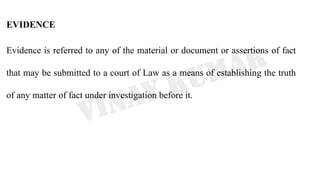
EVIDENCE
Evidence isreferred to any of the material or document or assertions of fact
that may be submitted to a court of Law as a means of establishing the truth
of any matter of fact under investigation before it.
16.
VINAY KUMAR
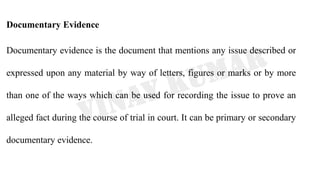
Documentary Evidence
Documentaryevidence is the document that mentions any issue described or
expressed upon any material by way of letters, figures or marks or by more
than one of the ways which can be used for recording the issue to prove an
alleged fact during the course of trial in court. It can be primary or secondary
documentary evidence.
VINAY KUMAR
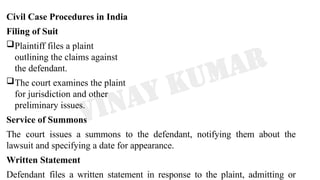
Civil CaseProcedures in India
Filing of Suit
Plaintiff files a plaint
outlining the claims against
the defendant.
The court examines the plaint
for jurisdiction and other
preliminary issues.
Service of Summons
The court issues a summons to the defendant, notifying them about the
lawsuit and specifying a date for appearance.
Written Statement
Defendant files a written statement in response to the plaint, admitting or
19.
VINAY KUMAR
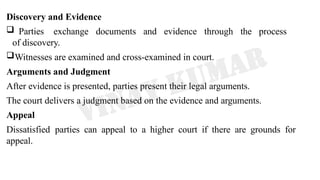
Discovery andEvidence
Parties exchange documents and evidence through the process
of discovery.
Witnesses are examined and cross-examined in court.
Arguments and Judgment
After evidence is presented, parties present their legal arguments.
The court delivers a judgment based on the evidence and arguments.
Appeal
Dissatisfied parties can appeal to a higher court if there are grounds for
appeal.
20.
VINAY KUMAR
Criminal CaseProcedures in India
First Information Report (FIR)
A criminal case begins with the lodging of an FIR with the police,
detailing the alleged criminal offense.
Investigation
The police investigate the case, gather evidence, and may arrest the accused
if necessary.
Filing of Chargesheet
If the police find sufficient evidence, they file a chargesheet in court,
formally accusing the accused.
21.
VINAY KUMAR
Cognizance andSummons/Warrant
The court takes cognizance of the chargesheet and issues summonses or
warrants for the accused’s appearance.
First Appearance and Bail
The accused appears before the court, and bail may be granted depending on
the nature of the offense.
Framing of Charges
The court reads out the charges to the accused, who pleads guilty or not
guilty.
VINAY KUMAR
Indian PenalCode (IPC)
The Indian Penal Code is referred to the official criminal code of the
Republic of India. It is a comprehensive code that covers all aspects of
substantive criminal law. It defines and categorizes various criminal
offenses, sets out their punishments, and provides for other related
matters. The IPC was enacted in 1860 and has undergone various
amendments over the years.
24.
VINAY KUMAR
Structure
The IPCis divided into chapters, each of which deals with different
categories of offenses. The offenses are further divided into sections that
specify the nature of the offense, its definition, and the punishment for
committing it.
25.
VINAY KUMAR
ICPC
ICPCstands for independent corrupt practices and other
related offences commission. Its objective is to investigate,
prosecute and prevent any form of corruption.
In India, the primary agency responsible for investigating
and preventing corruption is the Central Bureau of Investigation (CBI).
The CBI is a federal law enforcement agency that investigates a wide
range of cases, including corruption, economic offenses, and special
crimes. It operates under the jurisdiction of the Ministry of
Personnel, Public Grievances and Pensions of the Government of India.
26.
Functions
To investigatecomplaints received from members of the
public regarding corrupt practices and in appropriate cases,
prosecute the offenders.
To examine the practices, systems and procedures of public bodies
and where such systems aid corruption.
To instruct, advise and assist any officer or agency about methods
of liminating fraud or corruption.
To reduce the likelihood or incidence of bribery, corruption and
related offences.
27.
VINAY KUMAR
CRIMINAL PROCEDURECODE (CRPC)
The Criminal Procedure Code (CrPC) is a comprehensive procedural law
governing the procedures to be followed in India's investigation, trial, and
adjudication of criminal cases It was enacted in 1973 and has undergone
amendments to address evolving legal and societal needs. The CRPC
works in conjunction with the Indian Penal Code (IPC) to ensure the
proper administration of criminal justice in the country.
28.
VINAY KUMAR
INDIAN EVIDENCEACT
The Indian Evidence Act, 1872, is a key legislation that governs the rules
of evidence in India’s legal system. It outlines how evidence is to be
collected, presented, and evaluated in both civil and criminal proceedings.
The Act is designed to ensure fairness and accuracy in the judicial process
by determining what can be presented as evidence in court and how that
evidence should be treated.
29.
VINAY KUMAR
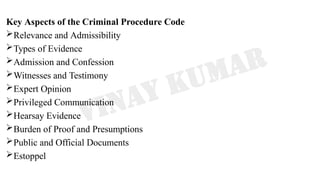
Key Aspectsof the Criminal Procedure Code
Relevance and Admissibility
Types of Evidence
Admission and Confession
Witnesses and Testimony
Expert Opinion
Privileged Communication
Hearsay Evidence
Burden of Proof and Presumptions
Public and Official Documents
Estoppel
30.
VINAY KUMAR
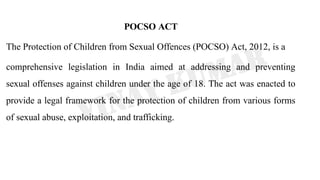
POCSO ACT
TheProtection of Children from Sexual Offences (POCSO) Act, 2012, is a
comprehensive legislation in India aimed at addressing and preventing
sexual offenses against children under the age of 18. The act was enacted to
provide a legal framework for the protection of children from various forms
of sexual abuse, exploitation, and trafficking.
31.
VINAY KUMAR
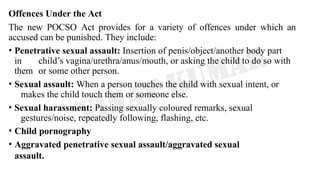
Offences Underthe Act
The new POCSO Act provides for a variety of offences under which an
accused can be punished. They include:
• Penetrative sexual assault: Insertion of penis/object/another body part
in child’s vagina/urethra/anus/mouth, or asking the child to do so with
them or some other person.
• Sexual assault: When a person touches the child with sexual intent, or
makes the child touch them or someone else.
• Sexual harassment: Passing sexually coloured remarks, sexual
gestures/noise, repeatedly following, flashing, etc.
• Child pornography
• Aggravated penetrative sexual assault/aggravated sexual
assault.
32.
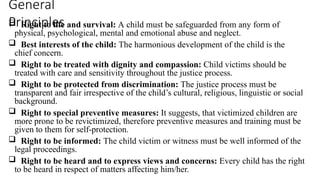
General
Principles
Right tolife and survival: A child must be safeguarded from any form of
physical, psychological, mental and emotional abuse and neglect.
Best interests of the child: The harmonious development of the child is the
chief concern.
Right to be treated with dignity and compassion: Child victims should be
treated with care and sensitivity throughout the justice process.
Right to be protected from discrimination: The justice process must be
transparent and fair irrespective of the child’s cultural, religious, linguistic or social
background.
Right to special preventive measures: It suggests, that victimized children are
more prone to be revictimized, therefore preventive measures and training must be
given to them for self-protection.
Right to be informed: The child victim or witness must be well informed of the
legal proceedings.
Right to be heard and to express views and concerns: Every child has the right
to be heard in respect of matters affecting him/her.

 Most read
 Most read