Redistricting Committee
Report
August 2012
1
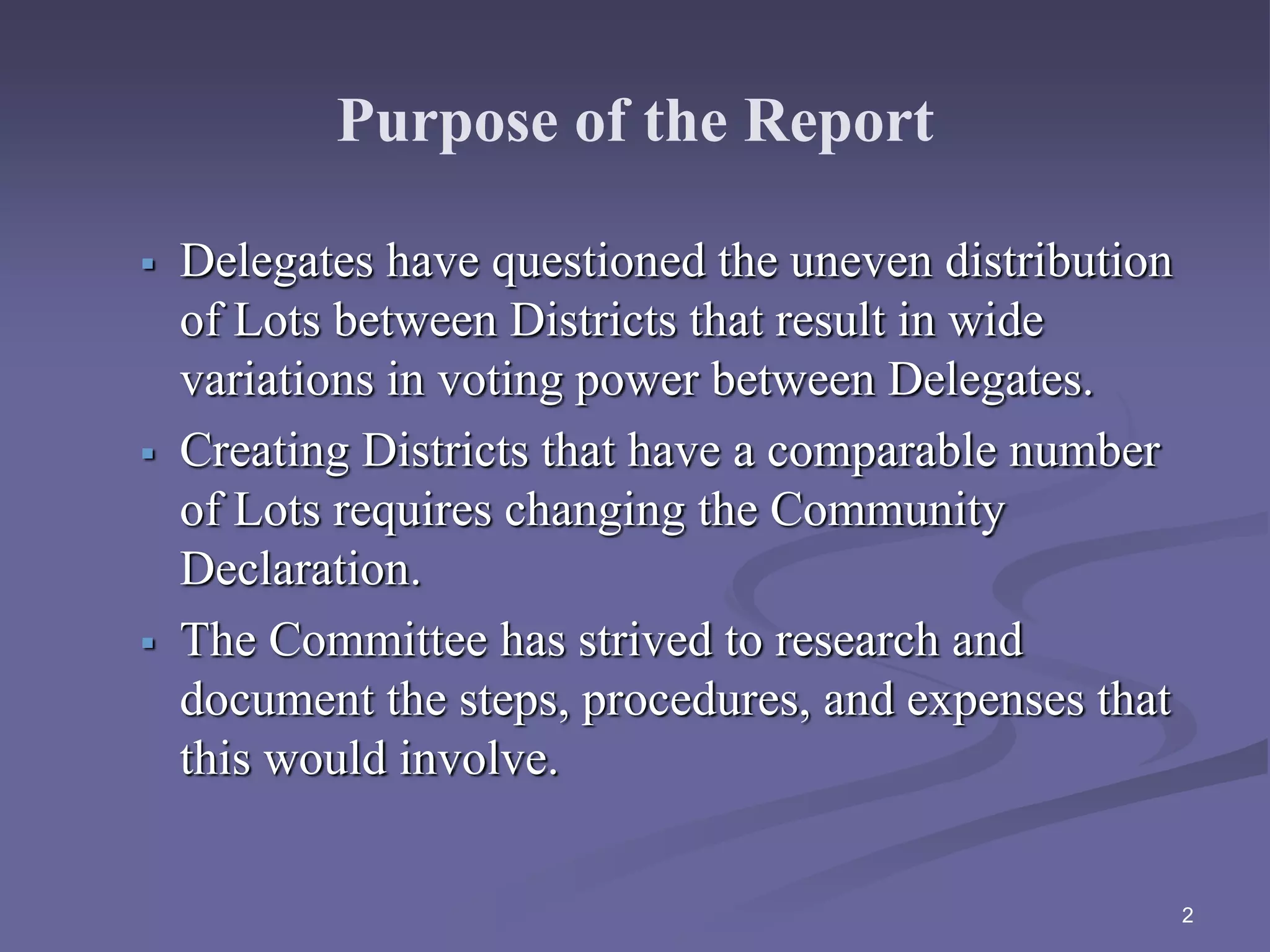
Purpose of the Report
 Delegates have questioned the uneven distribution
of Lots between Districts that result in wide
variations in voting power between Delegates.
 Creating Districts that have a comparable number
of Lots requires changing the Community
Declaration.
 The Committee has strived to research and
document the steps, procedures, and expenses that
this would involve.
2
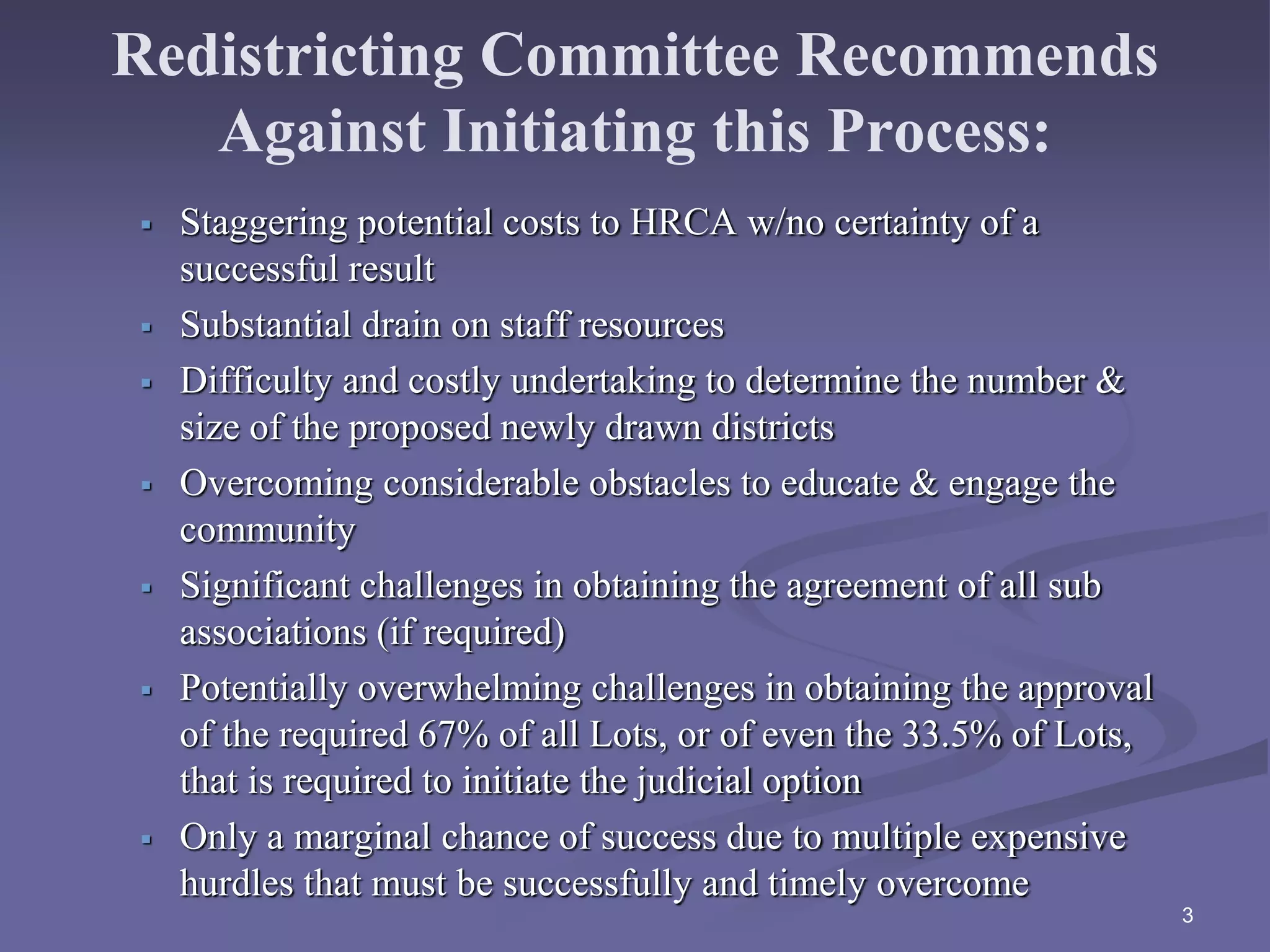
Redistricting Committee Recommends
Against Initiating this Process:
 Staggering potential costs to HRCA w/no certainty of a
successful result
 Substantial drain on staff resources
 Difficulty and costly undertaking to determine the number &
size of the proposed newly drawn districts
 Overcoming considerable obstacles to educate & engage the
community
 Significant challenges in obtaining the agreement of all sub
associations (if required)
 Potentially overwhelming challenges in obtaining the approval
of the required 67% of all Lots, or of even the 33.5% of Lots,
that is required to initiate the judicial option
 Only a marginal chance of success due to multiple expensive
hurdles that must be successfully and timely overcome
3
The current Delegate District structure
adheres to the fundamental
democratic principle of “one lot-one
vote” upon which the HRCA
Community Declaration is based.
4
5
Appendix A Redistricting - Steps 1-10 and associated tasks Time estimate Cost estimate Roadblocks
1A. Proposal by a Member(s), Delegate(s) or HRCA Board Member(s) to begin the process is
delivered to and approved by the HRCA Board.
2 months none HRCA Board does not
approve
1B. Establish funding for the project and build it into the budgets for successive years 6-15 months staff time Not funded by Board
2. Committee appointed by the HRCA Board:
Feasibility study is begun. Committee will manage the process including:
Defining the sections of the Declarations that need changing and
Seeking legal advice in answer to many questions.
Addressing the challenges with sub-associations
Recommending how districts will be drawn, such as contiguous etc.
6-12 months to
step #3
Legal (estimate)
$200,000-$400,000
including step #3 but
not step #7 or #8
3. Formal Resolution for the ballot question is written and the new district map redrawn. 1 month Map - (estimate)
$24,000-$30,400+
4. Mailing to all Lot owners and all sub-associations: The mailing includes the ballot
question along with FAQ’s and the map showing the new Districts. Possibility of a 2nd notice
reminder.
1 month Postage $30,030
+ 2nd notice
5. District meetings for all existing districts including sub-associations.
with 67% affirmative vote of lots and all sub-associations approval the amendment passes
proceed to step 6 and the judicial option (step 8, judicial option) is not required
with 10% of lots (quorum) voting and the majority opposing the amendment then it fails
with at least 10% (quorum) voting and with a majority but not a 33.5% affirmative vote OR
with less than 10% (quorum) voting - redo the election in an attempt to reach 33.5%
affirmative vote and less that 33.5% negative so that step 8, the judicial option can be
pursued
up to 12
months
Will HRCA cover
these unknown costs
including revisions to
sub-association
documents?
67% required
including all sub-
associations
or 33.5% affirmative
and less than 33.5%
negative required for
step 8 (judicial option)
6. Identify First Mortgage holders and notify: First Mortgage holders, Declarant, FHA and VA
by Certified mail. Publish Public Notice in newspapers two times at least one week apart.
4 months $150,000 + newsp +
certified mail
1st mortgage holders
object
7. Determine whether the amendments violate the terms of the bond financing documents and
if bond holders must approve the amendments. Notify bond holders if required.
1 month Legal review of bond
documents
Bond holders fail to
agree
8. If initiative failed to get 67% but it passed with all sub-associations (if required) approval
plus approval of 33.5% of all lots and less than 33.5% disapproval, and no objections from
bond holders (if required) and from First Mortgagees within 60 days; file a petition with the
court requesting the court to approve the proposed amendment. Then notify, in writing, within
10 days, all Unit Owners, the Declarant, First Mortgagees, FHA, and VA.
possibly 12-24
months
Unknown legal and
court costs
Judge’s decision is
unknown
9. If initiative is successful record the amendment in the records of Douglas County. 1 month p.1 $11 + $5 per page
10. Amend the bylaws to be consistent if legal has identified any inconsistencies. 3-6 months Legal - unknown
[1] See appendices A and C - Issues Requiring Legal Review
[2] Includes plat research and based on $150-$190 an hour for 160 hours, but could take longer
[3] $1 per mailing x 30,000 homes and 30 sub-associations = $30,030
[4] Requires Legal’s answer to: Must all sub-associations approve?
[5] Requires Legal’s answer to: Can court proceedings begin with 33.5% approval and all sub-associations agreeing?
[6] Requires Legal’s answer to: Is this a “material change” that requires First Mortgagees be notified?
[7] From title company’s estimate of $5 per home x 30,000 homes = $150,000
Appendix B
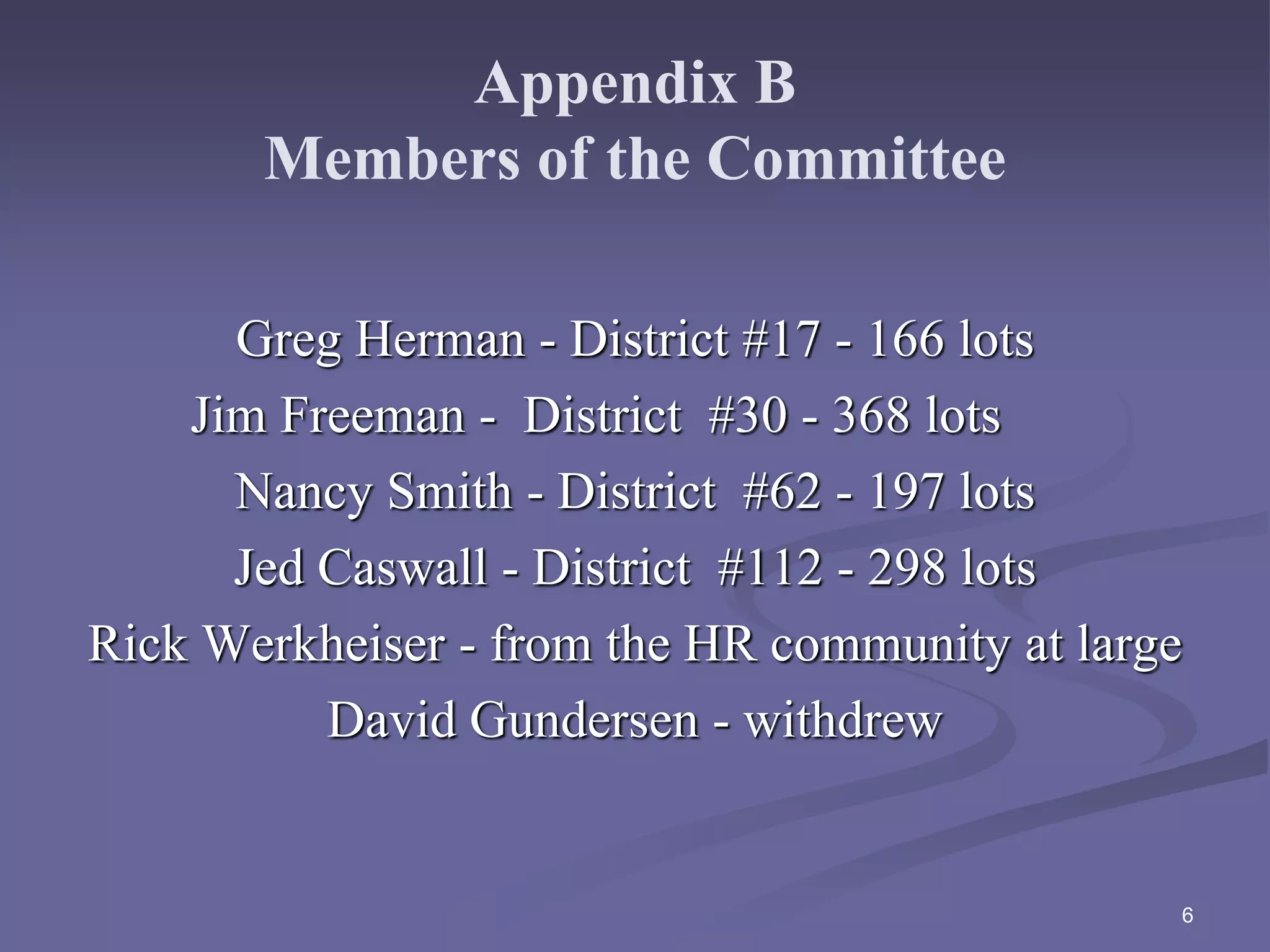
Members of the Committee
Greg Herman - District #17 - 166 lots
Jim Freeman - District #30 - 368 lots
Nancy Smith - District #62 - 197 lots
Jed Caswall - District #112 - 298 lots
Rick Werkheiser - from the HR community at large
David Gundersen - withdrew
6
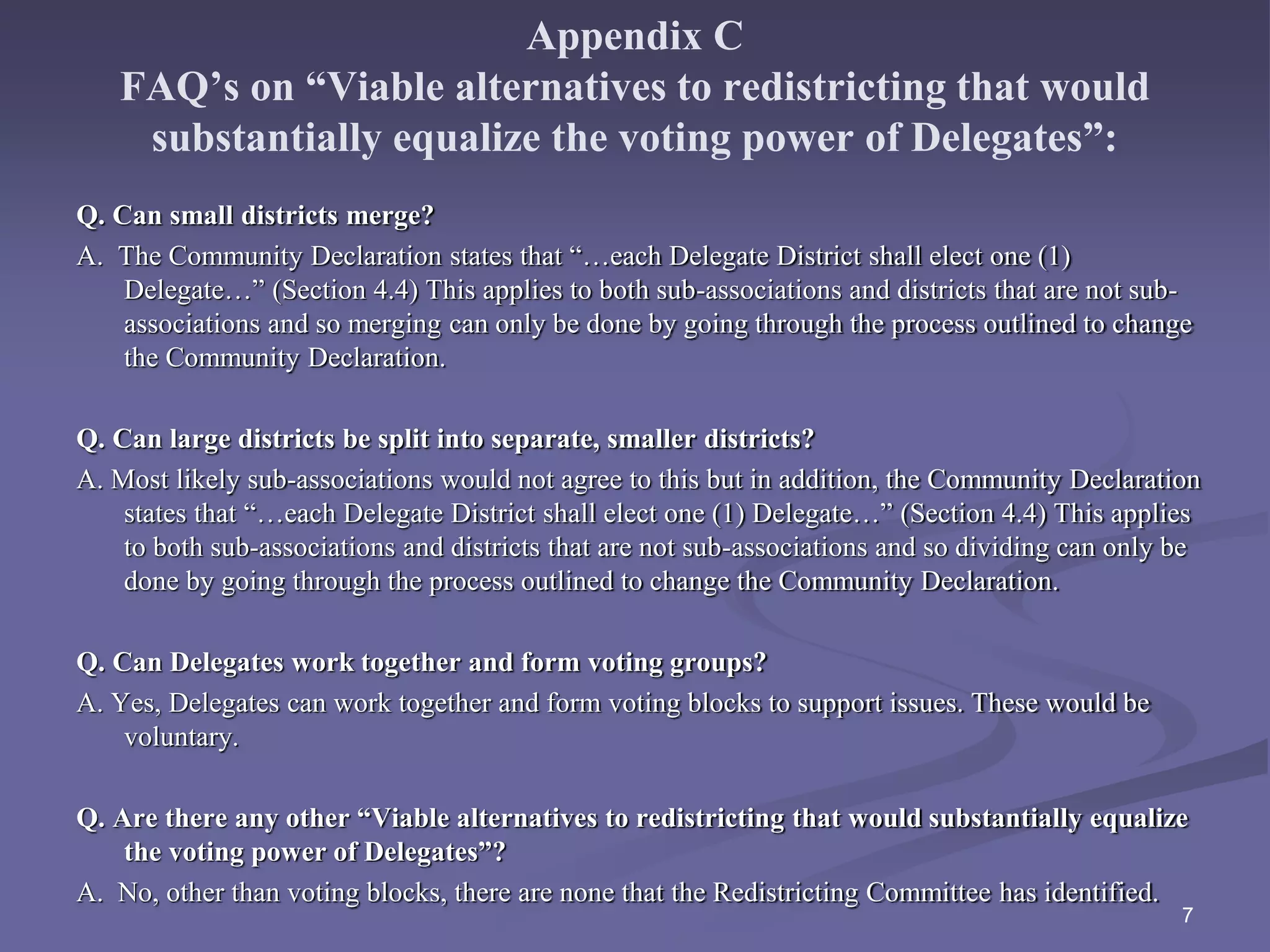
Appendix C
FAQ’s on “Viable alternatives to redistricting that would
substantially equalize the voting power of Delegates”:
Q. Can small districts merge?
A. The Community Declaration states that “…each Delegate District shall elect one (1)
Delegate…” (Section 4.4) This applies to both sub-associations and districts that are not sub-
associations and so merging can only be done by going through the process outlined to change
the Community Declaration.
Q. Can large districts be split into separate, smaller districts?
A. Most likely sub-associations would not agree to this but in addition, the Community Declaration
states that “…each Delegate District shall elect one (1) Delegate…” (Section 4.4) This applies
to both sub-associations and districts that are not sub-associations and so dividing can only be
done by going through the process outlined to change the Community Declaration.
Q. Can Delegates work together and form voting groups?
A. Yes, Delegates can work together and form voting blocks to support issues. These would be
voluntary.
Q. Are there any other “Viable alternatives to redistricting that would substantially equalize
the voting power of Delegates”?
A. No, other than voting blocks, there are none that the Redistricting Committee has identified.
7
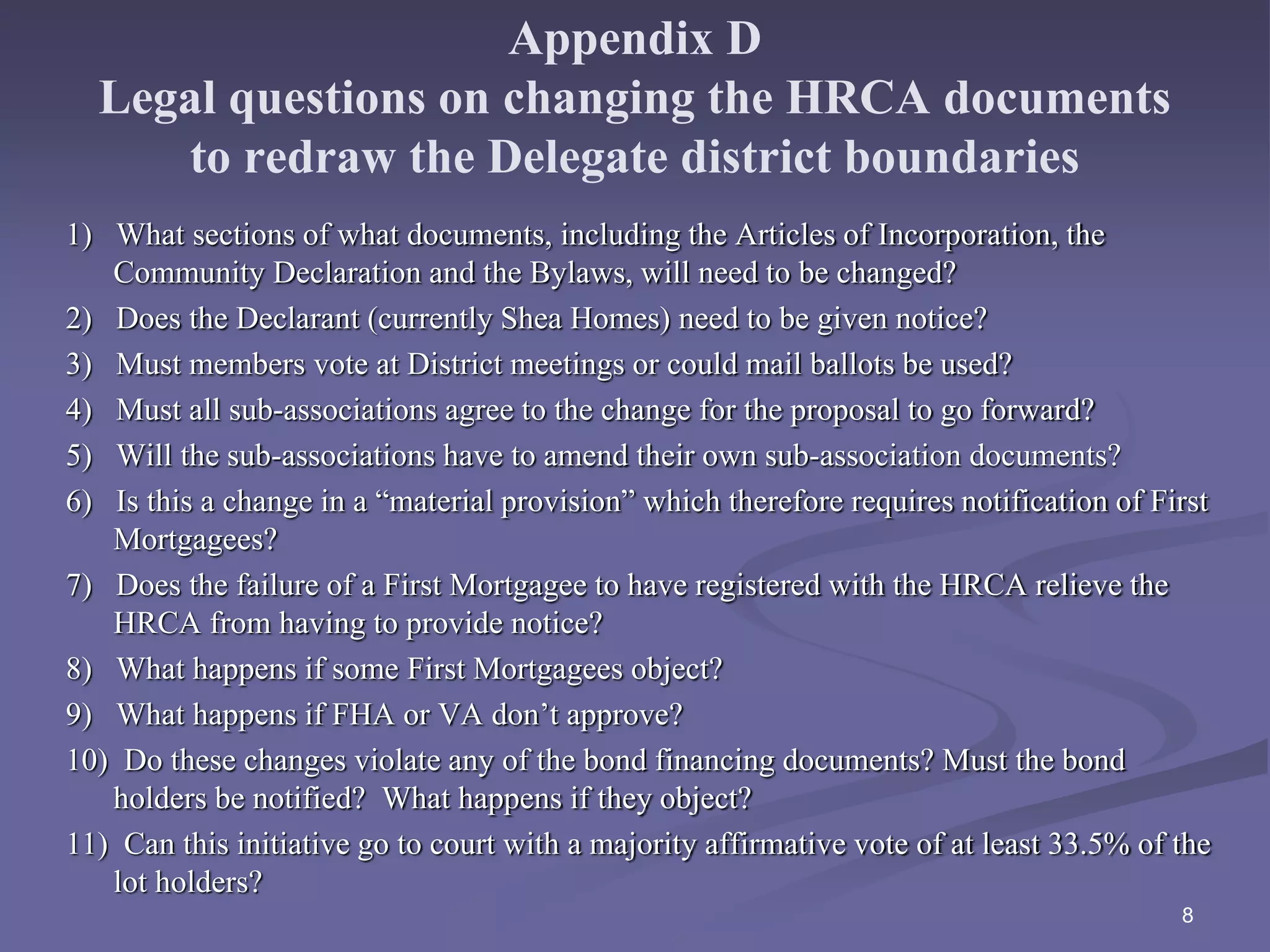
Appendix D
Legal questions on changing the HRCA documents
to redraw the Delegate district boundaries
1) What sections of what documents, including the Articles of Incorporation, the
Community Declaration and the Bylaws, will need to be changed?
2) Does the Declarant (currently Shea Homes) need to be given notice?
3) Must members vote at District meetings or could mail ballots be used?
4) Must all sub-associations agree to the change for the proposal to go forward?
5) Will the sub-associations have to amend their own sub-association documents?
6) Is this a change in a “material provision” which therefore requires notification of First
Mortgagees?
7) Does the failure of a First Mortgagee to have registered with the HRCA relieve the
HRCA from having to provide notice?
8) What happens if some First Mortgagees object?
9) What happens if FHA or VA don’t approve?
10) Do these changes violate any of the bond financing documents? Must the bond
holders be notified? What happens if they object?
11) Can this initiative go to court with a majority affirmative vote of at least 33.5% of the
lot holders?
8

Redistricting Committee Report 2012

  • 1.
  • 2.
    Purpose of theReport  Delegates have questioned the uneven distribution of Lots between Districts that result in wide variations in voting power between Delegates.  Creating Districts that have a comparable number of Lots requires changing the Community Declaration.  The Committee has strived to research and document the steps, procedures, and expenses that this would involve. 2
  • 3.
    Redistricting Committee Recommends AgainstInitiating this Process:  Staggering potential costs to HRCA w/no certainty of a successful result  Substantial drain on staff resources  Difficulty and costly undertaking to determine the number & size of the proposed newly drawn districts  Overcoming considerable obstacles to educate & engage the community  Significant challenges in obtaining the agreement of all sub associations (if required)  Potentially overwhelming challenges in obtaining the approval of the required 67% of all Lots, or of even the 33.5% of Lots, that is required to initiate the judicial option  Only a marginal chance of success due to multiple expensive hurdles that must be successfully and timely overcome 3
  • 4.
    The current DelegateDistrict structure adheres to the fundamental democratic principle of “one lot-one vote” upon which the HRCA Community Declaration is based. 4
  • 5.
    5 Appendix A Redistricting- Steps 1-10 and associated tasks Time estimate Cost estimate Roadblocks 1A. Proposal by a Member(s), Delegate(s) or HRCA Board Member(s) to begin the process is delivered to and approved by the HRCA Board. 2 months none HRCA Board does not approve 1B. Establish funding for the project and build it into the budgets for successive years 6-15 months staff time Not funded by Board 2. Committee appointed by the HRCA Board: Feasibility study is begun. Committee will manage the process including: Defining the sections of the Declarations that need changing and Seeking legal advice in answer to many questions. Addressing the challenges with sub-associations Recommending how districts will be drawn, such as contiguous etc. 6-12 months to step #3 Legal (estimate) $200,000-$400,000 including step #3 but not step #7 or #8 3. Formal Resolution for the ballot question is written and the new district map redrawn. 1 month Map - (estimate) $24,000-$30,400+ 4. Mailing to all Lot owners and all sub-associations: The mailing includes the ballot question along with FAQ’s and the map showing the new Districts. Possibility of a 2nd notice reminder. 1 month Postage $30,030 + 2nd notice 5. District meetings for all existing districts including sub-associations. with 67% affirmative vote of lots and all sub-associations approval the amendment passes proceed to step 6 and the judicial option (step 8, judicial option) is not required with 10% of lots (quorum) voting and the majority opposing the amendment then it fails with at least 10% (quorum) voting and with a majority but not a 33.5% affirmative vote OR with less than 10% (quorum) voting - redo the election in an attempt to reach 33.5% affirmative vote and less that 33.5% negative so that step 8, the judicial option can be pursued up to 12 months Will HRCA cover these unknown costs including revisions to sub-association documents? 67% required including all sub- associations or 33.5% affirmative and less than 33.5% negative required for step 8 (judicial option) 6. Identify First Mortgage holders and notify: First Mortgage holders, Declarant, FHA and VA by Certified mail. Publish Public Notice in newspapers two times at least one week apart. 4 months $150,000 + newsp + certified mail 1st mortgage holders object 7. Determine whether the amendments violate the terms of the bond financing documents and if bond holders must approve the amendments. Notify bond holders if required. 1 month Legal review of bond documents Bond holders fail to agree 8. If initiative failed to get 67% but it passed with all sub-associations (if required) approval plus approval of 33.5% of all lots and less than 33.5% disapproval, and no objections from bond holders (if required) and from First Mortgagees within 60 days; file a petition with the court requesting the court to approve the proposed amendment. Then notify, in writing, within 10 days, all Unit Owners, the Declarant, First Mortgagees, FHA, and VA. possibly 12-24 months Unknown legal and court costs Judge’s decision is unknown 9. If initiative is successful record the amendment in the records of Douglas County. 1 month p.1 $11 + $5 per page 10. Amend the bylaws to be consistent if legal has identified any inconsistencies. 3-6 months Legal - unknown [1] See appendices A and C - Issues Requiring Legal Review [2] Includes plat research and based on $150-$190 an hour for 160 hours, but could take longer [3] $1 per mailing x 30,000 homes and 30 sub-associations = $30,030 [4] Requires Legal’s answer to: Must all sub-associations approve? [5] Requires Legal’s answer to: Can court proceedings begin with 33.5% approval and all sub-associations agreeing? [6] Requires Legal’s answer to: Is this a “material change” that requires First Mortgagees be notified? [7] From title company’s estimate of $5 per home x 30,000 homes = $150,000
  • 6.
    Appendix B Members ofthe Committee Greg Herman - District #17 - 166 lots Jim Freeman - District #30 - 368 lots Nancy Smith - District #62 - 197 lots Jed Caswall - District #112 - 298 lots Rick Werkheiser - from the HR community at large David Gundersen - withdrew 6
  • 7.
    Appendix C FAQ’s on“Viable alternatives to redistricting that would substantially equalize the voting power of Delegates”: Q. Can small districts merge? A. The Community Declaration states that “…each Delegate District shall elect one (1) Delegate…” (Section 4.4) This applies to both sub-associations and districts that are not sub- associations and so merging can only be done by going through the process outlined to change the Community Declaration. Q. Can large districts be split into separate, smaller districts? A. Most likely sub-associations would not agree to this but in addition, the Community Declaration states that “…each Delegate District shall elect one (1) Delegate…” (Section 4.4) This applies to both sub-associations and districts that are not sub-associations and so dividing can only be done by going through the process outlined to change the Community Declaration. Q. Can Delegates work together and form voting groups? A. Yes, Delegates can work together and form voting blocks to support issues. These would be voluntary. Q. Are there any other “Viable alternatives to redistricting that would substantially equalize the voting power of Delegates”? A. No, other than voting blocks, there are none that the Redistricting Committee has identified. 7
  • 8.
    Appendix D Legal questionson changing the HRCA documents to redraw the Delegate district boundaries 1) What sections of what documents, including the Articles of Incorporation, the Community Declaration and the Bylaws, will need to be changed? 2) Does the Declarant (currently Shea Homes) need to be given notice? 3) Must members vote at District meetings or could mail ballots be used? 4) Must all sub-associations agree to the change for the proposal to go forward? 5) Will the sub-associations have to amend their own sub-association documents? 6) Is this a change in a “material provision” which therefore requires notification of First Mortgagees? 7) Does the failure of a First Mortgagee to have registered with the HRCA relieve the HRCA from having to provide notice? 8) What happens if some First Mortgagees object? 9) What happens if FHA or VA don’t approve? 10) Do these changes violate any of the bond financing documents? Must the bond holders be notified? What happens if they object? 11) Can this initiative go to court with a majority affirmative vote of at least 33.5% of the lot holders? 8