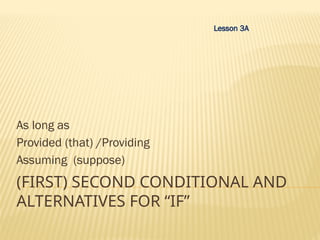
(FIRST) SECOND CONDITIONAL AND
ALTERNATIVES FOR “IF”
As long as
Provided (that) /Providing
Assuming (suppose)
Lesson 3A
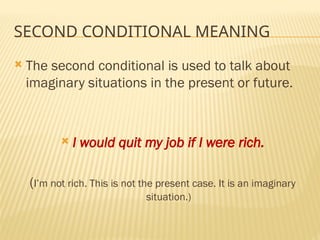
SECOND CONDITIONAL MEANING
 The second conditional is used to talk about
imaginary situations in the present or future.
 I would quit my job if I were rich.
(I’m not rich. This is not the present case. It is an imaginary
situation.)
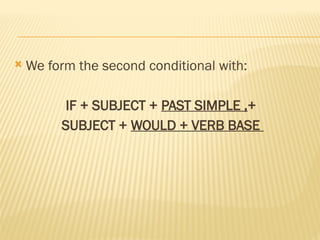
 We form the second conditional with:
IF + SUBJECT + PAST SIMPLE ,+
SUBJECT + WOULD + VERB BASE
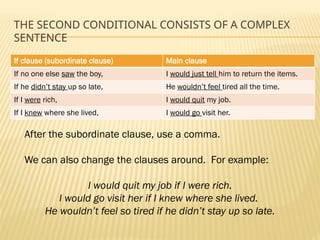
THE SECOND CONDITIONAL CONSISTS OF A COMPLEX
SENTENCE
If clause (subordinate clause) Main clause
If no one else saw the boy, I would just tell him to return the items.
If he didn’t stay up so late, He wouldn’t feel tired all the time.
If I were rich, I would quit my job.
If I knew where she lived, I would go visit her.
After the subordinate clause, use a comma.
We can also change the clauses around. For example:
I would quit my job if I were rich.
I would go visit her if I knew where she lived.
He wouldn’t feel so tired if he didn’t stay up so late.
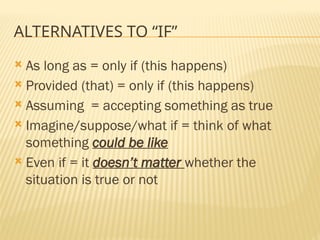
ALTERNATIVES TO “IF”
 As long as = only if (this happens)
 Provided (that) = only if (this happens)
 Assuming = accepting something as true
 Imagine/suppose/what if = think of what
something could be like
 Even if = it doesn’t matter whether the
situation is true or not
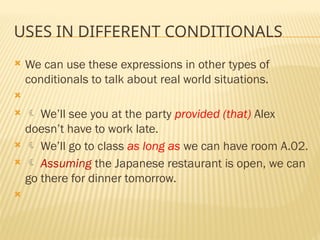
USES IN DIFFERENT CONDITIONALS
 We can use these expressions in other types of
conditionals to talk about real world situations.

  We’ll see you at the party provided (that) Alex
doesn’t have to work late.
  We’ll go to class as long as we can have room A.02.
  Assuming the Japanese restaurant is open, we can
go there for dinner tomorrow.

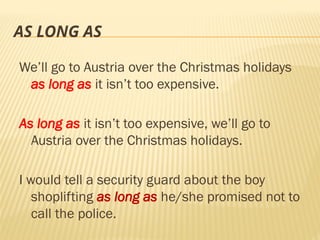
AS LONG AS
We’ll go to Austria over the Christmas holidays
as long as it isn’t too expensive.
As long as it isn’t too expensive, we’ll go to
Austria over the Christmas holidays.
I would tell a security guard about the boy
shoplifting as long as he/she promised not to
call the police.
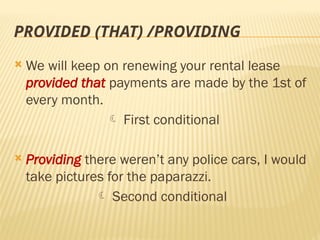
PROVIDED (THAT) /PROVIDING
 We will keep on renewing your rental lease
provided that payments are made by the 1st of
every month.
 First conditional
 Providing there weren’t any police cars, I would
take pictures for the paparazzi.
 Second conditional
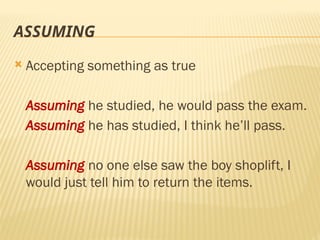
ASSUMING
 Accepting something as true
Assuming he studied, he would pass the exam.
Assuming he has studied, I think he’ll pass.
Assuming no one else saw the boy shoplift, I
would just tell him to return the items.
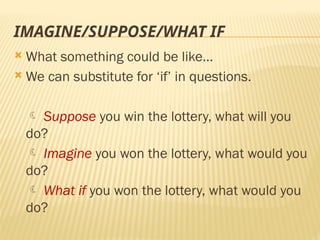
IMAGINE/SUPPOSE/WHAT IF
 What something could be like…
 We can substitute for ‘if’ in questions.
 Suppose you win the lottery, what will you
do?
 Imagine you won the lottery, what would you
do?
 What if you won the lottery, what would you
do?
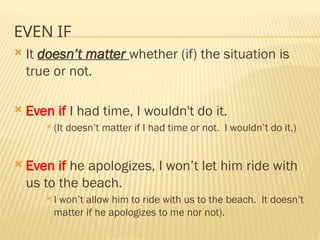
EVEN IF
 It doesn’t matter whether (if) the situation is
true or not.
 Even if I had time, I wouldn't do it.
 (It doesn’t matter if I had time or not. I wouldn’t do it.)
 Even if he apologizes, I won’t let him ride with
us to the beach.
 I won’t allow him to ride with us to the beach. It doesn’t
matter if he apologizes to me nor not).
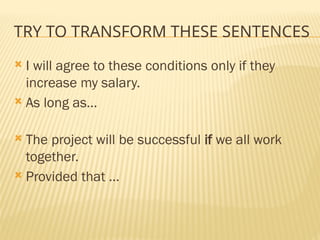
TRY TO TRANSFORM THESE SENTENCES
 I will agree to these conditions only if they
increase my salary.
 As long as…
 The project will be successful if we all work
together.
 Provided that …
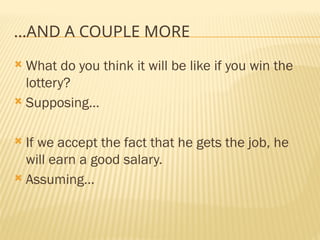
…AND A COUPLE MORE
 What do you think it will be like if you win the
lottery?
 Supposing…
 If we accept the fact that he gets the job, he
will earn a good salary.
 Assuming…
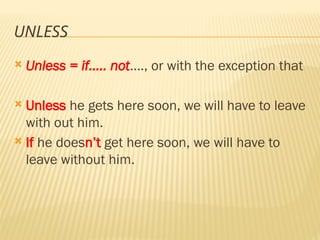
UNLESS
 Unless = if….. not…., or with the exception that
 Unless he gets here soon, we will have to leave
with out him.
 If he doesn’t get here soon, we will have to
leave without him.
power point about 3A-2nd-conditionals.pptx

  • 1.
    (FIRST) SECOND CONDITIONALAND ALTERNATIVES FOR “IF” As long as Provided (that) /Providing Assuming (suppose) Lesson 3A
  • 2.
    SECOND CONDITIONAL MEANING The second conditional is used to talk about imaginary situations in the present or future.  I would quit my job if I were rich. (I’m not rich. This is not the present case. It is an imaginary situation.)
  • 3.
     We formthe second conditional with: IF + SUBJECT + PAST SIMPLE ,+ SUBJECT + WOULD + VERB BASE
  • 4.
    THE SECOND CONDITIONALCONSISTS OF A COMPLEX SENTENCE If clause (subordinate clause) Main clause If no one else saw the boy, I would just tell him to return the items. If he didn’t stay up so late, He wouldn’t feel tired all the time. If I were rich, I would quit my job. If I knew where she lived, I would go visit her. After the subordinate clause, use a comma. We can also change the clauses around. For example: I would quit my job if I were rich. I would go visit her if I knew where she lived. He wouldn’t feel so tired if he didn’t stay up so late.
  • 5.
    ALTERNATIVES TO “IF” As long as = only if (this happens)  Provided (that) = only if (this happens)  Assuming = accepting something as true  Imagine/suppose/what if = think of what something could be like  Even if = it doesn’t matter whether the situation is true or not
  • 6.
    USES IN DIFFERENTCONDITIONALS  We can use these expressions in other types of conditionals to talk about real world situations.    We’ll see you at the party provided (that) Alex doesn’t have to work late.   We’ll go to class as long as we can have room A.02.   Assuming the Japanese restaurant is open, we can go there for dinner tomorrow. 
  • 7.
    AS LONG AS We’llgo to Austria over the Christmas holidays as long as it isn’t too expensive. As long as it isn’t too expensive, we’ll go to Austria over the Christmas holidays. I would tell a security guard about the boy shoplifting as long as he/she promised not to call the police.
  • 8.
    PROVIDED (THAT) /PROVIDING We will keep on renewing your rental lease provided that payments are made by the 1st of every month.  First conditional  Providing there weren’t any police cars, I would take pictures for the paparazzi.  Second conditional
  • 9.
    ASSUMING  Accepting somethingas true Assuming he studied, he would pass the exam. Assuming he has studied, I think he’ll pass. Assuming no one else saw the boy shoplift, I would just tell him to return the items.
  • 10.
    IMAGINE/SUPPOSE/WHAT IF  Whatsomething could be like…  We can substitute for ‘if’ in questions.  Suppose you win the lottery, what will you do?  Imagine you won the lottery, what would you do?  What if you won the lottery, what would you do?
  • 11.
    EVEN IF  Itdoesn’t matter whether (if) the situation is true or not.  Even if I had time, I wouldn't do it.  (It doesn’t matter if I had time or not. I wouldn’t do it.)  Even if he apologizes, I won’t let him ride with us to the beach.  I won’t allow him to ride with us to the beach. It doesn’t matter if he apologizes to me nor not).
  • 12.
    TRY TO TRANSFORMTHESE SENTENCES  I will agree to these conditions only if they increase my salary.  As long as…  The project will be successful if we all work together.  Provided that …
  • 13.
    …AND A COUPLEMORE  What do you think it will be like if you win the lottery?  Supposing…  If we accept the fact that he gets the job, he will earn a good salary.  Assuming…
  • 14.
    UNLESS  Unless =if….. not…., or with the exception that  Unless he gets here soon, we will have to leave with out him.  If he doesn’t get here soon, we will have to leave without him.