Speaker Name : Dr. Martin Svik, MBA.
Speaker Title : Executive	IT	Architect,	SPEED	Program	WW	Strategy	
Watson	iLAB Leader	
Power AI and Earth Observation Data
7-8	June	2018,	European	GNSS	Agency,	Janovského 438/2,	Prague	7
Agenda
AI	– Machine	Learning/Deep	Learning	Evolution
IBM	Power for	AI	
Challenge – Earth	Observation	Data
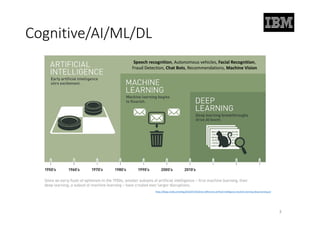
Cognitive/AI/ML/DL
3
https://blogs.nvidia.com/blog/2016/07/29/whats-difference-artificial-intelligence-machine-learning-deep-learning-ai/
Speech	recognition,	Autonomous	vehicles,	Facial Recognition,	
Fraud	Detection,	Chat	Bots,	Recommendations,	Machine	Vision
IBM	Power for	AI
• PowerAI the	fastest	platform	for	Artificial	Intelligence	providing	both	the	
best	of	breed	machine	learning	libraries	
• OpenCV image	processing	on	PowerAI for	Image	data	
https://opencv.org/
P100
GPU
POWER8
CPU
GPU	Memory
System	
Memory
P100
GPU
80 GB/s
NVLink
115	GB/s
P100
GPU
POWER8
CPU
System	
Memory
P100
GPU
80	
GB/s
NVLink
115	GB/s
80	GB/s
GPU	Memory GPU	Memory GPU	Memory
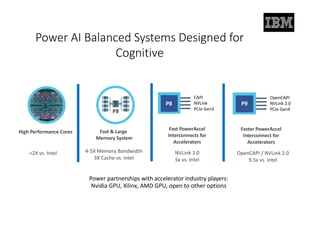
High	Performance	Cores Fast	&	Large
Memory	System
Fast	PowerAccel	
Interconnects	for	
Accelerators
>2X	vs.	Intel 4-5X	Memory	Bandwidth
3X	Cache	vs.	Intel
NVLink	1.0
5x	vs.	Intel
CAPI
NVLink
PCIe	Gen3
P8
Faster	PowerAccel	
Interconnect	for	
Accelerators
OpenCAPI	/	NVLink	2.0	
9.5x	vs.	Intel
OpenCAPI
NVLink	2.0
PCIe	Gen4
P9
Power	partnerships	with	accelerator	industry	players:	
Nvidia	GPU,	Xilinx,	AMD	GPU,	open	to	other	options
P8
Power	AI	Balanced	Systems	Designed	for	
Cognitive
Power	high-performance	core,	bandwidth,	accelerator	differentiation
6
The	client	challenge
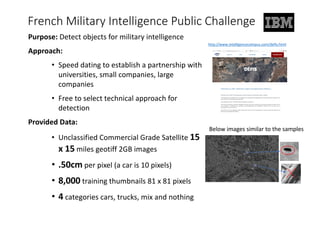
French	Military	Intelligence	Public	Challenge
Purpose:	Detect	objects	for	military	intelligence
Approach:	
• Speed	dating	to	establish	a	partnership	with	
universities,	small	companies,	large	
companies
• Free	to	select	technical	approach	for	
detection
Provided	Data:
• Unclassified	Commercial	Grade	Satellite	15	
x	15 miles	geotiff 2GB images
• .50cm per	pixel	(a	car	is	10	pixels)
• 8,000 training	thumbnails	81	x	81	pixels	
• 4 categories	cars,	trucks,	mix	and	nothing
Below	images	similar	to	the	samples
http://www.intelligencecampus.com/defis.html
Object	Recognition	Challenge	implications
Recognize	anywhere,	any	time	of	day,	any	weather,	any	vehicle	implies	a	minimum	
of	32	million	combinations	with	usual	classification	hardly	obtainable	by	a	manual	
selection:
·							9+1:	9	most	popular	vehicle	colors	1	for	all	other	colors
·							24 vehicle	models	in	the	official	classification
·							10 landscape:	city,	coastal,	mountain,	snowy,	desert,	tropical,	rocky,	riverside,
forest,	farm	field
·							14 lighting	conditions	under	5	latitudes,	12	hours	sun	light	orientation	plus	
night	street	light,	partially	shaded	vehicles
·						 6	Weather	conditions:	sunny,	fog,	rain,	dust	wind,	wind	alone,	snow
·							4 traffic	conditions
·						 8	or	more	view	angles
Object	Recognition	Challenge	
Vehicles under shadow
Original	image After	histogram	equalization	of		
absolute	difference	of	a	normalized	box	
filter	9*9	blur	and	gaussian	3*3	blur
Typical	problem	on	an	aerial	view	with	similar	resolution:	locate	vehicles	under	shadow
10
The	initial	solution
Proposed	Solution
• Creating	high	volume	of	synthetic	images	for	
complementing	training	data	with	our	partner	OKTAL-SE	
http://www.oktal-se.fr/website/
• Use	PowerAI the	fastest	platform	for	Artificial	
Intelligence	providing	both	the	best	of	breed	machine	
learning	libraries	
• Use	OpenCV	image	processing	on	PowerAI
https://opencv.org/
P100
GPU
POWER8
CPU
GPU	Memory
System	
Memory
P100
GPU
80 GB/s
NVLink
115	GB/s
P100
GPU
POWER8
CPU
System	
Memory
P100
GPU
80	
GB/s
NVLink
115	GB/s
80	GB/s
GPU	Memory GPU	Memory GPU	Memory
Satellite	Spectral	
response
Approach	presentation	:	
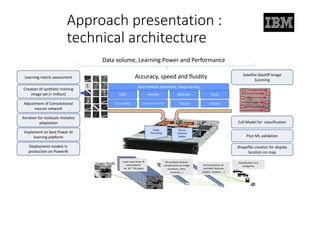
technical	architecture
Data	volume,	Learning	Power	and	Performance
Caffe NVCaffe TorchIBMCaffe
Distributed	TensorFlowTensorFlow Theano
Open PowerAI Plateforms, Deep learning
Chainer
Learning	metric	assessment
Creation	of	synthetic	training	
image	set	(>	million)
Adjustment	of	Convolutional	
neuron	network
Implement	on	best	Power	AI	
learning	platform
Iteration	for	residuals	mistakes	
adaptation
Deployment	models	in	
production	on	PowerAI
Accuracy,	speed	and	fluidity Satellite	Geotiff Image	
Scanning
Call	Model	for		classification
Shapefile	creation	for	display	
location	on	map
Post	ML	validation
Images	81x81
Local	zone	times	N	
convolutions
on		81	*	81	pixels
M	synthetic	feature	
computation	on	image
(contours,	lines,	
contrast,..)
M	Convolution	of	
synthetic	features		
(angles,	shadow,	…)
Classification	in	4	
categories
Image	
Processing
Neural	
Network
Model
13
The	object	detection	project	
initial	phase
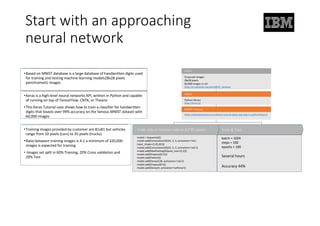
Start	with	an	approaching	
neural	network
•Based	on	MNIST	database	is	a	large	database	of	handwritten	digits	used	
for	training	and	testing	machine	learning	models28x28	pixels	
panchromatic	images
•Keras is	a	high-level	neural	networks	API,	written	in	Python	and	capable	
of	running	on	top	of	TensorFlow,	CNTK,	or	Theano
•This	Keras Tutorial	uses	shows	how	to	train	a	classifier	for	handwritten	
digits	that	boasts	over	99%	accuracy	on	the	famous	MNIST	dataset	with	
60,000	images
•Training	images	provided	by	customer	are	81x81	but	vehicles	
range	from	10	pixels	(cars)	to	35	pixels	(trucks)
•Ratio	between	training	images	is	4:1	a	minimum	of	320,000	
images	is	expected	for	training
• Images	set	split	in	60%	Training,	20%	Cross	validation	and	
20%	Test
https://elitedatascience.com/keras-tutorial-deep-learning-in-python#step-4
MNIST
Grayscale	images
28x28	pixels
60,000	images	in	set
https://en.wikipedia.org/wiki/MNIST_database
KERAS	Tutorial
KERAS
Python	library
https://keras.io/
batch	=	1024
steps	=	100
epochs	=	100
Several	hours
Accuracy	44%
Train	&	Test:	
model	=	Sequential()
model.add(Convolution2D(32,	3,	3,	activation='relu',	
input_shape=(1,81,81)))
model.add(Convolution2D(32,	3,	3,	activation='relu'))
model.add(MaxPooling2D(pool_size=(2,2)))
model.add(Dropout(0.25))
model.add(Flatten())
model.add(Dense(128,	activation='relu'))
model.add(Dropout(0.5))
model.add(Dense(4,	activation='softmax'))
Code:	Adjust	tutorial	code	to	81*81	pixels
Work	on	training	data	and	neural	
network	to	fit	use	case
•Perform image augmentation with Generators in Keras.
•Technique used to artificially expand the data-set. Thus the
images can be blurred, shifted, rotated multiplying by 100 the
initial training set size
•Tune neural network layers
•Tune dropout
•Add fully connected layers
•Add multithreading (very easy)
•Add Keras multi GPU code, initially parallizer.py
from Ronald Kemker, failed randomly, until version
that supports unequal size of GPU datasets found
•. Not tested as not available at the time of project,
available since October 11, 2017
Keras support of Multi GPU :
https://keras.io/getting-started/faq/#how-can-i-run-
a-keras-model-on-multiple-gpus
KERAS	Image	Augmentation	with	Generators
Shift	horizontally	20%
Shift vertically 20%
Flip	horizontally
IBM	HPC	and	Neural	Network	experts
Montpellier	high-performance computing (HPC) team
https://www.ibm.com/ibm/clientcenter/montpellier/b-pc.shtml
batch	=	1024
steps	=	100
epochs	=	100
One	hour
Accuracy	54%
Train	&	Test:	
model	=	Sequential()
model.add(Conv2D(1,	(5,5),	activation='relu',	input_shape=(81,81,3)))
model.add(Conv2D(32,	(5,	5),	activation='relu'))
model.add(MaxPooling2D(pool_size=(2,2)))
model.add(Conv2D(64,	(3,	3),	activation='relu'))
model.add(Dropout(0.05))
print('conv2D	4')
model.add(Conv2D(128,	(3,	3),	activation='relu'))
model.add(Dropout(0.25))
model.add(Flatten())
model.add(Dense(256,	activation='relu'))					
model.add(Dense(1024,	activation='relu'))
model.add(Dense(4,	activation='softmax'))
Code
Add	training	data	and	reduce	
overfitting
•Work with partner OKTAL-SE specialized in synthetic imaging
(video and still) for aircraft manufacturers, radar manufacturers.
•That company creates 3D landscape with physical
characteristics, electromagnetic, visible, infrared etc.
•Users of OKTAL-SE can create their own 3D environment or
use provided environments, European country side, mountain,
desert, maritime
•For the project we defined 2 vehicle types, one
trajectory is an mixed landscape with country side,
houses, bridges, other parked vehicles, 2 hours of
day, one dawn, one full daylight
•2000+ images generated (before Keras Image
Augmentation)
•Neural Network code unchanged
•Reduction of 15% of errors for the addition of 20%
synthetic image
OKTAL-SE	
Images	variability	controlled	based	on	parameters
Massive	image	generation	easy	to	reach	a	million.	
Images	produced	from	trajectories	and	view	points.
batch	=	1024
steps	=	100
epochs	=	100
One	hour
Accuracy	64%	
Train	&	Test:	Data
Source: OKTAL-SE
Test	Residual	Networks	and	
other	models
•Deep	Residual	Learning	for	Image	Recognition	were	introduced	by	Microsoft	
research.	They	consist	in	a	repetitive	set	of	layers	with	an	identity	connection	
merge	between	the	entry	and	the	exit	of	the	set	avoiding	loss	of	information	
from	the	initial	data
•Inception Neural Networks: compute in parallel and merge different
convolutions recall the “histogram equalization of absolute difference
of a normalized box filter 9*9 blur and gaussian 3*3 blur” on slide 7,
inception is able to find the “difference of a normalized box filter 9*9
blur and gaussian 3*3 blur” part of the filter
•Tried with 29 and 50 layers and other model
•Did not try the Keras resnet50 and inception not
available at time of project
• https://keras.io/applications/#resnet50
• https://keras.io/applications/#inceptionv3
Residual	Networks
batch	=	1024
steps	=	100
epochs	=	100,	200,	300
One	hour	per	100	Epochs
Accuracy	unstable	60%-66%	depending	on	
Epochs.
Train	&	Test:	Code
https://arxiv.org/pdf/1512.03385.pdf
Using available samples in github such as
https://github.com/titu1994/Keras-
ResNeXt/blob/master/resnext.py
Inception
https://www.ibm.com/blogs/research/2018/02/deep-learning-models/
18
Going	further	&	innovation
The	limitation	of	Neural	Networks
19
• “Convolutional	Networks	express	a	single	differentiable	function	from	raw	image	pixel	
values	to	class	probabilities”	https://cs.stanford.edu/people/karpathy/sfmltalk.pdf (except	a	few	singularities).	
• A	neural	network	cannot	learn	non-differentiable	features	e.g.	Fractals,	discrete	data	
processing	with	absolute	values.	
e.g.	Sigmoid	function
Final	Test	with	non-differentiable	
features
•I invented a way to have non-differentiable features. It requires
additional memory and CPU
•PowerAI seamlessly processed the implied workload
•Customer does not allow to give the exact resulting
precision on the images (both small images test and
satellite images)
Preprocess	to	generate		images
With Non differentiable features neural network
700,000	images	generated	from	clipped	to	64	bits
After	Horizontal	&	vertical	shift	pixel	by	pixel	and	
horizontal	flip
Found	a	way	to	have	non-differentiable	features	
processed	in	the	Neural	Network.
batch = 1024
steps = 100
epochs 5
Accuracy increased above 90%
Train & Test:
21
Conclusion	and	next	steps
Conclusion
PowerAI Vision provides the best of breed solution for most of the usual
cases, without requiring neural network knowledge, just a few iterations to
get to a satisfactory result
See demonstration on https://www.youtube.com/watch?v=0F5w6q0ZpBI
There are many industry domains where the classical deep learning
techniques cannot reach the levels when clients require recognition as good
as humans.
Lack of training data can be fixed with synthetic images creation,
which is very promising.
The IBM patented process can provide an improved recognition.
The patent requires a platform like PowerAI with enough compute power
and memory to perform efficiently the training and testing.
Thank	you
23
Speaker Name : Dr. Martin Svik, MBA.
Speaker Title : Executive	IT	Architect,	SPEED	Program	WW	Strategy	
Watson	iLAB Leader	
Contacts : martin.svik@cz.ibm.com
+420 737 264 389
https://www.linkedin.com/in/martinsvik/

Power AI for Earth Observation Data