RESEARCH POSTER PRESENTATION DESIGN © 2012
www.PosterPresentations.com
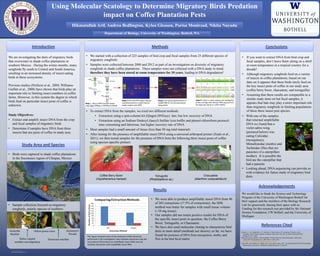
• If you want to extract DNA from bird crop and
fecal samples, don’t leave them sitting on a shelf
at room temperature in a tropical country for a
decade!
• Although migratory songbirds feed on a variety
of insects in coffee plantations, based on our
data set it appears that these birds rarely feed on
the key insect pests of coffee in our study area
(coffee berry borer, chacuatete, and tortuguilla)
• Assuming that these results are comparable to a
similar study done on bat fecal samples, it
appears that bats may play a more important role
than migratory songbirds in limiting populations
of these three insect pest species.
• Looking ahead, DNA sequencing can provide us
with evidence for future study of migratory bird
diets.
We are investigating the diets of migratory birds
that overwinter in shade coffee plantations in
southern Mexico. During the winter months, many
songbirds fly south to Central and South America,
resulting in an increased density of insect-eating
birds in these ecosystems.
Previous studies (Perfecto et al., 2004; Williams-
Guillén et al., 2008) have shown that birds play an
important role in limiting insect numbers in coffee
farms. However, in this system the degree to which
birds feed on particular insect pests of coffee is
unknown.
Study Objectives:
• Extract and amplify insect DNA from the crop
and fecal samples of migratory birds
• Determine if samples have DNA from three
insects that are pests of coffee in study area
Introduction
• Birds were captured in shade coffee plantations
in the Soconusco region of Chiapas, Mexico
Study Area and Species
Methods
Results
Conclusions
Acknowledgements
References Cited
Department of Biology, University of Washington, Bothell, WA
Hikmatullah Arif, Andrea Bedlington, Kylea Gleason, Parisa Monirzad, Nikita Nayudu
Using Molecular Scatology to Determine Migratory Birds Predation
impact on Coffee Plantation Pests
• We started with a collection of 225 samples of bird crop and fecal samples from 25 different species of
migratory songbirds
• Samples were collected between 2000 and 2012 as part of an investigation on diversity of migratory
songbirds in shade coffee plantations. These samples were not collected with a DNA study in mind;
therefore they have been stored at room temperature for 10 years, leading to DNA degradation!
• To extract DNA from the samples, we tried two different methods:
• Extraction using a spin-column kit (Qiagen DNEasy): fast, but low recovery of DNA
• Extraction using an Sodium Dodecyl (lauryl) Sulfate lysis buffer and phenol-chloroform protocol:
time consuming and laborious, but higher recovery rate of DNA
• Most samples had a small amount of tissue (less than 50 mg total material)
• After testing for the presence of amplifiable insect DNA using a universal arthropod primer (Zeale et al.,
2011), we then tested samples for the presence of DNA from the following three insect pests of coffee
using species-specific primers
We would like to thank the Science and Technology
Program of the University of Washington Bothell for
their support and the members of the Biology Research
Lab for generously sharing their space with us.
Funding for this research was provided by the National
Science Foundation, UW Bothell, and the University of
Michigan.
• Sample collection focused on migratory
songbirds, mainly species of warblers:
Coffee Berry Borer
(Hypothenemus hampei)
Tortuguilla
(Rhabdopterus sp.)
Chacuatete
(Idiarthron subquadratum)
This figure compares both of the methods of DNA extraction 
performed in this investigation; blue indicates extractions that did 
not produce PCR product (no amplifiable insect DNA) and red 
indicates extractions with amplifiable insect DNA.
• We were able to produce amplifiable insect DNA from 46
of 263 extractions (17.5% of extractions); the SDS
method was better for samples with small tissue volume
(<10 mg tissue).
• Our samples did not return positive results for DNA of
the specific insect pests in question: the Coffee Berry
Borer, Tortuguilla, or Chacuatete.
• We have also used molecular cloning to characterize bird
diets in more detail (methods not shown); so far, we have
found the presence of DNA from mosquitoes, moths, and
flies in the bird fecal matter.
Nashville	
Warbler
Rufus‐capped	
warbler‐not	migratory
Yellow	green	vireo
Tennessee	warbler
Swainson’s
Thrush
• With one of the samples
that returned amplifiable
DNA we found that a
violet-sabre-wing
(pictured below) was
eating Culicidae
(mosquitoes),
Mimallonidae (moths) and
Tachnidae (flies that are
parasites of a caterpillars
mother). It is possible the
bird ate the caterpillar that
had a parasite.
Perfecto, I., J. H. Vandermeer, G. L. Bautista, G. Ibarra-Nunez, R. Greenberg, P. Bichier, and S.
Langridge. 2004. Greater predation in shaded coffee farms: the role of resident neotropical birds.
Ecology 85:2677–2681.
Williams-Guillen, Kimberly. "Bats and Birds: A Potent Team for Coffee Plantations." BATS. Bat
Conservation International, Inc., 2008. Web. 17 May 2012.
http://batcon.org/pdfs/BATSmag/BATSSummer08.pdf
Zeale, M.R., R.K. Butlin, G.L. Barker, D.C. Lees, and G. Jones. 2011. Taxon-specific PCR for DNA barcoding
arthropod prey in bat feces. Molecular Ecology Resources 11:236-244.

PosterUWSeattleSymposium2012

  • 1.
    RESEARCH POSTER PRESENTATIONDESIGN © 2012 www.PosterPresentations.com • If you want to extract DNA from bird crop and fecal samples, don’t leave them sitting on a shelf at room temperature in a tropical country for a decade! • Although migratory songbirds feed on a variety of insects in coffee plantations, based on our data set it appears that these birds rarely feed on the key insect pests of coffee in our study area (coffee berry borer, chacuatete, and tortuguilla) • Assuming that these results are comparable to a similar study done on bat fecal samples, it appears that bats may play a more important role than migratory songbirds in limiting populations of these three insect pest species. • Looking ahead, DNA sequencing can provide us with evidence for future study of migratory bird diets. We are investigating the diets of migratory birds that overwinter in shade coffee plantations in southern Mexico. During the winter months, many songbirds fly south to Central and South America, resulting in an increased density of insect-eating birds in these ecosystems. Previous studies (Perfecto et al., 2004; Williams- Guillén et al., 2008) have shown that birds play an important role in limiting insect numbers in coffee farms. However, in this system the degree to which birds feed on particular insect pests of coffee is unknown. Study Objectives: • Extract and amplify insect DNA from the crop and fecal samples of migratory birds • Determine if samples have DNA from three insects that are pests of coffee in study area Introduction • Birds were captured in shade coffee plantations in the Soconusco region of Chiapas, Mexico Study Area and Species Methods Results Conclusions Acknowledgements References Cited Department of Biology, University of Washington, Bothell, WA Hikmatullah Arif, Andrea Bedlington, Kylea Gleason, Parisa Monirzad, Nikita Nayudu Using Molecular Scatology to Determine Migratory Birds Predation impact on Coffee Plantation Pests • We started with a collection of 225 samples of bird crop and fecal samples from 25 different species of migratory songbirds • Samples were collected between 2000 and 2012 as part of an investigation on diversity of migratory songbirds in shade coffee plantations. These samples were not collected with a DNA study in mind; therefore they have been stored at room temperature for 10 years, leading to DNA degradation! • To extract DNA from the samples, we tried two different methods: • Extraction using a spin-column kit (Qiagen DNEasy): fast, but low recovery of DNA • Extraction using an Sodium Dodecyl (lauryl) Sulfate lysis buffer and phenol-chloroform protocol: time consuming and laborious, but higher recovery rate of DNA • Most samples had a small amount of tissue (less than 50 mg total material) • After testing for the presence of amplifiable insect DNA using a universal arthropod primer (Zeale et al., 2011), we then tested samples for the presence of DNA from the following three insect pests of coffee using species-specific primers We would like to thank the Science and Technology Program of the University of Washington Bothell for their support and the members of the Biology Research Lab for generously sharing their space with us. Funding for this research was provided by the National Science Foundation, UW Bothell, and the University of Michigan. • Sample collection focused on migratory songbirds, mainly species of warblers: Coffee Berry Borer (Hypothenemus hampei) Tortuguilla (Rhabdopterus sp.) Chacuatete (Idiarthron subquadratum) This figure compares both of the methods of DNA extraction  performed in this investigation; blue indicates extractions that did  not produce PCR product (no amplifiable insect DNA) and red  indicates extractions with amplifiable insect DNA. • We were able to produce amplifiable insect DNA from 46 of 263 extractions (17.5% of extractions); the SDS method was better for samples with small tissue volume (<10 mg tissue). • Our samples did not return positive results for DNA of the specific insect pests in question: the Coffee Berry Borer, Tortuguilla, or Chacuatete. • We have also used molecular cloning to characterize bird diets in more detail (methods not shown); so far, we have found the presence of DNA from mosquitoes, moths, and flies in the bird fecal matter. Nashville Warbler Rufus‐capped warbler‐not migratory Yellow green vireo Tennessee warbler Swainson’s Thrush • With one of the samples that returned amplifiable DNA we found that a violet-sabre-wing (pictured below) was eating Culicidae (mosquitoes), Mimallonidae (moths) and Tachnidae (flies that are parasites of a caterpillars mother). It is possible the bird ate the caterpillar that had a parasite. Perfecto, I., J. H. Vandermeer, G. L. Bautista, G. Ibarra-Nunez, R. Greenberg, P. Bichier, and S. Langridge. 2004. Greater predation in shaded coffee farms: the role of resident neotropical birds. Ecology 85:2677–2681. Williams-Guillen, Kimberly. "Bats and Birds: A Potent Team for Coffee Plantations." BATS. Bat Conservation International, Inc., 2008. Web. 17 May 2012. http://batcon.org/pdfs/BATSmag/BATSSummer08.pdf Zeale, M.R., R.K. Butlin, G.L. Barker, D.C. Lees, and G. Jones. 2011. Taxon-specific PCR for DNA barcoding arthropod prey in bat feces. Molecular Ecology Resources 11:236-244.