Generative AI Development Services | GenAI Consulting Company | Eoxys IT
1.
What is GenAI,and how does it work? Complete Guide
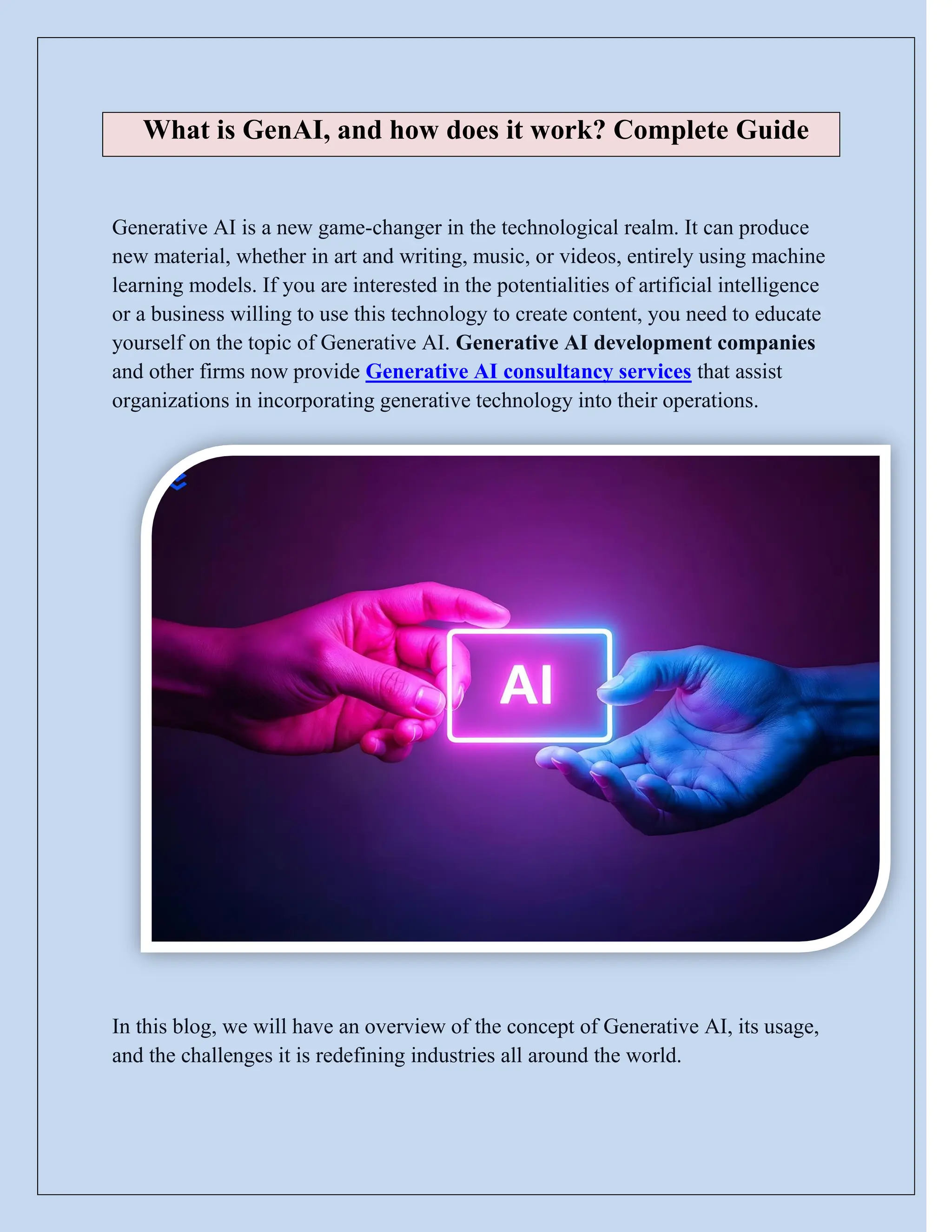
Generative AI is a new game-changer in the technological realm. It can produce
new material, whether in art and writing, music, or videos, entirely using machine
learning models. If you are interested in the potentialities of artificial intelligence
or a business willing to use this technology to create content, you need to educate
yourself on the topic of Generative AI. Generative AI development companies
and other firms now provide Generative AI consultancy services that assist
organizations in incorporating generative technology into their operations.
In this blog, we will have an overview of the concept of Generative AI, its usage,
and the challenges it is redefining industries all around the world.
2.
What is GenerativeAI?
Generative AI is a type of artificial intelligence that can create new data based on
the knowledge gained from existing one. In contrast to conventional AI,
Generative AI does not perform a classification and prediction task but produces
something new, e.g., images, text, music, or even videos. They are systems that
simulate human creativity to enable machines to develop new ideas, solutions, or
creations. For example, text-based generative AI (GPT-3) and image-based
generative AI (DALL-E) train on vast amounts of data to create realistic content.
Generative AI employs powerful machine learning systems, especially those
grounded in deep learning, to comprehend and model patterns in the data.
Generative Adversarial Networks (GANs) are one of the most popular techniques
of Generative AI. GANs have two neural networks: the generator that generates
new data and the discriminator that considers whether the generated data is
authentic. Eventually, their networks enhance their output, making the produced
material indistinguishable from real-life data.
How Does Generative AI Work?
Generative AI works by using algorithms that are meant to generate new data
examples similar to the training data. This can be used with several data types,
such as images, music, speech, and text. The workings of generative AI can be
further explained, mainly by concentrating on the two most trending generative AI
models: Generative Adversarial Networks (GANs) and Variational Autoencoders
(VAEs).
● Generative Adversarial Networks (GANs)
GANs are actually comprised of two neural networks, including the generator and
the discriminator. The generator outputs new data instances, and the discriminator
analyses them. The networks are both co-trained; typically, they are initialized with
random noise.
The discriminator attempts to distinguish between real and generated data in the
training process. In contrast, the generator produces data that appears to be the
3.
same as thereal one. This forms a feedback loop, as this causes the generator to
refine its outputs based on the feedback of the discriminator and vice versa.
The generator gets increasingly improved in generating images or texts to confuse
the discriminator. The end product is a generator network that can generate new
and realistic data, just like the input data.
● Variational Autoencoders (VAEs)
VAEs are encoder-decoder nets. An encoder reduces high-dimensional inputs to a
low-dimensional representation in the latent space, and the decoder is used to
reconstruct the data using that representation.
VAEs train by learning to squeeze input data into a latent code and then reproduce
it. But rather than merely learning to map the input data to a fixed latent space,
they should learn to map the input data to a distribution over the latent space. This
stochastic process provides the generative nature to VAEs.
Once trained, you can sample data points in the latent space and decode the data
into new instances. These new cases are a combination of the input data features
and, therefore, are a kind of new material.
● Transformers
Text-based generative AI, such as GPT-3, previously GPT-2 and GPT, employs a
different neural network architecture, dubbed Transformer, where the model can
quantify how various words in the input data interact and build extremely coherent
and contextual text by making detectable predictions.
They can read context, sentiment, and linguistic structure and generate human-like
writing in part by using sophisticated natural language processing, and thus, they
are considered human-like. They are learning from vast amounts of human-
generated text to anticipate the word that follows a phrase by discovering the
connections between every preceding word. This mechanism is known as
autoregression.
4.
The success pointof the generative AI models is not only the architecture but also
the scale; they are highly versatile, with billions of parameters to help comprehend
and generate text.
Applications of Generative AI
With the present limitation, it is natural to be skeptical about using ChatGPT (and
AI and machine learning in general). However, the possibilities and positive
consequences of generative AI can be attested to by the number of industries that
benefit from it already. Some of the seemingly uncommon applications of AI, in
the best interest of most people, are art therapy, medical imaging analysis, and
high-resolution weather forecasts.
To a large extent, individual employees are leading the trend toward generative AI
in the business world. A Salesforce study found that nearly 6 out of 10 employees
(61%) are already using or will use generative AI. That said, companies of all
calibers are scurrying to adopt generative AI tools in their business models to carve
a niche of a large pie. The McKinsey research indicates that generative AI
applications may add up to 4.4 trillion dollars annually to the global economy. It is
also possible that everything that cannot be connected to AI anywhere in the sphere
of technology, media, and telecommunications can be considered obsolete or
inefficient in three years.
As organizations get bandwagoning, here are some of the ways people and
businesses are already using generative AI in their practice:
1. Arts and Creative Fields
ChatGPT is a large language model that is good at creating text formats, including
poetry and copywriting web pages, advertisements, books, and script prose. They
are also helpful when it comes to writing speeches, but they may at times offer
irrelevant or repeated text, even when the consumer programs it. Sometimes, the
language created may also be strange, surprising, or plain wrong, such as using a
mixture of French and English in the same sentence.
5.
The graphical contentworld is also shifting its context based on the emergence of
Google Gemini and DALL-E, which demonstrate the capacity to generate
exclusive images that are not searchable through the customary internet search.
2. Healthcare and Medicine
There can be no doubt that the healthcare field is one of the few (and humanity in
general) to reap the benefits of AI. Clinicians have already started using the new
platforms to convert patient interactions to clinician notes within a couple of
seconds. Physicians can also take down patients' visits through a ChatGPT mobile
app. This app translates the information live, highlighting the gaps and making the
clinician fill them in, transforming the dictation into a structured note in
conversational language.
After an appointment, the doctor reads AI-created notes, adds modifications, and
passes them on to the patient's electronic health record (EHR). Such an almost-
instant mechanism renders the manual and tedious note-taking and administrative
work obsolete.
Other possible areas of use of generative AI in medicine are:
● Claims management: ChatGPT can provide summaries on the issues of
manual and denied claims and develop ways to resolve them. It can also
assist in diagnosing fraudulent claims by using patterns in claims data to
detect anomalies that can lead to fraudulent claims.
● Enhancing customer service to patients: Generative AI-based chatbots
have the potential to offer immediate care to patients, addressing frequently
asked questions, making appointments, and delivering information regarding
services and processes. This is handy when responding to custom coverage
summary questions on particular benefits.
● Value-based care: Analyzing the data about their patients can help the
providers anticipate their health and know which patients are at risk of
developing some particular condition, thus intervening early and preventing
potentially harmful (and expensive) health issues.
6.
There is thepossibility of bias when using generative AI in healthcare since the
models can be trained on biased data. In other words, biased or unrepresentative
data can yield biased results, which may be disastrous in inpatient treatment.
3. Entertainment and gaming
The current stage of gaming technology does not allow it to adjust as it plays.
However, that day might be soon, and AI will be the centerpiece of that
achievement. We are already seeing the use of AI to optimize graphics through
better rendering methods, visual effects, and performance optimization, depending
on the hardware's capability. Enhancement of lower-resolution images and textures
into high resolutions, not by using high-resolution source resources, could improve
the image quality.
4. Fraud detection and security
Financial services are text and numbers-based algorithms, two aspects of data that
generative AI and large language models can examine on a high level. Since large
portions of data can be checked in the blink of an eye by LLMs, they are necessary
for finance and e-commerce firms to perform many operations. AI can detect
suspicious financial behaviors and prevent them from causing economic losses.
The learning and adapting of the generative AI mean that it will be imperative to
combat fraudsters, who will continue to update their strategies.
Regulatory concerns arise in using artificial intelligence in finance since models
need access to sensitive data (i.e., financial transactions or personal data). The
regulatory frameworks, including GDPR in Europe and CCPA in California,
dictate that data protection principles must be adhered to. Therefore, an
organization that uses generative AI to identify fraud should comply with these
regulations since failure to comply is subject to fines.
5. Software Engineering
Programmers are enjoying how generative AI is helping them and automating
some parts of software development. It is worth noting that it is beneficial in the
cases of bug identification and solution proposal. Programming tracks to ChatGPT
can deal with coding to a certain degree, but they might not be as good as the very
7.
skilled programmers. Nevertheless,when the engineers can communicate the
coding requirements, ChatGPT will yield good outcomes, just as is the case for
human coders when presented with client requirements. Most teams can already
auto-generate the code given the high-level specifications, which minimizes the
manual coding requirements and accelerates development.
Challenges to the Adoption of Gen AI in Enterprise
Use Cases
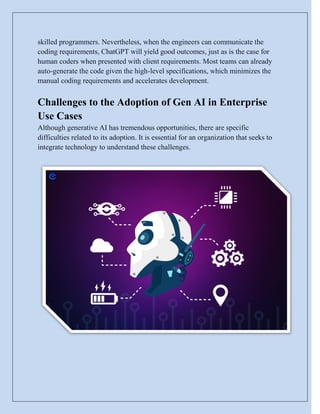
Although generative AI has tremendous opportunities, there are specific
difficulties related to its adoption. It is essential for an organization that seeks to
integrate technology to understand these challenges.
8.
1. Data Sensitivityand Quality
Generative AI models need a considerable quantity of qualitative information to
train on. It is difficult to gather, manage, and sustain these types of datasets,
particularly when sensitive data is concerned.
Businesses might find it challenging to get adequate representative and unbiased
data. Such insufficient data can also give false results, and sensitive information is
a concern regarding confidentiality and security.
2. Ethical and Legal Issues
The authenticity and intellectual property issues pertain to the realistic creativity
capabilities of Generative AI. Examples are deepfakes or generated articles that
cannot be differentiated in quality from the original ones.
Companies need to ensure that their local copyright is followed and that they
cannot give false or immoral transactional images.
3. Complexity and Cost of Implementation
Developing and sustaining a complex generative AI system also takes tremendous
talent, technology, and time investments. It is connected with complicated
algorithms that require continuous improvement.
The level of costs associated with it, as well as the involvement of resources, can
be too high, and some companies may not afford these expenses, or their small and
medium-sized enterprises (SMEs) may lack the needed funds or even the ability to
find skilled specialists.
4. Interpretability and Trust
As AI systems are considered a black box, it becomes hard to discover how they
lead to specific outputs or decisions. These intense learning models are applied in
generative artificial intelligence.
Such black-boxiness may result in losing the trust of stakeholders, customers, or
regulatory entities, especially when the AI-produced outcomes are not predictable
or do not have any explanations. Companies must develop a feeling of trust in the
decisions and outputs of AI.
9.
5. Integration withExisting Systems
This may prove a complicated task as it involves coupling generative AI
technology with a company's IT infrastructure and workflows, and providing
significant changes or upgrades.
During the merging, companies might experience disruptions in operations, and the
new system will not necessarily work smoothly with the existing processes already
set. These could mean inefficiencies or difficulties in adjusting to new systems by
personnel.
One needs a strategic approach to overcome these challenges, which implies
comprehensive planning, continuous assessment, and the best practices and ethical
standards.
Popular Generative AI Models
Google Bard, ChatGPT, and Dall-E are complex AI models whose functions
involve special abilities to comprehend, communicate, and create.
What is Google Bard?
Bard is a chatbot developed by Google. Depending on the requests, it can produce
texts, translate languages, write various types of creative content, etc.
Essentially, Bard is a vast language model trained on a massive amount of text,
enabling it to learn and recreate complicated language patterns. It produces a
reaction to cues by identifying these patterns and their application in suitable
contexts. Its primary role is to analyze and react to user messages according to its
training. It is a developing system, constantly learning, thanks to the new
interactions and feedback, and this is why it can be improved with time; however,
it can also be erroneous.
What is ChatGPT?
ChatGPT is simply a derivative of the GPT (Generative Pre-trained Transformer)
model that is deliberately tweaked to have a human-like text conversation. OpenAI
creates it and is intended to develop well-connected and contextually supportive
text according to the information it obtains.
10.
It can makeconversation, respond to questions, and even do more complicated
things like translating languages or explaining things.
Such GPT models as ChatGPT have been trained using a large text dataset. It
applies transformers, one of the neural network designs, analyzes the context and
innuendo of the textual input, and builds the right responses. It appears not only to
look at separate words but also the structure of sentences and paragraphs, tone, and
suggestions, and it makes it easier to talk more naturally.
What is Dall-E?
Along with GPT-3 is Dall-E, another generative AI model developed by OpenAI
that can generate images based on textual descriptions.
Dall-E allows the creation of a reasonably detailed and accurate picture based on a
textual request. In other words, if you request that it describe a two-story pink
house in the shape of a shoe, it can produce an image that pretty closely resembles
the description given.
Dall-E uses a huge text image dataset to train. It applies a version of the GPT-3
model to interpret text entered into it and a type of VAE (Variational
AutoEncoder) generative model to generate the image. It processes the description
to interpret it to know what it should account for and creates a new image by
combining its knowledge of real-world things and artistic styles.
Future of Generative AI
Generative AI is just developing and will achieve fresh innovation, efficiency, and
growth possibilities. Expect a significant transformation in how generative AI is
applied because it will become a creative partner in accomplishing complex tasks
in the future. Business Innovation Enterprise use cases hope to achieve
revolutionary advances in design, art, and storytelling, possibly transforming
business innovation.
Hyper-personalization will be much more commonplace with generative AI
designed to customize the experiences and content to the individual on a per-
11.
industry basis. Thiscan enhance customer engagement and consumer sales in the
fields of healthcare, e-commerce, and more. On the same note, the work of
generative AI will spread into real-time decision-making, allowing businesses to
avoid crises, financial markets, and strategic planning as soon as possible. Ethical
and regulatory approaches will have to parallel enterprise use cases of generative
AI to ensure a marketplace of equitability, openness, and sustained consumer
confidence.
Our vision of the future must be balanced, and we should use AI's opportunities.
However, we must also pay close attention to the questions about ethics, security,
and society. The future of generative AI should not only be discussed in terms of
technological advancements, but also in a responsible framework for generating a
sustainable and equitable model of its further evolution.
How Eoxys IT Solution Can Help You Leverage
Generative AI?
12.
Eoxys IT Solutionis one of the trusted companies that offers the best Generative
AI development services. Eoxys, a team of AI professionals, supports enterprises
in many sectors to incorporate Generative AI in their practice. You can use Eoxys
IT Solution to automate the creation of content, the analysis of data, and the design
of novel products that support your business requirements using custom solutions.
In selecting Eoxys IT Solution as your partner, you will have access to our
company's entire scope of services and a wide variety of Generative AI
consultancy services, such as the training of models, the implementation of AI,
and its support. Having developed a profound understanding of the application of
machine learning and artificial intelligence technologies, the company will
ascertain that your Generative AI systems work efficiently, securely, and on scale.
Eoxys IT Solution has a customer-centric model that involves close collaboration
with clients to learn more about their problems and offers solutions that motivate
efficiency, innovation, and resistant growth. Whether you work in healthcare,
finance, or entertainment, Eoxys IT Solution will provide you with the tools and
experience to release the full potential of Generative AI.
The Bottom Line
Generative AI can change the world, and it will transform whole industries. Using
this technology, Generative AI development companies can help businesses
automate work and boost creative approaches to innovation. With the advancement
of technology, Generative AI will occupy this sphere even more in future business
activities. Are you interested in the automation of content generation, customer
service enhancement, or data synthesis? Generative AI development services can
find a solution that suits you to ensure you remain market competitive.
13.
FAQ
What is thedistinction between Generative AI and typical AI?
Generative AI involves the production of novel content based on acquired
information, whereas traditional AI involves interpretation and forecasting.
Does Generative AI produce original art?
Yes, Generative AI can generate original art, music, and creative content from
previously acquired data and generate new items.
What are the useful applications of generative AI to businesses?
Generative AI allows companies to roll out automated content generation, enhance
customer experience, and increase their product development.
Which industries can the Generative AI be utilized in?
Generative AI is a value-added product in any industry, including healthcare,
marketing, entertainment, and education.
What does Generative AI do to enhance content creation?
Generative AI can also automate content creation, generating high-quality text,
images, and videos using a reduced amount of time and at scale.
Is Generative AI safe?
Security would be based on how GenAI systems are deployed. The right solutions
can guarantee high security for businesses.
What are the challenges of using Generative AI?
Issues like data privacy, biases in models, and the cost of development can be
resolved with planning.