Name :- Jagruti RVasani
Sem :- 3
Roll No. :- 15
Enrollment No :- 2069108420180054
Paper 11 :- Postcolonial Literature
Topic :- Orient was a reality and it was a distorted reality
Email-Id :- jagrutivasani17@gmail.com
SubmittedTo :- Smt S.B. Gardi Department of English
Maharaja Krishnkumarsinhji Bhavnagar University
ORIENT
Orient are such eastern people who are more flexible, superior and power.The term
originally had a literal geographic meaning, referring to the eastern part of the old
world, contrasting the cultures and civilization of Asia.
Conceptually the boundary between east and west is cultural, rather than geographical
as a result 0f which is typically grouped in the west.
Eastern culture has developed many themes and traditions.
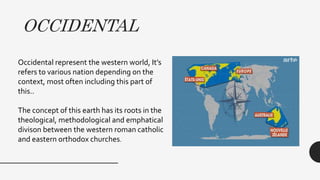
OCCIDENTAL
Occidental represent the western world, It’s
refers to various nation depending on the
context, most often including this part of
this..
The concept of this earth has its roots in the
theological, methodological and emphatical
divison between the western roman catholic
and eastern orthodox churches.
Orient and Occident
Countries
• Orient Countries
• Japan
• Korea
• Hong Kong andTaiwan
• Occidental Countries
• United States
• United Kingdom
• Germany
• France
• Netherlands
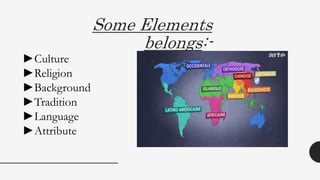
Some Elements
belongs:-
►Culture
►Religion
►Background
►Tradition
►Language
►Attribute
ORIENTALISM
Orientalism is a term, the representation of Asia in a
stereotyped and way that is regarded as embodying a
colonialist attitude. It is a way of seeing that imagines,
emphasizes, exaggerates and distorts differences of Arab
culture.
Examples of early orientalism can be seen in European
paintings and photographs and also in images from the
world’s fair in the U.S. in the 19th and early 2oth century.
Edward’s view…
Edward Said expresses in Orientalism is founded upon his
three point definition of his concept of Orientalism, an
academic field within multiple disciplines. A conception of
reality based on the binary form of “Occidental” opposing
“Oriental”.
Four arguments said make’s expressing:-
1.Accumulating and analyzing present day evidence of
the cultures and psychologies of the oriental east rather
than emphasizing past historical Oriental eras.
2.Dispelling the doctrine that Orientals are sociologically
unworthy of scholarly recognition and denouncing
reliance on social science’s uninvestigated generalities
of cultures and human anthropological characteristics.
Continued...
3. Rejecting international policy relations that represent the
Occidental west as superior and rational while representing
the Oriental east as deviant and inferior.
4. Eradication of binary facilitated domination by the powerful,
rational, superior occident over the impotent, irrelevant,
deviant and inferior orient.
Conclusion
Orientalism was written to show European American power
to the orient and the mystification of the “Orient” as we see
earlier the western’s view towards the east which is discussed
by said in the book. He shows the European western imperial
power along with the confused feeling of the oriental
countries towards the western power.
  Postcolonial Studies

Postcolonial Studies

  • 1.
    Name :- JagrutiRVasani Sem :- 3 Roll No. :- 15 Enrollment No :- 2069108420180054 Paper 11 :- Postcolonial Literature Topic :- Orient was a reality and it was a distorted reality Email-Id :- jagrutivasani17@gmail.com SubmittedTo :- Smt S.B. Gardi Department of English Maharaja Krishnkumarsinhji Bhavnagar University
  • 2.
    ORIENT Orient are sucheastern people who are more flexible, superior and power.The term originally had a literal geographic meaning, referring to the eastern part of the old world, contrasting the cultures and civilization of Asia. Conceptually the boundary between east and west is cultural, rather than geographical as a result 0f which is typically grouped in the west. Eastern culture has developed many themes and traditions.
  • 3.
    OCCIDENTAL Occidental represent thewestern world, It’s refers to various nation depending on the context, most often including this part of this.. The concept of this earth has its roots in the theological, methodological and emphatical divison between the western roman catholic and eastern orthodox churches.
  • 4.
    Orient and Occident Countries •Orient Countries • Japan • Korea • Hong Kong andTaiwan • Occidental Countries • United States • United Kingdom • Germany • France • Netherlands
  • 5.
  • 6.
    ORIENTALISM Orientalism is aterm, the representation of Asia in a stereotyped and way that is regarded as embodying a colonialist attitude. It is a way of seeing that imagines, emphasizes, exaggerates and distorts differences of Arab culture. Examples of early orientalism can be seen in European paintings and photographs and also in images from the world’s fair in the U.S. in the 19th and early 2oth century.
  • 7.
    Edward’s view… Edward Saidexpresses in Orientalism is founded upon his three point definition of his concept of Orientalism, an academic field within multiple disciplines. A conception of reality based on the binary form of “Occidental” opposing “Oriental”.
  • 8.
    Four arguments saidmake’s expressing:- 1.Accumulating and analyzing present day evidence of the cultures and psychologies of the oriental east rather than emphasizing past historical Oriental eras. 2.Dispelling the doctrine that Orientals are sociologically unworthy of scholarly recognition and denouncing reliance on social science’s uninvestigated generalities of cultures and human anthropological characteristics.
  • 9.
    Continued... 3. Rejecting internationalpolicy relations that represent the Occidental west as superior and rational while representing the Oriental east as deviant and inferior. 4. Eradication of binary facilitated domination by the powerful, rational, superior occident over the impotent, irrelevant, deviant and inferior orient.
  • 10.
    Conclusion Orientalism was writtento show European American power to the orient and the mystification of the “Orient” as we see earlier the western’s view towards the east which is discussed by said in the book. He shows the European western imperial power along with the confused feeling of the oriental countries towards the western power.