DEVELOPING A POSITION STATEMENT
 What pressing problem does the school library program
solve?
 What specific benefit does the school library program
deliver?
 Why is the school library program a good solution?
 What makes the school library program/school librarian
unique to solving the problem?
 Can you communicate this difference in a way that sets the
school library program apart from the alternatives?
Repeat your message everywhere - website, handouts,
parent/ teacher/administrator communications, and in your
email signature. Repetition is how you “own” a position
statement; use it to create a tag line; keep it for at least 2
years.
• Short, declarative, direct
(less than 12 words,
excluding the subject)
• Simple language
• Includes an important
benefit
• Addresses a problem that
is student-oriented
POSITIONING STATEMENT
The goal in positioning is to help the target audience
associate a benefit they value with the school library
program or the role of the librarian. Over time and with
repetition, you can “own” that position by consistently
communicating the idea in all your marketing/advocacy
communications.
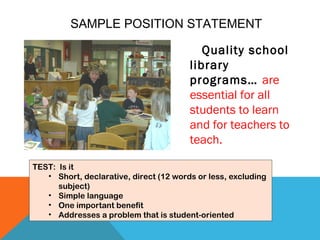
Quality school
library
programs… are
essential for all
students to learn
and for teachers to
teach.
SAMPLE POSITION STATEMENT
TEST: Is it
• Short, declarative, direct (12 words or less, excluding
subject)
• Simple language
• One important benefit
• Addresses a problem that is student-oriented

Position statement

  • 1.
    DEVELOPING A POSITIONSTATEMENT  What pressing problem does the school library program solve?  What specific benefit does the school library program deliver?  Why is the school library program a good solution?  What makes the school library program/school librarian unique to solving the problem?  Can you communicate this difference in a way that sets the school library program apart from the alternatives? Repeat your message everywhere - website, handouts, parent/ teacher/administrator communications, and in your email signature. Repetition is how you “own” a position statement; use it to create a tag line; keep it for at least 2 years.
  • 2.
    • Short, declarative,direct (less than 12 words, excluding the subject) • Simple language • Includes an important benefit • Addresses a problem that is student-oriented POSITIONING STATEMENT The goal in positioning is to help the target audience associate a benefit they value with the school library program or the role of the librarian. Over time and with repetition, you can “own” that position by consistently communicating the idea in all your marketing/advocacy communications.
  • 3.
    Quality school library programs… are essentialfor all students to learn and for teachers to teach. SAMPLE POSITION STATEMENT TEST: Is it • Short, declarative, direct (12 words or less, excluding subject) • Simple language • One important benefit • Addresses a problem that is student-oriented

Editor's Notes

  • #2 Source: Messages That Matter. http://www.messagesthatmatter.com/positioning.php A consulting group that focuses on message strategy development for business-to-business software applications and Internet infrastructure technologies. 
  • #3 Key: When asking for support, messages should be child-centered. Write in terms of "what the students will gain or lose with a diminished educational opportunities" and not about "what the library will gain or lose." Stakeholders are interested in children, not libraries.
  • #4 Would this “fit” on your email signature, your library website, annual report, newsletter, etc? This then becomes your foundation for all messaging- talking point, elevator speeches, springboard stories, etc.