20CMB13
PRODUCTION AND OPERATION
MANAGEMENT
UNIT -1 INTRODUCTION TO PRODUCTION AND OPERATIONS
• Definition, Concept, Significance, and Functions of Production and
Operations System; Evolution from manufacturing to operations
management; Recent trends in manufacturing; Types of Production
Systems; Operations Management and Strategy
Definition
Production / Operations Management is defined as the process which
transforms the inputs/resources of an organization into final goods (or
services) through a set of defined, controlled and repeatable policies.
By policies, we refer to the rules that add value to the final output. The
value added can be in different dimensions, but the industrial set-up is
mostly concerned with the duo of quality and throughput.
Difference between Production and Operations
Management
• Production and operations management are more similar than
different: if manufacturing products is a prime concern then it is
called production management, whereas management of services is
somewhat broader in scope and called operations management
(because manufacturing services sounds absurd, right?).
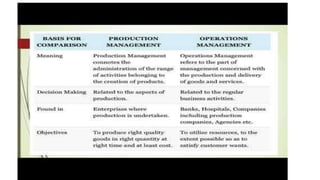
Production Management v/s Operations Management
• A high level comparison which distinct production and operations management can
be done on following characteristics:
Output: Production management deals with the manufacturing of products like
(computer, car, etc) while operations management cover both products and services.
Usage of Output: Products like computer/car are utilized over a period of time
whereas services need to be consumed immediately
Classification of work: To produce products like computer/car more of capital
equipment and less labour are required while services require more labour and lesser
capital equipment.
Customer Contact: There is no participation of the customer during production
whereas for services constant contact with customer is required.
• Production management and operations management both are very essential in
meeting objective of an organization.
Concept of Production and Operation
Management
• "Production" and "Management" are common terms that are
defined in many ways. Generally, Production is 'the act or process
producing' and Management is the 'art of managing' thus defining
Production Management as the 'art of managing production process
best support the organizational goals and policies'.
Concepts
• Production and Operation Management deals with the creation of goods and
services through the application of the business concept. They are also vital in
both service and manufacturing firms.
• Production and Operations Management has a primary objective, which is to
employ the company’s resources to produce goods and services fit for the
market. This post highlights the definitions, importance, and function of both
management concepts.
The Function of Production Management
• The role of Production Management is quite elaborate. But the sole aim is to ensure the business produces
quality products that can satisfy the needs of customers on a regular basis. Below are the functions of
production management.
Production Control – Here the manager supervises and directs the production process. He or she also
must find out and ensure the right production plan is followed during the production process. If there are
deviations, the production manager has to take the right steps to correct them.
Scheduling – This function is critical in every organization. It has to do with planning when the actual
production would begin and ends.
Cost and Quality Control – Every company knows how essential quality control and price are. Customers
are not just looking for the best products. But they also want to have them at the lowest possible
price. Quality control is an essential duty the production manager has to perform. It entails multiple checks
performed on the product to ensure quality is intact.
Maintenance of Machines – Production management also entails making sure that instruments used are in
good working condition. And that means replacing the ones that are underper forming or changing
damaged parts to enable the machine to function optimally.
Why Production Management is so Important
• Production management is relevant to the firm’s success in many ways. Used
efficiently, it can lead to numerous accomplishments which will take the business to
a great height. Below is the importance of production management.
Helps the Firm to Accomplish its Objectives
Production management helps the firm to achieve its sales and business objectives
by producing goods and services that meet the need of consumers. Sales and profit
will increase if the product produced satisfies the customers’ needs.
Boost Business Reputation and Goodwill
A satisfied customer will undoubtedly want to repeat patronage. That’s why
businesses should ensure that quality products are delivered continuously. Making
sure that your customers are always happy can also boost business reputation.
Reduces the Cost of Production
Production management ensures that resources are used judiciously, without
compromising on quality. In other words, the business will continue to deliver quality
products and sell at a convenient price to customers. But this can only be possible in a
situation where the input and output are maximized.
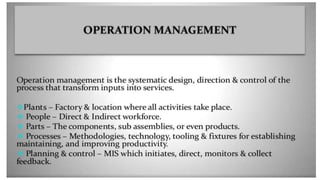
Meaning of Operation Management
• Operation Management is in charge of managing the conversion
process. This unit handles the day-to-day running of the business to
ensure operations within the organization are carried out smoothly. It
is also in charge of production administration, manufacturing and
other processes like the rendering of services.
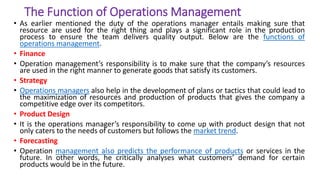
The Function of Operations Management
• As earlier mentioned the duty of the operations manager entails making sure that
resource are used for the right thing and plays a significant role in the production
process to ensure the team delivers quality output. Below are the functions of
operations management.
• Finance
• Operation management’s responsibility is to make sure that the company’s resources
are used in the right manner to generate goods that satisfy its customers.
• Strategy
• Operations managers also help in the development of plans or tactics that could lead to
the maximization of resources and production of products that gives the company a
competitive edge over its competitors.
• Product Design
• It is the operations manager’s responsibility to come up with product design that not
only caters to the needs of customers but follows the market trend.
• Forecasting
• Operation management also predicts the performance of products or services in the
future. In other words, he critically analyses what customers’ demand for certain
products would be in the future.
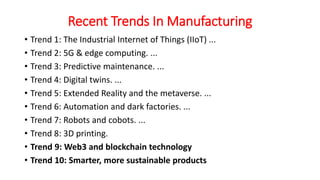
Recent Trends In Manufacturing
• Trend 1: The Industrial Internet of Things (IIoT) ...
• Trend 2: 5G & edge computing. ...
• Trend 3: Predictive maintenance. ...
• Trend 4: Digital twins. ...
• Trend 5: Extended Reality and the metaverse. ...
• Trend 6: Automation and dark factories. ...
• Trend 7: Robots and cobots. ...
• Trend 8: 3D printing.
• Trend 9: Web3 and blockchain technology
• Trend 10: Smarter, more sustainable products
Industrial Internet of Things (IIoT)
• Industrial Internet of Things (IIoT), where interconnected devices are used in
manufacturing and industrial settings to collect data – data that can then be
used to enhance the manufacturing process.
• Sensors are a prime example of these interconnected IIoT devices. Data
gathered from sensors on factory machines can help manufacturers
understand how machines are performing, optimize the maintenance process,
reduce machine downtime, and even predict when things will go wrong.
Which brings us to the next big trend in manufacturing
Trend 2: 5G & edge computing
• The fifth generation of mobile data network technology (5G) will enable
manufacturers to easily connect their IIoT technology and leverage the data
collection and data processing within devices such as smart machines and
sensors (what we refer to as edge computing).
• Manufacturers can create a private 5G network on their premises which will
give them superfast data speeds without the need for cables and much-
improved data security.
Trend 3: Predictive maintenance
• In a manufacturing context, predictive maintenance refers to the use of
sensor data and artificial intelligence (AI) to detect failure patterns in
machinery and components.
• The idea is that by understanding when a machine or part is likely to fail,
manufacturers can take preventative action and maintain their equipment
more effectively.
Trend 4: Digital twins
• Digital twins can be used to simulate any physical process or object. For
example, in a manufacturing setting, a digital twin could be used to simulate
a new product's dimensions or create a digital replica of the equipment on
the factory floor to see how the machinery operates under certain
conditions.
• Digital twin technology can even be used to visualize and simulate an entire
supply chain. By 2022, as many as 70 percent of manufacturers may be using
digital twins to conduct simulations and evaluations – which gives you an
idea of just how transformative this trend could be.
Trend 5: Extended Reality and the metaverse
• Extended reality technologies such as augmented and virtual reality will play
an increasingly important part in manufacturing, from enhanced product
design, better production planning, augmenting human abilities on
assembly lines, and more immersive training.
• As more of the world extends into the metaverse, more opportunities will
arise for manufacturers.
Trend 6: Automation and dark factories
• Thanks to AI, machines are now capable of carrying out more and more
tasks that were previously reserved for humans. So it makes sense that
machines can take on more and more manufacturing tasks.
• Automation can bring many advantages to manufacturers, including
higher productivity (machines don’t get tired), greater accuracy, and
lower costs. We may even see more entirely automated factories or so-
called dark factories – fully automated sites where production happens
without direct human intervention on site.
Trend 7: Robots and cobots
• One of the key enablers of automation is the use of robots. But it’s worth noting that not all robots
are there to replace human workers – many are there to enhance the work of humans. For example,
we have robotic exoskeletons that help those on the production line lift heavier parts without
compromising their safety. And we have collaborative, intelligent robots – or “cobots” – that are
specifically designed to work alongside humans.
• Robots and cobots can help manufacturers achieve greater efficiencies. This was the case for Nissan,
who deployed Universal Robots’ robotic arms at its motor production facilities in Japan to help
overcome problems around maintaining production times (largely due to labor shortages). Nissan
also deployed cobots to help employees install engine intakes, among other tasks.
Trend 8: 3D printing
• As 3D printing becomes more cost-effective, efficient, and scalable,
manufacturers will increasingly be able to make products using 3D
printing methods – which use fewer materials and create less waste than
traditional manufacturing methods.
• 3D printing will also drive a new era of personalization because
individually personalized products can be made without worrying about
economies of scale. Plus, 3D printing can help to drive innovation by
allowing rapid prototyping.
Trend 9: Web3 and blockchain technology
• With the emergence of Web3 and distributed computing technology such
as blockchains and NFTs (non-fungible tokens), there will be opportunities for
manufacturers to better monitor their supply chains and even automate many of
the transactions along their supply chains.
• Many of the products that will be manufactured in the future will be sold with
their NFT digital certificates.
Non -fungible token (NFT) is a digital identifier, similar to a certificate of ownership,
that represents a digital or physical asset.
Trend 10: Smarter, more sustainable products
• The emergence of smart connected IoT devices isn’t just
changing how products are manufactured but what types of products are
manufactured.
• These days it seems there are “smart” versions of everything from vacuum
cleaners to toilets, and the trend for smart products shows no sign of
slowing down.
• Therefore, manufacturers will increasingly have to explore ways of giving
customers the intelligent products they expect.
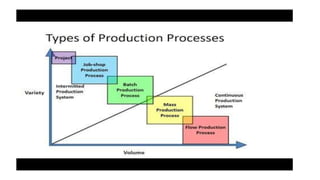
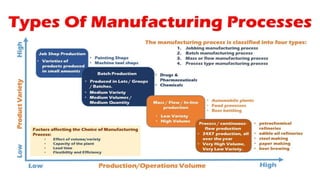
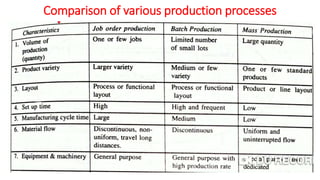
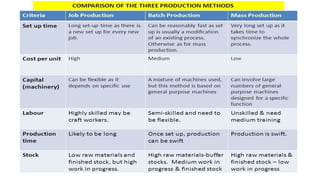
Comparison of various production processes
POM UNIT 1.pptx
POM UNIT 1.pptx
POM UNIT 1.pptx
POM UNIT 1.pptx
POM UNIT 1.pptx
POM UNIT 1.pptx

POM UNIT 1.pptx

  • 1.
  • 2.
    UNIT -1 INTRODUCTIONTO PRODUCTION AND OPERATIONS • Definition, Concept, Significance, and Functions of Production and Operations System; Evolution from manufacturing to operations management; Recent trends in manufacturing; Types of Production Systems; Operations Management and Strategy
  • 3.
    Definition Production / OperationsManagement is defined as the process which transforms the inputs/resources of an organization into final goods (or services) through a set of defined, controlled and repeatable policies. By policies, we refer to the rules that add value to the final output. The value added can be in different dimensions, but the industrial set-up is mostly concerned with the duo of quality and throughput.
  • 4.
    Difference between Productionand Operations Management • Production and operations management are more similar than different: if manufacturing products is a prime concern then it is called production management, whereas management of services is somewhat broader in scope and called operations management (because manufacturing services sounds absurd, right?).
  • 5.
    Production Management v/sOperations Management • A high level comparison which distinct production and operations management can be done on following characteristics: Output: Production management deals with the manufacturing of products like (computer, car, etc) while operations management cover both products and services. Usage of Output: Products like computer/car are utilized over a period of time whereas services need to be consumed immediately Classification of work: To produce products like computer/car more of capital equipment and less labour are required while services require more labour and lesser capital equipment. Customer Contact: There is no participation of the customer during production whereas for services constant contact with customer is required. • Production management and operations management both are very essential in meeting objective of an organization.
  • 6.
    Concept of Productionand Operation Management • "Production" and "Management" are common terms that are defined in many ways. Generally, Production is 'the act or process producing' and Management is the 'art of managing' thus defining Production Management as the 'art of managing production process best support the organizational goals and policies'.
  • 7.
    Concepts • Production andOperation Management deals with the creation of goods and services through the application of the business concept. They are also vital in both service and manufacturing firms. • Production and Operations Management has a primary objective, which is to employ the company’s resources to produce goods and services fit for the market. This post highlights the definitions, importance, and function of both management concepts.
  • 10.
    The Function ofProduction Management • The role of Production Management is quite elaborate. But the sole aim is to ensure the business produces quality products that can satisfy the needs of customers on a regular basis. Below are the functions of production management. Production Control – Here the manager supervises and directs the production process. He or she also must find out and ensure the right production plan is followed during the production process. If there are deviations, the production manager has to take the right steps to correct them. Scheduling – This function is critical in every organization. It has to do with planning when the actual production would begin and ends. Cost and Quality Control – Every company knows how essential quality control and price are. Customers are not just looking for the best products. But they also want to have them at the lowest possible price. Quality control is an essential duty the production manager has to perform. It entails multiple checks performed on the product to ensure quality is intact. Maintenance of Machines – Production management also entails making sure that instruments used are in good working condition. And that means replacing the ones that are underper forming or changing damaged parts to enable the machine to function optimally.
  • 11.
    Why Production Managementis so Important • Production management is relevant to the firm’s success in many ways. Used efficiently, it can lead to numerous accomplishments which will take the business to a great height. Below is the importance of production management. Helps the Firm to Accomplish its Objectives Production management helps the firm to achieve its sales and business objectives by producing goods and services that meet the need of consumers. Sales and profit will increase if the product produced satisfies the customers’ needs. Boost Business Reputation and Goodwill A satisfied customer will undoubtedly want to repeat patronage. That’s why businesses should ensure that quality products are delivered continuously. Making sure that your customers are always happy can also boost business reputation. Reduces the Cost of Production Production management ensures that resources are used judiciously, without compromising on quality. In other words, the business will continue to deliver quality products and sell at a convenient price to customers. But this can only be possible in a situation where the input and output are maximized.
  • 12.
    Meaning of OperationManagement • Operation Management is in charge of managing the conversion process. This unit handles the day-to-day running of the business to ensure operations within the organization are carried out smoothly. It is also in charge of production administration, manufacturing and other processes like the rendering of services.
  • 13.
    The Function ofOperations Management • As earlier mentioned the duty of the operations manager entails making sure that resource are used for the right thing and plays a significant role in the production process to ensure the team delivers quality output. Below are the functions of operations management. • Finance • Operation management’s responsibility is to make sure that the company’s resources are used in the right manner to generate goods that satisfy its customers. • Strategy • Operations managers also help in the development of plans or tactics that could lead to the maximization of resources and production of products that gives the company a competitive edge over its competitors. • Product Design • It is the operations manager’s responsibility to come up with product design that not only caters to the needs of customers but follows the market trend. • Forecasting • Operation management also predicts the performance of products or services in the future. In other words, he critically analyses what customers’ demand for certain products would be in the future.
  • 16.
    Recent Trends InManufacturing • Trend 1: The Industrial Internet of Things (IIoT) ... • Trend 2: 5G & edge computing. ... • Trend 3: Predictive maintenance. ... • Trend 4: Digital twins. ... • Trend 5: Extended Reality and the metaverse. ... • Trend 6: Automation and dark factories. ... • Trend 7: Robots and cobots. ... • Trend 8: 3D printing. • Trend 9: Web3 and blockchain technology • Trend 10: Smarter, more sustainable products
  • 17.
    Industrial Internet ofThings (IIoT) • Industrial Internet of Things (IIoT), where interconnected devices are used in manufacturing and industrial settings to collect data – data that can then be used to enhance the manufacturing process. • Sensors are a prime example of these interconnected IIoT devices. Data gathered from sensors on factory machines can help manufacturers understand how machines are performing, optimize the maintenance process, reduce machine downtime, and even predict when things will go wrong. Which brings us to the next big trend in manufacturing
  • 18.
    Trend 2: 5G& edge computing • The fifth generation of mobile data network technology (5G) will enable manufacturers to easily connect their IIoT technology and leverage the data collection and data processing within devices such as smart machines and sensors (what we refer to as edge computing). • Manufacturers can create a private 5G network on their premises which will give them superfast data speeds without the need for cables and much- improved data security.
  • 19.
    Trend 3: Predictivemaintenance • In a manufacturing context, predictive maintenance refers to the use of sensor data and artificial intelligence (AI) to detect failure patterns in machinery and components. • The idea is that by understanding when a machine or part is likely to fail, manufacturers can take preventative action and maintain their equipment more effectively.
  • 20.
    Trend 4: Digitaltwins • Digital twins can be used to simulate any physical process or object. For example, in a manufacturing setting, a digital twin could be used to simulate a new product's dimensions or create a digital replica of the equipment on the factory floor to see how the machinery operates under certain conditions. • Digital twin technology can even be used to visualize and simulate an entire supply chain. By 2022, as many as 70 percent of manufacturers may be using digital twins to conduct simulations and evaluations – which gives you an idea of just how transformative this trend could be.
  • 21.
    Trend 5: ExtendedReality and the metaverse • Extended reality technologies such as augmented and virtual reality will play an increasingly important part in manufacturing, from enhanced product design, better production planning, augmenting human abilities on assembly lines, and more immersive training. • As more of the world extends into the metaverse, more opportunities will arise for manufacturers.
  • 22.
    Trend 6: Automationand dark factories • Thanks to AI, machines are now capable of carrying out more and more tasks that were previously reserved for humans. So it makes sense that machines can take on more and more manufacturing tasks. • Automation can bring many advantages to manufacturers, including higher productivity (machines don’t get tired), greater accuracy, and lower costs. We may even see more entirely automated factories or so- called dark factories – fully automated sites where production happens without direct human intervention on site.
  • 23.
    Trend 7: Robotsand cobots • One of the key enablers of automation is the use of robots. But it’s worth noting that not all robots are there to replace human workers – many are there to enhance the work of humans. For example, we have robotic exoskeletons that help those on the production line lift heavier parts without compromising their safety. And we have collaborative, intelligent robots – or “cobots” – that are specifically designed to work alongside humans. • Robots and cobots can help manufacturers achieve greater efficiencies. This was the case for Nissan, who deployed Universal Robots’ robotic arms at its motor production facilities in Japan to help overcome problems around maintaining production times (largely due to labor shortages). Nissan also deployed cobots to help employees install engine intakes, among other tasks.
  • 24.
    Trend 8: 3Dprinting • As 3D printing becomes more cost-effective, efficient, and scalable, manufacturers will increasingly be able to make products using 3D printing methods – which use fewer materials and create less waste than traditional manufacturing methods. • 3D printing will also drive a new era of personalization because individually personalized products can be made without worrying about economies of scale. Plus, 3D printing can help to drive innovation by allowing rapid prototyping.
  • 25.
    Trend 9: Web3and blockchain technology • With the emergence of Web3 and distributed computing technology such as blockchains and NFTs (non-fungible tokens), there will be opportunities for manufacturers to better monitor their supply chains and even automate many of the transactions along their supply chains. • Many of the products that will be manufactured in the future will be sold with their NFT digital certificates. Non -fungible token (NFT) is a digital identifier, similar to a certificate of ownership, that represents a digital or physical asset.
  • 26.
    Trend 10: Smarter,more sustainable products • The emergence of smart connected IoT devices isn’t just changing how products are manufactured but what types of products are manufactured. • These days it seems there are “smart” versions of everything from vacuum cleaners to toilets, and the trend for smart products shows no sign of slowing down. • Therefore, manufacturers will increasingly have to explore ways of giving customers the intelligent products they expect.
  • 30.
    Comparison of variousproduction processes