POLYDACTALY
DEFINITION
• Presence of one or more supernumerary fingers
• radial side (preaxial), ulnar side (postaxial) or involve non-border
(central) digits
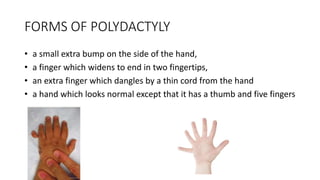
FORMS OF POLYDACTYLY
• a small extra bump on the side of the hand,
• a finger which widens to end in two fingertips,
• an extra finger which dangles by a thin cord from the hand
• a hand which looks normal except that it has a thumb and five fingers
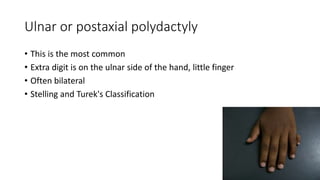
Ulnar or postaxial polydactyly
• This is the most common
• Extra digit is on the ulnar side of the hand, little finger
• Often bilateral
• Stelling and Turek's Classification
Stelling and Turek's Classification
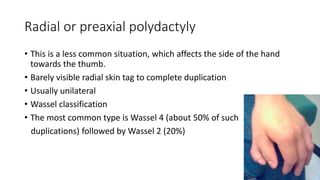
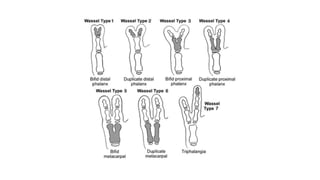
Radial or preaxial polydactyly
• This is a less common situation, which affects the side of the hand
towards the thumb.
• Barely visible radial skin tag to complete duplication
• Usually unilateral
• Wassel classification
• The most common type is Wassel 4 (about 50% of such
duplications) followed by Wassel 2 (20%)
Central Polydactaly
• This is a very rare situation
• the index finger is most often affected, whereas the ring finger is
rarely affected
• Type 1
• Type 2a & 2B
• Type 3
Treatment
1. Preaxial
• to construct a thumb that is 80% of the size of the contralateral
thumb
• resect smaller thumb (usually radial component)
• preserve / reconstruct medial collateral structures in order to
preserve pinch function
• reconstruction of all components typically done in one procedure
Post axial
Type 1
• tie off in nursery or amputate before 1 year of age
Type 2 & 3
• preserve radial digit
• preserve or reconstruct collateral ligaments from ulnar digit remnant
• preserve muscles
Central
• Early osteotomy and ligament reconstructions should be done to
prevent deformities, such as angular growth deformities
POLYDACTALY.pptx

POLYDACTALY.pptx

  • 1.
  • 2.
    DEFINITION • Presence ofone or more supernumerary fingers • radial side (preaxial), ulnar side (postaxial) or involve non-border (central) digits
  • 3.
    FORMS OF POLYDACTYLY •a small extra bump on the side of the hand, • a finger which widens to end in two fingertips, • an extra finger which dangles by a thin cord from the hand • a hand which looks normal except that it has a thumb and five fingers
  • 4.
    Ulnar or postaxialpolydactyly • This is the most common • Extra digit is on the ulnar side of the hand, little finger • Often bilateral • Stelling and Turek's Classification
  • 5.
    Stelling and Turek'sClassification
  • 6.
    Radial or preaxialpolydactyly • This is a less common situation, which affects the side of the hand towards the thumb. • Barely visible radial skin tag to complete duplication • Usually unilateral • Wassel classification • The most common type is Wassel 4 (about 50% of such duplications) followed by Wassel 2 (20%)
  • 8.
    Central Polydactaly • Thisis a very rare situation • the index finger is most often affected, whereas the ring finger is rarely affected • Type 1 • Type 2a & 2B • Type 3
  • 9.
    Treatment 1. Preaxial • toconstruct a thumb that is 80% of the size of the contralateral thumb • resect smaller thumb (usually radial component) • preserve / reconstruct medial collateral structures in order to preserve pinch function • reconstruction of all components typically done in one procedure
  • 11.
    Post axial Type 1 •tie off in nursery or amputate before 1 year of age Type 2 & 3 • preserve radial digit • preserve or reconstruct collateral ligaments from ulnar digit remnant • preserve muscles
  • 12.
    Central • Early osteotomyand ligament reconstructions should be done to prevent deformities, such as angular growth deformities

Editor's Notes

  • #6 type 1, there is soft tissue duplication. In type 2, there is a complete digit. In type 3, there is a complete ray including a metacarpal
  • #9 Type I is a central duplication, not attached to the adjacent finger by osseous or ligamentous attachments; it frequently does not include bones, joints, cartilage, or tendons. Type IIA is a nonsyndactylous duplication of a digit or part of a digit with normal components, and articulates with a broad or bifid metacarpal or phalanx. Type IIB is a syndactylous duplication of a digit or part of a digit with normal components, and articulates with a broad or bifid metacarpal or phalanx. Type III is a complete digital duplication, which has a well-formed duplicated metacarpal
  • #11 E: The tendon and muscle belly of the APB are elevated (arrow), with care being made to preserve the underlying RCL of the MCP joint, and prepared for later transfer. F: A wide, bifacet MC head is characteristically present. G: Schematic diagram depicting the RCL elevation with a strip of periosteum distally and an intact periosteal base proximally. If additional correction of the longitudinal alignment is needed, a closing wedge osteotomy through the distal MC may be done. H: Schematic diagram and I: clinical photo depicting advancement of the RCL into the base of the ulnar thumb proximal phalanx. The APB is similarly advanced and sewn into the base of the proximal phalanx and extensor hood 
  • #12 The ulnar collateral ligament and the insertions of the abductor digiti minimi are then elevated with a periosteal sleeve.
  • #14 Palmar views of central polydactyly with mobile, independent digits. The middle finger here is the polydactylous digit. B: Radiograph of the same patient with duplicated phalanges and bifid metacarpal. C: Surgical incision markings for excision of ulnar middle finger and reconstruction of web between the radial middle finger and the ring finger. Note the nonlinear Z-plasty incision is preferred to a longitudinal incision. D: Intraoperative closure after ray resection and reconstruction of web.