Power and Politics
Power
Power is the ability to influence behaviour,
people or things through the control of
important resources
Bases of Power
I Formal Power- is based on an individual’s position in an
organisation
1. Coercive power- the ability to influence punishment eg
reprimand, demotion, etc
2. Reward power- the extent to which one has control over rewards
that are valued by the other
3. Legitimate power- positional power because of the authority
inherent in the position as a result of hierarchy
4. Information power- comes from access to and control over
information
Bases of Power (contd)
II Personal Power- does not depend on the formal position of an
individual in the organisation
1. Expert power- is the result of expertise, special skill or
knowledge
2. Referent power- as a result of follower’s loyalty, respect,
friendship, affection, or desire to seek approval
3. Charismatic power- is an extension of referent power stemming
from an individual’s personality and interpersonal style
Dependency: The Key To Power
• The General Dependency Postulate
– The greater B’s dependency on A, the greater the power A has over
B.
– Possession/control of scarce organizational resources that others
need makes a manager powerful.
– Access to optional resources (e.g., multiple suppliers) reduces the
resource holder’s power.
• What Creates Dependency
– Importance of the resource to the organization
– Scarcity of the resource
– Nonsubstitutability of the resource
Faces of Power
As per David McClelland there are two types of power
1. Negative Face-
It is usually expressed in terms of dominance or submission ie I
win, you lose
Leadership on this bases uses people as need arises to be sacrificed
This face of power is self defeating
Person’s subjected to this power either resist leadership or become
passive
2. Positive Face-
Involves exerting influence on behalf of others rather than over
others
Involves exhibiting dominance to get work done for organisational
betterment and employee wellbeing
Leaders exercising this power encourage their subordinates to
develop strength and competence. They need to succeed as
human beings and as organisation members
Strategies for Power Acquisition
1. Maintain alliance with powerful people
2. Divide and Rule
3. Manipulate classified information
4. Attacking and blaming others
5. Wait for a crisis
6. Being aware of resource dependence
7. Coalition
Power Structure and Blocs
• Power relationships existing between the members
of an organisation usually match their positions in
the organisation chart
• Power relationships can be direct as well as
indirect
• Indirect power at times can be greater than direct
power because people can become members of
power elite due to casteism, club membership or
some other form of common interest
• Power elite are formed due to mutual sharing of
power
Power Blocs
• Unlike power elites which supplement the power
of people who are already powerful, power blocs
are large groups of people who possess limited
individual power
• People come together to form power blocs to
increase their collective power or reduce or
balance the power of those on whom they depend
• Formation of power blocs leads to instability in
social interactions
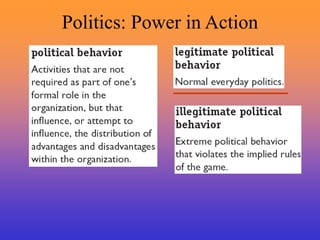
Politics
Politics: Power in Action
Causes of Political Behaviour
1. Scarcity of resources
2. Ambiguous goals
3. Technology and external environment
4. Lust of power
5. Saturation in career
6. Organisational Culture
7. Psychological factors
Negative Aspects of Politics
1. Self interest
2. Differential aspects of power politics on
employees
3. Organisational conflicts
4. Effect on managers
5. Inequitable distribution of power
Functions of Organisational Politics
1. Overcome employees inadequacies
2. Cope with change
3. Channel personal contacts
4. Substitute for formal authority
5. Execution of decisions
6. Act in Darwinian way
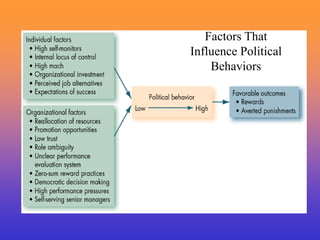
Factors That
Influence Political
Behaviors

politics10.ppt

  • 1.
  • 2.
    Power Power is theability to influence behaviour, people or things through the control of important resources
  • 3.
    Bases of Power IFormal Power- is based on an individual’s position in an organisation 1. Coercive power- the ability to influence punishment eg reprimand, demotion, etc 2. Reward power- the extent to which one has control over rewards that are valued by the other 3. Legitimate power- positional power because of the authority inherent in the position as a result of hierarchy 4. Information power- comes from access to and control over information
  • 4.
    Bases of Power(contd) II Personal Power- does not depend on the formal position of an individual in the organisation 1. Expert power- is the result of expertise, special skill or knowledge 2. Referent power- as a result of follower’s loyalty, respect, friendship, affection, or desire to seek approval 3. Charismatic power- is an extension of referent power stemming from an individual’s personality and interpersonal style
  • 5.
    Dependency: The KeyTo Power • The General Dependency Postulate – The greater B’s dependency on A, the greater the power A has over B. – Possession/control of scarce organizational resources that others need makes a manager powerful. – Access to optional resources (e.g., multiple suppliers) reduces the resource holder’s power. • What Creates Dependency – Importance of the resource to the organization – Scarcity of the resource – Nonsubstitutability of the resource
  • 6.
    Faces of Power Asper David McClelland there are two types of power 1. Negative Face- It is usually expressed in terms of dominance or submission ie I win, you lose Leadership on this bases uses people as need arises to be sacrificed This face of power is self defeating Person’s subjected to this power either resist leadership or become passive 2. Positive Face- Involves exerting influence on behalf of others rather than over others Involves exhibiting dominance to get work done for organisational betterment and employee wellbeing Leaders exercising this power encourage their subordinates to develop strength and competence. They need to succeed as human beings and as organisation members
  • 7.
    Strategies for PowerAcquisition 1. Maintain alliance with powerful people 2. Divide and Rule 3. Manipulate classified information 4. Attacking and blaming others 5. Wait for a crisis 6. Being aware of resource dependence 7. Coalition
  • 8.
    Power Structure andBlocs • Power relationships existing between the members of an organisation usually match their positions in the organisation chart • Power relationships can be direct as well as indirect • Indirect power at times can be greater than direct power because people can become members of power elite due to casteism, club membership or some other form of common interest • Power elite are formed due to mutual sharing of power
  • 9.
    Power Blocs • Unlikepower elites which supplement the power of people who are already powerful, power blocs are large groups of people who possess limited individual power • People come together to form power blocs to increase their collective power or reduce or balance the power of those on whom they depend • Formation of power blocs leads to instability in social interactions
  • 10.
  • 11.
  • 12.
    Causes of PoliticalBehaviour 1. Scarcity of resources 2. Ambiguous goals 3. Technology and external environment 4. Lust of power 5. Saturation in career 6. Organisational Culture 7. Psychological factors
  • 13.
    Negative Aspects ofPolitics 1. Self interest 2. Differential aspects of power politics on employees 3. Organisational conflicts 4. Effect on managers 5. Inequitable distribution of power
  • 14.
    Functions of OrganisationalPolitics 1. Overcome employees inadequacies 2. Cope with change 3. Channel personal contacts 4. Substitute for formal authority 5. Execution of decisions 6. Act in Darwinian way
  • 15.