POLICY COHERENCE
ANALYSIS IN CLIMATE-
SMART AGRICULTURE
(CSA) IN AFRICA
ROMY CHEVALLIER
CSA policy coherence occurs when actions
across policies, sectors and stakeholders
are actively aligned towards meeting their
agreed objectives
IMPORTANCE OF CSA POLICY COHERENCE IN AFRICA
• Greater coherence between policies, frameworks and programmes
dealing with climate change, agricultural development and
food security is a key prerequisite for the adoption and
transformation of CSA across Africa. It is also a requirement for
coherent financing of CSA across the continent
• Achieving this can trigger the desired transformation of
resilient agricultural production and food systems needed
to support Africa’s development goals.
OBJECTIVES OF THE REPORT
• To assess Africa-wide efforts that support the coherence of climate
change, agriculture and food security policies at multiple scales.
• Assess the institutional and stakeholder environment that
informs and influences CSA policy development in Africa.
• Identify policy gaps and entry points to inform future funding
interventions in CSA-related activities.
• Case studies and best practice examples
• Provide recommendations to policy makers and the development
community on areas where they can support efforts to promote policy
coherence
CSA has been used broadly to
include climate adaptation and
mitigation actions in agriculture
or actions that promote resilience
in the agricultural sector
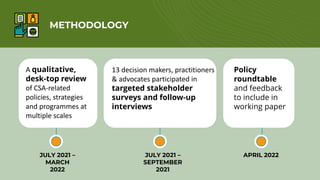
METHODOLOGY
13 decision makers, practitioners
& advocates participated in
targeted stakeholder
surveys and follow-up
interviews
A qualitative,
desk-top review
of CSA-related
policies, strategies
and programmes at
multiple scales
Policy
roundtable
and feedback
to include in
working paper
JULY 2021 –
MARCH
2022
JULY 2021 –
SEPTEMBER
2021
APRIL 2022
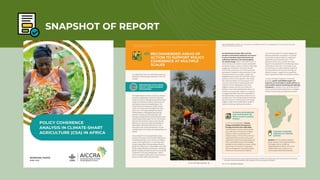
SNAPSHOT OF REPORT
KEY RECOMMENDATIONS AND AREAS
OF SUPPORT TO PROMOTE COHERENT
CSA POLICIES
REINFORCE GLOBAL TO LOCAL POLICY ENGAGEMENT
• Support the high-level integration of global agendas by encouraging
synergies and collaboration amongst multiple policy objectives
and priorities that include CSA.
• Create virtuous circles of reinforcement between global agreements
and action at the national level through national multi-stakeholder
dialogues that mirror international policy processes.
• Build agency and clear communication channels with local-level
actors to inform them about the outcomes of key global policy processes so
that projects are aligned, and actions can support international policy
agendas.
• Support the representation of diverse actors on national negotiating
teams to relevant UN meetings.
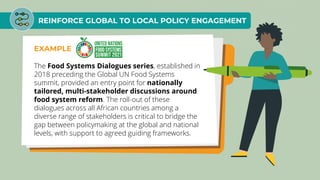
REINFORCE GLOBAL TO LOCAL POLICY ENGAGEMENT
EXAMPLE
The Food Systems Dialogues series, established in
2018 preceding the Global UN Food Systems
summit, provided an entry point for nationally
tailored, multi-stakeholder discussions around
food system reform. The roll-out of these
dialogues across all African countries among a
diverse range of stakeholders is critical to bridge the
gap between policymaking at the global and national
levels, with support to agreed guiding frameworks.
STRENGTHEN AND SUPPORT EXISTING
CSA POLICY FRAMEWORKS AND ACTORS
• CAADP and its Biennial Review - through leadership to drive
government and stakeholder buy-in for financing and implementation of key
recommendations.
• Regional Common Results Frameworks for CSA - through the
production of relevant input data for national reviews.
• Long-Term Strategies, NDCs, as well as national dialogues on
food systems transition and resilient pathways – through inclusive
processes, shared learning, adopting targets and indicators for agricultural
mitigation and adaptation interventions
• AUDA-NEPAD as the focal institute for CSA policy coordination -
through technical assistance, increased finance and institutional
capacity.
MAINSTREAM CSA INTO POLICY
• Mainstream CSA into Africa’s green and blue economy
strategies, including post-COVID Green Recovery Stimulus
Plans.
• Promote CSA programmes within NAIPs to ensure a stronger
focus on climate change and extreme weather events.
• Integrate CSA into mid- to long-term country
investment and development plans, including sectoral,
sub-national budgets and national budgets and national
development plans.
• Mainstream CSA indicators into M&E frameworks
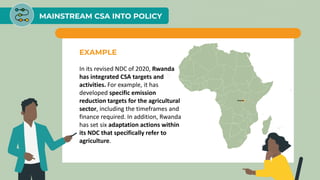
MAINSTREAM CSA INTO POLICY
EXAMPLE
In its revised NDC of 2020, Rwanda
has integrated CSA targets and
activities. For example, it has
developed specific emission
reduction targets for the agricultural
sector, including the timeframes and
finance required. In addition, Rwanda
has set six adaptation actions within
its NDC that specifically refer to
agriculture.
STRENGTHEN INSTITUTIONAL COORDINATION
• Equip national and regional institutional structures and
processes with the financial and technical tools needed to
enhance cross-sectoral coordination and
intergovernmental collaboration.
• Assist structures at the national and regional level to enhance
coordination with continental bodies, including oversight
functions related to progress of continental policies.
• Institutionalise bodies responsible for M&E functions at
multiple levels
STRENGTHEN INSTITUTIONAL COORDINATION
EXAMPLE
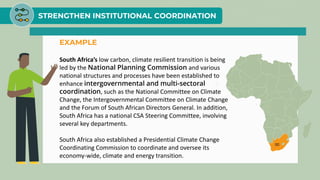
South Africa’s low carbon, climate resilient transition is being
led by the National Planning Commission and various
national structures and processes have been established to
enhance intergovernmental and multi-sectoral
coordination, such as the National Committee on Climate
Change, the Intergovernmental Committee on Climate Change
and the Forum of South African Directors General. In addition,
South Africa has a national CSA Steering Committee, involving
several key departments.
South Africa also established a Presidential Climate Change
Coordinating Commission to coordinate and oversee its
economy-wide, climate and energy transition.
ENHANCE MECHANISMS FOR
DIALOGUE AND COMMUNICATION
• Strengthen multi-stakeholder platforms, at various
scales, to promote learning and lesson sharing between state
and non-state actors, and between sectors.
• Ensure that vulnerable groupings and CSA alliances are
well represented in policy dialogues related to CSA.
• Partnerships with the private sector
ENHANCE MECHANISMS FOR DIALOGUE AND
COMMUNICATION
EXAMPLE
Promote a multi-stakeholder national
dialogue process to reflect on the results of the
third Biennial Review report under the Malabo
Declaration (endorsed in February 2022) to develop
policy and programmatic responses to support
Commitment 6 (on climate resilience).
SUPPORT UPTAKE OF SCIENCE AND
EVIDENCE IN POLICY PROCESSES
• Integrate the co-production of data, including local
knowledge, into CSA policies.
• Improve the capacity, and support, relevant scientific,
technical and policy organisations to guide climate change
adaptation and mitigation in agriculture.
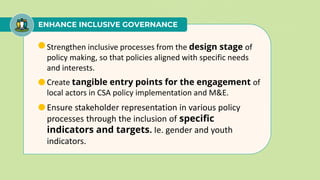
ENHANCE INCLUSIVE GOVERNANCE
• Strengthen inclusive processes from the design stage of
policy making, so that policies aligned with specific needs
and interests.
• Create tangible entry points for the engagement of
local actors in CSA policy implementation and M&E.
• Ensure stakeholder representation in various policy
processes through the inclusion of specific
indicators and targets. Ie. gender and youth
indicators.
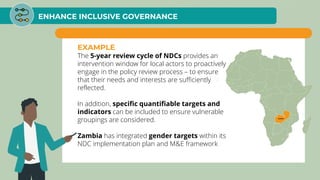
ENHANCE INCLUSIVE GOVERNANCE
EXAMPLE
The 5-year review cycle of NDCs provides an
intervention window for local actors to proactively
engage in the policy review process – to ensure
that their needs and interests are sufficiently
reflected.
In addition, specific quantifiable targets and
indicators can be included to ensure vulnerable
groupings are considered.
Zambia has integrated gender targets within its
NDC implementation plan and M&E framework
PROMOTE LEADERSHIP AND POLITICAL WILL
• Strengthen the role of CSA policy champions and focal
points by equipping them with the necessary budgetary tools
and public dissemination platforms.
• Encourage strong political leadership and commitment,
and the requisite capacity, to urgently drive government
and stakeholder buy-in for financing and implementation of CSA
policies at all scales, including CAADP’s Biennial Review
recommendations.
STRENGTHEN CAPACITY IN CSA POLICY ENGAGEMENT
• Strengthen the agency and capacity of local organisations
through training in CSA policy coherence and engagement.
• Provide technical support to capacity building forums and
partnerships that aid policy makers understand CSA-related
global and regional policy processes
STRENGTHEN CAPACITY IN CLIMATE POLICY ENGAGEMENT
EXAMPLE
The African Group of Negotiators Experts Support (AGNES) runs a
series of training programmes for African policy makers, climate
advocates and researchers to build their knowledge and capacity on
climate governance, diplomacy and negotiations leadership
programme.
SUPPORT MONITORING AND EVALUATION PROCESSES
• Develop a set of multi-sectoral indicators, nested at different levels, to
increase alignment/ implementation, including CSA policy coherence
as an indicator.
• Expand accountability systems to include actions by a broader range of
players (private sector, farmer organisations, CSOs, development
partners).
• Enhance the technical capacity of civil society to conduct M&E
reporting related to CSA policy.
• Enhance the technical and human capacity of national government
and RECs to support their ability to produce and compile quality country
reports
SUPPORT MONITORING AND EVALUATION PROCESSES
EXAMPLE
The ECOWAS’ Agricultural Policy developed a review and reporting process for
its member countries to ensure that their plans integrate cross-cutting themes
beyond agricultural development, such as nutrition, resilience and
sustainable and inclusive food systems. It includes specific sustainability
indicators and criteria against which these policies are reviewed. For example,
one criteria is that NAIP-FNS must report on is climate change commitments
under the NDCs.
ECOWAS also developed the Global Alliance for Resilience which aims to
channel efforts of regional and international stakeholders towards a common
results framework. It also encourages each country to conduct an inclusive
dialogue process to formulate its own National Resilience Priorities.
ENHANCE POLICY IMPLEMENTATION
• Enhance efforts to adopt and popularize CSA policy frameworks at
all levels.
• Enhance and strengthen systems for implementation/
domestication ie. through the development of implementation
matrixes that identify common targets, indicators, roles and
responsibilities for various activities; a resource mobilisation plan, as
well as a detailed M&E and learning plans.
• Attract adequate financing to support implementation and capacity
development
ENHANCE POLICY IMPLEMENTATION
EXAMPLE
Financial organisations should include CSA policy
coherence in their funding criteria and play a role in
screening projects for climate risks, as well as in
developing and using metrics and indicators to measure
outcomes, and account for GHG emissions in projects
and operations.
In 2020, for example, 52 percent of World Bank
financing in agriculture also targeted climate adaption
and mitigation.
NEXT
STEPS
• Include feedback from this event into
working paper
• Include comments from individual
reviews
• Produce a policy briefing of key
outcomes and recommendations
THANK YOU!
ROMY
CHEVALLIER
R.Chevallier@cgiar.org

Policy coherence presentation.pdf

  • 1.
    POLICY COHERENCE ANALYSIS INCLIMATE- SMART AGRICULTURE (CSA) IN AFRICA ROMY CHEVALLIER
  • 2.
    CSA policy coherenceoccurs when actions across policies, sectors and stakeholders are actively aligned towards meeting their agreed objectives
  • 3.
    IMPORTANCE OF CSAPOLICY COHERENCE IN AFRICA • Greater coherence between policies, frameworks and programmes dealing with climate change, agricultural development and food security is a key prerequisite for the adoption and transformation of CSA across Africa. It is also a requirement for coherent financing of CSA across the continent • Achieving this can trigger the desired transformation of resilient agricultural production and food systems needed to support Africa’s development goals.
  • 4.
    OBJECTIVES OF THEREPORT • To assess Africa-wide efforts that support the coherence of climate change, agriculture and food security policies at multiple scales. • Assess the institutional and stakeholder environment that informs and influences CSA policy development in Africa. • Identify policy gaps and entry points to inform future funding interventions in CSA-related activities. • Case studies and best practice examples • Provide recommendations to policy makers and the development community on areas where they can support efforts to promote policy coherence
  • 5.
    CSA has beenused broadly to include climate adaptation and mitigation actions in agriculture or actions that promote resilience in the agricultural sector
  • 6.
    METHODOLOGY 13 decision makers,practitioners & advocates participated in targeted stakeholder surveys and follow-up interviews A qualitative, desk-top review of CSA-related policies, strategies and programmes at multiple scales Policy roundtable and feedback to include in working paper JULY 2021 – MARCH 2022 JULY 2021 – SEPTEMBER 2021 APRIL 2022
  • 8.
  • 9.
    KEY RECOMMENDATIONS ANDAREAS OF SUPPORT TO PROMOTE COHERENT CSA POLICIES
  • 10.
    REINFORCE GLOBAL TOLOCAL POLICY ENGAGEMENT • Support the high-level integration of global agendas by encouraging synergies and collaboration amongst multiple policy objectives and priorities that include CSA. • Create virtuous circles of reinforcement between global agreements and action at the national level through national multi-stakeholder dialogues that mirror international policy processes. • Build agency and clear communication channels with local-level actors to inform them about the outcomes of key global policy processes so that projects are aligned, and actions can support international policy agendas. • Support the representation of diverse actors on national negotiating teams to relevant UN meetings.
  • 11.
    REINFORCE GLOBAL TOLOCAL POLICY ENGAGEMENT EXAMPLE The Food Systems Dialogues series, established in 2018 preceding the Global UN Food Systems summit, provided an entry point for nationally tailored, multi-stakeholder discussions around food system reform. The roll-out of these dialogues across all African countries among a diverse range of stakeholders is critical to bridge the gap between policymaking at the global and national levels, with support to agreed guiding frameworks.
  • 12.
    STRENGTHEN AND SUPPORTEXISTING CSA POLICY FRAMEWORKS AND ACTORS • CAADP and its Biennial Review - through leadership to drive government and stakeholder buy-in for financing and implementation of key recommendations. • Regional Common Results Frameworks for CSA - through the production of relevant input data for national reviews. • Long-Term Strategies, NDCs, as well as national dialogues on food systems transition and resilient pathways – through inclusive processes, shared learning, adopting targets and indicators for agricultural mitigation and adaptation interventions • AUDA-NEPAD as the focal institute for CSA policy coordination - through technical assistance, increased finance and institutional capacity.
  • 13.
    MAINSTREAM CSA INTOPOLICY • Mainstream CSA into Africa’s green and blue economy strategies, including post-COVID Green Recovery Stimulus Plans. • Promote CSA programmes within NAIPs to ensure a stronger focus on climate change and extreme weather events. • Integrate CSA into mid- to long-term country investment and development plans, including sectoral, sub-national budgets and national budgets and national development plans. • Mainstream CSA indicators into M&E frameworks
  • 14.
    MAINSTREAM CSA INTOPOLICY EXAMPLE In its revised NDC of 2020, Rwanda has integrated CSA targets and activities. For example, it has developed specific emission reduction targets for the agricultural sector, including the timeframes and finance required. In addition, Rwanda has set six adaptation actions within its NDC that specifically refer to agriculture.
  • 15.
    STRENGTHEN INSTITUTIONAL COORDINATION •Equip national and regional institutional structures and processes with the financial and technical tools needed to enhance cross-sectoral coordination and intergovernmental collaboration. • Assist structures at the national and regional level to enhance coordination with continental bodies, including oversight functions related to progress of continental policies. • Institutionalise bodies responsible for M&E functions at multiple levels
  • 16.
    STRENGTHEN INSTITUTIONAL COORDINATION EXAMPLE SouthAfrica’s low carbon, climate resilient transition is being led by the National Planning Commission and various national structures and processes have been established to enhance intergovernmental and multi-sectoral coordination, such as the National Committee on Climate Change, the Intergovernmental Committee on Climate Change and the Forum of South African Directors General. In addition, South Africa has a national CSA Steering Committee, involving several key departments. South Africa also established a Presidential Climate Change Coordinating Commission to coordinate and oversee its economy-wide, climate and energy transition.
  • 17.
    ENHANCE MECHANISMS FOR DIALOGUEAND COMMUNICATION • Strengthen multi-stakeholder platforms, at various scales, to promote learning and lesson sharing between state and non-state actors, and between sectors. • Ensure that vulnerable groupings and CSA alliances are well represented in policy dialogues related to CSA. • Partnerships with the private sector
  • 18.
    ENHANCE MECHANISMS FORDIALOGUE AND COMMUNICATION EXAMPLE Promote a multi-stakeholder national dialogue process to reflect on the results of the third Biennial Review report under the Malabo Declaration (endorsed in February 2022) to develop policy and programmatic responses to support Commitment 6 (on climate resilience).
  • 19.
    SUPPORT UPTAKE OFSCIENCE AND EVIDENCE IN POLICY PROCESSES • Integrate the co-production of data, including local knowledge, into CSA policies. • Improve the capacity, and support, relevant scientific, technical and policy organisations to guide climate change adaptation and mitigation in agriculture.
  • 20.
    ENHANCE INCLUSIVE GOVERNANCE •Strengthen inclusive processes from the design stage of policy making, so that policies aligned with specific needs and interests. • Create tangible entry points for the engagement of local actors in CSA policy implementation and M&E. • Ensure stakeholder representation in various policy processes through the inclusion of specific indicators and targets. Ie. gender and youth indicators.
  • 21.
    ENHANCE INCLUSIVE GOVERNANCE EXAMPLE The5-year review cycle of NDCs provides an intervention window for local actors to proactively engage in the policy review process – to ensure that their needs and interests are sufficiently reflected. In addition, specific quantifiable targets and indicators can be included to ensure vulnerable groupings are considered. Zambia has integrated gender targets within its NDC implementation plan and M&E framework
  • 22.
    PROMOTE LEADERSHIP ANDPOLITICAL WILL • Strengthen the role of CSA policy champions and focal points by equipping them with the necessary budgetary tools and public dissemination platforms. • Encourage strong political leadership and commitment, and the requisite capacity, to urgently drive government and stakeholder buy-in for financing and implementation of CSA policies at all scales, including CAADP’s Biennial Review recommendations.
  • 23.
    STRENGTHEN CAPACITY INCSA POLICY ENGAGEMENT • Strengthen the agency and capacity of local organisations through training in CSA policy coherence and engagement. • Provide technical support to capacity building forums and partnerships that aid policy makers understand CSA-related global and regional policy processes
  • 24.
    STRENGTHEN CAPACITY INCLIMATE POLICY ENGAGEMENT EXAMPLE The African Group of Negotiators Experts Support (AGNES) runs a series of training programmes for African policy makers, climate advocates and researchers to build their knowledge and capacity on climate governance, diplomacy and negotiations leadership programme.
  • 25.
    SUPPORT MONITORING ANDEVALUATION PROCESSES • Develop a set of multi-sectoral indicators, nested at different levels, to increase alignment/ implementation, including CSA policy coherence as an indicator. • Expand accountability systems to include actions by a broader range of players (private sector, farmer organisations, CSOs, development partners). • Enhance the technical capacity of civil society to conduct M&E reporting related to CSA policy. • Enhance the technical and human capacity of national government and RECs to support their ability to produce and compile quality country reports
  • 26.
    SUPPORT MONITORING ANDEVALUATION PROCESSES EXAMPLE The ECOWAS’ Agricultural Policy developed a review and reporting process for its member countries to ensure that their plans integrate cross-cutting themes beyond agricultural development, such as nutrition, resilience and sustainable and inclusive food systems. It includes specific sustainability indicators and criteria against which these policies are reviewed. For example, one criteria is that NAIP-FNS must report on is climate change commitments under the NDCs. ECOWAS also developed the Global Alliance for Resilience which aims to channel efforts of regional and international stakeholders towards a common results framework. It also encourages each country to conduct an inclusive dialogue process to formulate its own National Resilience Priorities.
  • 27.
    ENHANCE POLICY IMPLEMENTATION •Enhance efforts to adopt and popularize CSA policy frameworks at all levels. • Enhance and strengthen systems for implementation/ domestication ie. through the development of implementation matrixes that identify common targets, indicators, roles and responsibilities for various activities; a resource mobilisation plan, as well as a detailed M&E and learning plans. • Attract adequate financing to support implementation and capacity development
  • 28.
    ENHANCE POLICY IMPLEMENTATION EXAMPLE Financialorganisations should include CSA policy coherence in their funding criteria and play a role in screening projects for climate risks, as well as in developing and using metrics and indicators to measure outcomes, and account for GHG emissions in projects and operations. In 2020, for example, 52 percent of World Bank financing in agriculture also targeted climate adaption and mitigation.
  • 29.
    NEXT STEPS • Include feedbackfrom this event into working paper • Include comments from individual reviews • Produce a policy briefing of key outcomes and recommendations
  • 30.