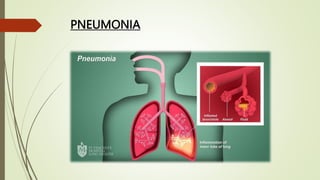
PNEUMONIA
DEFINITION
It is an acute infectious respiratory illness associated with
radiological pulmonary shadowing that may be segmental,
lobar or multi-lobular.
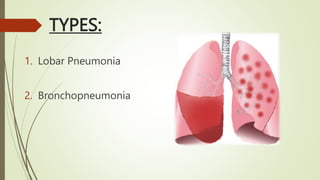
TYPES:
1. Lobar Pneumonia
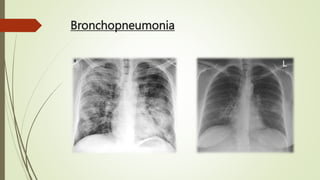
2. Bronchopneumonia
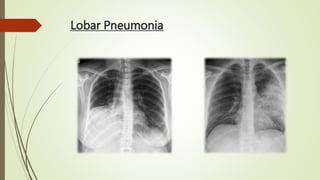
Lobar Pneumonia
Bronchopneumonia
CLASSIFICATION
 Community acquired pneumonia
 Hospital acquired pneumonia
COMMUNITY ACQUIRED PNEUMONIA
It occurs out of Hospital or within first 72 hours of hospitalization
TYPES
Typical CAP
Atypical CAP
Typical CAP
It presents with fever, shaking chills, cough, pleuritic
chest pain and dyspnea (typical features)
EXAMINATION
Tachycardia / Tachypnea
Late Inspiratory Crackles
Bronchial Breath Sounds
Dullness on Percussion
Pleural Friction Rub
Increase tactile and vocal fremitus
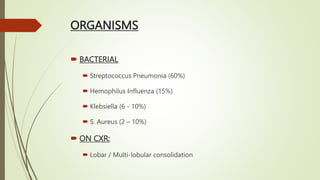
ORGANISMS
 BACTERIAL
 Streptococcus Pneumonia (60%)
 Hemophilus Influenza (15%)
 Klebsiella (6 - 10%)
 S. Aureus (2 – 10%)
 ON CXR:
 Lobar / Multi-lobular consolidation
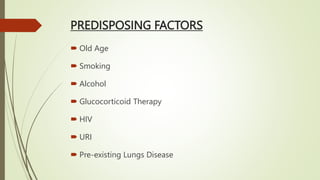
PREDISPOSING FACTORS
 Old Age
 Smoking
 Alcohol
 Glucocorticoid Therapy
 HIV
 URI
 Pre-existing Lungs Disease
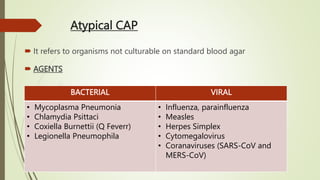
Atypical CAP
 It refers to organisms not culturable on standard blood agar
 AGENTS
BACTERIAL VIRAL
• Mycoplasma Pneumonia
• Chlamydia Psittaci
• Coxiella Burnettii (Q Feverr)
• Legionella Pneumophila
• Influenza, parainfluenza
• Measles
• Herpes Simplex
• Cytomegalovirus
• Coranaviruses (SARS-CoV and
MERS-CoV)
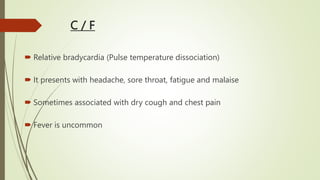
C / F
 Relative bradycardia (Pulse temperature dissociation)
 It presents with headache, sore throat, fatigue and malaise
 Sometimes associated with dry cough and chest pain
 Fever is uncommon
LEGIONELLA PNEUMONIA
RISKS
 Organ transplant Recipients
 Renal Failure
 CLD
 Smokers
 GI Symptoms
 Hyponatremia
INVESTIGATIONS
BLOOD
CBC (TLC Count > 20 / < 4 * 10-e9)
S / E (Hyponatremia)
Serum Albumin (low)
RFTs (Urea > 7 mmol / Liter)
ESR, CRP (Elevated)
Blood Culture ( Bacteremia)
ABGs (PH  Low / SaO2 < 92%)
Cold Agglutinins (Increase 50%)
 SPUTUM
 Staining and Culture (Acid Fast / Silver Stain)
 OROPHARANGEAL SWAB (PCR)
 URINE
 Legionella Antigen Test
 PLEURAL FLUID
 Culture
 CHEST X-RAY
 PA View
 Lateral View
DIFFERENTIALS
Pulmonary Infarction
Pulmonary TB
Pulmonary Edema
Pulmonary Eosinophilia
Malignancy
SEVERITY MARKERS
CURB – 65 (Score 4 – 5)
PaO2 < 8 Kpa (60 mmHg)
Progressive Hypercapnia
Severe Acidosis
Circulatory Shock
Consciousness Level Reduced
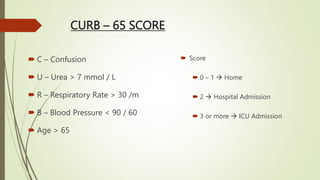
CURB – 65 SCORE
 C – Confusion
 U – Urea > 7 mmol / L
 R – Respiratory Rate > 30 /m
 B – Blood Pressure < 90 / 60
 Age > 65
 Score
 0 – 1  Home
 2  Hospital Admission
 3 or more  ICU Admission
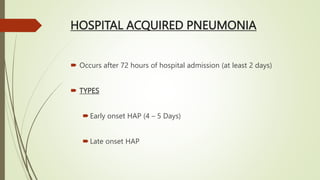
HOSPITAL ACQUIRED PNEUMONIA
 Occurs after 72 hours of hospital admission (at least 2 days)
 TYPES
Early onset HAP (4 – 5 Days)
Late onset HAP
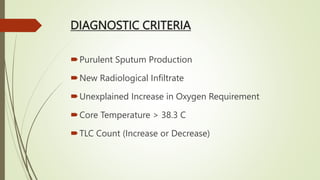
DIAGNOSTIC CRITERIA
Purulent Sputum Production
New Radiological Infiltrate
Unexplained Increase in Oxygen Requirement
Core Temperature > 38.3 C
TLC Count (Increase or Decrease)
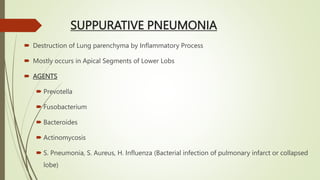
SUPPURATIVE PNEUMONIA
 Destruction of Lung parenchyma by Inflammatory Process
 Mostly occurs in Apical Segments of Lower Lobs
 AGENTS
 Prevotella
 Fusobacterium
 Bacteroides
 Actinomycosis
 S. Pneumonia, S. Aureus, H. Influenza (Bacterial infection of pulmonary infarct or collapsed
lobe)
CA – MRSA
Produce cytotoxin pantone – valentine leucocidin
Causes suppurative skin infection
Rapidly progressive severe necrotizing pneumonia
CXR
Abscess with cavitation and air fluid level
LEMIERRE’S SYNDROME
Rare Cause of Pulmonary
Abscess
Causative Agent
Fusobacterium Necrophorum
C / F
Sore throat
Painful Swollen neck
Fever with Rigors
Foul Smelling Sputum
Dyspnea
hemoptysis
PNEUMONIA IN IMMUNO COMPROMISED
PATIENTS
It is caused by low virulence non pathogenic opportunistic
bacteria, viruses and fungi
Mostly present in HIV patients and drug users
AGENTS
Pneumocystis Jiroveci
Mycobacteria
HRCT and biopsy leads to diagnosis
MANAGEMENT
Goals of Management should be
Oxygen Maintenance
Fluid Balance
Nutrition
Anti-biotics (Main Stay)
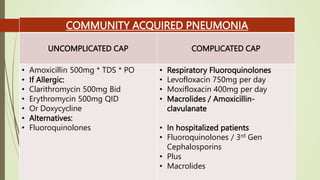
COMMUNITY ACQUIRED PNEUMONIA
UNCOMPLICATED CAP COMPLICATED CAP
• Amoxicillin 500mg * TDS * PO
• If Allergic:
• Clarithromycin 500mg Bid
• Erythromycin 500mg QID
• Or Doxycycline
• Alternatives:
• Fluoroquinolones
• Respiratory Fluoroquinolones
• Levofloxacin 750mg per day
• Moxifloxacin 400mg per day
• Macrolides / Amoxicillin-
clavulanate
• In hospitalized patients
• Fluoroquinolones / 3rd Gen
Cephalosporins
• Plus
• Macrolides
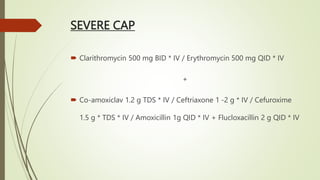
SEVERE CAP
 Clarithromycin 500 mg BID * IV / Erythromycin 500 mg QID * IV
+
 Co-amoxiclav 1.2 g TDS * IV / Ceftriaxone 1 -2 g * IV / Cefuroxime
1.5 g * TDS * IV / Amoxicillin 1g QID * IV + Flucloxacillin 2 g QID * IV
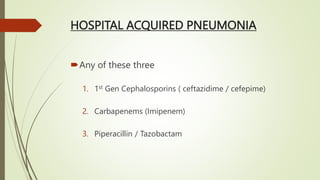
HOSPITAL ACQUIRED PNEUMONIA
Any of these three
1. 1st Gen Cephalosporins ( ceftazidime / cefepime)
2. Carbapenems (Imipenem)
3. Piperacillin / Tazobactam
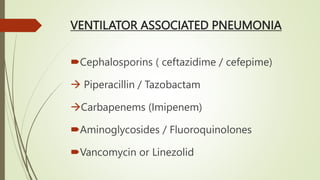
VENTILATOR ASSOCIATED PNEUMONIA
Cephalosporins ( ceftazidime / cefepime)
 Piperacillin / Tazobactam
Carbapenems (Imipenem)
Aminoglycosides / Fluoroquinolones
Vancomycin or Linezolid
SUPPURATIVE PNEUMONIA
Duration of therapy is 4 – 6 weeks with abscess
Amoxicillin 1g TDS
metronidazole
Co-amoxiclav  risk of C. difficile infection
IN HIV PATIENTS
3rd Gen Cephalosporins / Quinolones
Antipseudomonal Penicillin
Aminoglycosides
S. Aureus
Flucloxacillin (1 – 2 g) QID * IV
Clarithromycin 500 mg BID * IV
Mycoplasma / Legionella
Clarithromycin 500 mg BID * IV
Erythromycin 500 mg QID * IV
Plus
Rifampicin 600 mg BID * IV (Severe)
COMPLICATION
 Para-pneumonic effusion  common
 Empyema
 Lobar collapse
 DVT / PE
 Pneumothorax
 Lung Abscess
 ARDS
 Multi-organ failure
 Atrial Fibrillation
 Hepatitis / pericarditis / myocarditis
PROGNOSIS
Mortality Rate
< 1% (Non Severe)
5 – 10 % (Severe)
THE END

Pneumonia Topic Presentation ppt by Dr Muhammad Hassan

  • 2.
  • 3.
    DEFINITION It is anacute infectious respiratory illness associated with radiological pulmonary shadowing that may be segmental, lobar or multi-lobular.
  • 4.
  • 5.
  • 6.
  • 7.
    CLASSIFICATION  Community acquiredpneumonia  Hospital acquired pneumonia
  • 8.
    COMMUNITY ACQUIRED PNEUMONIA Itoccurs out of Hospital or within first 72 hours of hospitalization TYPES Typical CAP Atypical CAP
  • 9.
    Typical CAP It presentswith fever, shaking chills, cough, pleuritic chest pain and dyspnea (typical features) EXAMINATION Tachycardia / Tachypnea Late Inspiratory Crackles Bronchial Breath Sounds Dullness on Percussion Pleural Friction Rub Increase tactile and vocal fremitus
  • 10.
    ORGANISMS  BACTERIAL  StreptococcusPneumonia (60%)  Hemophilus Influenza (15%)  Klebsiella (6 - 10%)  S. Aureus (2 – 10%)  ON CXR:  Lobar / Multi-lobular consolidation
  • 11.
    PREDISPOSING FACTORS  OldAge  Smoking  Alcohol  Glucocorticoid Therapy  HIV  URI  Pre-existing Lungs Disease
  • 12.
    Atypical CAP  Itrefers to organisms not culturable on standard blood agar  AGENTS BACTERIAL VIRAL • Mycoplasma Pneumonia • Chlamydia Psittaci • Coxiella Burnettii (Q Feverr) • Legionella Pneumophila • Influenza, parainfluenza • Measles • Herpes Simplex • Cytomegalovirus • Coranaviruses (SARS-CoV and MERS-CoV)
  • 13.
    C / F Relative bradycardia (Pulse temperature dissociation)  It presents with headache, sore throat, fatigue and malaise  Sometimes associated with dry cough and chest pain  Fever is uncommon
  • 14.
    LEGIONELLA PNEUMONIA RISKS  Organtransplant Recipients  Renal Failure  CLD  Smokers  GI Symptoms  Hyponatremia
  • 15.
    INVESTIGATIONS BLOOD CBC (TLC Count> 20 / < 4 * 10-e9) S / E (Hyponatremia) Serum Albumin (low) RFTs (Urea > 7 mmol / Liter) ESR, CRP (Elevated) Blood Culture ( Bacteremia) ABGs (PH  Low / SaO2 < 92%) Cold Agglutinins (Increase 50%)
  • 16.
     SPUTUM  Stainingand Culture (Acid Fast / Silver Stain)  OROPHARANGEAL SWAB (PCR)  URINE  Legionella Antigen Test  PLEURAL FLUID  Culture  CHEST X-RAY  PA View  Lateral View
  • 17.
    DIFFERENTIALS Pulmonary Infarction Pulmonary TB PulmonaryEdema Pulmonary Eosinophilia Malignancy
  • 18.
    SEVERITY MARKERS CURB –65 (Score 4 – 5) PaO2 < 8 Kpa (60 mmHg) Progressive Hypercapnia Severe Acidosis Circulatory Shock Consciousness Level Reduced
  • 19.
    CURB – 65SCORE  C – Confusion  U – Urea > 7 mmol / L  R – Respiratory Rate > 30 /m  B – Blood Pressure < 90 / 60  Age > 65  Score  0 – 1  Home  2  Hospital Admission  3 or more  ICU Admission
  • 20.
    HOSPITAL ACQUIRED PNEUMONIA Occurs after 72 hours of hospital admission (at least 2 days)  TYPES Early onset HAP (4 – 5 Days) Late onset HAP
  • 21.
    DIAGNOSTIC CRITERIA Purulent SputumProduction New Radiological Infiltrate Unexplained Increase in Oxygen Requirement Core Temperature > 38.3 C TLC Count (Increase or Decrease)
  • 22.
    SUPPURATIVE PNEUMONIA  Destructionof Lung parenchyma by Inflammatory Process  Mostly occurs in Apical Segments of Lower Lobs  AGENTS  Prevotella  Fusobacterium  Bacteroides  Actinomycosis  S. Pneumonia, S. Aureus, H. Influenza (Bacterial infection of pulmonary infarct or collapsed lobe)
  • 23.
    CA – MRSA Producecytotoxin pantone – valentine leucocidin Causes suppurative skin infection Rapidly progressive severe necrotizing pneumonia CXR Abscess with cavitation and air fluid level
  • 24.
    LEMIERRE’S SYNDROME Rare Causeof Pulmonary Abscess Causative Agent Fusobacterium Necrophorum C / F Sore throat Painful Swollen neck Fever with Rigors Foul Smelling Sputum Dyspnea hemoptysis
  • 25.
    PNEUMONIA IN IMMUNOCOMPROMISED PATIENTS It is caused by low virulence non pathogenic opportunistic bacteria, viruses and fungi Mostly present in HIV patients and drug users AGENTS Pneumocystis Jiroveci Mycobacteria HRCT and biopsy leads to diagnosis
  • 26.
    MANAGEMENT Goals of Managementshould be Oxygen Maintenance Fluid Balance Nutrition Anti-biotics (Main Stay)
  • 27.
    COMMUNITY ACQUIRED PNEUMONIA UNCOMPLICATEDCAP COMPLICATED CAP • Amoxicillin 500mg * TDS * PO • If Allergic: • Clarithromycin 500mg Bid • Erythromycin 500mg QID • Or Doxycycline • Alternatives: • Fluoroquinolones • Respiratory Fluoroquinolones • Levofloxacin 750mg per day • Moxifloxacin 400mg per day • Macrolides / Amoxicillin- clavulanate • In hospitalized patients • Fluoroquinolones / 3rd Gen Cephalosporins • Plus • Macrolides
  • 28.
    SEVERE CAP  Clarithromycin500 mg BID * IV / Erythromycin 500 mg QID * IV +  Co-amoxiclav 1.2 g TDS * IV / Ceftriaxone 1 -2 g * IV / Cefuroxime 1.5 g * TDS * IV / Amoxicillin 1g QID * IV + Flucloxacillin 2 g QID * IV
  • 29.
    HOSPITAL ACQUIRED PNEUMONIA Anyof these three 1. 1st Gen Cephalosporins ( ceftazidime / cefepime) 2. Carbapenems (Imipenem) 3. Piperacillin / Tazobactam
  • 30.
    VENTILATOR ASSOCIATED PNEUMONIA Cephalosporins( ceftazidime / cefepime)  Piperacillin / Tazobactam Carbapenems (Imipenem) Aminoglycosides / Fluoroquinolones Vancomycin or Linezolid
  • 31.
    SUPPURATIVE PNEUMONIA Duration oftherapy is 4 – 6 weeks with abscess Amoxicillin 1g TDS metronidazole Co-amoxiclav  risk of C. difficile infection
  • 32.
    IN HIV PATIENTS 3rdGen Cephalosporins / Quinolones Antipseudomonal Penicillin Aminoglycosides
  • 33.
    S. Aureus Flucloxacillin (1– 2 g) QID * IV Clarithromycin 500 mg BID * IV Mycoplasma / Legionella Clarithromycin 500 mg BID * IV Erythromycin 500 mg QID * IV Plus Rifampicin 600 mg BID * IV (Severe)
  • 34.
    COMPLICATION  Para-pneumonic effusion common  Empyema  Lobar collapse  DVT / PE  Pneumothorax  Lung Abscess  ARDS  Multi-organ failure  Atrial Fibrillation  Hepatitis / pericarditis / myocarditis
  • 35.
    PROGNOSIS Mortality Rate < 1%(Non Severe) 5 – 10 % (Severe)
  • 36.