A FINANCIAL INSTITUTION
ANALYSIS B Y B R E N D A
J A N S E N
HISTORY
• PNC has a history dating back to the 1800s
• Pittsburgh National Corporation was originally formed 1852 as Pittsburgh Trust
and Savings Company
• The oldest bank in Pittsburgh
• First bank to apply for a charter under the National Banking Act of 1863
• The bank came to be First National Bank of Pittsburgh
• Joined with Peoples-Pittsburgh Trust Company in 1946 forming Peoples First
National Bank and Trust Company
• 1959: Fidelity Trust Company merged with Peoples First which merged with
First National
• A new symbol in the shape of a triangle
HISTORY CONT.
• PNC also has roots in Provident Life and Trust Company, an insurance
company that was created in 1865
• Informally known as “the Quaker bank”
• 1922: The company split into two separate entities of Provident Mutual Life
Insurance Company and Provident Trust Company
• Provident Trust Company of Philadelphia merged with Provident Tradesmens
Bank and Trust Company in 1957 to create Provident National Bank.
• 1982: Pennsylvania passed a law that allowed banks to have statewide banking
• Two of the first banks to act on this were Pittsburgh National and Provident
National
• In 1983, the two banks came together in the largest U.S. bank merger at the
time and used their shared initials to create a new entity called PNC Financial
Corp.
• The company now has the name The PNC Financial Services Group, Inc.
PRODUCTS AND SERVICES
• PNC serves individuals, small businesses, corporations, and government entities
• Retail banking:
• Lending, deposits, cash management, and investment services
• 6 million consumer and small business customers
• 19 states and the District of Columbia
• 2,700 branches and 74,000 ATMs
• Online and mobile services
• Award-winning Virtual Wallet
• Wealth management group:
• Tailored investments, wealth planning, trust and estate administration and
private banking services
• Wealth Insight
• Institutional Investments
• PNC Capital Advisors, LLC (a multi-strategy investment management
organization)
PRODUCTS AND SERVICES CONT.
• Corporate and Institutional Banking:
• Serves the middle market
• Harris Williams (PNC’s investment bank) is one of the most successful advisory
teams in the nation
• Residential Mortgage:
• 2,700 bank branches and 90 retail mortgage offices in the U.S.
• PNC Mortgage
• One of the top residential mortgage originators and servicers in the nation
• As of September 2013, PNC’s loan portfolio is $115 billion
• BlackRock:
• One of the largest publicly traded investment management firms in the country
• PNC owns 25%
• Around the world they provide equity, fixed income, liquidity and alternative
investment products to institutional and individual investors
• Provide risk management, investment system outsourcing, and financial
advisory services to institutional investors
MANAGEMENT STRUCTURE
• Vertical management structure
• Lots of levels
• PNC’s president and CEO is William S. Demchak
• Elected to CEO in February of 2013
• At the Annual Meeting of Shareholders on April 23, 2013
James E. Rohr elected to step down as CEO
• Rohr will assume new role as executive chairman
and plans to retire in 2014
• Board of Directors
• Regional Managers
• Branch Managers
William S. Demchak
RISK FACTORS
• Economic conditions
• Still recovering from recent crash
• Regulatory
• Uncertainty of ultimate impacts of Dodd-Frank law passed in July 2010
• New capital and liquidity standards (proposed June 2012)
• Risk retention plan
• Competition
• Other big banks such as Citigroup
• Financial services institutions are interrelated
RISK FACTORS CONT.
• Highly subjective and various interpretations
• Estimation of the amount of loss allowances and impairments
• Asset valuation methods
• Use of models
• Operational
• Internal processes and systems, human error and external events
• Technology: need to keep up to date to remain competitive, new products
frequently, help serving customers better
• Information systems
GEOGRAPHIC CONSIDERATIONS
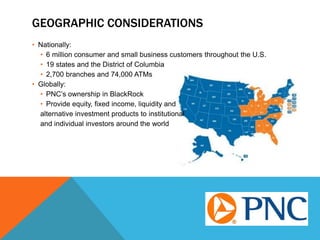
• Nationally:
• 6 million consumer and small business customers throughout the U.S.
• 19 states and the District of Columbia
• 2,700 branches and 74,000 ATMs
• Globally:
• PNC’s ownership in BlackRock
• Provide equity, fixed income, liquidity and
alternative investment products to institutional
and individual investors around the world
REGULATORY CONSIDERATIONS
• Federal and state levels of governance
• Federal Reserve is the national regulatory body
• In every state where PNC has a branch, there are different rules and
regulations
• Securities and Exchange Commission (SEC)
• Form 4
• Federal Deposit Insurance Corporation (FDIC) provides deposit insurance for
every depositor up to $250,000
• Office of the Comptroller of the Currency (OCC)
• U.S. Department of the Treasury
• The Dodd-Frank Wall Street Reform and Consumer Protection Act
PROFITABILITY
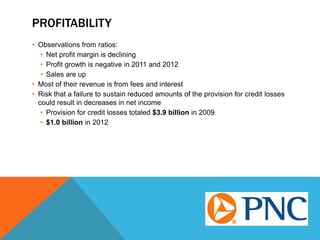
• Observations from ratios:
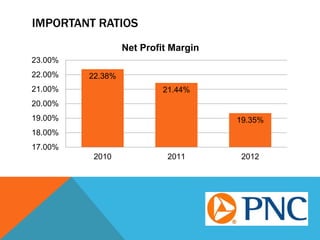
• Net profit margin is declining
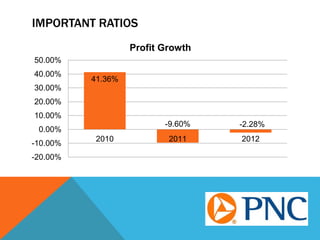
• Profit growth is negative in 2011 and 2012
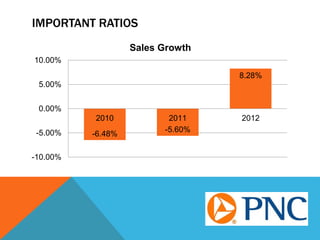
• Sales are up
• Most of their revenue is from fees and interest
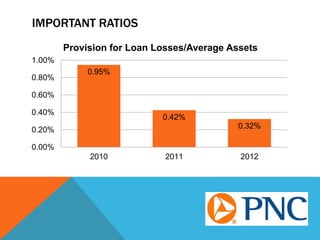
• Risk that a failure to sustain reduced amounts of the provision for credit losses
could result in decreases in net income
• Provision for credit losses totaled $3.9 billion in 2009
• $1.0 billion in 2012
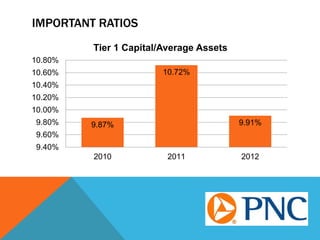
IMPORTANT RATIOS
22.38%
21.44%
19.35%
17.00%
18.00%
19.00%
20.00%
21.00%
22.00%
23.00%
2010 2011 2012
Net Profit Margin
IMPORTANT RATIOS
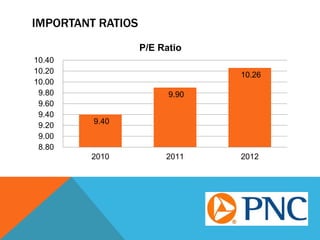
9.40
9.90
10.26
8.80
9.00
9.20
9.40
9.60
9.80
10.00
10.20
10.40
2010 2011 2012
P/E Ratio
IMPORTANT RATIOS
-6.48%
-5.60%
8.28%
-10.00%
-5.00%
0.00%
5.00%
10.00%
2010 2011 2012
Sales Growth
IMPORTANT RATIOS
41.36%
-9.60% -2.28%
-20.00%
-10.00%
0.00%
10.00%
20.00%
30.00%
40.00%
50.00%
2010 2011 2012
Profit Growth
IMPORTANT RATIOS
3.49%
3.21%
3.16%
2.90%
3.00%
3.10%
3.20%
3.30%
3.40%
3.50%
3.60%
2010 2011 2012
Net Interest Income/Average Assets
IMPORTANT RATIOS
0.95%
0.42%
0.32%
0.00%
0.20%
0.40%
0.60%
0.80%
1.00%
2010 2011 2012
Provision for Loan Losses/Average Assets
IMPORTANT RATIOS
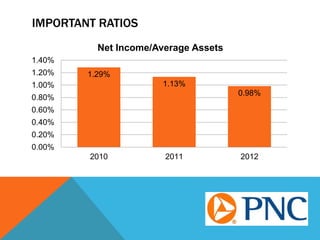
1.29%
1.13%
0.98%
0.00%
0.20%
0.40%
0.60%
0.80%
1.00%
1.20%
1.40%
2010 2011 2012
Net Income/Average Assets
IMPORTANT RATIOS
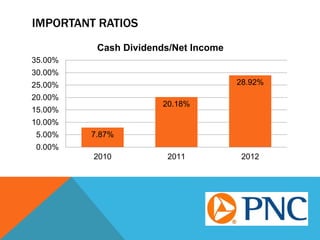
7.87%
20.18%
28.92%
0.00%
5.00%
10.00%
15.00%
20.00%
25.00%
30.00%
35.00%
2010 2011 2012
Cash Dividends/Net Income
IMPORTANT RATIOS
9.87%
10.72%
9.91%
9.40%
9.60%
9.80%
10.00%
10.20%
10.40%
10.60%
10.80%
2010 2011 2012
Tier 1 Capital/Average Assets
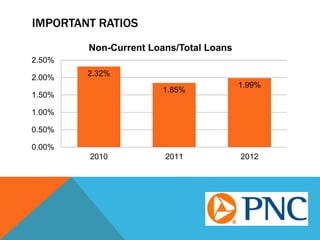
IMPORTANT RATIOS
2.32%
1.85%
1.99%
0.00%
0.50%
1.00%
1.50%
2.00%
2.50%
2010 2011 2012
Non-Current Loans/Total Loans
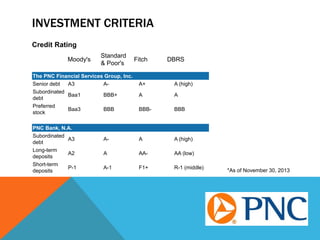
INVESTMENT CRITERIA
Credit Rating
The PNC Financial Services Group, Inc.
Senior debt A3 A- A+ A (high)
Subordinated
debt
Baa1 BBB+ A A
Preferred
stock
Baa3 BBB BBB- BBB
PNC Bank, N.A.
Subordinated
debt
A3 A- A A (high)
Long-term
deposits
A2 A AA- AA (low)
Short-term
deposits
P-1 A-1 F1+ R-1 (middle)
Moody's
Standard
& Poor's
Fitch DBRS
*As of November 30, 2013
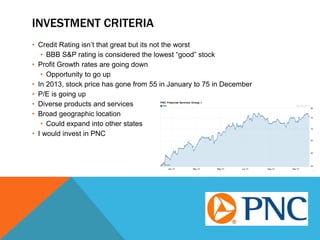
INVESTMENT CRITERIA
• Credit Rating isn’t that great but its not the worst
• BBB S&P rating is considered the lowest “good” stock
• Profit Growth rates are going down
• Opportunity to go up
• In 2013, stock price has gone from 55 in January to 75 in December
• P/E is going up
• Diverse products and services
• Broad geographic location
• Could expand into other states
• I would invest in PNC

PNC Presentation

  • 1.
    A FINANCIAL INSTITUTION ANALYSISB Y B R E N D A J A N S E N
  • 2.
    HISTORY • PNC hasa history dating back to the 1800s • Pittsburgh National Corporation was originally formed 1852 as Pittsburgh Trust and Savings Company • The oldest bank in Pittsburgh • First bank to apply for a charter under the National Banking Act of 1863 • The bank came to be First National Bank of Pittsburgh • Joined with Peoples-Pittsburgh Trust Company in 1946 forming Peoples First National Bank and Trust Company • 1959: Fidelity Trust Company merged with Peoples First which merged with First National • A new symbol in the shape of a triangle
  • 3.
    HISTORY CONT. • PNCalso has roots in Provident Life and Trust Company, an insurance company that was created in 1865 • Informally known as “the Quaker bank” • 1922: The company split into two separate entities of Provident Mutual Life Insurance Company and Provident Trust Company • Provident Trust Company of Philadelphia merged with Provident Tradesmens Bank and Trust Company in 1957 to create Provident National Bank. • 1982: Pennsylvania passed a law that allowed banks to have statewide banking • Two of the first banks to act on this were Pittsburgh National and Provident National • In 1983, the two banks came together in the largest U.S. bank merger at the time and used their shared initials to create a new entity called PNC Financial Corp. • The company now has the name The PNC Financial Services Group, Inc.
  • 4.
    PRODUCTS AND SERVICES •PNC serves individuals, small businesses, corporations, and government entities • Retail banking: • Lending, deposits, cash management, and investment services • 6 million consumer and small business customers • 19 states and the District of Columbia • 2,700 branches and 74,000 ATMs • Online and mobile services • Award-winning Virtual Wallet • Wealth management group: • Tailored investments, wealth planning, trust and estate administration and private banking services • Wealth Insight • Institutional Investments • PNC Capital Advisors, LLC (a multi-strategy investment management organization)
  • 5.
    PRODUCTS AND SERVICESCONT. • Corporate and Institutional Banking: • Serves the middle market • Harris Williams (PNC’s investment bank) is one of the most successful advisory teams in the nation • Residential Mortgage: • 2,700 bank branches and 90 retail mortgage offices in the U.S. • PNC Mortgage • One of the top residential mortgage originators and servicers in the nation • As of September 2013, PNC’s loan portfolio is $115 billion • BlackRock: • One of the largest publicly traded investment management firms in the country • PNC owns 25% • Around the world they provide equity, fixed income, liquidity and alternative investment products to institutional and individual investors • Provide risk management, investment system outsourcing, and financial advisory services to institutional investors
  • 6.
    MANAGEMENT STRUCTURE • Verticalmanagement structure • Lots of levels • PNC’s president and CEO is William S. Demchak • Elected to CEO in February of 2013 • At the Annual Meeting of Shareholders on April 23, 2013 James E. Rohr elected to step down as CEO • Rohr will assume new role as executive chairman and plans to retire in 2014 • Board of Directors • Regional Managers • Branch Managers William S. Demchak
  • 7.
    RISK FACTORS • Economicconditions • Still recovering from recent crash • Regulatory • Uncertainty of ultimate impacts of Dodd-Frank law passed in July 2010 • New capital and liquidity standards (proposed June 2012) • Risk retention plan • Competition • Other big banks such as Citigroup • Financial services institutions are interrelated
  • 8.
    RISK FACTORS CONT. •Highly subjective and various interpretations • Estimation of the amount of loss allowances and impairments • Asset valuation methods • Use of models • Operational • Internal processes and systems, human error and external events • Technology: need to keep up to date to remain competitive, new products frequently, help serving customers better • Information systems
  • 9.
    GEOGRAPHIC CONSIDERATIONS • Nationally: •6 million consumer and small business customers throughout the U.S. • 19 states and the District of Columbia • 2,700 branches and 74,000 ATMs • Globally: • PNC’s ownership in BlackRock • Provide equity, fixed income, liquidity and alternative investment products to institutional and individual investors around the world
  • 10.
    REGULATORY CONSIDERATIONS • Federaland state levels of governance • Federal Reserve is the national regulatory body • In every state where PNC has a branch, there are different rules and regulations • Securities and Exchange Commission (SEC) • Form 4 • Federal Deposit Insurance Corporation (FDIC) provides deposit insurance for every depositor up to $250,000 • Office of the Comptroller of the Currency (OCC) • U.S. Department of the Treasury • The Dodd-Frank Wall Street Reform and Consumer Protection Act
  • 11.
    PROFITABILITY • Observations fromratios: • Net profit margin is declining • Profit growth is negative in 2011 and 2012 • Sales are up • Most of their revenue is from fees and interest • Risk that a failure to sustain reduced amounts of the provision for credit losses could result in decreases in net income • Provision for credit losses totaled $3.9 billion in 2009 • $1.0 billion in 2012
  • 12.
  • 13.
  • 14.
  • 15.
  • 16.
  • 17.
  • 18.
  • 19.
  • 20.
  • 21.
  • 22.
    INVESTMENT CRITERIA Credit Rating ThePNC Financial Services Group, Inc. Senior debt A3 A- A+ A (high) Subordinated debt Baa1 BBB+ A A Preferred stock Baa3 BBB BBB- BBB PNC Bank, N.A. Subordinated debt A3 A- A A (high) Long-term deposits A2 A AA- AA (low) Short-term deposits P-1 A-1 F1+ R-1 (middle) Moody's Standard & Poor's Fitch DBRS *As of November 30, 2013
  • 23.
    INVESTMENT CRITERIA • CreditRating isn’t that great but its not the worst • BBB S&P rating is considered the lowest “good” stock • Profit Growth rates are going down • Opportunity to go up • In 2013, stock price has gone from 55 in January to 75 in December • P/E is going up • Diverse products and services • Broad geographic location • Could expand into other states • I would invest in PNC