Peabody Developmental Motor Scales  HRD 845-441 December 5th, 2008 By: Lynn Brecht
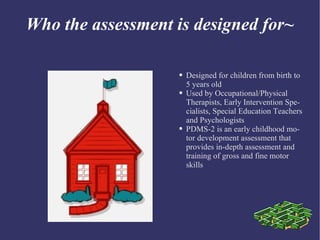
Who the assessment is designed for~ Designed for children from birth to 5 years old Used by Occupational/Physical Therapists, Early Intervention Specialists, Special Education Teachers and Psychologists PDMS-2 is an early childhood motor development assessment that provides in-depth assessment and training of gross and fine motor skills
What PMDS Assess~ Reflexes:  child's ability to automatically react to environmental events, this section of the assessment is composed of 8 items Stationary: child's ability to keep control of their body within its center of gravity. It involves the ability of children to control his or her body. This section is composed of 30 items. Locomotion: child's ability to move from one place to another, including crawling, walking and running. This section includes 89 items. Object Manipulation: child's ability to manipulate balls such as catching, throwing, and kicking. This section includes 24 items.
What PMDS Assess (cont.)~ Grasping: child's ability to use their hands. This section includes 26 items. Visual-Motor Integration: child's ability to use their  visual skills to perform eye-hand coordination tasks including reaching and grasping for an object, building with blocks and tracing designs. This section includes 72 items. PMDS is used as a tool to assess at what level children are preforming PMDS helps to place children in the appropriate classroom or therapy
Founder of PMDS~ Rebecca R. Fewell, Ph.D. George Peabody College Ph.D. May, 1972 Assistant Professor at George Peabody College 1972-77 Associate Professor 1972-79 George Peabody College Chairperson 1976-79 Professor at University of Washington 1982-88 Tulane University, Karen Gore Prof. in Special Education 1988-91 Acting Chairperson for Tulane University 1989-91 Professor at University of Miami School of Medicine 1991-2002 Education Director of Mailman Center for Child Development 1991-2002 Director of the Debbie Institute 1991-2002 Vanderbilt University, Visiting Scholar 2003-present Helped write 5 books about children with Special Needs Helped write over 50 articles concerning child development and special needs  BEH Graduate Fellowship Award, 1971-71 New Mexico Fed. of CEC, Outstanding Contribution to Exceptional Children Award, 1981 Agnes Scott College, Distinguished Career Award, 1988 Newcomb College Fellow Award, 1989-90 International Division of Early Childhood of the Council for Exceptional Children, Distinguished Service to the Field Award, 2000
People that have  worked with  Rebecca Fewell~ All of the following are authors of books and magazines concerning the life and growth of children with special needs and also are ambassadors for early  intervention Patricia F. Vadasy G. Schnell D. J. Meyer S. G. Garwood Mark Wolery J. T. Neisworth B. Deutscher G. Mahoney L. R. Metsch H. P. Wolfe C. B. McCoy W. N. Elwood B. Wohler-Torres P. Petersen-Baston H. V. Haskins
Do you have any questions?

PMDS

  • 1.
    Peabody Developmental MotorScales HRD 845-441 December 5th, 2008 By: Lynn Brecht
  • 2.
    Who the assessmentis designed for~ Designed for children from birth to 5 years old Used by Occupational/Physical Therapists, Early Intervention Specialists, Special Education Teachers and Psychologists PDMS-2 is an early childhood motor development assessment that provides in-depth assessment and training of gross and fine motor skills
  • 3.
    What PMDS Assess~Reflexes: child's ability to automatically react to environmental events, this section of the assessment is composed of 8 items Stationary: child's ability to keep control of their body within its center of gravity. It involves the ability of children to control his or her body. This section is composed of 30 items. Locomotion: child's ability to move from one place to another, including crawling, walking and running. This section includes 89 items. Object Manipulation: child's ability to manipulate balls such as catching, throwing, and kicking. This section includes 24 items.
  • 4.
    What PMDS Assess(cont.)~ Grasping: child's ability to use their hands. This section includes 26 items. Visual-Motor Integration: child's ability to use their visual skills to perform eye-hand coordination tasks including reaching and grasping for an object, building with blocks and tracing designs. This section includes 72 items. PMDS is used as a tool to assess at what level children are preforming PMDS helps to place children in the appropriate classroom or therapy
  • 5.
    Founder of PMDS~Rebecca R. Fewell, Ph.D. George Peabody College Ph.D. May, 1972 Assistant Professor at George Peabody College 1972-77 Associate Professor 1972-79 George Peabody College Chairperson 1976-79 Professor at University of Washington 1982-88 Tulane University, Karen Gore Prof. in Special Education 1988-91 Acting Chairperson for Tulane University 1989-91 Professor at University of Miami School of Medicine 1991-2002 Education Director of Mailman Center for Child Development 1991-2002 Director of the Debbie Institute 1991-2002 Vanderbilt University, Visiting Scholar 2003-present Helped write 5 books about children with Special Needs Helped write over 50 articles concerning child development and special needs BEH Graduate Fellowship Award, 1971-71 New Mexico Fed. of CEC, Outstanding Contribution to Exceptional Children Award, 1981 Agnes Scott College, Distinguished Career Award, 1988 Newcomb College Fellow Award, 1989-90 International Division of Early Childhood of the Council for Exceptional Children, Distinguished Service to the Field Award, 2000
  • 6.
    People that have worked with Rebecca Fewell~ All of the following are authors of books and magazines concerning the life and growth of children with special needs and also are ambassadors for early intervention Patricia F. Vadasy G. Schnell D. J. Meyer S. G. Garwood Mark Wolery J. T. Neisworth B. Deutscher G. Mahoney L. R. Metsch H. P. Wolfe C. B. McCoy W. N. Elwood B. Wohler-Torres P. Petersen-Baston H. V. Haskins
  • 7.
    Do you haveany questions?