PLYLER V.
DOE
This court case is considered to be a Fourteenth
Amendment Landmark case
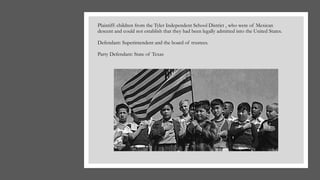
Plaintiff: children from the Tyler Independent School District , who were of Mexican
descent and could not establish that they had been legally admitted into the United States.
Defendant: Superintendent and the board of trustees.
Party Defendant: State of Texas
◦ Proceeding the case-In 1975 the Texas State Legislature passed a law that allowed schools to deny enrollment
and block state funding of students who were not admitted to the United States legally.
Plyler v. Doe- was filed in 1977 as a class action on behalf of certain school age students who asked the court
to prevent the school district from denying them access to a free public education.
◦ The District Court ruled that barring children from receiving an education violated the Fourteenth
Amendment. The Fourteenth Amendment provides protection against discrimination for illegal aliens in the
United States.
◦ The Court of Appeals affirmed this decision and the Supreme Court heard the case next.
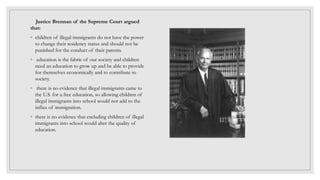
Justice Brennan of the Supreme Court argued
that:
◦ children of illegal immigrants do not have the power
to change their residency status and should not be
punished for the conduct of their parents.
◦ education is the fabric of our society and children
need an education to grow up and be able to provide
for themselves economically and to contribute to
society.
◦ there is no evidence that illegal immigrants came to
the U.S. for a free education, so allowing children of
illegal immigrants into school would not add to the
influx of immigration.
◦ there is no evidence that excluding children of illegal
immigrants into school would alter the quality of
education.
◦ In 1982 the Supreme Court Ruled 5-4 in favor
of the children (Plaintiff)
◦ This court case is still cited today when
advocating for protection and equal rights of
children of Mexican origin who may not be able
to verify their residency status.
◦ Children are protected under the Fourteenth
Amendment and have equal rights in the United
States, regardless of residency status.
◦ This was a landmark case and reinforced the
rights of Mexican American children to a free
and public education.
REFERENCES
Access To Education - Rule Of Law
https://www.uscourts.gov/educational-resources/educational-activities/access-education-rule-law
Plyler V. Doe
https://www.law.cornell.edu/supremecourt/text/457/202
Plyler V. Doe: The Landmark Maldef Case That Changed Education in America
https://www.maldef.org/2018/12/plyler-case/

Plyler v Doe

  • 1.
    PLYLER V. DOE This courtcase is considered to be a Fourteenth Amendment Landmark case
  • 2.
    Plaintiff: children fromthe Tyler Independent School District , who were of Mexican descent and could not establish that they had been legally admitted into the United States. Defendant: Superintendent and the board of trustees. Party Defendant: State of Texas
  • 3.
    ◦ Proceeding thecase-In 1975 the Texas State Legislature passed a law that allowed schools to deny enrollment and block state funding of students who were not admitted to the United States legally. Plyler v. Doe- was filed in 1977 as a class action on behalf of certain school age students who asked the court to prevent the school district from denying them access to a free public education.
  • 4.
    ◦ The DistrictCourt ruled that barring children from receiving an education violated the Fourteenth Amendment. The Fourteenth Amendment provides protection against discrimination for illegal aliens in the United States. ◦ The Court of Appeals affirmed this decision and the Supreme Court heard the case next.
  • 5.
    Justice Brennan ofthe Supreme Court argued that: ◦ children of illegal immigrants do not have the power to change their residency status and should not be punished for the conduct of their parents. ◦ education is the fabric of our society and children need an education to grow up and be able to provide for themselves economically and to contribute to society. ◦ there is no evidence that illegal immigrants came to the U.S. for a free education, so allowing children of illegal immigrants into school would not add to the influx of immigration. ◦ there is no evidence that excluding children of illegal immigrants into school would alter the quality of education.
  • 6.
    ◦ In 1982the Supreme Court Ruled 5-4 in favor of the children (Plaintiff) ◦ This court case is still cited today when advocating for protection and equal rights of children of Mexican origin who may not be able to verify their residency status. ◦ Children are protected under the Fourteenth Amendment and have equal rights in the United States, regardless of residency status. ◦ This was a landmark case and reinforced the rights of Mexican American children to a free and public education.
  • 7.
    REFERENCES Access To Education- Rule Of Law https://www.uscourts.gov/educational-resources/educational-activities/access-education-rule-law Plyler V. Doe https://www.law.cornell.edu/supremecourt/text/457/202 Plyler V. Doe: The Landmark Maldef Case That Changed Education in America https://www.maldef.org/2018/12/plyler-case/