PLOT, SETTING, AND
CHARACTERIZATION
LESSON 3 QUARTER 2
OBJECTIVES
differentiate plot, setting, and
characterization, and identify the
author’s purpose.
CHARACTERS
Characters refer to persons,
persons, creatures, or things
serving as actors or movers in a
story. They portray specific roles
with corresponding dialogues
and plot lines. Stories have
protagonist/s and antagonist/s.
CHARACTERIZATION
Characterization is a writer’s tool, or “literary
device” that occurs any time the author uses
details to teach us about a character. This is
used over the course of a story in order to
tell the tale. Let’s figure it out from the
example below:
In the Harry Potter series, Dobby refers to
Potter as “the noble Harry Potter,” or “good
Harry Potter,” which shows us how the house elf
adores the young wizard. It might also be a
hint of how Dobby would show affection for
other people he admires.
PLOT
Plot shows how the author arranges
events to develop the basic idea. There
are five essential parts of plot:
1. Exposition (introduction) is the
beginning of the story.
2. Conflict can be any form of struggle the
main character faces. There may be only
one central struggle, or there may be
many minor obstacles within a dominant
struggle.
TYPES OF CONFLICT
 Character vs. Self -struggles with own
soul, physical limitations, choices, etc.
 External - struggles with a force outside
one's self
Character vs. Character - struggles
against other people
Character vs. Nature - struggles against
animals, weather, environment, etc.
 Character vs. Society - struggles
against ideas, practices, or customs of
others
PLOT
3. Climax is the turning point of the story.
Readers wonder what will happen next;
will the conflict be resolved or not?
4. Falling action is where the resolution
begins; events and complications start to
fall into place. These are the events
between climax and denouement.
5. Resolution (Conclusion) is the final
outcome of events in the story.
SETTING
Setting refers to the time and
location when and where a story
takes place. For some stories, the
setting is very important; while for
others, it is not. When examining
how setting contributes to a story,
there are multiple aspects to
consider:
SETTING
 Place - Geographical location/Where does
the story take place?
 Time - Historical period, time of day, year,
etc./When does the story take place?
 Weather Conditions - Is it rainy, sunny,
stormy, etc.?
 Social Conditions - What is the daily life of
the character's like? Does the story contain
local color (writing that focuses on the
speech, dress, mannerisms, customs, etc.
of a particular place)?
 Mood or atmosphere - What feeling is
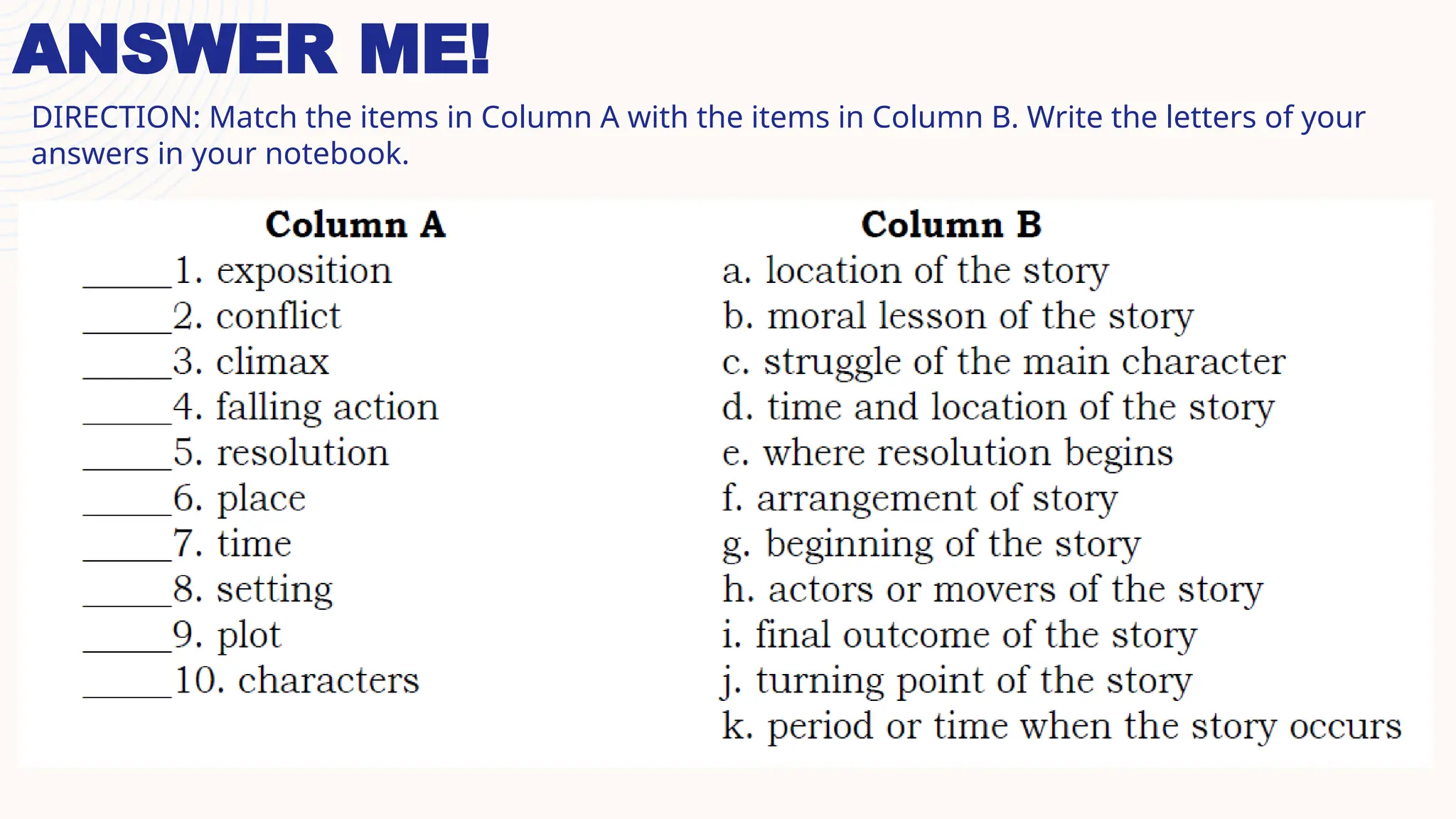
ANSWER ME!
DIRECTION: Match the items in Column A with the items in Column B. Write the letters of your
answers in your notebook.

PLOT, SETTING, AND CHARACTERIZATION.pptx

  • 1.
  • 2.
    OBJECTIVES differentiate plot, setting,and characterization, and identify the author’s purpose.
  • 3.
    CHARACTERS Characters refer topersons, persons, creatures, or things serving as actors or movers in a story. They portray specific roles with corresponding dialogues and plot lines. Stories have protagonist/s and antagonist/s.
  • 4.
    CHARACTERIZATION Characterization is awriter’s tool, or “literary device” that occurs any time the author uses details to teach us about a character. This is used over the course of a story in order to tell the tale. Let’s figure it out from the example below: In the Harry Potter series, Dobby refers to Potter as “the noble Harry Potter,” or “good Harry Potter,” which shows us how the house elf adores the young wizard. It might also be a hint of how Dobby would show affection for other people he admires.
  • 5.
    PLOT Plot shows howthe author arranges events to develop the basic idea. There are five essential parts of plot: 1. Exposition (introduction) is the beginning of the story. 2. Conflict can be any form of struggle the main character faces. There may be only one central struggle, or there may be many minor obstacles within a dominant struggle.
  • 6.
    TYPES OF CONFLICT Character vs. Self -struggles with own soul, physical limitations, choices, etc.  External - struggles with a force outside one's self Character vs. Character - struggles against other people Character vs. Nature - struggles against animals, weather, environment, etc.  Character vs. Society - struggles against ideas, practices, or customs of others
  • 7.
    PLOT 3. Climax isthe turning point of the story. Readers wonder what will happen next; will the conflict be resolved or not? 4. Falling action is where the resolution begins; events and complications start to fall into place. These are the events between climax and denouement. 5. Resolution (Conclusion) is the final outcome of events in the story.
  • 8.
    SETTING Setting refers tothe time and location when and where a story takes place. For some stories, the setting is very important; while for others, it is not. When examining how setting contributes to a story, there are multiple aspects to consider:
  • 9.
    SETTING  Place -Geographical location/Where does the story take place?  Time - Historical period, time of day, year, etc./When does the story take place?  Weather Conditions - Is it rainy, sunny, stormy, etc.?  Social Conditions - What is the daily life of the character's like? Does the story contain local color (writing that focuses on the speech, dress, mannerisms, customs, etc. of a particular place)?  Mood or atmosphere - What feeling is
  • 10.
    ANSWER ME! DIRECTION: Matchthe items in Column A with the items in Column B. Write the letters of your answers in your notebook.