INTRODUCTION
TO
REAL TIME
APPLICATION
OF PLC
.
INTRODUCTION TO PLCS
PLC is an industrial computer designed for
multiple inputs and output arrangements . It is
capable of storing the instructions to implement
control functions such as sequencing ,timing
counting arithmetic ,data manipulation and
communication.
The evolution of PLC technology has
revolutionized industrial automation.
From simple relay-based systems to
advanced microprocessor-controlled
units, PLCs have become indispensable
in controlling complex industrial
processes.
EVOLUTION OF PLC
TECHNOLOGY
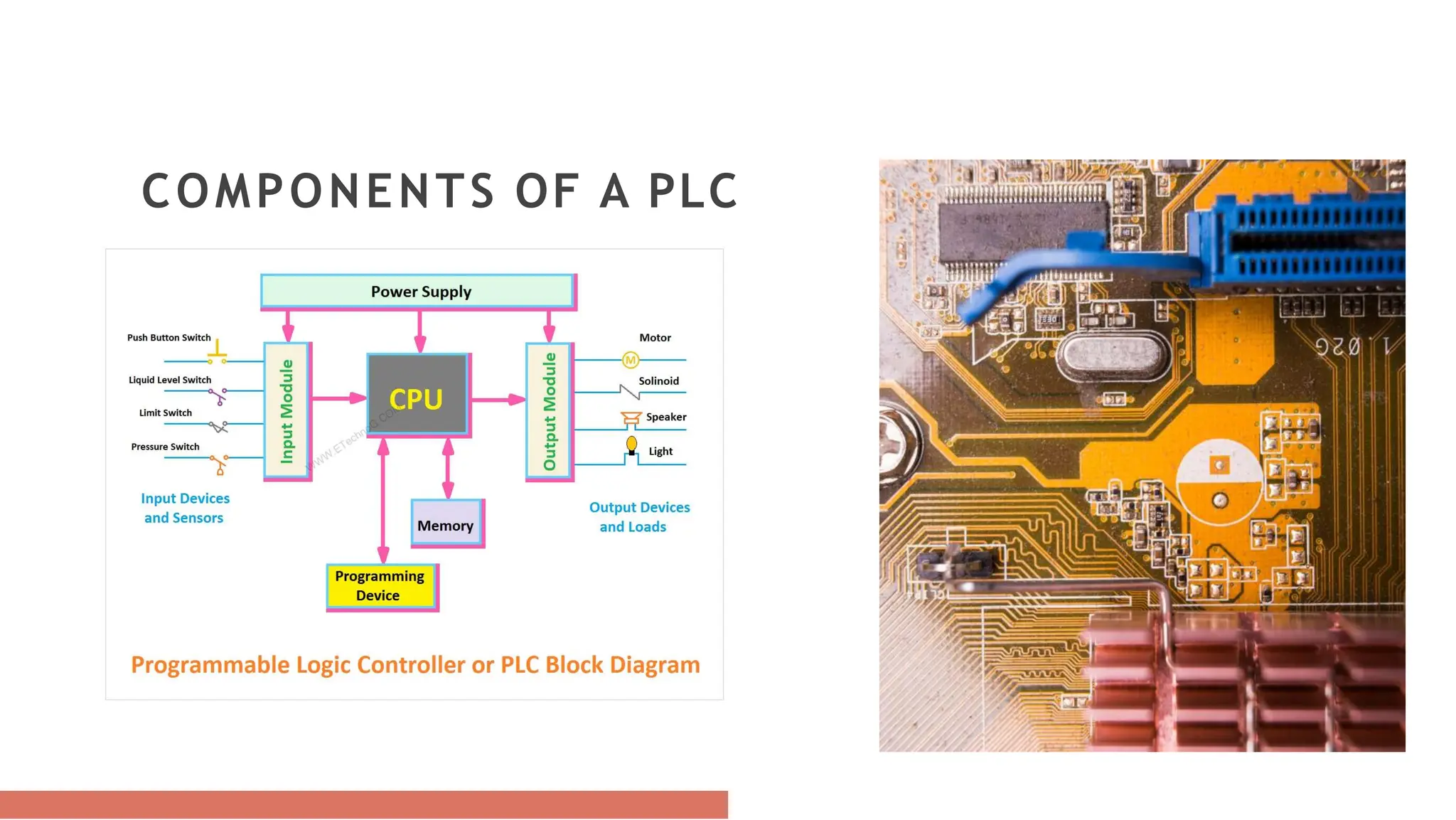
COMPONENTS OF A PLC
COMPONENTS OF A PLC
POWER SUPPLY
Provides the voltage needed to run the primary PLC components.
I/O MODULES
Provides signal conversion and isolation between the internal logic-
level signals inside the PLC and the field’s high level signal.
PROCESSOR
Provides intelligence to command and govern the activities of the
entire PLC systems.
PROGRAMMING DEVICE
Used to enter the desired program that will determine the sequence
of operation and control of process equipment or driven machine.
PLC PROGRAMMING LANGUAGES
PLCs can be programmed using various
languages such as ladder logic, function
block diagrams, and structured text.
Each language overs unique
advantages in expressing control logic
and is suited for different
applications.
PLC PROGRAMMING LANGUAGES
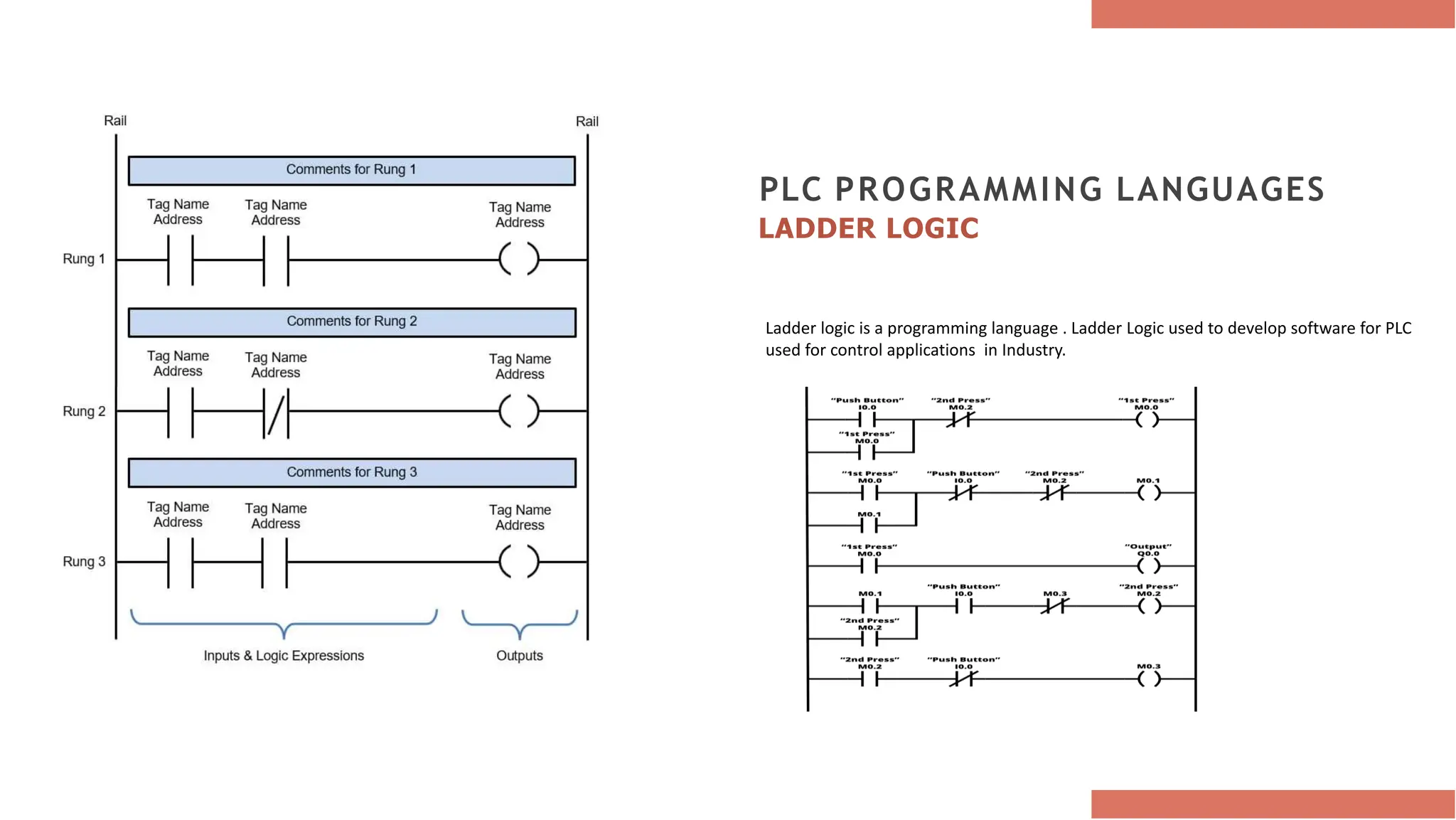
LADDER LOGIC
Ladder logic is a programming language . Ladder Logic used to develop software for PLC
used for control applications in Industry.
PLC COMMUNICATION
PROTOCOLS
Interface Standards and Devices
Two interface standards and one interface device are mentioned
below:
USB:
USB, or Universal Serial Bus, is an interface standard. It is used for point-to-
point
connections for a wide variety of purposes, such as between a mouse or
printer and a
computer.
USB 3.0 allows communications at up to 5 GiGa bytes per second (Gbps) .
USB 4.0 supports 40 Gbps communications. USB has replaced the much older
and
slower RS-232 interface, which was used on legacy computers.
RS-485:
RS-485 is an interface standard for data communications that allows data
transmission speeds of up to 1 megabit per second (1 Mbps) on a 100 meter
cable.
Data communications speed varies inversely with the total length of an RS-
485 cable.
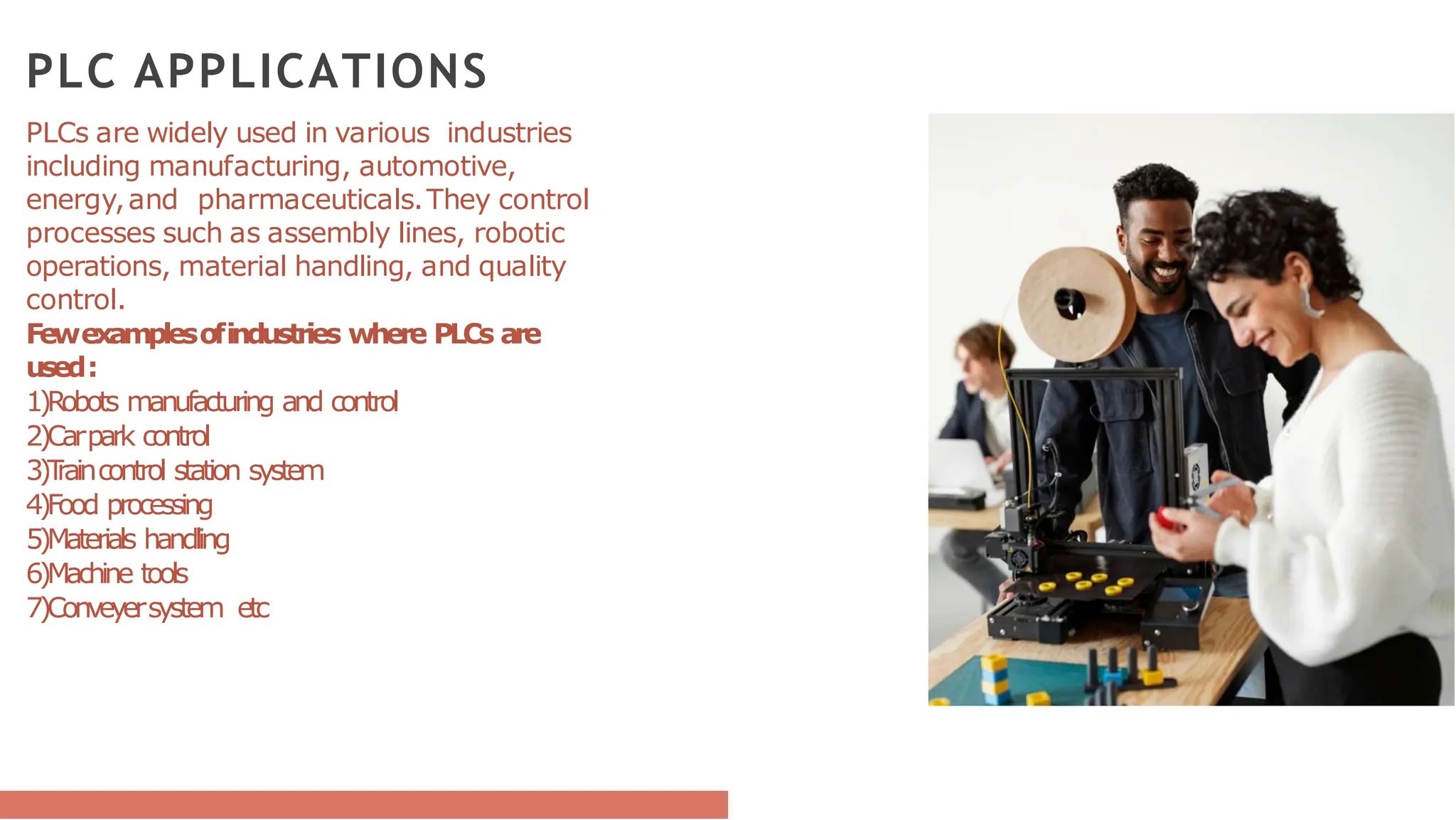
PLCs are widely used in various industries
including manufacturing, automotive,
energy,and pharmaceuticals.They control
processes such as assembly lines, robotic
operations, material handling, and quality
control.
Fewexamplesofindustries where PLCs are
used:
1)Robots manufacturing and control
2)Carpark control
3)T
raincontrol station system
4)Food processing
5)Materials handling
6)Machine tools
7)Conveyersystem etc
PLC APPLICATIONS
ADVANTAGES OF PLCS
• Reliability .
• Flexibility in programming and reprogramming.
• Cost effective for controlling complex systems.
• Small physical size.
• High speed of operation.
• Ease of maintenance /troubleshooting.
• Reduced space .
• Energy saving.
DISADVANTAGE
OF PLC
• PLC devices are proprietary it
means that part or software of
one manufacturer can’t be used
in combination with parts of
another manufacturer.
• Limited design and cost option.
• Fixed Circuit Operations.
• PLCs manufacturers offer only
closed architectures.
Basic PLC Program Which we would be
Doing.
CASE STUDIES
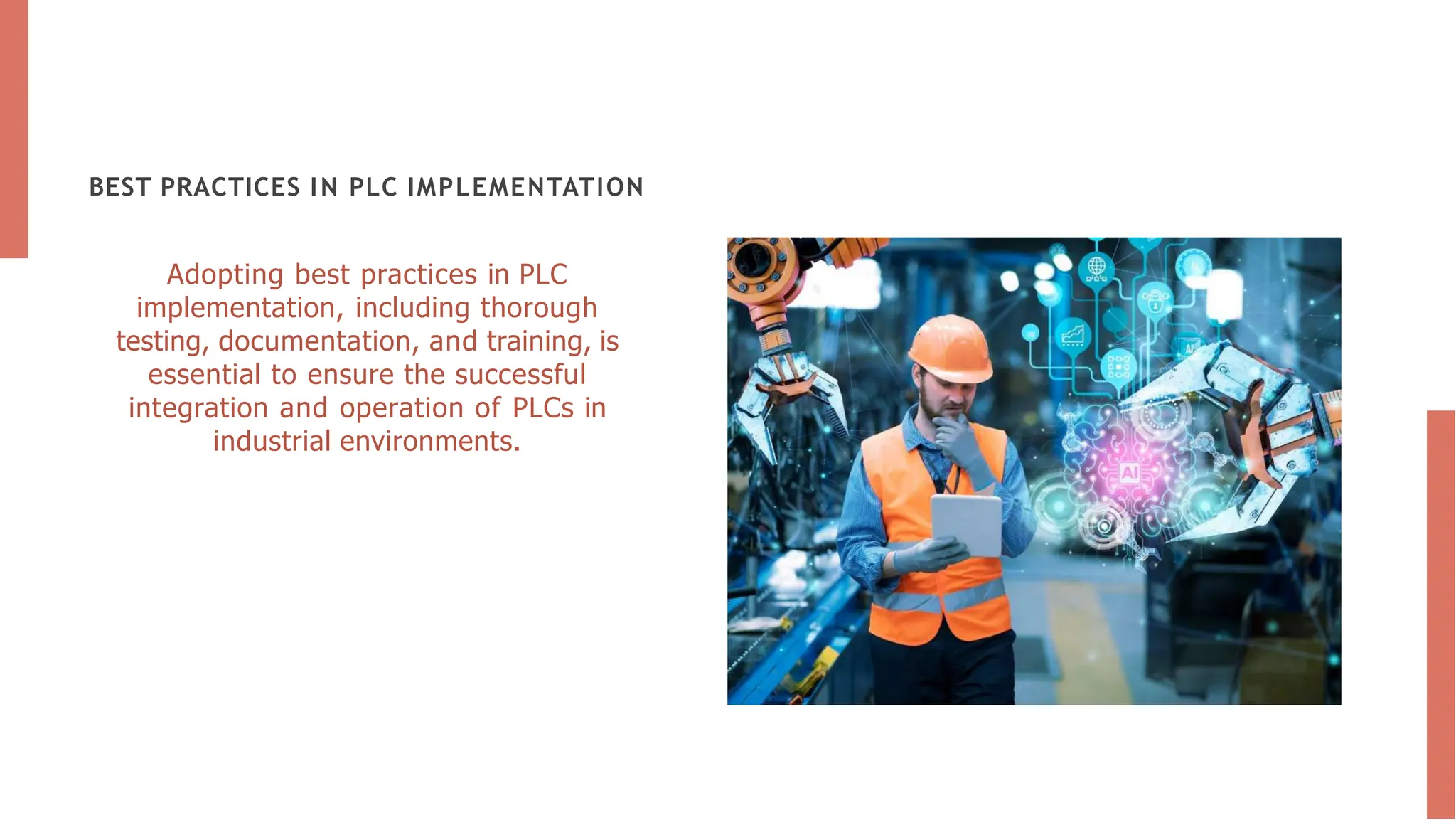
BEST PRACTICES IN PLC IMPLEMENTATION
Adopting best practices in PLC
implementation, including thorough
testing, documentation, and training, is
essential to ensure the successful
integration and operation of PLCs in
industrial environments.
CONCLUSION
In conclusion, PLCs play a pivotal role in modern industrial
automation, o ering unparalleled control capabilities and driving
operational e ciency. As industries continue to evolve, PLC
technology will remain at the forefront of innovative solutions for
complex control and monitoring tasks.
PLC- PROGRAMMABLE LOGIC CONTROLLER-PLC LOGIC

PLC- PROGRAMMABLE LOGIC CONTROLLER-PLC LOGIC

  • 1.
  • 2.
    . INTRODUCTION TO PLCS PLCis an industrial computer designed for multiple inputs and output arrangements . It is capable of storing the instructions to implement control functions such as sequencing ,timing counting arithmetic ,data manipulation and communication.
  • 3.
    The evolution ofPLC technology has revolutionized industrial automation. From simple relay-based systems to advanced microprocessor-controlled units, PLCs have become indispensable in controlling complex industrial processes. EVOLUTION OF PLC TECHNOLOGY
  • 4.
  • 5.
    COMPONENTS OF APLC POWER SUPPLY Provides the voltage needed to run the primary PLC components. I/O MODULES Provides signal conversion and isolation between the internal logic- level signals inside the PLC and the field’s high level signal. PROCESSOR Provides intelligence to command and govern the activities of the entire PLC systems. PROGRAMMING DEVICE Used to enter the desired program that will determine the sequence of operation and control of process equipment or driven machine.
  • 6.
    PLC PROGRAMMING LANGUAGES PLCscan be programmed using various languages such as ladder logic, function block diagrams, and structured text. Each language overs unique advantages in expressing control logic and is suited for different applications.
  • 7.
    PLC PROGRAMMING LANGUAGES LADDERLOGIC Ladder logic is a programming language . Ladder Logic used to develop software for PLC used for control applications in Industry.
  • 8.
    PLC COMMUNICATION PROTOCOLS Interface Standardsand Devices Two interface standards and one interface device are mentioned below: USB: USB, or Universal Serial Bus, is an interface standard. It is used for point-to- point connections for a wide variety of purposes, such as between a mouse or printer and a computer. USB 3.0 allows communications at up to 5 GiGa bytes per second (Gbps) . USB 4.0 supports 40 Gbps communications. USB has replaced the much older and slower RS-232 interface, which was used on legacy computers. RS-485: RS-485 is an interface standard for data communications that allows data transmission speeds of up to 1 megabit per second (1 Mbps) on a 100 meter cable. Data communications speed varies inversely with the total length of an RS- 485 cable.
  • 9.
    PLCs are widelyused in various industries including manufacturing, automotive, energy,and pharmaceuticals.They control processes such as assembly lines, robotic operations, material handling, and quality control. Fewexamplesofindustries where PLCs are used: 1)Robots manufacturing and control 2)Carpark control 3)T raincontrol station system 4)Food processing 5)Materials handling 6)Machine tools 7)Conveyersystem etc PLC APPLICATIONS
  • 10.
    ADVANTAGES OF PLCS •Reliability . • Flexibility in programming and reprogramming. • Cost effective for controlling complex systems. • Small physical size. • High speed of operation. • Ease of maintenance /troubleshooting. • Reduced space . • Energy saving.
  • 11.
    DISADVANTAGE OF PLC • PLCdevices are proprietary it means that part or software of one manufacturer can’t be used in combination with parts of another manufacturer. • Limited design and cost option. • Fixed Circuit Operations. • PLCs manufacturers offer only closed architectures.
  • 12.
    Basic PLC ProgramWhich we would be Doing.
  • 13.
  • 14.
    BEST PRACTICES INPLC IMPLEMENTATION Adopting best practices in PLC implementation, including thorough testing, documentation, and training, is essential to ensure the successful integration and operation of PLCs in industrial environments.
  • 15.
    CONCLUSION In conclusion, PLCsplay a pivotal role in modern industrial automation, o ering unparalleled control capabilities and driving operational e ciency. As industries continue to evolve, PLC technology will remain at the forefront of innovative solutions for complex control and monitoring tasks.