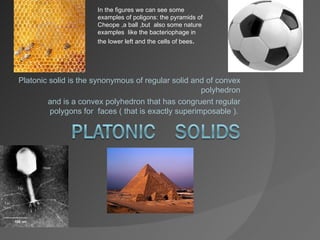
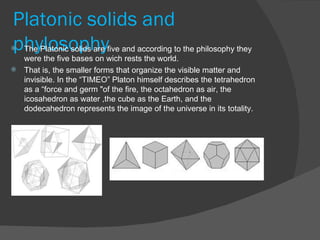
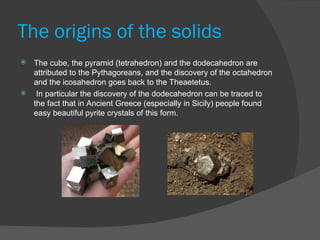
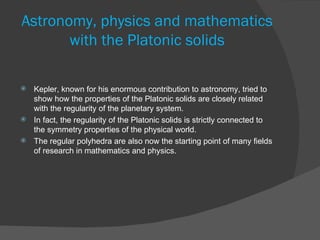
In the figures we can see some
                      examples of poligons: the pyramids of
                      Cheope ,a ball ,but also some nature
                      examples like the bacteriophage in
                      the lower left and the cells of bees.


Platonic solid is the synonymous of regular solid and of convex
                                                     polyhedron
        and is a convex polyhedron that has congruent regular
         polygons for faces ( that is exactly superimposable ).
Platonic solids and
phylosophy
 The Platonic solids are five and according to the philosophy they
  were the five bases on wich rests the world.
 That is, the smaller forms that organize the visible matter and
  invisible. In the “TIMEO” Platon himself describes the tetrahedron
  as a “force and germ "of the fire, the octahedron as air, the
  icosahedron as water ,the cube as the Earth, and the
  dodecahedron represents the image of the universe in its totality.
The origins of the solids
 The cube, the pyramid (tetrahedron) and the dodecahedron are
  attributed to the Pythagoreans, and the discovery of the octahedron
  and the icosahedron goes back to the Theaetetus.
  In particular the discovery of the dodecahedron can be traced to
  the fact that in Ancient Greece (especially in Sicily) people found
  easy beautiful pyrite crystals of this form.
Luck in the history of Platonic solids
    The luck of the Platonic solids in thescientific imagination of Western culture has
                                      been enormous.
               Art and science blend in a deep, Piero Della Francesca writes
    the "de Libellus quinque corporibus regularibus" and Luca Pacioli gives a vulgar
  version in the "De divina proportione “. He commissioned 60 plates to Leonardo da
      Vinci precisely in order to illustrate the possible variations of simple regular
                                          polyhedra.
Science is no longer seen only as an abstraction or a purely technical but also as a
  liberal art. (below you can see on the left "The Flagellation of Christ" by Piero della
   Francesca, and right on "De Divina Proportione"). Is interesting to note how in the
       work of Piero della Francesca the proportions and harmony are respected.
Astronomy, physics and mathematics
       with the Platonic solids

 Kepler, known for his enormous contribution to astronomy, tried to
  show how the properties of the Platonic solids are closely related
  with the regularity of the planetary system.
 In fact, the regularity of the Platonic solids is strictly connected to
  the symmetry properties of the physical world.
 The regular polyhedra are also now the starting point of many fields
  of research in mathematics and physics.
Thanks to the orbiting Hubble telescope and other new
               telescopes outside the Earth's atmosphere that have

The Platonic   taken more detailed pictures and clear than those from
               the ground, it has been possible since 2000, creating
               new maps of the sky, galaxies, galaxy clusters and
solids and     super-clusters of galaxies. Using radio waves, x-rays
               and other measurements, were located many galaxies
the universe   are not visible. These data were combined and found
               that the super-clusters are collected along known lines
               and points of intersection which form at least 4
               octahedra premises, which are joined to the vertices in a
               kind of crystalline scheme. Among these octahedra and
               within them, there are gaps related to magnetic fields
               and galaxies should contain a lot of dark matter. This is
               the largest structure in the Universe directly observed:
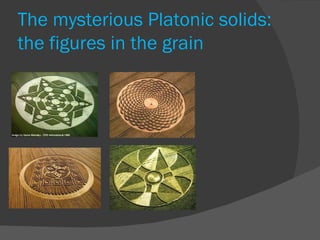
The mysterious Platonic solids:
the figures in the grain
Platonic    solids

Platonic solids

  • 1.
    In the figureswe can see some examples of poligons: the pyramids of Cheope ,a ball ,but also some nature examples like the bacteriophage in the lower left and the cells of bees. Platonic solid is the synonymous of regular solid and of convex polyhedron and is a convex polyhedron that has congruent regular polygons for faces ( that is exactly superimposable ).
  • 2.
    Platonic solids and phylosophy The Platonic solids are five and according to the philosophy they were the five bases on wich rests the world.  That is, the smaller forms that organize the visible matter and invisible. In the “TIMEO” Platon himself describes the tetrahedron as a “force and germ "of the fire, the octahedron as air, the icosahedron as water ,the cube as the Earth, and the dodecahedron represents the image of the universe in its totality.
  • 3.
    The origins ofthe solids  The cube, the pyramid (tetrahedron) and the dodecahedron are attributed to the Pythagoreans, and the discovery of the octahedron and the icosahedron goes back to the Theaetetus.  In particular the discovery of the dodecahedron can be traced to the fact that in Ancient Greece (especially in Sicily) people found easy beautiful pyrite crystals of this form.
  • 4.
    Luck in thehistory of Platonic solids The luck of the Platonic solids in thescientific imagination of Western culture has been enormous. Art and science blend in a deep, Piero Della Francesca writes the "de Libellus quinque corporibus regularibus" and Luca Pacioli gives a vulgar version in the "De divina proportione “. He commissioned 60 plates to Leonardo da Vinci precisely in order to illustrate the possible variations of simple regular polyhedra. Science is no longer seen only as an abstraction or a purely technical but also as a liberal art. (below you can see on the left "The Flagellation of Christ" by Piero della Francesca, and right on "De Divina Proportione"). Is interesting to note how in the work of Piero della Francesca the proportions and harmony are respected.
  • 5.
    Astronomy, physics andmathematics with the Platonic solids  Kepler, known for his enormous contribution to astronomy, tried to show how the properties of the Platonic solids are closely related with the regularity of the planetary system.  In fact, the regularity of the Platonic solids is strictly connected to the symmetry properties of the physical world.  The regular polyhedra are also now the starting point of many fields of research in mathematics and physics.
  • 6.
    Thanks to theorbiting Hubble telescope and other new telescopes outside the Earth's atmosphere that have The Platonic taken more detailed pictures and clear than those from the ground, it has been possible since 2000, creating new maps of the sky, galaxies, galaxy clusters and solids and super-clusters of galaxies. Using radio waves, x-rays and other measurements, were located many galaxies the universe are not visible. These data were combined and found that the super-clusters are collected along known lines and points of intersection which form at least 4 octahedra premises, which are joined to the vertices in a kind of crystalline scheme. Among these octahedra and within them, there are gaps related to magnetic fields and galaxies should contain a lot of dark matter. This is the largest structure in the Universe directly observed:
  • 7.
    The mysterious Platonicsolids: the figures in the grain