BY Dr. ARUNA
SENIOR RESIDENT
PATHOLOGY
KIMS
PLATELET DISORDERS
INTRODUCTION:
 Def : Bleeding disorders is a general term for a wide range of
medical problems that lead to poor blood clotting and
continuous bleeding.
 characterized clinically by abnormal bleeding, which can
either be spontaneous or become evident after some inciting
event.
 can result from :
1. defects in the blood vessel
2. abnormalities in the blood itself- clotting factors and platelets
Etiology
 PLATLETS DISORDER
 VESSEL WALL ABNORMALITIES
 CLOTTING DISORDER
i) PLATELET DISORDER, what is
it?
WHAT IS PLATELET ?
 Oblong discshape
 Size- 2-4 µm
 Produced in bone marrow by megakaryocte cell
Platelet count in blood- 150,000-350,000 µL
 Life span- mean survival time (8-10) days
 Function :- Aggregation & adherence to injured vessel
to form primary clot (plug)
 help in clot formation
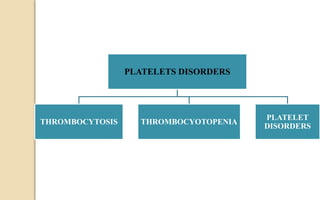
PLATELETS DISORDERS
THROMBOCYTOSIS THROMBOCYOTOPENIA
PLATELET
DISORDERS
THROMBOCYTOPENIA
 Defined as reduced in the platelet count< 150, 000µL
that characterized by spontaneous bleeding, a prolonged
bleeding time, and a normal PT and PTT.
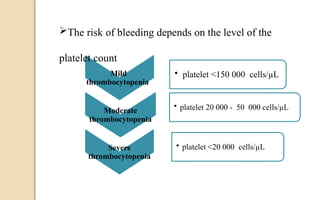
Mild
thrombocytopenia
• platelet <150 000 cells/µL
Moderate
thrombocytopenia
• platelet 20 000 - 50 000 cells/µL
Severe
thrombocytopenia
• platelet <20 000 cells/µL
The risk of bleeding depends on the level of the
platelet count
Etiology:
Idiopathic (ITP):
1. Increased platelet destruction
2. Decreased platelets production.
3. Both.
Secondary to:
1. Drugs induced thrombocytopenia→ e.g (cytotoxic drugs)
 Secondary to some diseases
1. Bacterial or viral infection.
2. Uremia, SLE.
3. Neoplasia of bone marrow or lymphoid tissues (leukemia, lymphomas).
4. Radiotherapy .
CLINICAL MANIFESTATIONS
 Onset is usually sudden for acute ITP and in chronic ITP,
it is insidious onset.
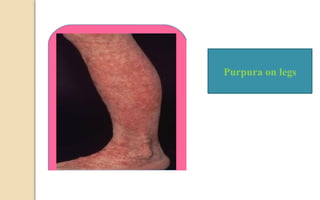
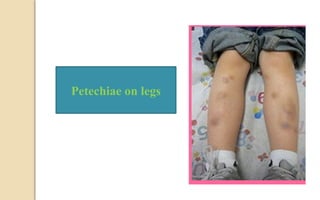
 Petechiae or purpura on Feet, legs, arms, and buttocks.
 Mucosal bleeding.
 Palatal petechiae, epistaxis, hematuria, menorrhagia, GI
bleeding.
 Gingival bleeding
Purpura on legs
Petechiae on legs
DIAGNOSIS
 History taking.
 Physical examination.
1. Signs of bleeding (petechiae and purpura).
2. Mucosal bleeding. Investigations.
3. Full blood count.-Low platelet count.
 Histological findings.
1. Platelets are normal in size or may appear larger than normal.
2. Normal red blood cells morphology.
3. Normal white blood cells morphology.
 Coagulation tests.
TREATMENT & MANA GEMENT
1. Remove the underlying cause if known.
2. Corticosteroids are useful in idiopathic,
thrombocytopenia purpura (ITP) and in autoimmune drugs
induced thrombocytopenia.
3. Splenectomy.
4.Platelets transfusion for secondary thrmbocytopenia.
5.Neumega is a new drug used to stimulate platelets inbone marrow.
Dental implication:
Gingival bleeding can be controlled by the use of fibrin
foam,gel foam or absorbable cellulose with thrombin.
20 vol.hydrogen peroxide should be tried , in many
cases it will control gingival oozing.
Elective dental surgery should be deferred.
Thrombocytosis / Thrombocythemia
There is increased number of circulating platelets , the elevation is in the range of
500,000_1000,000/cubic mm, but may be higher.
Etiology:
 idiopathic
 secondary: may be secondary to
1. Splenectomy.
2. Myeloproliferative diseases
Disorder Of Platelets Function
 Congenital platelets disorders ↓↓↓
 Defect in adherence :-
Bernard-Soulier syndrome-The glycoprotein (Ib) receptor for
VIII:Vwf is absent on platelet membrane.
 Rx: platelets transfusion.
 Defect in aggregation :-
Glanzmann thrombasthenia-the platelets lack surface
glycoprotein receptor(IIb, IIIa)necessary for binding
fibrinogen(fibrinogen receptor)
 Bleeding time is prolonged
Disorder Of Platelets Function
 Acquired platelets disorders ↓↓↓
1. Meloproliferative diseases
2. UREMIA
3. Dysproteinemia
4. Drugs (Aspirin .Clopidogrol)
Vessel Wall Abnormalities
1. SCURVY
2. INFECTIONS (measles, scarlet fever,
endocarditis,malaria)
3. ALLERGY
4. HEREDITARY HEMORRHAGIC
TELANGIECTASIS
Heridetary hemorrhagic telangectsis
Dominant inherited condition , there is a telengectiasis and small
aneurysms found on finger tips, face,nasal passages, tongue and GIT.
• Small group of people develope pulmonary A/V
malformation.
• Pt either develops reccurent bleeding /epistaxis/iron def. anemia due
to GIT bleeding.
• Rx ↓
1. Iron therapy for blood loss.
Dental aspect:
Trauma should be avoided whenever possible.
Lesions may occasionally interfere with periodontal therapy or oral
surgery and the bleeding can be treated by electrocoagulation, laser
therapy, cryo-therapy or resection.
Escharotic agents such as silver nitrate, 50% trichloro-acetic acid and
chromic acid are effective on only small bleeding points.
Sclerosing agents such as prophylaxis.
Iron and folate therapy may be required if there is chronic anemia.
Non steroidal anti-inflammatory analgesics are contraindicated because
of the risk of gastrointestinal
Vessel Wall Abnormalities
EHLERS DANLOS DISEASE :
Congenital disorder of collagen synthesis in which capillaries
are poorly supported by collagen and ecchymosis are
commonly observed.
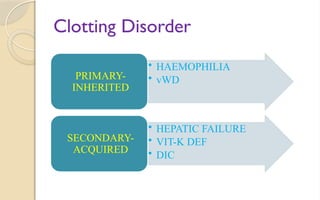
Clotting Disorder
• HAEMOPHILIA
• vWD
PRIMARY-
INHERITED
• HEPATIC FAILURE
• VIT-K DEF
• DIC
SECONDARY-
ACQUIRED
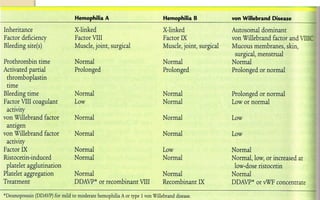
Haemophilia – overview
1. A group of blood disorders in which there is defect in clotting
factors.
2. 70% are X-linked recessive disorder. 30% spontaneous
mutation.
3. The bleeding patterns of haemophilia are similar.
Types :
 A:Deficiency in factor VIII (classic
Hemophilia A (classic or true
hemophilia)
Definition:
• This is most common type of hemophilia ,it is characterized by
deficiency of factor VIII and prolonged (APTT).
• Normal value of VIII is 50% -150%.
• Normal value of (APTT) is 25 -40 sec.
• Bleeding character in hemophilia: Bleeding
stop immediately after injury as a result of
normal vascular and platelets response but
after an hour or more intractable oozing or
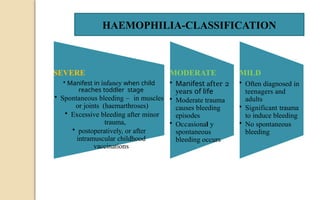
SEVERE
• Manifest in infancy when child
reaches toddler stage
• Spontaneous bleeding – in muscles
or joints (haemarthroses)
• Excessive bleeding after minor
trauma,
• postoperatively, or after
intramuscular childhood
vaccinations.
MODERATE
• Manifest after 2
years of life
• Moderate trauma
causes bleeding
episodes
• Occasional y
spontaneous
bleeding occurs
MILD
• Often diagnosed in
teenagers and
adults
• Significant trauma
to induce bleeding
• No spontaneous
bleeding
HAEMOPHILIA-CLASSIFICATION
26
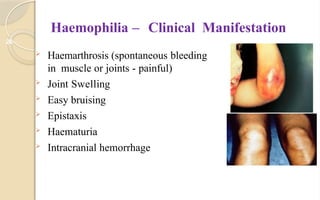
Haemophilia – Clinical Manifestation
 Haemarthrosis (spontaneous bleeding
in muscle or joints - painful)
 Joint Swelling
 Easy bruising
 Epistaxis
 Haematuria
 Intracranial hemorrhage
Oral Manifestations
1. Bleeding from any site of oral cavity and sometimes it may
cause respiratory obstruction.
2. Gingival hemorrhage.
3. Bleeding associated with physiological erupation.
4. Tooth extraction or minor surgery may lead to sever
hemorrhage, sometimes may be fatal.
Dental management of hemophilia A
Prophylactic measures:-
1. regular dental care.
2. fluoride application.
3. sugar restriction.
4. prevention of
periodontal disease.
5. These measures reduce the need for extraction which may be major
hazard in hemophilia.
6. Endodontics: reaming through the apex should be avoided.
7. Periodontal therapy: scaling can be performed(except in sever
hemophilia)under antifibrinolytic cover.
HAZARD OF ANASTHESIA :
□
Local and general anesthesia are hazardous in absence of factor replacement .
Anesthesia injection especially nerve block can be hazard particularly for severe
hemophiliacs, bec the needle tear the wall of small blood vessels and a
deep spreading hematoma can threaten the air way also the hematoma is formed
during intramuscular injection so the best safer is nitrous oxide analgesia to
avoid use of L.A.
MANAGEMENT OF EXTRACTION:
1Laboratory tests : factor VIII should be raised to 50%_70%before dental
extraction and raised to 100% for major surgery.
□
□
□
□
HEMOPHILIA B-CHRISTMAS
DISEASE
The disease is identical to hemophilia A but charaterised by
deficiency of factor IX.
TREATMENT :-
1- mild hemophilia B :- fresh frozen plasma is adequate.
2-severe hemophilia B:-factor IX (I.V) 1hr preoperatively.
Von willebrand‘s disorder - overview
□
□ Most common hereditary deficiency caused abnormality in
von Willerbrand protein.
Functions on both primary & secondary homestasis.
 To act as bridge between subendothelial collagen and
platelets
Bind and protect factor VIII from rapid clearance then
delivers it to site of injury.

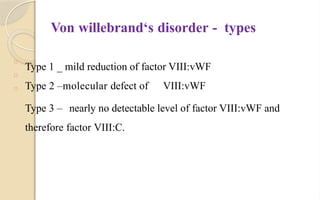
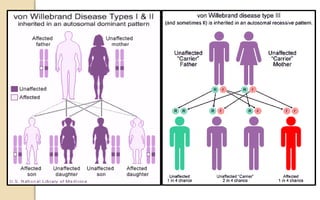
Von willebrand‘s disorder - types
□
Type 1 _ mild reduction of factor VIII:vWF
Type 2 –molecular defect of VIII:vWF
Type 3 – nearly no detectable level of factor VIII:vWF and
therefore factor VIII:C.
□
□
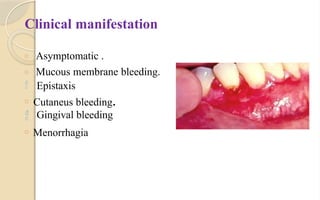
Clinical manifestation
□ Asymptomatic .
□ Mucous membrane bleeding.
 Epistaxis
□ Cutaneus bleeding.
 Gingival bleeding
□ Menorrhagia
investigation
□ Complete Blood Count – platelet
normal
□ APTT PROLONGED or normal
□ Factor VIII LOWor normal.
□ von Willerbrand Factor activity
(ristocetin cofactor)
 Ristocetin, an antibiotic that causes vWF to bind
to platelet taken from plasma.
In healthy people, platelet rapidly agglutinate.

□ von Willerbrand Factor
antigen
 Measure vWF protein and binding
treatment
1-Mild-Moderate vWD
:
❖
❖
❖ Desmopressin for minor
surgery. Fresh frozen plasma.
Cryoprecipitate.
2- in severe vWD : factor VIII concentrate for major
surgery.
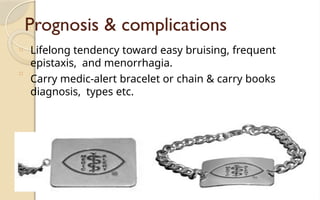
Prognosis & complications
□ Lifelong tendency toward easy bruising, frequent
epistaxis, and menorrhagia.
Carry medic-alert bracelet or chain & carry books
diagnosis, types etc.
□
Hepatic faliure
In addition to vit k dependent factors(II, VII, IX ,X) the
liver synthesizes fibrinogen ,plasminogen,factors
(V,VIII,XI,XIII).
Liver disease may be associated with increased
bleeding tendency and this may be due to:
1 reduced vit K absorption.
2reduced synthesis of coagulation
factors. 3-increased fibrinolysis.
4 thrombocytopenia.
5iral hepatitis or alcoholism .
Management
❑
In mild liver disease : vit K may be effective.
In sever cases : tranxemic acid and fresh plasma may
control bleeding.
□
❑ REYE‘S SYNDROME :
□ There is some evidence that use of aspirin in children up to
the a of
15 yrs ,may develop rarely liver damage(diffuse microvascular
fatty infiltration)and acute encephalopathy with cerebral
edema.
Heparin
Action:
prevent fibrin formation through:
a. Inhibition of thrombin-fibrinogen reaction.
b. Inactivate factors 1Xa,Xa,X1a, and X11a.
c. Prevention of platelets aggregation (large dose).
Management :
1.Surgery can be safely carried out ,when the
effect of heparin has ceased.
2.In renal dialysis, surgery is better carried out the
Disorder characterized by coagulation pathway
activation leading to diffuse fibrin deposition
in the microvasculature and consumption of
coagulation factors and platelets.
❑ Occurs as secondary complication of
variety diseases.
❑ Caused by the systemic activation of
coagulation pathways, leading to formation of
thrombi throughout the microcirculation and
Disseminated Intravascular Coagulation
(DIC)
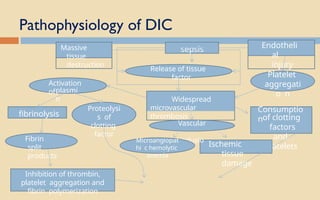
Pathophysiology of DIC
Massive
tissue
destruction
sepsis Endotheli
al
injury
Release of tissue
factor Platelet
aggregati
o n
Widespread
microvascular
thrombosis
Consumptio
nof clotting
factors
and
platelets
Ischemic
tissue
damage
fibrinolysis
Vascular
occlusio
n
Microangiopat
hi c hemolytic
anemia
Activation
ofplasmi
n
Proteolysi
s of
clotting
factor
Fibrin
split
products
Inhibition of thrombin,
platelet aggregation and
fibrin polymerization
DIC
Precipitating factors:
Including incompatible blood transfusion, severe
sepsis,severe trauma or burns and cancer
(metastatic cancer of the pancreas, lung, stomach
or prostate).
The possible effect of DIC includes:
a.Hemorrhagic
tendencies. b.Thrombotic
phenomenon.
c.Hemolysis of red cells.
Clinical features
□Bleeding, thrombosis,bleeding far from common
than thrombosis.
Subacute DIC :
Occures primarily in cancerous pts results in superficial
+deep venous thrombosis.
Other manifestation :
High incidence of cardio respiratory faliure.
Treatment
❑
Treat the disorder inducing the DIC first such as
sepsis.
Support the patient by correcting hypoxia, acidosis and
poor perfusion.
Replace depleted blood clotting factors, platelets
and anticoagulant proteins by transfusion.
Heparin may be used to treat significant arterial or
venous thrombotic disease unless sites of life-
threatening bleeding coexist. Thus, the use of heparin
remains controversial.
Treatment with anticoagulants or coagulants
❑
❑
❑
❑
❑
Diagnosis of patient with
bleeding disorders
An adequate history is the single most important part of
the evaluation of Pts with abnormal bleeding
tendency, clinical examination is also necessary, but the
hematological tests are needed to confirm the diagnosis.
Diagnosis of patientswith
bleeding disorders
□History
1.Bleeding problem in relatives.
2.Bleeding problem following
trauma.
3. Bleeding problem following
operation.
4. Medication that may cause
bleeding
problems.
5.Presence of disease that may have associated
Diagnosis of patients with
bleeding disorders
Clinical Examination
oThe skin and mucous membranes should be examined
for
:
petechia, ecchymosis, hematoma, angiomas and
jaundice.
oThe lymph nodes should be examined and mobility of
the joint should be observed.
Diagnosis of patients with
bleeding disorders
□Screeing Laboratory TESTS
❖Hemgram
❖PT
❖BT
❖aPTT
❖TT
Thank
you

platelet disorders pathology questio s

  • 1.
    BY Dr. ARUNA SENIORRESIDENT PATHOLOGY KIMS PLATELET DISORDERS
  • 2.
    INTRODUCTION:  Def :Bleeding disorders is a general term for a wide range of medical problems that lead to poor blood clotting and continuous bleeding.  characterized clinically by abnormal bleeding, which can either be spontaneous or become evident after some inciting event.  can result from : 1. defects in the blood vessel 2. abnormalities in the blood itself- clotting factors and platelets
  • 3.
    Etiology  PLATLETS DISORDER VESSEL WALL ABNORMALITIES  CLOTTING DISORDER
  • 4.
  • 5.
    WHAT IS PLATELET?  Oblong discshape  Size- 2-4 µm  Produced in bone marrow by megakaryocte cell Platelet count in blood- 150,000-350,000 µL  Life span- mean survival time (8-10) days  Function :- Aggregation & adherence to injured vessel to form primary clot (plug)  help in clot formation
  • 6.
  • 7.
    THROMBOCYTOPENIA  Defined asreduced in the platelet count< 150, 000µL that characterized by spontaneous bleeding, a prolonged bleeding time, and a normal PT and PTT.
  • 8.
    Mild thrombocytopenia • platelet <150000 cells/µL Moderate thrombocytopenia • platelet 20 000 - 50 000 cells/µL Severe thrombocytopenia • platelet <20 000 cells/µL The risk of bleeding depends on the level of the platelet count
  • 9.
    Etiology: Idiopathic (ITP): 1. Increasedplatelet destruction 2. Decreased platelets production. 3. Both. Secondary to: 1. Drugs induced thrombocytopenia→ e.g (cytotoxic drugs)  Secondary to some diseases 1. Bacterial or viral infection. 2. Uremia, SLE. 3. Neoplasia of bone marrow or lymphoid tissues (leukemia, lymphomas). 4. Radiotherapy .
  • 10.
    CLINICAL MANIFESTATIONS  Onsetis usually sudden for acute ITP and in chronic ITP, it is insidious onset.  Petechiae or purpura on Feet, legs, arms, and buttocks.  Mucosal bleeding.  Palatal petechiae, epistaxis, hematuria, menorrhagia, GI bleeding.  Gingival bleeding
  • 11.
  • 12.
  • 13.
    DIAGNOSIS  History taking. Physical examination. 1. Signs of bleeding (petechiae and purpura). 2. Mucosal bleeding. Investigations. 3. Full blood count.-Low platelet count.  Histological findings. 1. Platelets are normal in size or may appear larger than normal. 2. Normal red blood cells morphology. 3. Normal white blood cells morphology.  Coagulation tests.
  • 14.
    TREATMENT & MANAGEMENT 1. Remove the underlying cause if known. 2. Corticosteroids are useful in idiopathic, thrombocytopenia purpura (ITP) and in autoimmune drugs induced thrombocytopenia. 3. Splenectomy. 4.Platelets transfusion for secondary thrmbocytopenia. 5.Neumega is a new drug used to stimulate platelets inbone marrow.
  • 15.
    Dental implication: Gingival bleedingcan be controlled by the use of fibrin foam,gel foam or absorbable cellulose with thrombin. 20 vol.hydrogen peroxide should be tried , in many cases it will control gingival oozing. Elective dental surgery should be deferred.
  • 16.
    Thrombocytosis / Thrombocythemia Thereis increased number of circulating platelets , the elevation is in the range of 500,000_1000,000/cubic mm, but may be higher. Etiology:  idiopathic  secondary: may be secondary to 1. Splenectomy. 2. Myeloproliferative diseases
  • 17.
    Disorder Of PlateletsFunction  Congenital platelets disorders ↓↓↓  Defect in adherence :- Bernard-Soulier syndrome-The glycoprotein (Ib) receptor for VIII:Vwf is absent on platelet membrane.  Rx: platelets transfusion.  Defect in aggregation :- Glanzmann thrombasthenia-the platelets lack surface glycoprotein receptor(IIb, IIIa)necessary for binding fibrinogen(fibrinogen receptor)  Bleeding time is prolonged
  • 18.
    Disorder Of PlateletsFunction  Acquired platelets disorders ↓↓↓ 1. Meloproliferative diseases 2. UREMIA 3. Dysproteinemia 4. Drugs (Aspirin .Clopidogrol)
  • 19.
    Vessel Wall Abnormalities 1.SCURVY 2. INFECTIONS (measles, scarlet fever, endocarditis,malaria) 3. ALLERGY 4. HEREDITARY HEMORRHAGIC TELANGIECTASIS
  • 20.
    Heridetary hemorrhagic telangectsis Dominantinherited condition , there is a telengectiasis and small aneurysms found on finger tips, face,nasal passages, tongue and GIT. • Small group of people develope pulmonary A/V malformation. • Pt either develops reccurent bleeding /epistaxis/iron def. anemia due to GIT bleeding. • Rx ↓ 1. Iron therapy for blood loss.
  • 21.
    Dental aspect: Trauma shouldbe avoided whenever possible. Lesions may occasionally interfere with periodontal therapy or oral surgery and the bleeding can be treated by electrocoagulation, laser therapy, cryo-therapy or resection. Escharotic agents such as silver nitrate, 50% trichloro-acetic acid and chromic acid are effective on only small bleeding points. Sclerosing agents such as prophylaxis. Iron and folate therapy may be required if there is chronic anemia. Non steroidal anti-inflammatory analgesics are contraindicated because of the risk of gastrointestinal
  • 22.
    Vessel Wall Abnormalities EHLERSDANLOS DISEASE : Congenital disorder of collagen synthesis in which capillaries are poorly supported by collagen and ecchymosis are commonly observed.
  • 23.
    Clotting Disorder • HAEMOPHILIA •vWD PRIMARY- INHERITED • HEPATIC FAILURE • VIT-K DEF • DIC SECONDARY- ACQUIRED
  • 24.
    Haemophilia – overview 1.A group of blood disorders in which there is defect in clotting factors. 2. 70% are X-linked recessive disorder. 30% spontaneous mutation. 3. The bleeding patterns of haemophilia are similar. Types :  A:Deficiency in factor VIII (classic
  • 25.
    Hemophilia A (classicor true hemophilia) Definition: • This is most common type of hemophilia ,it is characterized by deficiency of factor VIII and prolonged (APTT). • Normal value of VIII is 50% -150%. • Normal value of (APTT) is 25 -40 sec. • Bleeding character in hemophilia: Bleeding stop immediately after injury as a result of normal vascular and platelets response but after an hour or more intractable oozing or
  • 26.
    SEVERE • Manifest ininfancy when child reaches toddler stage • Spontaneous bleeding – in muscles or joints (haemarthroses) • Excessive bleeding after minor trauma, • postoperatively, or after intramuscular childhood vaccinations. MODERATE • Manifest after 2 years of life • Moderate trauma causes bleeding episodes • Occasional y spontaneous bleeding occurs MILD • Often diagnosed in teenagers and adults • Significant trauma to induce bleeding • No spontaneous bleeding HAEMOPHILIA-CLASSIFICATION
  • 27.
    26 Haemophilia – ClinicalManifestation  Haemarthrosis (spontaneous bleeding in muscle or joints - painful)  Joint Swelling  Easy bruising  Epistaxis  Haematuria  Intracranial hemorrhage
  • 28.
    Oral Manifestations 1. Bleedingfrom any site of oral cavity and sometimes it may cause respiratory obstruction. 2. Gingival hemorrhage. 3. Bleeding associated with physiological erupation. 4. Tooth extraction or minor surgery may lead to sever hemorrhage, sometimes may be fatal.
  • 29.
    Dental management ofhemophilia A Prophylactic measures:- 1. regular dental care. 2. fluoride application. 3. sugar restriction. 4. prevention of periodontal disease. 5. These measures reduce the need for extraction which may be major hazard in hemophilia. 6. Endodontics: reaming through the apex should be avoided. 7. Periodontal therapy: scaling can be performed(except in sever hemophilia)under antifibrinolytic cover.
  • 30.
    HAZARD OF ANASTHESIA: □ Local and general anesthesia are hazardous in absence of factor replacement . Anesthesia injection especially nerve block can be hazard particularly for severe hemophiliacs, bec the needle tear the wall of small blood vessels and a deep spreading hematoma can threaten the air way also the hematoma is formed during intramuscular injection so the best safer is nitrous oxide analgesia to avoid use of L.A. MANAGEMENT OF EXTRACTION: 1Laboratory tests : factor VIII should be raised to 50%_70%before dental extraction and raised to 100% for major surgery. □ □ □ □
  • 31.
    HEMOPHILIA B-CHRISTMAS DISEASE The diseaseis identical to hemophilia A but charaterised by deficiency of factor IX. TREATMENT :- 1- mild hemophilia B :- fresh frozen plasma is adequate. 2-severe hemophilia B:-factor IX (I.V) 1hr preoperatively.
  • 32.
    Von willebrand‘s disorder- overview □ □ Most common hereditary deficiency caused abnormality in von Willerbrand protein. Functions on both primary & secondary homestasis.  To act as bridge between subendothelial collagen and platelets Bind and protect factor VIII from rapid clearance then delivers it to site of injury. 
  • 33.
    Von willebrand‘s disorder- types □ Type 1 _ mild reduction of factor VIII:vWF Type 2 –molecular defect of VIII:vWF Type 3 – nearly no detectable level of factor VIII:vWF and therefore factor VIII:C. □ □
  • 35.
    Clinical manifestation □ Asymptomatic. □ Mucous membrane bleeding.  Epistaxis □ Cutaneus bleeding.  Gingival bleeding □ Menorrhagia
  • 36.
    investigation □ Complete BloodCount – platelet normal □ APTT PROLONGED or normal □ Factor VIII LOWor normal. □ von Willerbrand Factor activity (ristocetin cofactor)  Ristocetin, an antibiotic that causes vWF to bind to platelet taken from plasma. In healthy people, platelet rapidly agglutinate.  □ von Willerbrand Factor antigen  Measure vWF protein and binding
  • 37.
    treatment 1-Mild-Moderate vWD : ❖ ❖ ❖ Desmopressinfor minor surgery. Fresh frozen plasma. Cryoprecipitate. 2- in severe vWD : factor VIII concentrate for major surgery.
  • 38.
    Prognosis & complications □Lifelong tendency toward easy bruising, frequent epistaxis, and menorrhagia. Carry medic-alert bracelet or chain & carry books diagnosis, types etc. □
  • 40.
    Hepatic faliure In additionto vit k dependent factors(II, VII, IX ,X) the liver synthesizes fibrinogen ,plasminogen,factors (V,VIII,XI,XIII). Liver disease may be associated with increased bleeding tendency and this may be due to: 1 reduced vit K absorption. 2reduced synthesis of coagulation factors. 3-increased fibrinolysis. 4 thrombocytopenia. 5iral hepatitis or alcoholism .
  • 41.
    Management ❑ In mild liverdisease : vit K may be effective. In sever cases : tranxemic acid and fresh plasma may control bleeding. □ ❑ REYE‘S SYNDROME : □ There is some evidence that use of aspirin in children up to the a of 15 yrs ,may develop rarely liver damage(diffuse microvascular fatty infiltration)and acute encephalopathy with cerebral edema.
  • 42.
    Heparin Action: prevent fibrin formationthrough: a. Inhibition of thrombin-fibrinogen reaction. b. Inactivate factors 1Xa,Xa,X1a, and X11a. c. Prevention of platelets aggregation (large dose). Management : 1.Surgery can be safely carried out ,when the effect of heparin has ceased. 2.In renal dialysis, surgery is better carried out the
  • 43.
    Disorder characterized bycoagulation pathway activation leading to diffuse fibrin deposition in the microvasculature and consumption of coagulation factors and platelets. ❑ Occurs as secondary complication of variety diseases. ❑ Caused by the systemic activation of coagulation pathways, leading to formation of thrombi throughout the microcirculation and Disseminated Intravascular Coagulation (DIC)
  • 44.
    Pathophysiology of DIC Massive tissue destruction sepsisEndotheli al injury Release of tissue factor Platelet aggregati o n Widespread microvascular thrombosis Consumptio nof clotting factors and platelets Ischemic tissue damage fibrinolysis Vascular occlusio n Microangiopat hi c hemolytic anemia Activation ofplasmi n Proteolysi s of clotting factor Fibrin split products Inhibition of thrombin, platelet aggregation and fibrin polymerization
  • 45.
    DIC Precipitating factors: Including incompatibleblood transfusion, severe sepsis,severe trauma or burns and cancer (metastatic cancer of the pancreas, lung, stomach or prostate). The possible effect of DIC includes: a.Hemorrhagic tendencies. b.Thrombotic phenomenon. c.Hemolysis of red cells.
  • 46.
    Clinical features □Bleeding, thrombosis,bleedingfar from common than thrombosis. Subacute DIC : Occures primarily in cancerous pts results in superficial +deep venous thrombosis. Other manifestation : High incidence of cardio respiratory faliure.
  • 47.
    Treatment ❑ Treat the disorderinducing the DIC first such as sepsis. Support the patient by correcting hypoxia, acidosis and poor perfusion. Replace depleted blood clotting factors, platelets and anticoagulant proteins by transfusion. Heparin may be used to treat significant arterial or venous thrombotic disease unless sites of life- threatening bleeding coexist. Thus, the use of heparin remains controversial. Treatment with anticoagulants or coagulants ❑ ❑ ❑ ❑ ❑
  • 48.
    Diagnosis of patientwith bleeding disorders An adequate history is the single most important part of the evaluation of Pts with abnormal bleeding tendency, clinical examination is also necessary, but the hematological tests are needed to confirm the diagnosis.
  • 49.
    Diagnosis of patientswith bleedingdisorders □History 1.Bleeding problem in relatives. 2.Bleeding problem following trauma. 3. Bleeding problem following operation. 4. Medication that may cause bleeding problems. 5.Presence of disease that may have associated
  • 50.
    Diagnosis of patientswith bleeding disorders Clinical Examination oThe skin and mucous membranes should be examined for : petechia, ecchymosis, hematoma, angiomas and jaundice. oThe lymph nodes should be examined and mobility of the joint should be observed.
  • 51.
    Diagnosis of patientswith bleeding disorders □Screeing Laboratory TESTS ❖Hemgram ❖PT ❖BT ❖aPTT ❖TT
  • 52.