PLATE BOUNDARIES
PREPARED BY: FRANCESS JOHANNA DELA FUENTE
2
3
PRESENTATION
TITLE
4
PRESENTATION
TITLE
PLATE
BOUNDARIES
6
PRESENTATION
TITLE
PLATE TECTONICS
•A theory that deals with the dynamics of
Earth’s outer shell—the lithosphere—
providing a uniform context for
understanding mountain-building
processes, volcanoes, and earthquakes
as well as the evolution of Earth’s
surface and reconstructing its past
continents and oceans.
7
PRESENTATION
TITLE
PLATE BOUNDARIES
•It is the location where two plates
meet.
•Plate boundaries are where
geological events occur, such as
earthquakes and the creation of
topographic features such as
mountains, volcanoes, mid-ocean
ridges, and oceanic trenches.
8
PRESENTATION
TITLE
THREE TYPES OF PLATE BOUNDARIES
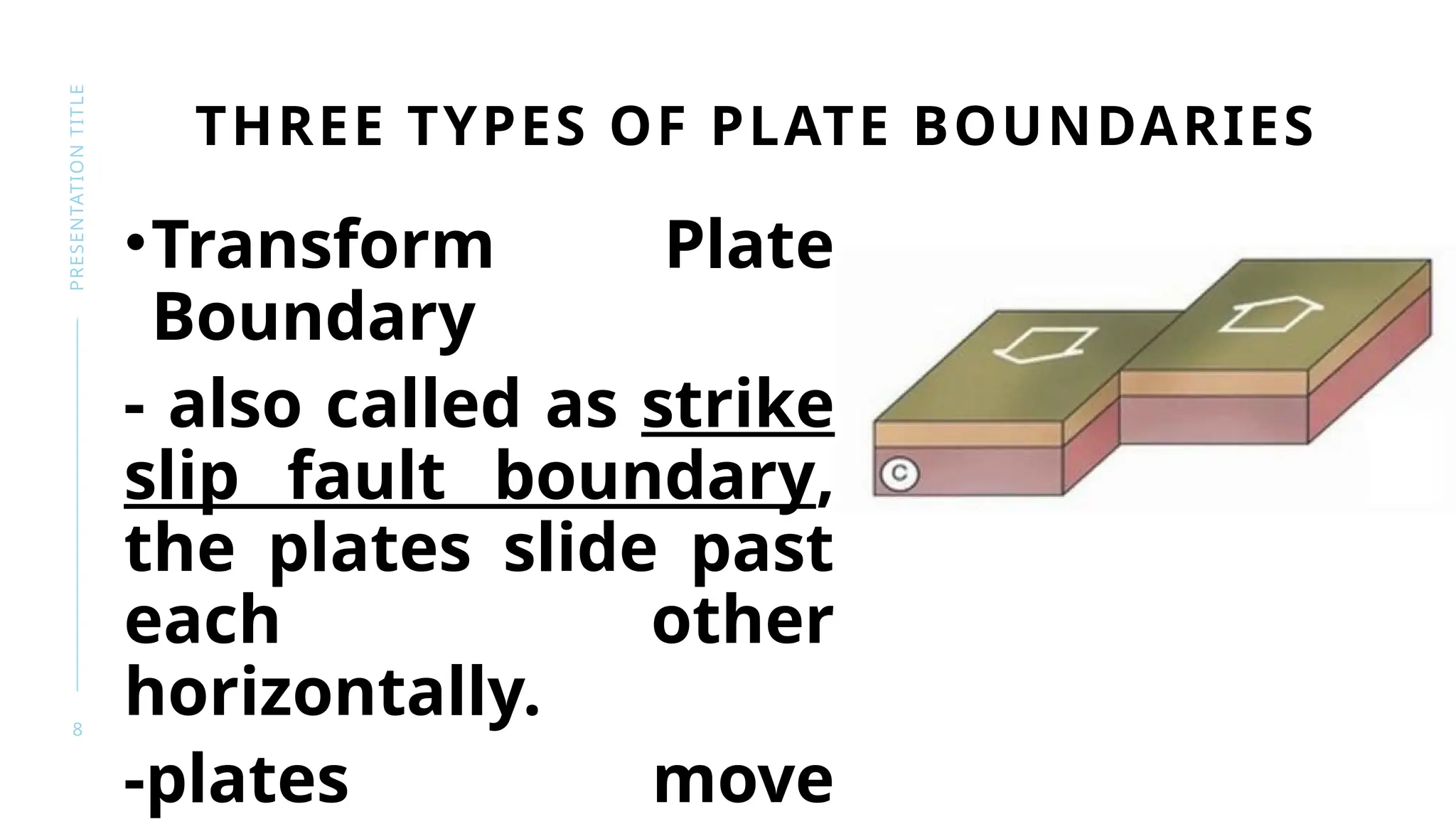
•Transform Plate
Boundary
- also called as strike
slip fault boundary,
the plates slide past
each other
horizontally.
-plates move
9
PRESENTATION
TITLE
This is a type of
boundary that
cuts through
California, the
well-known San
Andreas Fault.
1 0
PRESENTATION
TITLE
THREE TYPES OF PLATE BOUNDARIES
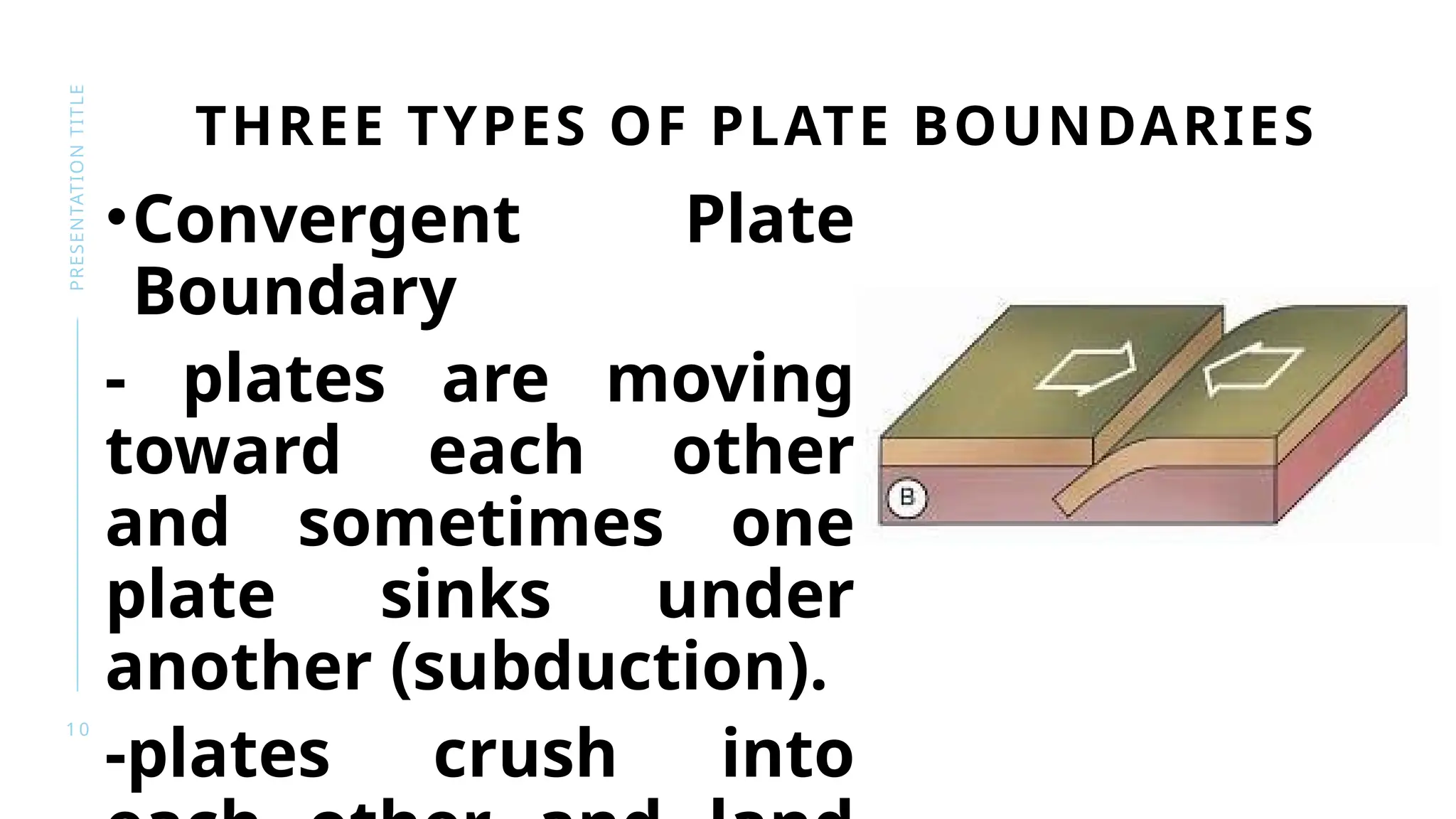
•Convergent Plate
Boundary
- plates are moving
toward each other
and sometimes one
plate sinks under
another (subduction).
-plates crush into
MT. FUJI, JAPAN
1 1
PRESENTATION
TITLE
1 2
PRESENTATION
TITLE
CASCADIA SUBDUCTION ZONE:
1 3
PRESENTATION
TITLE
THREE TYPES OF PLATE BOUNDARIES
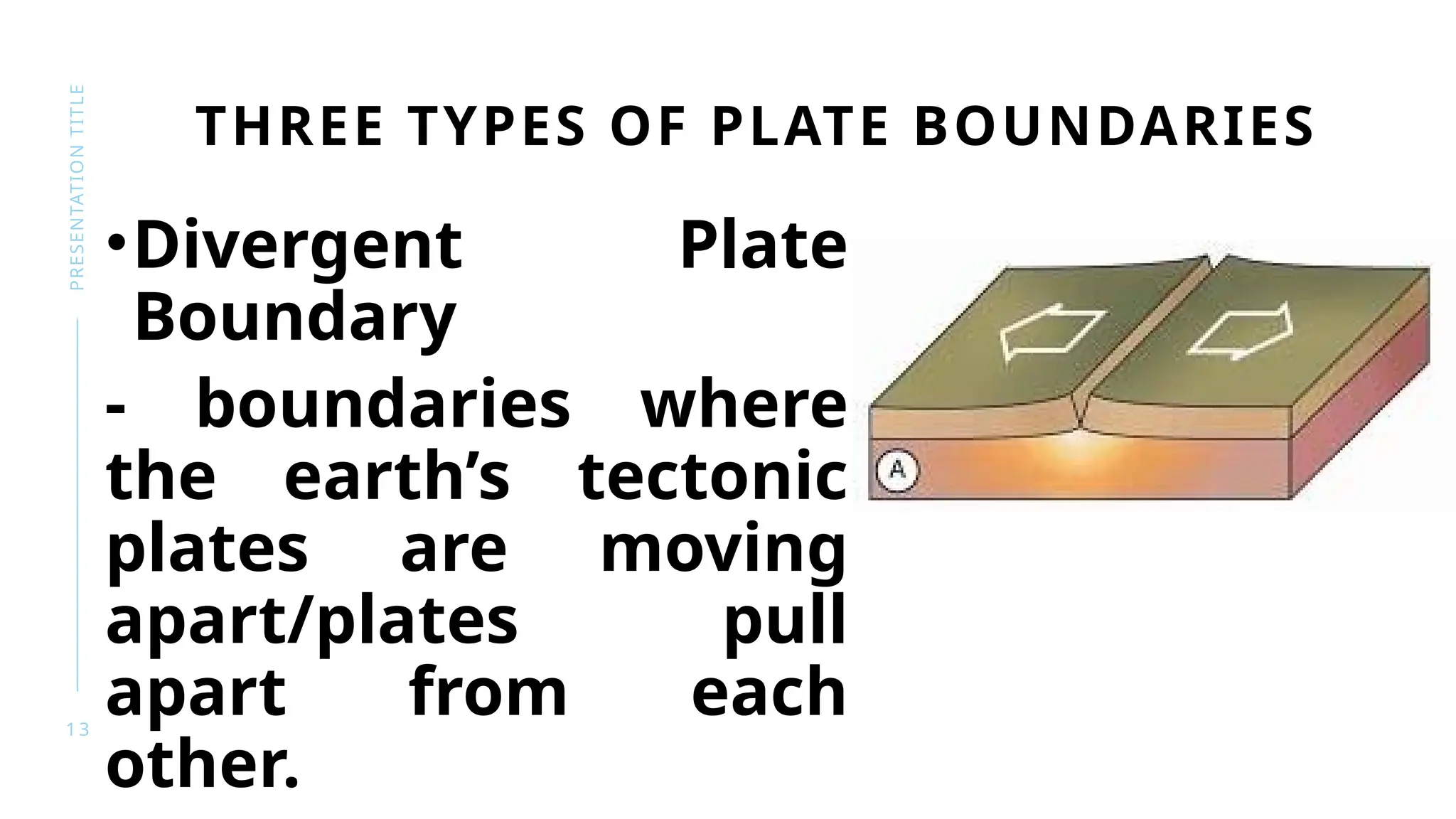
•Divergent Plate
Boundary
- boundaries where
the earth’s tectonic
plates are moving
apart/plates pull
apart from each
other.
1 4
PRESENTATION
TITLE
MID-ATLANTIC RIDGE
1 5
PRESENTATION
TITLE
THANK YOU

Plate boundaries.pptx science science aa

Editor's Notes

  • #3 The continental drift hypothesis refers to the theory where at one point in time, all of the continents were joined together in one large landmass prior to splitting apart and drifting into their current positions (known as the various continents in the world today). The continental drift theory states the movement of tectonic plates, which drift apart from the land which sits on top, is the cause for this shift. When the land spread apart, it formed individual smaller landmasses known as continents. Continental drifts are caused by the spreading of the seafloor. When tectonic plates, also known as massive slabs of rocks, move, this causes the landmasses, or continents, to drift and move apart from one another.
  • #4 In the case of a convergent boundary between two oceanic plates, one is usually subducted under the other, and in the process a trench is formed. "The Marianas Trench (paralleling the Mariana Islands), for example, marks where the fast-moving Pacific Plate converges against the slower moving Philippine Plate.
  • #9 The San Andreas Fault Zone, which is about 1300 km long and is tens of kilometer wide, slice through two thirds of the length of California. Along with it, the Pacific Plate has been moving for 10 million years, at an average rate of about 5 cm/yr (Pavico and Faraon, 2007, 193).
  • #10 The heavier oceanic crust sinks below the lighter continental crust.
  • #11 Marianas Trench marks where the fast-moving Pacific Plate converges against the slower moving Philippine Plate. This boundary is often where major volcanoes such as Mount Fuji in Japan can be located.
  • #12 In a collision of two pieces of oceanic crust, the result is a chain of volcanic islands, of which Indonesia is a prime example. Where oceanic crust collides with a plate carrying the continent, the result is a chain of volcanoes on the continent, such as the Cascade of volcanic chain in Pacific Northwest of the US and the Andes Mountains of South America. When two continental crusts collide, the result is a range of mountains such as the Himalayan Mountain (Pavico and Faraon, 2007, 193-194).
  • #13 For the most part, these boundaries are located on the ocean floors, where they form a continuous chain of volcanic mountains and rift called mid-ocean ridges that extend throughout the earth’s oceans.
  • #14 The Mid-Atlantic Ridge is a good example, which runs down the middle of the Atlantic Ocean. As the plates move apart, magma wells up to fill the space between them, and this is why divergent plate boundaries are the sites of volcanic activity. It is also a set where the earth’s crust is growing (Pavico and Faraon, 2007, 194).