Plant Rescues 
One person can organize a rescue to save valuable 
native plants from destruction due to development 
Ed Travis, Austin NPSOT, July 19, 2014
Plant Rescues 
What is a Plant Rescue? 
Development puts native plants 
at risk 
Plant rescues can save valuable 
native plants 
A “For Sale” sign is essentially 
an invitation to inspect the 
property. 
Individual circumstances 
determine the ease of 
collecting/saving these 
plants 
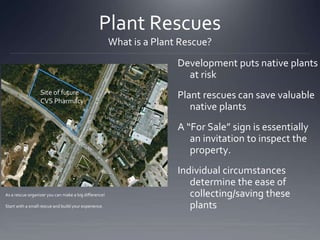
Site of future 
CVS Pharmacy 
As a rescue organizer you can make a big difference! 
Start with a small rescue and build your experience.
Urban/Large, Rural/Small 
Plant rescues vary from one situation to the next 
 The number of volunteers can vary from 
one or two, to scores of participants 
 Larger rescue efforts take much more 
planning to provide access, parking, 
tools, transportation, and care of 
rescued plants. 
 The agreement with the 
landowner/developer may be informal 
for small rescues, but larger rescues 
should use liability waivers, etc. to 
ensure protection for the rescuers as 
well as for the landowner/developer. 
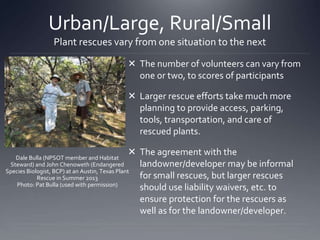
Dale Bulla (NPSOT member and Habitat 
Steward) and John Chenoweth (Endangered 
Species Biologist, BCP) at an Austin, Texas Plant 
Rescue in Summer 2013 
Photo: Pat Bulla (used with permission)
Uses For Rescued Plants 
Obvious benefits to wildlife 
 Food 
 Habitat 
 Places to 
raise young 
Photos: Ed Travis 
(used with permission) 
Capsicum annuum 
Chasmanthium latifolium 
Callicarpa americana
Uses For Rescued Plants 
 As restoration plants for parks or 
other areas damaged by non-native 
invasives. 
 As plant material for schools to use 
in their outdoor education classes. 
 For use landscaping rescuers’ 
homes, gifts, etc. 
 For use as propagation stock for 
native plant growers 
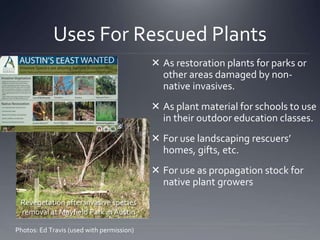
Revegetation after invasive species 
removal at Mayfield Park in Austin 
Photos: Ed Travis (used with permission)
Value of Rescued Plants 
 One worker can save 50-75 
small one to five gallon plants in 
one day, worth $500-$1000. 
 Uncommon or even rare 
species are sometimes rescued. 
 In one instance, the entire 
population of the Cat Mountain 
strain of the Bracted twistflower 
was saved during an Austin plant 
rescue. 
Jenny Norman, NWF Habitat Steward, 
collecting plants at an Austin, Texas Plant 
Rescue in Summer 2013 
Photo: Pat Bulla (used with permission)
Plant Rescue Partners 
 There are MANY potential partners for a plant rescue that you may contact 
to increase your impact 
 Park support organizations like the Austin Parks Foundation 
 Non-profits that support environmental causes like Keep Austin Beautiful 
 Local NPSOT chapters 
 Organizations such as the NWF Habitat Stewards, the Audubon Society, 
gardening clubs, homeowner’s organizations, the Sierra Club, Recreational Sports 
clubs, fraternities and sororities can all provide volunteers. 
 The developer may be interested in portraying their project in a more 
positive light, and may therefore be willing to provide logistic and even 
limited financial support for a visible public acknowledgement from the 
participating environmental groups. 
 Start small, build a set of reliable partners, and repeat the effort as often as 
sites can be identified and approval obtained.
Important Rescue Issues 
 Access and parking, especially for larger rescues 
 Safety, including water and food for longer/harder rescue 
efforts 
 Large rescue efforts need a lot of empty one and five gallon 
pots, lots of trailer space, and facilities to care for plants 
during rehabilitation. 
 If you make it fun and rewarding (take some plants home) 
for volunteers you’ll have more participants.
Plant Rescue Checklist 
(Not all items are relevant for small/informal/rural rescues.) 
 Identify legal owner of property 
 Owner involvement and approval 
 Establish overall bounds of rescue area 
 Clearly stake out and/or tape off entire boundary of 
rescue area 
 Identify off-limits areas 
 Determine access limitations, if any, and quantity and location 
for parking. 
 Method for on-site communication (cell phone, radio) 
 Announcement: Date and time (start and end), printable map 
with directions to site 
 Pre-registration (if required, do NOT provide location until 
individual is pre-registered) 
 Check-in forms, staff, table 
 Waiver of Liability (see attached example) 
 Detailed instructions sheet 
 Define scope of natives available (the opportunity) 
 Any restrictions on rescued plant disposition? 
 For personal use 
 For local city parks, etc. 
 For resale? 
 Equipment and materials (shovels, pails, water, etc.) 
 Safety issues, e.g. weather; possibility of cancellation 
 Volunteers identified 
 Check-in staff 
 Parking directors 
 Plant identification experts 
 Plant collection and removal area 
 Trucks and/or trailers for transportation 
 Publicity 
 NPSOT News, chapter websites, blogs, etc. 
 Local newspapers and other media 
 Partner Organization newsletters

Plant rescues

  • 1.
    Plant Rescues Oneperson can organize a rescue to save valuable native plants from destruction due to development Ed Travis, Austin NPSOT, July 19, 2014
  • 2.
    Plant Rescues Whatis a Plant Rescue? Development puts native plants at risk Plant rescues can save valuable native plants A “For Sale” sign is essentially an invitation to inspect the property. Individual circumstances determine the ease of collecting/saving these plants Site of future CVS Pharmacy As a rescue organizer you can make a big difference! Start with a small rescue and build your experience.
  • 3.
    Urban/Large, Rural/Small Plantrescues vary from one situation to the next  The number of volunteers can vary from one or two, to scores of participants  Larger rescue efforts take much more planning to provide access, parking, tools, transportation, and care of rescued plants.  The agreement with the landowner/developer may be informal for small rescues, but larger rescues should use liability waivers, etc. to ensure protection for the rescuers as well as for the landowner/developer. Dale Bulla (NPSOT member and Habitat Steward) and John Chenoweth (Endangered Species Biologist, BCP) at an Austin, Texas Plant Rescue in Summer 2013 Photo: Pat Bulla (used with permission)
  • 4.
    Uses For RescuedPlants Obvious benefits to wildlife  Food  Habitat  Places to raise young Photos: Ed Travis (used with permission) Capsicum annuum Chasmanthium latifolium Callicarpa americana
  • 5.
    Uses For RescuedPlants  As restoration plants for parks or other areas damaged by non-native invasives.  As plant material for schools to use in their outdoor education classes.  For use landscaping rescuers’ homes, gifts, etc.  For use as propagation stock for native plant growers Revegetation after invasive species removal at Mayfield Park in Austin Photos: Ed Travis (used with permission)
  • 6.
    Value of RescuedPlants  One worker can save 50-75 small one to five gallon plants in one day, worth $500-$1000.  Uncommon or even rare species are sometimes rescued.  In one instance, the entire population of the Cat Mountain strain of the Bracted twistflower was saved during an Austin plant rescue. Jenny Norman, NWF Habitat Steward, collecting plants at an Austin, Texas Plant Rescue in Summer 2013 Photo: Pat Bulla (used with permission)
  • 7.
    Plant Rescue Partners  There are MANY potential partners for a plant rescue that you may contact to increase your impact  Park support organizations like the Austin Parks Foundation  Non-profits that support environmental causes like Keep Austin Beautiful  Local NPSOT chapters  Organizations such as the NWF Habitat Stewards, the Audubon Society, gardening clubs, homeowner’s organizations, the Sierra Club, Recreational Sports clubs, fraternities and sororities can all provide volunteers.  The developer may be interested in portraying their project in a more positive light, and may therefore be willing to provide logistic and even limited financial support for a visible public acknowledgement from the participating environmental groups.  Start small, build a set of reliable partners, and repeat the effort as often as sites can be identified and approval obtained.
  • 8.
    Important Rescue Issues  Access and parking, especially for larger rescues  Safety, including water and food for longer/harder rescue efforts  Large rescue efforts need a lot of empty one and five gallon pots, lots of trailer space, and facilities to care for plants during rehabilitation.  If you make it fun and rewarding (take some plants home) for volunteers you’ll have more participants.
  • 9.
    Plant Rescue Checklist (Not all items are relevant for small/informal/rural rescues.)  Identify legal owner of property  Owner involvement and approval  Establish overall bounds of rescue area  Clearly stake out and/or tape off entire boundary of rescue area  Identify off-limits areas  Determine access limitations, if any, and quantity and location for parking.  Method for on-site communication (cell phone, radio)  Announcement: Date and time (start and end), printable map with directions to site  Pre-registration (if required, do NOT provide location until individual is pre-registered)  Check-in forms, staff, table  Waiver of Liability (see attached example)  Detailed instructions sheet  Define scope of natives available (the opportunity)  Any restrictions on rescued plant disposition?  For personal use  For local city parks, etc.  For resale?  Equipment and materials (shovels, pails, water, etc.)  Safety issues, e.g. weather; possibility of cancellation  Volunteers identified  Check-in staff  Parking directors  Plant identification experts  Plant collection and removal area  Trucks and/or trailers for transportation  Publicity  NPSOT News, chapter websites, blogs, etc.  Local newspapers and other media  Partner Organization newsletters