PITH-BALL
ELECTROSCOPE:
A MODIFIED
EXPERIMENT IN
COULOMB'S LAW TO
INVESTIGATING
#
Objective
s
• To understand the relationship between key variables such as
mass of the pith ball and the length of the string in
electrostatic interactions.
• To demonstrate the principles of Coulomb’s Law using the
pith-ball electroscope, analyzing charge interactions and force
distribution.
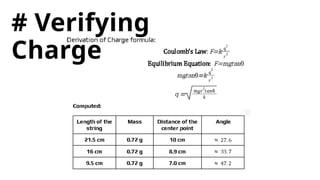
• To verify the measured distance to the center point and angle
difference through computation
#
Discussio
n
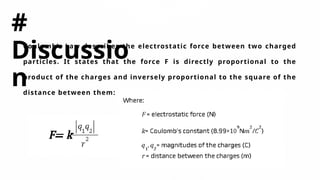
Coulomb’s Law describes the electrostatic force between two charged
particles. It states that the force F is directly proportional to the
product of the charges and inversely proportional to the square of the
distance between them:
#
Discussio
n
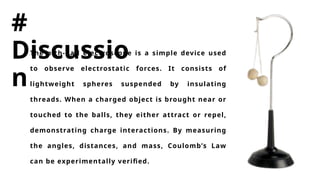
The pith-ball electroscope is a simple device used
to observe electrostatic forces. It consists of
lightweight spheres suspended by insulating
threads. When a charged object is brought near or
touched to the balls, they either attract or repel,
demonstrating charge interactions. By measuring
the angles, distances, and mass, Coulomb’s Law
can be experimentally verified.
#
Materials
• Wooden Frame
• 1.5 inches Styrofoam Ball
• Glass rod
• Silk cloth
• String
• Protractor
• Ruler
• Glue Gun
#
Procedures
1. Setup of the Pith-Ball Electroscope
• Attach the pith ball , two styrofoam balls, to two separate pieces
of insulating string of equal length.
• Suspend the balls attached of the center of the protractor to
hang freely and close to each other, ensuring they are initially
touching or nearly touching.
• Measure and record the mass each pith ball for later calculations.
#
Procedures
2. Charging and Observing the Pith Balls
• Charge the pith balls by rubbing a glass rod with silk cloth, then
transferring the charge to the left ball by touching them gently.
Assuming the ball received the charge, If one pith ball is neutral
and the other is charged, they will attract due to charge
induction.
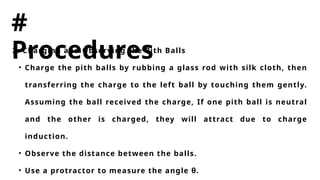
• Observe the distance between the balls.
• Use a protractor to measure the angle θ.
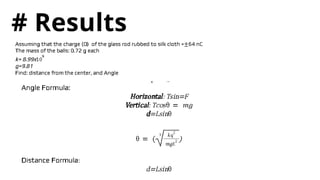
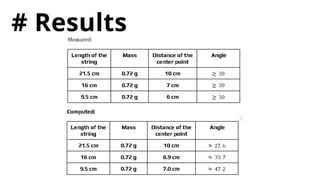
# Results
# Results
# Verifying
Charge
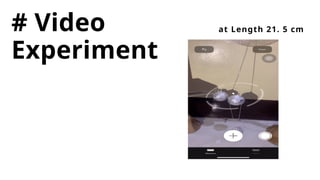
# Video
Experiment
at Length 21. 5 cm
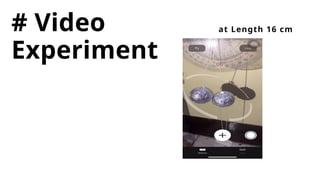
# Video
Experiment
at Length 16 cm
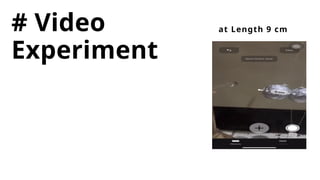
# Video
Experiment
at Length 9 cm
# Conclusion
• Influence of Distance on Electrostatic Force: As the separation between the charged
spheres increased, the force between them decreased significantly, aligning with
theoretical predictions.
• Effect of String Length on Displacement and Angle: Longer strings resulted in greater
horizontal displacement with smaller angles, while shorter strings led to reduced
horizontal displacement but significantly increased angles.
• Charge Distribution and Equilibrium Position: The experiment demonstrated that charge
distribution influenced the equilibrium position of the spheres, reinforcing that
electrostatic forces can be quantified


pith-ball electromagnetic experiment.pptx

  • 1.
  • 2.
    # Objective s • To understandthe relationship between key variables such as mass of the pith ball and the length of the string in electrostatic interactions. • To demonstrate the principles of Coulomb’s Law using the pith-ball electroscope, analyzing charge interactions and force distribution. • To verify the measured distance to the center point and angle difference through computation
  • 3.
    # Discussio n Coulomb’s Law describesthe electrostatic force between two charged particles. It states that the force F is directly proportional to the product of the charges and inversely proportional to the square of the distance between them:
  • 4.
    # Discussio n The pith-ball electroscopeis a simple device used to observe electrostatic forces. It consists of lightweight spheres suspended by insulating threads. When a charged object is brought near or touched to the balls, they either attract or repel, demonstrating charge interactions. By measuring the angles, distances, and mass, Coulomb’s Law can be experimentally verified.
  • 5.
    # Materials • Wooden Frame •1.5 inches Styrofoam Ball • Glass rod • Silk cloth • String • Protractor • Ruler • Glue Gun
  • 6.
    # Procedures 1. Setup ofthe Pith-Ball Electroscope • Attach the pith ball , two styrofoam balls, to two separate pieces of insulating string of equal length. • Suspend the balls attached of the center of the protractor to hang freely and close to each other, ensuring they are initially touching or nearly touching. • Measure and record the mass each pith ball for later calculations.
  • 7.
    # Procedures 2. Charging andObserving the Pith Balls • Charge the pith balls by rubbing a glass rod with silk cloth, then transferring the charge to the left ball by touching them gently. Assuming the ball received the charge, If one pith ball is neutral and the other is charged, they will attract due to charge induction. • Observe the distance between the balls. • Use a protractor to measure the angle θ.
  • 8.
  • 9.
  • 10.
  • 11.
  • 12.
  • 13.
  • 14.
    # Conclusion • Influenceof Distance on Electrostatic Force: As the separation between the charged spheres increased, the force between them decreased significantly, aligning with theoretical predictions. • Effect of String Length on Displacement and Angle: Longer strings resulted in greater horizontal displacement with smaller angles, while shorter strings led to reduced horizontal displacement but significantly increased angles. • Charge Distribution and Equilibrium Position: The experiment demonstrated that charge distribution influenced the equilibrium position of the spheres, reinforcing that electrostatic forces can be quantified