Tim Osebold 
Pimp My Unit: Grade 5 
Road to the Revolution 
PIMP #1 - Teaching 5th grade history, a timeline should be observable to every student at all time, 
because this section is so condensed, an addition time line would be added to expand the focus of 
time and add important details easier to the time line. Doing this, you can prompt the students to 
pull out their personal timeline sheets and do this together. 
PIMP #2 (If Possible) Connection to place outside of local community, (Field Trip): Educational 
Program: Three Cultures in Conflict at Fort Necessity - 
http://www.nps.gov/fone/forteachers/upload/FONE-4th-Grade-FandI-SiteB_NBl_pc2012.pdf 
“Three very different cultures came into conflict over trade and land, sparking the Battle at Fort 
Necessity which had important ramifications on our nation’s history. This half-day program helps 
students learn about the French, the British and the American Indians; and the circumstances that 
led to war. The program includes a workshop in the learning lab where students learn about the 
three cultures through hands-on activities, a guided tour of the reconstructed fort, a tour of the 
exhibits, viewing the 20- minute film, visiting the bookstore and access to picnic tables for lunch.” 
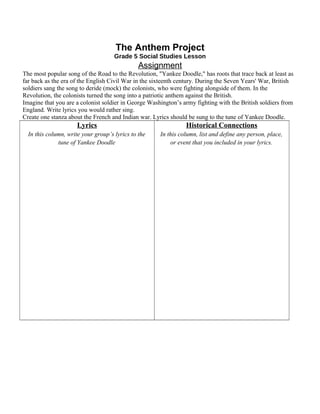
PIMP #3 – 22.5. Tell students that they will write a parody using a familiar tune: Yankee Doodle. 
Listen to the song: http://www.youtube.com/watch?v=IzRhFH5OyHo 
Distribute the lyrics to Yankee Doodle: 
http://lcweb2.loc.gov/diglib/ihas/loc.rbc.hc.00037b/enlarge.html?page=1&from=pageturner 
Sing the song with the students to remind them of the melody. Organize students into small groups 
and assign each group the responsibility to rewrite one stanza of Yankee Doodle. Possible topics 
for individual stanzas can include: Causes of the war, Colonies, George Washington’s mission that 
led to the first battle, the first battle, Fort Necessity, The French and Indian War (7 Years War). 
PIMP #4 – As you add important people to the chart, play a short video about that person, so 
students can get a better visual about that person. 
Washington: http://www.history.com/topics/us-presidents/george-washington/videos#george-washington 
Ben Franklin: http://www.earlyamerica.com/videos/ben-franklin-story/ 
PIMP #5 (If Possible) Connection to place outside of local community, (Field Trip): Colonial 
Michilimackinac /Fort Mackinac. Being that Pontiac’s Rebellion effect Michigan, what better way to 
enhance the excitement then to check out our states very own fort: 
http://www.mackinacparks.com/ 
If a fieldtrip is out of the question, students can explore and learn about the fort online at: 
According to http://www.mightymac.org/michilimackinac.htm, the French garrison departed the 
Mackinac Straits at the conclusion of the French and Indian War and British troops arrived 1761. 
The French civilian community remained and encouraged the Native Americans to drive out the 
English. During Pontiac's Uprising in 1763, Native Americans defeated the British garrison, using 
the subterfuge of a bagataway (lacrosse) game to take the British unexpectedly. Many of the 
British were killed with some taken prisoner.
PIMP #6 – Social/Political Action Activity: Divide the class to have a debate on the results of the 
Proclamation of 1763. Consider both the British Reason and the Colonists. Have at least 3 reasons 
why it is either fair or unfair for your side. 
PIMP #7- As you add important people to the chart, play a short video about that person, so 
students can get a better visual about that person. Watch Video on Chief Pontiac and rebellion. 
Note Mention of Fort Detroit! http://www.youtube.com/watch?v=KVx0Is3XKu0&spfreload=10 
PIMP #8 – Art Connection - For excitement and review, pick groups in the class to do a show. With 
a little guidance by the teacher, and using the Effects of the French and Indian War each group 
could represent a different group The British, French, Natives and the Colonists would each get 
their time to shine. Half of each group would perform what they thought would happen as a result 
of the war, the other would perform what actually happened. The students are actively involved 
with the ambitions of each group and then acting out the actual mood of each group after the result 
of the war. After each skit, students can add to their chart things they learned and haven’t 
previously added. 
PIMP #9 - As you add important people to the chart, play a short video about that person, so 
students can get a better visual about that person. http://www.teachertube.com:8808/video/james-otis- 
140214 
PIMP #10 Work in pairs. Write a script for a news report breaking the news about the Stamp Act 
passed by Parliament. Find quotes from colonists and add them to your report. Using an Ipad, 
record your report with your partner. Resources for your report can be found here: http://www.u-s-history. 
com/pages/h642.html and http://www.historywiz.com/stampact.htm 
PIMP #11 As you add important people to the chart, play a short video about that person, so 
students can get a better visual about that person. Watch video: 
http://www.history.com/topics/american-revolution/samuel-adams 
PIMP #12 As you add important people to the chart, play a short video about that person, so 
students can get a better visual about that person. Watch Video on Patrick Henry: 
http://www.biography.com/people/patrick-henry-9335512. 
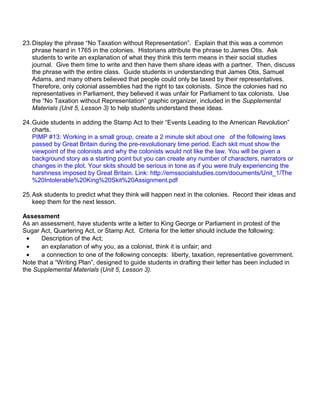
PIMP #13 : Working in a small group, create a 2 minute skit about one of the following laws 
passed by Great Britain during the pre-revolutionary time period. Each skit must show the 
viewpoint of the colonists and why the colonists would not like the law. You will be given a 
background story as a starting point but you can create any number of characters, narrators or 
changes in the plot. Your skits should be serious in tone as if you were truly experiencing the 
harshness imposed by Great Britain. Link: http://emssocialstudies.com/documents/Unit_1/The 
%20Intolerable%20King%20Skit%20Assignment.pdf 
Books 
Fritz, Jean. Why Don’t You Get a Horse, Sam Adams? New York: Putnam Juvenile Press, 1996. 
(optional) 
Maestro, Betsy, and Giulio Maestro - Liberty or death: the American Revolution, 1763- 1783 - 
New York - HarperCollins - 2005
Maestro, Betsy, and Giulio Maestro. Struugle for a Continent the French and Indian Wars. N.p.: 
Harper Collins, 2000. Print. 
Moore, Kay, and Daniel O'Leary. --if You Lived at the Time of the American Revolution. New York: 
Scholastic, 1997. Print. 
Schanzer, Rosalyn, George Vs. George: The American Revolution As Seen By Both 
Sides. Washington, DC: National Geographic, 2004. 
Woodruff, Elvira, George Washington's Socks. New York: Scholastic, 2010. 
NCSS Books 
Brown, Don. Henry and the Cannons: An Extraordinary True Story of the American Revolution. 
N.p.: Roaring Brook, n.d. Print. 
Delano, Marfe Ferguson., and Lori Epstein. Master George's People: George Washington, His 
Slaves, and His Revolutionary Transformation. N.p.: n.p., n.d. Print. 
Freedman, Russell. Becoming Ben Franklin: How a Candle-maker's Son Helped Light the Flame 
of Liberty. N.p.: n.p., n.d. Print. 
Kidd, Ronald, Karen Zacarías, La Puma Deborah Wicks, and Ard Hoyt.Chasing George 
Washington. New York: Simon & Schuster for Young Readers, 2009. Print. 
Images 
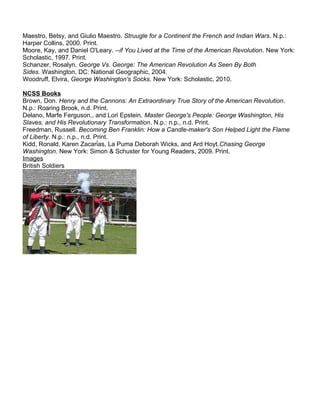
British Soldiers
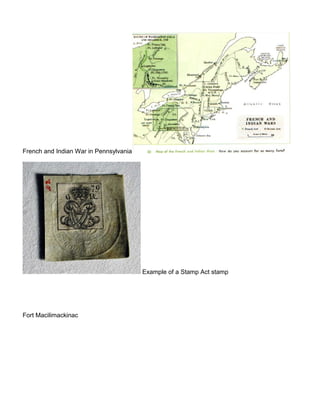
French and Indian War in Pennsylvania 
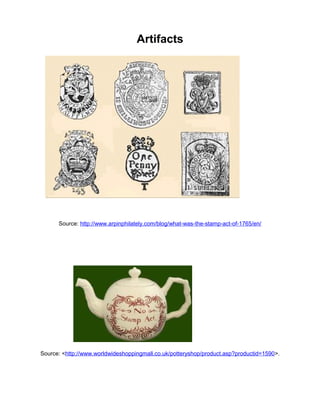
Example of a Stamp Act stamp 
Fort Macilimackinac
British Parliament: Quartering Act 
Marching into battle playing Yankee Doodle? 
French and Indian War
Battle at Fort Detroit
Reference Page 
(in order of use) 
"Atlas - Unit 5: Road to Revolution." Atlas - Unit 5: Road to Revolution. Rubicon International, 
2014. Web. 10 Nov. 2014. 
< http://oaklandk12-public.rubiconatlas.org/Atlas/Browse/UnitMap/View/Default? 
BackLink=291493&strkeys=social+studies&UnitID=13492&YearID=2015&CurriculumMapID=112& 
SourceSiteID=2599> 
Education Program for 4th, 5th & 6th Grade Classes. (n.d.). Retrieved November 7, 2014. 
< http://www.nps.gov/fone/forteachers/upload/FONE-4th-Grade-FandI-SiteB_NBl_pc2012.pdf> 
Digital History. (n.d.). Retrieved November 7, 2014. 
< http://www.digitalhistory.uh.edu/era.cfm?eraID=3&smtID=6> 
Yankee Doodle ( American Patriotic Song ). (n.d.). Retrieved November 7, 2014. 
< http://www.youtube.com/watch?v=IzRhFH5OyHo> 
Yankee Doodle. [song sheet]:Song Sheet Enlargement: Performing Arts Encyclopedia, Library of 
Congress. (n.d.). Retrieved November 7, 2014. 
<http://lcweb2.loc.gov/diglib/ihas/loc.rbc.hc.00037b/enlarge.html?page=1&from=pageturner> 
The Ben Franklin Story - Archiving Early America. (n.d.). Retrieved November 7, 2014. 
<http://www.earlyamerica.com/videos/ben-franklin-story/> 
Colonial Fort Michilimackinac - Mackinaw City, Michigan. (n.d.). Retrieved November 8, 2014. 
<http://www.mightymac.org/michilimackinac.htm> 
Pontiac's Rebellion.wmv. (n.d.). Retrieved November 8, 2014. 
< http://www.youtube.com/watch?v=KVx0Is3XKu0&spfreload=10> 
Stamp Act. (n.d.). Retrieved November 7, 2014. 
<http://www.u-s-history.com/pages/h642.html> 
The Stamp Act - HistoryWiz American Revolution. (n.d.). Retrieved November 7, 2014. 
< http://www.historywiz.com/stampact.htm> 
Samuel Adams. (n.d.). Retrieved November 8, 2014. 
<http://www.history.com/topics/american-revolution/samuel-adams> 
Patrick Henry. (2014). The Biography.com website. Retrieved Nov 08, 2014. 
<http://www.biography.com/people/patrick-henry-9335512> 
EMS Social Studies (n.d.). Retrieved November 8, 2014. 
http://emssocialstudies.com/documents/Unit_1/The%20Intolerable%20King%20Skit 
%20Assignment.pdf
Images 
Colonial Fort Michilimackinac - Mackinaw City, Michigan. (n.d.). Retrieved November 8, 2014. 
http://www.mightymac.org/michilimackinac04.jpg 
*The French and Indian War of the 1750s. 31 January 2012 
<http://www.mccordfamilyassn.com/FrIndnWar100.jpg> 
Examples of Stamp Act Stamps. The American Revolution Website. 31 January 
2012<http://blog.arpinphilately.com/wp-content/uploads/taxstamp.jpg> 
Colonial Fort Michilimackinac - Mackinaw City, Michigan. (n.d.). Retrieved November 8, 2014. 
http://www.mightymac.org/michilimackinac01.jpg 
"Quartering Act." Of 1774 ***. N.p., n.d. Web. 10 Nov. 2014. < http://1- 
ps.googleusercontent.com/h/www.landofthebrave.info/images/parliament- 
1700,27s.jpg.pagespeed.ce.ZAZe1niIFM.jpg> 
"The Revolutionary Period." The Rutherford Institute. The Rutherford Institute, n.d. Web. 10 Nov. 
2014. 
<https://www.rutherford.org/files_images/general/Spirit-of-76.jpg> 
Important People of the American Revolution. The American Revolution. 31 January 2012 
<http://www.theamericanrevolution.org/img/people/1_a.jpg> 
Important People of the American Revolution. The American Revolution. 31 January 2012 
http://www.theamericanrevolution.org/img/people/6_a.jpg 
http://www3.gettysburg.edu/~tshannon/hist106web/site5/bushy_run.jpg 
"Flintlock and Tomahawk: September 2013." Flintlock and Tomahawk: September 2013. N.p., n.d. 
Web. 10 Nov. 2014. <http://4.bp.blogspot.com/-W6W9_-C07Rk/UjoU-z-10bI/AAAAAAAARrU/- 
cnNI19wkyg/s1600/loes3.jpg> 
"Flintlock and Tomahawk: September 2013." Flintlock and Tomahawk: September 2013. N.p., n.d. 
Web. 10 Nov. 2014. <http://3.bp.blogspot.com/- 
ZufkPCIueD0/UjoVE_GbE9I/AAAAAAAARrc/ZEj8mrKxMLk/s1600/koes8.jpg> 
"Flintlock and Tomahawk: September 2013." Flintlock and Tomahawk: September 2013. N.p., n.d. 
Web. 10 Nov. 2014. http://3.bp.blogspot.com/- <http://4.bp.blogspot.com/- 
hk8QyyoilOk/UjoU29qNS6I/AAAAAAAARrE/4dfQr-FdTEw/s320/loes59.jpg 
*The French and Indian War of the 1750s. 31 January 2012 
<http://www.mccordfamilyassn.com/Ft.Detroit55.jpg>
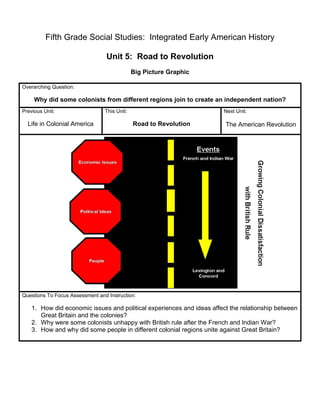
Fifth Grade Social Studies: Integrated Early American History 
Unit 5: Road to Revolution 
Big Picture Graphic 
Overarching Question: 
Why did some colonists from different regions join to create an independent nation? 
Previous Unit: 
Life in Colonial America 
This Unit: 
Road to Revolution 
Next Unit: 
The American Revolution 
Questions To Focus Assessment and Instruction: 
1. How did economic issues and political experiences and ideas affect the relationship between 
Great Britain and the colonies? 
2. Why were some colonists unhappy with British rule after the French and Indian War? 
3. How and why did some people in different colonial regions unite against Great Britain?
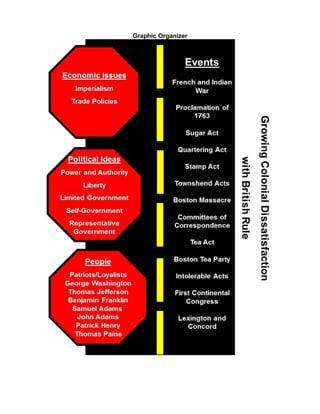
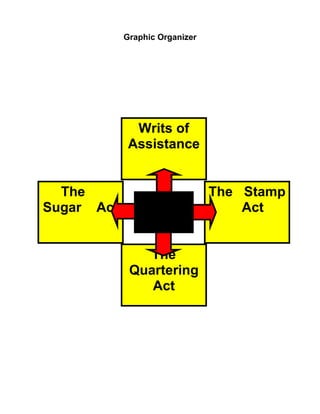
Graphic Organizer
Middle School Foundations (see Grade 8, F1.1) 
Describe the ideas, experiences, and interactions that influenced the colonists’ decision to declare 
independence by analyzing 
· colonial ideas about government (e.g., limited government, republicanism, protecting individual rights and 
promoting the common good, representative government, natural rights) 
· experiences with self-government (e.g., House of Burgesses and town meetings) 
· changing interactions with the royal government of Great Britain after the French and Indian War. 
Historical Overview 
Well into the 1750s, most American colonists considered themselves loyal British citizens, perfectly 
content to remain part of the British Empire. By 1775, however, when the “shots heard round the 
world” rang out in Lexington, enough Americans were committed to the cause of independence to 
push the movement forward. How so much changed in such a relatively short span of time is, at 
first glance, remarkable. What one must keep in mind, though, is that American colonists, despite 
all of their regional differences, had basically been governing themselves for generations. It was 
through the momentous French and Indian War that the American colonists started down the 
irrevocable road toward independence. As American colonists fought against stout French and 
indigenous foes in the hinterlands of British North America, the British hardly sent any troops to aid 
the Americans for roughly the first two years of the struggle. It was during this crucial time that the 
Americans not only staved off defeat, but also forged the stirrings of a common American identity. 
The blood shed on the battlefields confirmed what the American colonists had vaguely felt through 
many years of self-government and liberty: they were different from their British cousins, and that 
distinction would soon translate into a movement for independence. 
Feeling a separate and distinct American identity and actually going to war with the world’s 
strongest nation to achieve political independence are two very different things. Thus, it would be 
the American colonists’ reactions to postwar British policy that would ignite the true fire of 
revolution. After nearly a century of neglect, Britain started paying much more attention to its North 
American colonies. Stricter enforcement of the Navigation Acts, coupled with the infamous 
Proclamation of 1763, were two early signs of greater British involvement. The Sugar Act and, 
most harmful of all to colonial American sensibilities of liberty, the Stamp Act, further inflamed 
American public opinion. They had lived for generations in relative isolation from the British, all the 
while cultivating notions of self-government and quasi-political independence. They had even 
participated valiantly in a great war for control of North America. It is no wonder, then, that they felt 
they had earned and deserved certain basic rights of self-government afforded to all British 
citizens, and that they bristled under each successive British measure meant to exact greater 
control over their collective political destinies. 
A collection of extraordinary events, individuals, and political developments emerged to finally 
galvanize the still disparate American colonists and deliver them to Lexington and Concord by 
1775. Chafing under increased British supervision, American colonists were a restless bunch, 
waiting for someone or something to drive them together toward war. One such catalyst occurred 
on the wintry streets of Boston in March 1770. As a scuffle between British troops and Boston 
laborers escalated, shots were fired into a crowd, killing five people. American Patriot leaders, 
especially Paul Revere and Samuel Adams, immediately sensationalized the event and made 
martyrs out of its victims. The Boston Massacre, as it would become known, served as a powerful
motivating force for the Americans for the remainder of the 1770’s. In fact, Samuel Adams used 
this event to help him create a committee of correspondence in Boston as a kind of clearinghouse 
for American Patriots’ information and grievances against the British. Adams’s committee in turn 
spurred the creation of other similar committees throughout the colonies, thus serving as a key 
unifying force for the Patriots. Not even three years later Boston was again home to a signal event 
in the process of American colonial unification. In response to the Tea Act, mass boycotts 
involving thousands broke out across the colonies. The greatest moment, however, occurred on a 
cold December night in 1773 when roughly 150 men posing as Mohawks broke into ships 
belonging to the East India Company and dumped chests of the loathsome British tea into the 
harbor. When Lord North and the British crown responded with the most hated measures to date, 
the Coercive Acts (known in America as the Intolerable Acts), American Patriots grew ever closer 
and more unified. The First Continental Congress, convened in Philadelphia in 1774 partly in 
response to the Intolerable Acts, proved a great example of what many Americans had been 
increasingly feeling over the past decade: the time for independence had come. Thus, when the 
shots heard round the world rang out in Lexington on April 19, 1775, enough Americans at least 
felt ready for independence; beating seemingly insurmountable odds and actually slaying their 
Goliath on the battlefield, however, would be a different story entirely. 
Challenges for Students: 
Students might face a range of challenges as they engage in this unit. Many students at this level 
“see the past as fixed,” and they often conceptualize history as a series of discrete, disconnected 
events.1 This view of the past as isolated events may be a crucial factor in preventing students 
from developing a more organized and usable “big picture” of the past”.2 Other scholars have 
found that students who are learning history tend to favor more personal explanations of that past 
and see actors from the past as making deliberate decisions on their own. In doing so, students 
ignore the larger historical context or societal forces affecting events.3 
In addition, students often bring a range of preconceptions, sometimes developed from narratives 
and images in popular culture, to their interpretation of historical events without realizing it. These 
preconceptions can be misleading and even erroneous. For example, some research describes 
how young people brought their “Disney” narrative around Pocahantas to their study of 
Jamestown.4 Historical thinking then, in particular the consideration of diverse points of view as 
well as complex causal models of events, needs to be clearly modeled and taught to students, 
particularly at the upper levels of elementary school. 
Reviews of the literature on historical learning found that students’ struggles with developing 
cohesive historical explanations appeared to stem from: 1) a lack of necessary historical 
knowledge, 2) failure to consider the reliability of sources, 3) presentist ways of thinking, and 4) a 
1 Lee, P. (2004). Historical literacy: Theory and research. Paper presented at the History 
Education International Research Network Conference. Ambleside: UK. p. 4. 
2 Ibid. p. 6. 
3 Carretero, M., López-Manjón, A., & Jacott, L. (1997). Explaining historical events. 
International Journal of Educational Research 27(3): 245–254. 
4 Afflerbach, P. & VanSledright, B. (2001, May). Hath! Doth! What? Middle graders 
reading innovative history text. Journal of Adolescent and Adult Literacy, vol. 44, no. 8, pp. 696-707.
lack of consideration of multiple causes for historical events.5 The complexity of historical texts 
and the abstract concepts represented in these texts are challenging for students, so teachers 
need to model and make visible the interpretation of historical language and texts. 
One of the biggest misconceptions students have from studying this period of history is the notion 
that all colonists wanted to fight for independence from Britain. This period thus provides ample 
opportunity to explore competing perspectives of people about the same event. Another challenge 
for students (and teachers) is to understand the importance of the ideas behind the revolution. 
Oftentimes students study this period with a complete focus on cause-event relationships, which 
are important; however, the American Revolution’s uniqueness rests in the political ideas behind 
the revolution. 
It is important for teachers to be aware of some common misconceptions that people have about 
this period of history when teaching. The following are a list of commonly identified misconceptions 
and why historians believe these to be erroneous: 
· Colonists were upset about being taxed. The colonists had always paid taxes to Britain. 
The increase in frustration was in the lack of representation in determining the taxes; not the 
taxes themselves. 
· Taxes were the reason for independence. While taxes were a part of the cause of 
discontent among colonists, this common rallying cry “No taxation without representation” 
misconstrues its importance. In reality, the colonists were upset about the mercantilist 
policies that Britain used to control almost every aspect of the colonial economy. In fact, 
taxes were number 17 in the list of grievances in the Declaration of Independence. 
· The Boston Massacre caused the Revolutionary War. This event was not called the “Boston 
Massacre” until many years after it occurred in 1773. The first popular name popularized by 
Paul Revere was “The Bloody Massacre in King Street,” and some historians today call the 
event the King Street Riot. By the early 1800's it was also called the State Street Massacre. 
Textbooks tend to describe the shooting as the spark that ignited the Revolutionary War. In 
reality there were several other historic milestones although less dramatic, that moved 
Boston towards the revolution. Townshend Acts, Stamp Act, and Boston Tea Party were 
some of them. 
· Independence preceded the war. In fact, the war preceded independence by more than a 
year (April 1775 to July 1776). In that period, towns and community groups throughout the 
American colonies released their own local "declarations of independence" from Britain. The 
grievances most commonly cited in the documents related to the war. 
Unit Abstract: 
In this unit, students explore the causes of the American Revolution. Focusing on the period from 
the Seven Years’ War6 to the battles at Lexington and Concord (1756 to 1775), students trace the 
disputes between the British government and her colonies. They examine the British Parliament’s 
attempts to tighten control from the early Navigation Acts and the Proclamation of 1763 to the 
Sugar Act, Stamp Act, the Townsend Acts, the Tea Act, and the Intolerable Acts. Students explore 
5 Van Drie and van Boxtel (2008) van Drie, J. & van Boxtel, C. (2008). Historical reasoning: Towards a framework for 
analyzing students’ reasoning about the past. Educational Psychology Review. 20(2): 87-110. 
6 Historians generally refer to the French and Indian War as the Seven Years’ War.
how colonists responded to the increasing control by Britain and analyze conflicting accounts of a 
variety of events such as the Boston Massacre and the Boston Tea Party. In doing so, students 
analyze how colonial and British views on authority and the use of power without authority differed. 
They read biographies of significant colonial leaders and compare their contributions during the 
Revolutionary War era. Students also focus on the role of political ideas, such as liberty 
(unalienable rights), representative government, and consent of the governed (social compact) as 
they analyze colonial disputes with Great Britain. They assess how colonial experiences with self-government, 
including the Committees of Correspondence and the First Continental Congress 
united many colonists from different colonial regions. Students also explore loyalist and patriot 
perspectives as the colonies moved closer towards declaring independence. The unit culminates 
with students constructing a chronology of events. Students then analyze the causes and effects 
of these events and assess their significance in leading to armed conflict at Lexington and 
Concord. 
Focus Questions 
1. How did economic issues and political experiences and ideas affect the relationship 
between Great Britain and the colonies? 
2. Why were some colonists unhappy with British rule after the French and Indian War? 
3. How and why did some people in different colonial regions unite against Great Britain? 
Content Expectations 
5 – U3.1.1: Describe the role of the French and Indian War, how British policy toward the 
colonies in America changed from 1763 to 1775, and colonial dissatisfaction with the 
new policy. 
5 – U3.1.2: Describe the causes and effects of events such as the Stamp Act, Boston Tea Party, 
the Intolerable Acts, and the Boston Massacre. 
5 – U3.1.3: Using an event from the Revolutionary era (e.g., Boston Tea Party, quartering of 
soldiers, writs of assistance, closing of colonial legislatures), explain how British and 
colonial views on authority and the use of power without authority differed (views on 
representative government).345 
5 – U3.1.4: Describe the role of the First and Second Continental Congress in unifying the 
colonies (addressing the Intolerable Acts, declaring independence, drafting the 
Articles of Confederation). 
5 – U3.1.6: Identify the role that key individuals played in leading the colonists to revolution, 
including George Washington, Thomas Jefferson, Benjamin Franklin, Patrick Henry, 
Samuel Adams, John Adams, and Thomas Paine. 
5 – U3.1.8: Identify a problem confronting people in the colonies, identify alternative choices for 
addressing the problem with possible consequences, and describe the course of 
action taken.
Common Core State Standards 
5 – RL.2: Determine a theme of a story, drama, or poem from details in the text, including how 
characters in a story or drama respond to challenges or how the speaker in a poem 
reflects upon a topic; summarize the text. 7 
5 – RL.3: Compare and contrast two or more characters, settings, or events in a story or 
drama, drawing on specific details in the text (e.g., how characters interact). 
5 -RI.1: Quote accurately from a text when explaining what the text says explicitly and when 
drawing inferences from the text. 
5 – RI.3: Explain the relationships or interactions between two or more individuals, events, 
ideas, or concepts in a historical, scientific, or technical text based on specific 
information in the text.2 
5 – RI.4: Determine the meaning of general academic and domain-specific words and phrases 
in a text relevant to a grade 5 topic or subject area.2 
5 – RI.6: Analyze multiple accounts of the same event or topic, noting important similarities 
and difference in the point of view they represent.3 
5 - RI.7: Draw on information from multiple print or digital sources, demonstrating the ability to 
locate an answer to a question quickly or to solve a problem efficiently. 1 
5 – RI.9: Integrate information from several texts on the same topic in order to write or speak 
about the subject knowledgeably. 178 
5 – RF.3: Know and apply grade-level phonics and word analysis skills in decoding words. 
a. Use combined knowledge of all letter-sound correspondences, syllabication 
patterns, and morphology (e.g., roots and affixes) to read accurately unfamiliar 
multisyllabic words in context and out of context.7 
5 – RF.4: Read with sufficient accuracy and fluency to support comprehension 
c. Use context to confirm or self-correct word recognition and understanding, 
rereading as necessary. 7 
5 – W.1: Write opinion pieces on topics or texts, supporting a point of view with reasons and 
information. 
a. Introduce a topic or text clearly, state an opinion, and create an organizational 
structure in which ideas are logically grouped to support the writer’s purpose. 
b. Provide logically ordered reasons that are supported by facts and details. 
c. Link opinion and reasons using words and phrases and clauses (e.g., 
consequently, specifically). 
d. Provide a concluding statement or section related to the opinion presented. 3 
5 – W.4: Produce clear and coherent writing in which the development and organization are 
appropriate to task, purpose, and audience.8
5 – W.9: Draw evidence from literary or informational texts to support analysis, reflection, and 
research.8 
5 – SL.1: Engage effectively in a range of collaborative discussions (one-on-one, in groups, 
and teacher led) with diverse partners on grade 5 topics and texts, building on others’ 
ideas and expressing their own clearly.4 
Key Concepts 
authority / power 
cause and effect 
chronology 
conflict 
imperialism 
liberty 
limited government 
patriot/loyalist 
perspective 
representative government 
self-government 
taxation 
trade policies 
Duration 
6 weeks 
Lesson Sequence 
Lesson 1: The French and Indian War 
Lesson 2: British Control of North America 
Lesson 3: Sugar and Stamps - Governing without Consent 
Assessment 
Selected Response Items 
Constructed Response Items 
Extended Response Items 
Performance Assessments 
Resources 
Equipment/Manipulative 
Chart paper 
Document Camera or Projector 
Map of the United States
Markers or crayons 
Tissue boxes, one per student 
Student Resource 
*Abigail Adams. Early American Primary Sources Kit. Teacher Created Materials. CA: Huntington 
Beach, 2005. 
American Revolution. Kid Info website. 31 January 2012 
<http://www.kidinfo.com/American_History/American_Revolution.html>. 
*Archiving Early America. 31 January 2012 <http://www.earlyamerica.com/>. 
Bower, Burt, et al. America’s Past, Social Studies Alive Program. Palo Alto, CA: Teacher’s 
Curriculum Institute, 2010. pp. 133-59, or a similar fifth grade social studies textbook. 
Fort Necessity. National Park Service. 31 January 2012 <http://www.nps.gov/fone/index.htm> 
*Berson, Michael J. Horizons: United States History: Beginnings. Orlando: Harcourt School 
Publishers, 2005 (or similar 5th grade Early American History textbook). 
Fradin, Dennis Brindell. Let It Begin Here! Lexington and Concord: First Battles of the American 
Revolution. New York: Walker Books for Young Readers, 2005. 
*The French and Indian War of the 1750s. 31 January 2012 
<http://www.mccordfamilyassn.com/french.htm>. 
Fritz, Jean. Why Don’t You Get a Horse, Sam Adams? New York: Putnam Juvenile Press, 1996. 
(optional) 
*George Washington’s Journal. 31 January 2012 
<http://www.earlyamerica.com/earlyamerica/milestones/journal/journaltext.html>. 
History Makers of the American Revolution. History Central. 31 January 2012 
<http://www.historycentral.com/bio/RevoltBIOS/INDEX.html>. 
Important People of the American Revolution. The American Revolution. 31 January 2012 
<http://www.theamericanrevolution.org/ipeople.asp>. 
Intolerable Acts and The First Continental Congress. The American Revolution. University of San 
Fransisco. 1999. 31 January 2012 
<http://www.usfca.edu/fac_staff/conwell/revolution/congress.htm>. 
People of the Revolution. ThinkQuest USA. 2003. 26 December 2011 
<http://library.thinkquest.org/TQ0312848/>. 
 Although not specifically cited in the lessons for this unit, this resource has been included to provide meaningful 
options for teachers.
Phillis Wheatley. Early American Primary Sources Kit. Teacher Created Materials. CA: Huntington 
Beach, 2005. (optional) 
*Quigley, Charles N. and Ken Rodriguez. We the People. Calabasas, CA: Center for Civic 
Education. 2003. 21-24. 
Turner, Ann. Katie’s Trunk. New York: Aladdin Paperbacks, 1997. (optional) 
Teacher Resource 
After the Treaty of Paris Map. National Park Services. 31 January 2012 
<http://www.cr.nps.gov/history/online_books/colonials-patriots/introf.htm>. 
*Authority: Foundations of Democracy. Calabasas, CA: Center for Civic Education, 1997. 5-11. 
Causes of the American Revolution. Discovery School.com. 31 January 2012 
<http://school.discovery.com/lessonplans/programs/revwar1/>. 
Colonial Government and the Crown. Eagleton Institute of Politics. Rutgers, the State University of 
New Jersey. 31 January 2012 <http://www.revolutionary-war-and-beyond. 
com/massachusetts-circular-letter-february-11-1768.html>. 
Egbo, Carol. Supplemental Materials (Unit 5, Lessons 1-8). Teacher-made material. Michigan 
Citizenship Collaborative, 2011. 
Examples of Stamp Act Stamps. The American Revolution Website. 31 January 2012 
<http://www.arpinphilately.com/blog/what-was-the-stamp-act-of-1765/en/>. 
Eyewitness Accounts of the Boston Massacre. Historywiz.com. 31 January 2012 
<http://www.historywiz.com/primarysources/eyewit-boston.htm>. 
The First Continental Congress. Architect of the Capitol. 31 January 2012 
<http://www.aoc.gov/cc/art/cox_corr/g_exp/first_continental.cfm?closeup=1>. 
The French and Indian War of the 1750s. McCord Family Association. 31 January 2012 
<http://www.mccordfamilyassn.com/french.htm>. 
George Washington’s Journal. Archiving Early America. 31 January 2012 
<http://www.earlyamerica.com/earlyamerica/milestones/journal/journaltext.html>. 
Glorious News. The American Revolution, 1763-1783. The Learning Page. Library of Congress. 31 
January 2012 
<http://www.loc.gov/teachers/classroommaterials/presentationsandactivities/presentations/ti 
meline/amrev/britref/news.html>. 
Illustrations of the Boston Massacre. 31 January 2012 <http://www.archives.gov/research/arc/>. 
 Although not specifically cited in the lessons for this unit, this resource has been included to provide meaningful 
options for teachers.
Illustration of Phillis Wheatley Book. Africans in America. PBS/WGBH. 31 January 2012 
<http://www.pbs.org/wgbh/aia/part2/2h7b.html>. 
Join or Die Cartoon. Archiving Early America. 31 January 2012 
<http://www.earlyamerica.com/earlyamerica/firsts/cartoon/snake.html>. 
Map of Boston Area. American Experience. PBS/WGBH. 31 January 2012 
<http://www.pbs.org/wgbh/amex/patriotsday/maps/index.html#info1>. 
Moore, Frank. American eloquence: a collection of speeches and addresses: by the most eminent 
orators of America, Volume 1. D. Appleton and Co., 1857. Page 4. 31 January 2012 
http://books.google.com/books?id=l9gYWiLfZkgC&printsec=frontcover&dq=bibliogroup: 
%22American+Eloquence:+a+Collection+of+Speeches+and+Addresses: 
+By+the+Most+Eminent+Orators+of+America%22&hl=en&sa=X&ei=I-cUT-LxGcnF0AH9hsmLAw& 
ved=0CDIQ6AEwAA#v=onepage&q=bibliogroup%3A%22American 
%20Eloquence%3A%20a%20Collection%20of%20Speeches%20and%20Addresses%3A 
%20By%20the%20Most%20Eminent%20Orators%20of%20America%22&f=false> 
No Stamp Act Teapot. 31 January 2012 
<http://www.worldwideshoppingmall.co.uk/potteryshop/product.asp?productid=1590>. 
Patrick Henry Speech. Colonial Williamsburg. 31 January 2012 
<http://www.history.org/almanack/people/bios/pathenryspeech_short.html>. 
*Paul Revere’s Engraving. Archiving America. 31 January 2012 
<http://www.earlyamerica.com/review/winter96/enlargement.html>. 
Winters, Jay. Colonial Voices: Hear Them Speak. New York: Dutton Juvenile, 2008. 
Resources for Further Professional Knowledge 
American History Websites. Discovery Education. 31 January 2012 
<http://school.discoveryeducation.com/schrockguide/history/hista.html>. 
Digital History. 31 January 2012 <http://www.digitalhistory.uh.edu/>. 
Foner, Eric. The Story of American Freedom. New York: WW Norton & Co., Inc., 1998. 
The Gilder Lehrman Institute of American History. 31 January 2012 
<http://www.gilderlehrman.org/>. 
History Cooperative. 31 January 2012 <http://www.historycooperative.org/>. 
The History Place. 31 January 2012 <http://www.historyplace.com/>. 
A Hypertext on American History. 31 January 2012 < http://odur.let.rug.nl/~usa/usa.htm>. 
 Although not specifically cited in the lessons for this unit, this resource has been included to provide meaningful 
options for teachers.
Kruman, Marc W. Between Authority and Liberty: State Constitution Making in Revolutionary 
America. Chapel Hill: University of North Carolina Press, 1997. 
Making of America. 31 January 2012 <http://quod.lib.umich.edu/m/moagrp/>. 
National Council for History Education. 31 January 2012 <http://www.nche.net/>. 
National History Education Clearinghouse. 31 January 2012 <http://teachinghistory.org/>. 
National History Standards: Era I. 31 January 2012 <http://nchs.ucla.edu/standards/era1-5- 
12.html>. 
Lesson 1: The French and Indian War
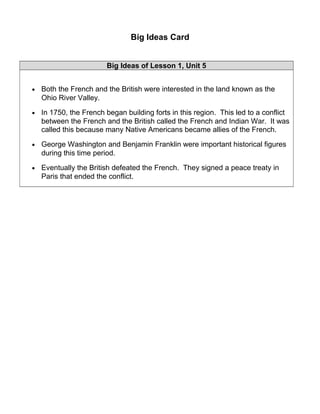
Big Ideas of the Lesson 
· Both the French and the British were interested in the land known as the 
Ohio River Valley. 
· In 1750, the French began building forts in this region. This led to a conflict 
between the French and the British called the French and Indian War. It was called this 
because many Native Americans became allies of the French. 
· George Washington and Benjamin Franklin were important historical 
figures during this time period. 
· Eventually the British defeated the French. They signed a peace treaty in 
Paris that ended the conflict. 
Lesson Abstract: 
In this lesson, students explore the causes and major events of the French and Indian War. They 
begin by analyzing a primary source and comparing two historical maps. Next, they analyze a 
section of George Washington’s 1753 journal and chronological information about the beginnings 
of the conflict. Early attempts at unifying the colonies are explored through a discussion of 
Benjamin Franklin’s Albany Plan of Union. Finally, students explore the expansion and end of the 
conflict and predict effects of the war. 
Content Expectations 
5 – U3.1.1: Describe the role of the French and Indian War, how British policy toward the 
colonies in America changed from 1763 to 1775, and colonial dissatisfaction with the 
new policy. 
5 – U3.1.6: Identify the role that key individuals played in leading the colonists to revolution, 
including George Washington, Thomas Jefferson, Benjamin Franklin, Patrick Henry, 
Samuel Adams, John Adams, and Thomas Paine. 
5 – U3.1.8: Identify a problem confronting people in the colonies, identify alternative choices for 
addressing the problem with possible consequences, and describe the course of 
action taken. 
Common Core State Standards 
5 - RI.7: Draw on information from multiple print or digital sources, demonstrating the ability to 
locate an answer to a question quickly or to solve a problem efficiently 
5 – RI.9: Integrate information from several texts on the same topic in order to write or speak 
about the subject knowledgeably. 
Key Concepts 
cause and effect 
conflict 
Instructional Resources
Equipment/Manipulative 
Chart paper 
Map of the United States 
Overhead projector or document camera/projector 
Student Resource 
Bower, Burt, et al. America’s Past, Social Studies Alive Program. Palo Alto, CA: Teacher’s 
Curriculum Institute, 2010. pp. 133-34, or a similar fifth grade social studies textbook. 
Fort Necessity. National Park Service. 31 January 2012 <http://www.nps.gov/fone/index.htm> 
Teacher Resource 
Egbo, Carol. Supplemental Materials (Unit 5, Lesson 1). Teacher-made material. Michigan 
Citizenship Collaborative, 2012. 
The French and Indian War of the 1750s. McCord Family Association. 31 January 2012 
<http://www.mccordfamilyassn.com/french.htm>. 
George Washington’s Journal. Archiving Early America. 31 January 2012 
<http://www.earlyamerica.com/earlyamerica/milestones/journal/journaltext.html>. 
Join or Die Cartoon. Archiving Early America. 31 January 2012 
<http://www.earlyamerica.com/earlyamerica/firsts/cartoon/snake.html>. 
Lesson Sequence 
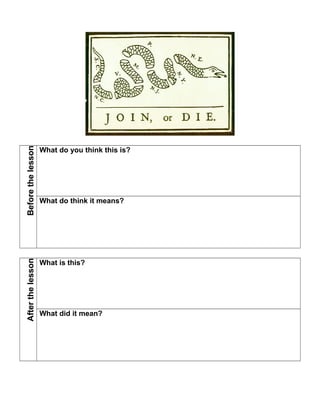
1. To engage students in this lesson, give each student a copy of the “Primary Source #1 
Analysis” located in the Supplemental Materials (Unit 5, Lesson 1). Have students examine the 
primary source and then answer the two questions in the section marked “Before the Lesson.” 
When students have completed the activity, briefly discuss their answers to the questions and 
then collect the sheets, which will be used again at the end of the lesson. 
2. Ask students to think about what they have already learned about the Thirteen Colonies in the 
previous unit. Then, have them write an entry in their social studies journal that describes what 
the Thirteen Colonies were like in 1750. Encourage them to include ideas that relate to 
government and the economy in the colonies. Give students time to write. (This technique is 
also called “stop and jot” or a “quick write” wherein students stop to think about something and 
write their thoughts.) 
3. Have students share their journal entries with a partner and compare and contrast their 
descriptions. Next, create a class list of descriptive statements about the Thirteen Colonies by 
having students share ideas from their journals. Possible statements include: 
· The 13 Colonies formed three distinct regions. 
· Each colony had its own government. This included an appointed governor, an 
appointed council, and an elected assembly. 
· Different economic activities had developed in the three regions. These included 
things like ship-building in New England, growing of grain in the Middle Colonies, and 
the growing of rice and tobacco on large plantations in the Southern Colonies.
· The colonies exported raw materials to Britain and imported manufactured goods 
from Britain. 
· Except for the Navigation Acts, Britain had not interfered much in the colonies. 
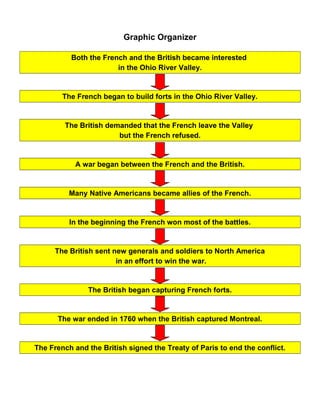
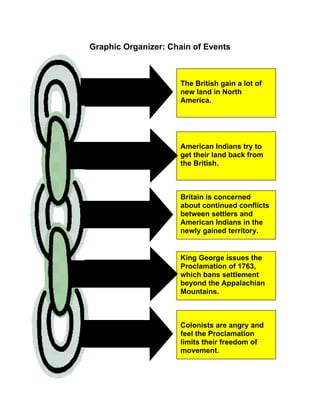
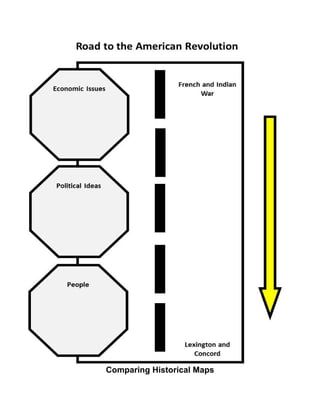
4. Display the “Road to the American Revolution” graphic located in the Supplemental Materials 
(Unit 5, Lesson 1) to students and provide students with a copy of the graphic. Explain that at 
the beginning of this period, Britain and her colonies were on the same side in a war against 
the French and Indians (French and Indian War). However, soon the colonies would start a 
war against Britain. Explain that the words “Battles of Lexington and Concord” are the first 
battles in this conflict. Explain to students that between 1750 and 1775, a chain of events took 
place that led to the colonies rebelling against Britain and fighting a war for independence that 
led to the creation of a new country the United States of America. Explain these events as well 
as the important political ideas connected to them will be explored in this unit. Also explain that 
the “stop signs” on the graphic represent different forces that stopped cooperation between 
Britain and her colonies. At this point, just generally describe each stop sign in simple terms: 
economic issues have to do with the control of resources; political issues have to do with 
power; and that certain people played important roles in the colonies moving toward 
independence. Teacher Note: Although direct reference to the unit graphic “Road to the 
Revolution” is not made in the lessons, it is recommended that teachers use the graphic 
throughout the lessons of the unit to remind students about what the events they studied that 
led to the conflict between Great Britain and her colonies. This is important so that students see 
how what they are learning in a particular lesson connects to the big picture of the unit. 
Students can add information to the “Road to the American Revolution” graphic from Lesson 1 
throughout the subsequent lessons so that they will build the unit graphic organizer as they 
progress through the lessons of the unit. 
5. P IMP #1 - Teaching 5 th grade history, a timeline should be observable to every student at all 
time, because this section is so condensed, an addition time line would be added to expand 
the focus of time and add important details easier to the time line. Doing this, you can prompt 
the students to pull out their personal timeline sheets and do this together. 
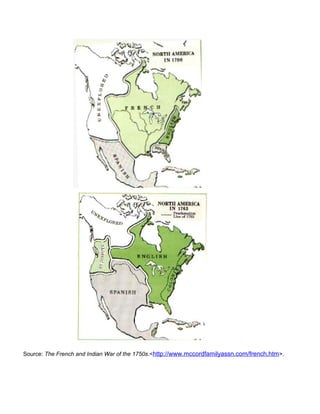
6. Display the maps on the “Comparing Historical Maps”, located in the Supplemental Materials 
(Unit 5, Lesson 1). If possible, make copies for students. Have students examine the maps 
and discuss with a partner what the maps tell them. Ask students to share their insights with 
the entire class. Prompt students by asking them to explain their answers using the following 
kinds of questions: How do you know? What evidence leads you to think so? Guide students 
to understand that historians, like detectives, look for evidence. Explain that often, some 
evidence leads to more questions. Model how a historian might look at the two maps by 
identifying the dates on both first. Ask students the following question: “According to these two 
maps, what changes took place between 1700 and 1763 in North America?” Discuss student 
ideas. Possible responses include: 
· France lost its territory in North America. 
· The English took over some of the French territory. 
· English territory in North America greatly expanded. 
· Spain lost Florida but gained other territory. 
7. Ask students to think of more questions that come to mind as they look at the two maps. Have 
students work in small groups of three or four students each to identify some questions that
they have based on their exploration of the maps. Reconvene the class and list students’ 
questions on the board or overhead transparency. 
8. Ask students how they think such dramatic changes came about. Discuss student responses. 
Guide students to the idea that France, Britain, and Spain were involved in a conflict that led to 
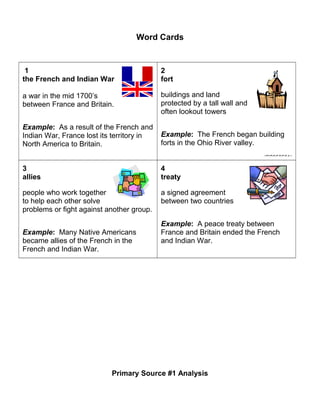
major changes in North America. Using Word Card #1, explain that this war was known as the 
French and Indian War in North America, but was part of a bigger conflict known as the Seven 
Years War in Europe. 
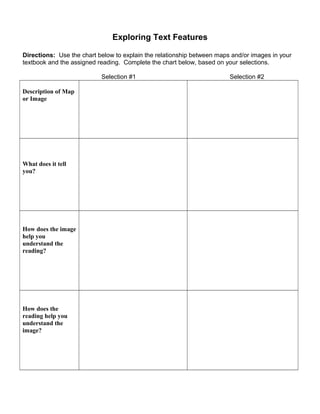
9. Have students analyze the text features of the section from their textbook on the French and 
Indian War. If you are using the text listed in the student resources this would include pages 
133-134. Have students work with a partner to make a list describing the text features they 
find. Note that common text features relating to the French and Indian war include: 
· A photograph of a re-creation of a fort called Fort Necessity 
· A map of North America in 1754 
· An illustration or sidebar relating to George Washington 
· An illustration of Ben Franklin 
· A painting of a general and a battle 
· A map of forts and battles 
10.Ask students to make predictions about the French and Indian War based on the text features 
they have analyzed. Possible predictions include: 
· Benjamin Franklin and George Washington have something to do with the war. 
· Battles took place in the Great Lakes region and near the Ohio River. 
· Forts played an important role in the war. 
· Native Americans were involved in the war also. 
Assign students to read the section in their text relating to the French and Indian War for 
homework. To focus students reading, have them explain how two or three text features 
identified in Step 8 assist in understanding the text. Distribute copies of “Exploring Text 
Features” located in the Supplemental Materials (Unit 5, Lesson 1) to guide students’ reading 
and analysis. Have students review their work with a partner and then discuss as a whole 
class. 
11.Using a physical map of the United States, point out the Ohio River Valley. Explain that 
conflicts over this area of land led to the French and Indian War. Share the following 
information about this region: 
· The Ohio Valley is a region about 1000 miles wide along the Ohio River from the 
Appalachian Mountains to the Mississippi River. 
· Native Americans had lived in this region for a very long time. In the 1750s, between 
3000 and 4000 Native Americans were living in the valley. 
· Both the French and the British claimed this region. 
· The French claimed the region because it was an important link between French land 
in Canada and Louisiana, another French territory. 
· The British claimed the region because it offered an area for growth and trade.
12.Using Word Card #2, explain that around 1750 the French began to make moves to strengthen 
their claim to the Ohio River Valley. They sent soldiers into the region to drive out British 
traders and also began to build a line of forts in the eastern end of the valley. Ask students 
how they think the British reacted to these actions. Discuss student responses and guide 
students to the idea that the British considered these actions “acts of war.” 
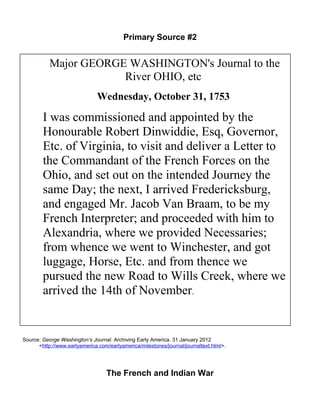
13.Display “Primary Source #2”, located in the Supplemental Materials (Unit 5, Lesson 1). Read 
the text out loud and ask students what they can infer from this primary source. Possible 
answers include: 
· George Washington kept a journal in the 1750’s. 
· In 1753, he was sent to the Ohio River valley region by the Governor of Virginia to 
deliver a letter to the French. 
14.Ask students what they think the letter carried by George Washington to the French was about. 
Discuss student responses and guide them to the idea that the letter demanded that the French 
leave the Ohio River Valley. Explain that the French responded that they intended to stay in 
the region. Ask students to predict what they think happened next. 
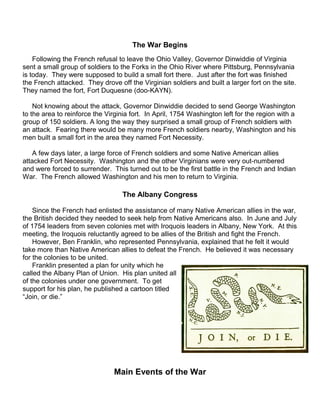
15.Give each student a copy of the informational text article, “The French and Indian War” located 
in the Supplemental Materials (Unit 5, Lesson 1). Ask students to read the first section entitled 
“The War Begins.” Use the following questions to discuss this section: 
· Did the French have a right to build forts in the Ohio River Valley? Why or why not? 
· How do you think Native Americans viewed the building of French forts? 
· Did the British have a right to protest the building of French forts? Why or why not? 
16.Ask students why they think the war was called the French and Indian War not the French and 
British War. Discuss student responses. Then, using Word Card #3, explain that many Native 
Americans sided with the French during the war and that is where the name came from. 
Explain that two important Native American groups helping the French were the Algonquin and 
the Huron. 
17.Ask students why they think most Native Americans chose to side with the French. Discuss 
student responses and guide students to the idea that Native Americans felt the French were 
less a threat than the British. Guide students to recall what they learned about the relationship 
between the Native Americans and French that they learned in the previous units and lessons. 
Remind students that the French were mainly traders. Most French people respected Native 
American ways and some even married Native American women. The British, however, were 
mainly farmers who took Native American hunting grounds and were less respectful of Native 
Americans. 
18.Ask students to read the section entitled “The Albany Congress” in the informational text 
selection they began in Step 14. Then, explain that the British government did try to get Native 
American allies. British leaders in London encouraged colonial leaders to meet with the 
Iroquois who had been allies of the British in the past. The groups met in Albany, New York in 
June and July of 1754. This became known as the Albany Congress.
19.Point out the Ben Franklin cartoon at the bottom of the informational text selection. Note that 
this is the primary source students were asked to analyze in Step 1 of this lesson. Explain that 
Ben Franklin got the idea for the cartoon from an old folk tale about snakes that said a snake 
cut into pieces would come back to life if it were put together before sunset. Franklin felt the 
colonies had to come together in order to survive. Explain that the colonies were not ready to 
come together in 1754 so Franklin’s plan was never put into action. 
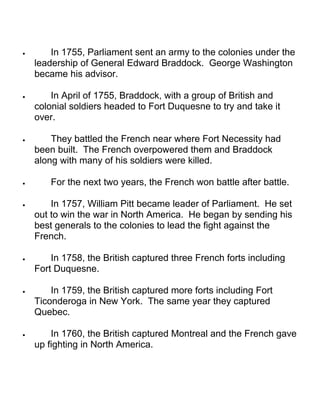
20.Display “Main Events of the War”, located in the Supplemental Materials (Unit 5, Lesson 1). 
Use the information to conclude a discussion about the French and Indian War. Then, share 
the following information with students: 
· Although the fighting stopped around 1760 in North America, fighting continued in 
Europe. 
· In 1762 the Spanish joined with the French hoping to defeat their old enemy the 
British. 
· The powerful British navy defeated the Spanish forces, however. 
· To compensate for Spanish losses, the French gave Spain most of Louisiana and 
part of what is now Florida. 
· In 1763, the French and British met in Paris to try and come up with a peace treaty. 
(Use Word Card #4 for this section.) 
21.Ask students to predict what the peace treaty signed in Paris said. Explain that they will learn 
about the actual details in the next lesson. 
22.PIMP #2 Connection to place outside of local community, (Field Trip): Educational Program: 
Three Cultures in Conflict at Fort Necessity - 
http://www.nps.gov/fone/forteachers/upload/FONE-4th-Grade-FandI-SiteB_NBl_pc2012.pdf 
23.For enrichment activities to supplement the lesson consider the following: 
· Have students visit the site of Fort Necessity at the following website: 
www.nps.gov/fone/home.htm>. 
· Have students read more sections of George Washington’s journal at the following 
website: 
http://www.earlyamerica.com/earlyamerica/milestones/journal/journaltext.html 
· Have students explore library books, websites, etc. to find more information about the 
early life of George Washington. 
PIMP #3 – 22.5. Tell students that they will write a parody using a familiar tune: Yankee Doodle. 
Listen to the song: http://www.youtube.com/watch?v=IzRhFH5OyHo 
Distribute the lyrics to Yankee Doodle: 
http://lcweb2.loc.gov/diglib/ihas/loc.rbc.hc.00037b/enlarge.html?page=1&from=pageturner 
Sing the song with the students to remind them of the melody. Organize students into small groups 
and assign each group the responsibility to rewrite one stanza of Yankee Doodle. Possible topics 
for individual stanzas can include: Causes of the war, Colonies, George Washington’s mission that 
led to the first battle, the first battle, Fort Necessity, The French and Indian War (7 Years War).
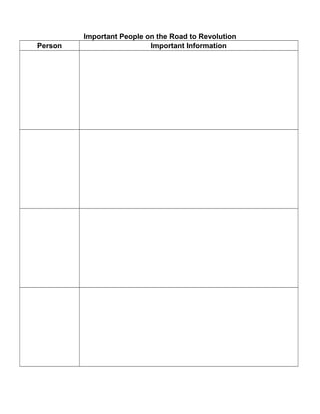
24.Give each person a copy of “Important People on the Road to Revolution”, located in the 
Supplemental Materials (Unit 5, Lesson 1). Explain that students will be adding people to the 
chart in each lesson of this unit. When they complete four people, they will begin a new chart. 
Have them add George Washington and Benjamin Franklin to the chart and write a brief 
explanation of what they learned about each person in this lesson. Explain that they will add 
further information about each of these two people in subsequent lessons. Possible entries 
would be: 
· George Washington built Fort Necessity and was involved in the first battle of the 
French and Indian War. 
· Ben Franklin came up with a plan to unite the colonies called the Albany Plan of 
Union. 
25. PIMP #4 – As you add important people to the chart, play a short video about that person, so 
students can get a better visual about that person. 
Washington: http://www.history.com/topics/us-presidents/george-washington/videos#george-washington 
Ben Franklin: http://www.earlyamerica.com/videos/ben-franklin-story/ 
26.Pass out “Primary Source #1 Analysis Sheet”, used in Step 1 of the lesson and have students 
complete the bottom section: “After the lesson.” 
27. 
Assessment 
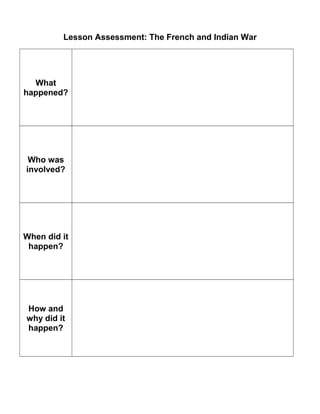
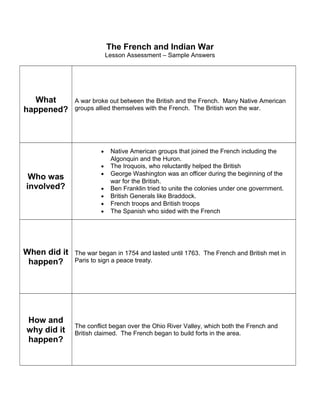
An assessment has been included in the Supplemental Materials (Unit 5, Lesson 1) in which 
students complete a chart containing questions about the French and Indian War. A completed 
chart of possible answers has also been included as a guide in evaluating student charts.
Lesson 2: British Control of North America 
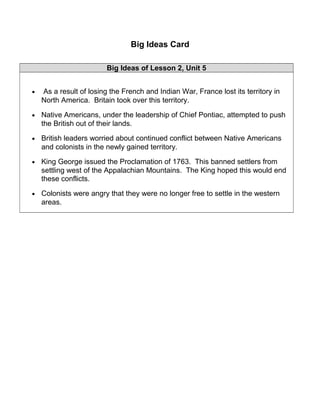
Big Ideas of the Lesson 
· As a result of losing the French and Indian War, France lost its territory in 
North America. Britain took over this territory. 
· Native Americans, under the leadership of Chief Pontiac, attempted to push 
the British out of their lands. 
· British leaders worried about continued conflict between Native Americans 
and colonists in the newly gained territory. 
· King George issued the Proclamation of 1763. This banned settlers from 
settling west of the Appalachian Mountains. The King hoped this would end these conflicts. 
· Colonists were angry that they were no longer free to settle in the western 
areas. 
Lesson Abstract: 
In this lesson, students explore examples of authority and the use of power without authority by 
examining several interactions between the British government, colonists, and Native Americans. 
They begin by reviewing the French and Indian War and explore the Treaty of Paris, predicting 
possible effects of the treaty. Next, they examine the effects of the French and Indian War, and 
causes and effects of Pontiac’s Rebellion. Finally, they analyze the Proclamation of 1763 and 
colonial reactions to the proclamation in terms of power and authority. They also begin gathering 
notes for a timeline to be constructed at the end of the unit. 
Content Expectations 
5 – U3.1.1: Describe the role of the French and Indian War, how British policy toward the 
colonies in America changed from 1763 to 1775, and colonial dissatisfaction with the 
new policy. 
5 – U3.1.3: Using an event from the Revolutionary era (e.g., Boston Tea Party, quartering of 
soldiers, writs of assistance, closing of colonial legislatures), explain how British and 
colonial views on authority and the use of power without authority differed (views on 
representative government). 
5 – U3.1.8: Identify a problem confronting people in the colonies, identify alternative choices for 
addressing the problem with possible consequences, and describe the course of 
action taken. 
Common Core State Standards 
5 – RI.3: Explain the relationships or interactions between two or more individuals, events, 
ideas, or concepts in a historical, scientific, or technical text based on specific 
information in the text. 
5 – RI.4: Determine the meaning of general academic and domain-specific words and phrases 
in a text relevant to a grade 5 topic or subject area.
Key Concepts 
authority/power 
conflict 
imperialism 
Instructional Resources 
Equipment/Manipulative 
Chart paper 
Map of the United States 
Overhead projector or document camera/projector 
Student Resource 
Bower, Burt, et al. America’s Past, Social Studies Alive Program. Palo Alto, CA: Teacher’s 
Curriculum Institute, 2010. Pp. 134-35, or a similar fifth grade social studies textbook. 
Teacher Resource 
After the Treaty of Paris Map. National Park Services. 31 January 2012 
<http://www.cr.nps.gov/history/online_books/colonials-patriots/introf.htm>. 
Egbo, Carol. Supplemental Materials (Unit 5, Lesson 2). Teacher-made material. Michigan 
Citizenship Collaborative, 2012. 
Lesson Sequence 
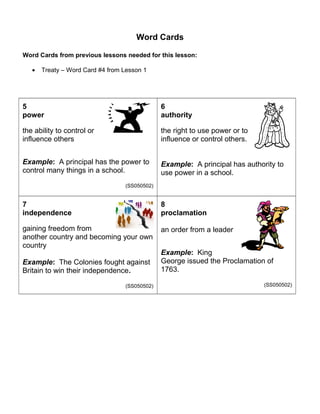
1. Write the words “power” and “authority” on the board. Explain that these two words mean 
different things. Instruct students to turn and talk to a partner about how they might be 
different. Then, using Word Cards #5 and #6, engage the whole class in a discussion of how 
these two terms might be different. Guide students to think about power and authority by 
using the following questions: 
· When do you have a right to tell others what to do? 
· When does someone else have a right to tell you what to do? 
· Do your parents have a right to make you go to bed at a certain time? 
· Do you have a right to make a friend give you something they own? 
2. Explain that authority is “the right to use power to influence or control the behavior of others.” 
Power is defined as “the ability to control or influence others.” Have students work with a 
partner to identify an example of someone using power without authority and one example of 
someone using power with authority. Then have students share their examples with the entire 
class. The following scenarios will help students distinguish between power and authority: 
· Robert is a bully. Using threats, he exerts power on the playground. When he wants 
to swing, he tells another student to get off and let him swing. Students are afraid of 
him so they give up their swing. He is using power without authority. 
· Sometimes a teacher asks a student to get off a swing because it is muddy 
underneath or he/she is swinging unsafely. The teacher has the authority to do this. 
The teacher is using power with authority.
3. Using Word Card #7, explain to students that they are going to be learning about the events 
and ideas that led to our country’s fight for independence. As they learn about these different 
events, they should be thinking about how the ideas of authority and the use of power without 
authority played a role in how the British and colonists reacted to different events and to each 
other. 
4. Briefly review the causes and main events of the French and Indian War. Give each student a 
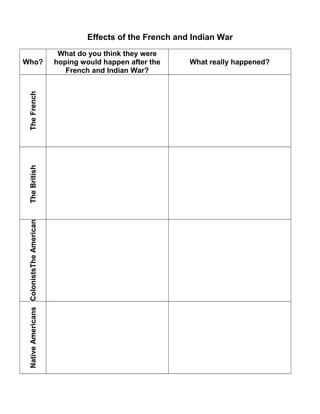
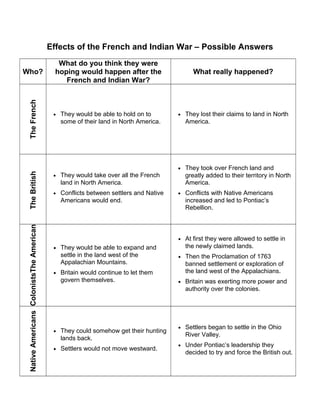
copy of “Effects of the French and Indian War” chart, located in the Supplemental Materials 
(Unit 5, Lesson 2) and display a copy of the chart. Explain that students should think carefully 
about each of the four groups listed on the chart and then describe what they think each group 
was hoping would happen after the end of the war (the middle column). If necessary, model 
the process by talking about the French with the entire group. Have students complete the 
middle column of the chart and then share their ideas with a partner or small group. Collect the 
charts and explain that students will complete the rest of the chart at the conclusion of the 
lesson. Note that a chart showing possible answers has been included in the Supplemental 
Materials (Unit 5, Lesson 2). 
5. Write the word “treaty” on the board and ask students to define the term in their own words. 
Guide students to the idea that a treaty is a written agreement between two or more nations. 
Explain that following the French and Indian War, France and Britain met in Paris to negotiate a 
peace treaty that also involved Spain. Ask students to predict what some of the provisions of 
the treaty were. Then, share the following information about land provisions in the treaty and 
agreements between France, Britain, and Spain: 
· France gave up all land in North America with the exception of New Orleans. 
· Britain was given Canada and the land from the Appalachians to the Mississippi 
River. 
· Britain was given Florida by Spain. 
· The French gave Spain New Orleans and the lands west of the Mississippi. 
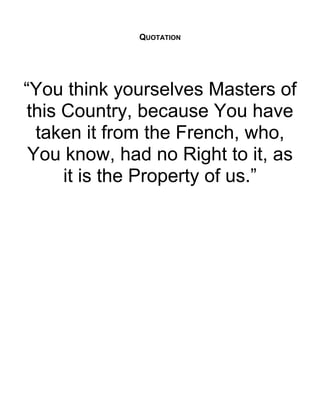
6. Display the “Quotation” located in the Supplemental Materials (Unit 5, Lesson 2). Ask students 
to make inferences regarding who may have said these words and why. If desired, have 
students write their ideas as a journal prompt. 
7. Explain that the quotation comes from Nimwha, a Shawnee diplomat. He made the statement 
following the French and Indian War. Reread the quotation to the class. Ask students to 
explain how their understanding of the quotation changed once they knew who said it. Remind 
students that it is important for historians to think like a detective. Knowing who made a 
statement and when it was made, provides vital clues to understanding what the quotation 
meant. Ask students to think about what additional questions this quotation might raise. Guide 
students to think about whether other Native American leaders feared what would happen as 
the British took over French territory. 
8. Ask students to predict what they think happened in the Ohio River Valley following the Treaty 
of Paris. Discuss student responses and guide students to the idea that colonial settlers began 
to move into the region. Ask students how they think Native Americans reacted to these new 
settlers. Discuss student responses and guide students to the idea that Native Americans were 
very angry over the potential loss of land and hunting grounds.
9. Write the word “Pontiac” on the board or an overhead transparency. Have students “stop and 
jot” down what they know about it. After a few minutes, elicit students’ responses. Then add 
the word “Chief” so that “Chief Pontiac” is displayed on the board or an overhead transparency. 
Ask students to share any information they might know about Chief Pontiac. Guide students to 
understand that this Native American leader tried to unite several Native American tribes in 
order to fight against the British. Note that Chief Pontiac is covered in Unit 3 of third grade. 
Share the following information about Chief Pontiac: 
· Chief Pontiac was an Ottawa leader who wanted to stop the loss of Native American 
hunting grounds. 
· He united the tribes of the Great Lakes region and the Ohio River Valley region to 
fight against the settlers in those areas. 
· Starting in May of 1763, Pontiac and his united tribes began attacks on British forts in 
Pennsylvania, Ohio, Michigan, and Indiana. Most were destroyed except Fort Detroit 
and Fort Pitt, which had formerly been Fort Duquesne. 
· In Michigan, Fort St. Joseph, located where Niles is today, was captured on May 25, 
1763. Fort Michilimackinac was taken by surprise on June 4, 1763. 
· By the end of 1763, Pontiac and other Native American leaders were short of 
supplies including ammunition. Some tribes signed treaties with the British. Pontiac 
eventually gave up control of the British forts. 
· These historical events became known as Pontiac’s Rebellion or Pontiac’s War. 
PIMP #5 (If Possible) Connection to place outside of local community, (Field Trip): Colonial 
Michilimackinac /Fort Mackinac. Being that Pontiac’s Rebellion effect Michigan, what better way to 
enhance the excitement then to check out our states very own fort: 
http://www.mackinacparks.com/ 
If a fieldtrip is out of the question, students can explore and learn about the fort online at: 
According to http://www.mightymac.org/michilimackinac.htm, the French garrison departed the 
Mackinac Straits at the conclusion of the French and Indian War and British troops arrived 1761. 
The French civilian community remained and encouraged the Native Americans to drive out the 
English. During Pontiac's Uprising in 1763, Native Americans defeated the British garrison, using 
the subterfuge of a bagataway (lacrosse) game to take the British unexpectedly. Many of the 
British were killed with some taken prisoner. 
10. Explain that Pontiac’s War caused a lot of concern in Britain. Many British leaders blamed 
colonial settlers for the conflict and stated that they had no right to claim land in the Ohio River 
Valley region. These leaders worried about more trouble and fighting. Ask students the 
following question: “What could Britain do to prevent further conflict between Native Americans 
and colonists who wanted to settle in the newly won regions?” Discuss student responses. 
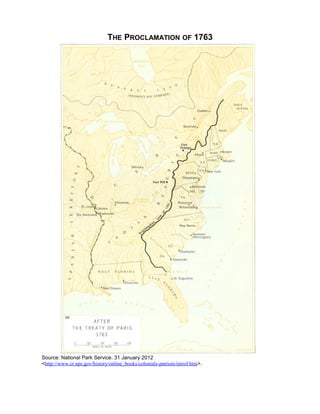
11. Display the map entitled “Proclamation of 1763”, located in the Supplemental Materials (Unit 5, 
Lesson 2). Use Word Card #8 to explain that a proclamation is an order from a leader. Ask 
students to examine the map carefully and draw a conclusion as to what the British king did in 
1763 to try to prevent further conflict. If necessary, draw attention to the Proclamation Line of 
1763 and the term “Indian Reserve.” Discuss student ideas. 
12. Using the map, explain that the British king, King George III, issued a proclamation stating 
colonists could not claim or buy land west of the Appalachian Mountains. They could not
explore it or hunt on it either. He stated that the land in this region was to be used by Native 
Americans only. Ask students to predict how colonists would feel about this proclamation. 
Discuss the King’s decision to issue the proclamation in terms of power and authority which 
were explored in Steps 1 and 2, using the following questions: 
· Did the King have authority to issue the Proclamation? Why or why not? 
· Do you think the colonists thought the King had authority to issue the Proclamation? 
Why or why not? 
· Do you think the King had the power to enforce the proclamation? Why or why not? 
As an alternative method, place a paper crown on your head and announce that you are King 
George III and students are colonists. Using the map announce your royal proclamation and 
ask the “colonists” how they feel about your ruling. Counter their arguments by responding with 
statements such as the following: 
· I am your king and you must do as I say. 
· You have plenty of land east of the Appalachians. 
· I am trying to prevent further conflict. 
· You are under my authority and control. Therefore, you must obey my proclamation. 
13. Explain that the colonists were angry over “The Proclamation of 1763.” Share the following 
regarding their anger: 
· Colonists were supposed to have the same rights as British citizens in Britain. 
These rights had been stated in the English Bill of Rights of 1689. 
· Colonists felt the Proclamation of 1763 took away their right as British citizens to 
move where they wanted. 
· Colonists had hoped to gain more authority to govern themselves, but the opposite 
seemed to be happening. 
14. Explain that colonists became even angrier when King George ordered British soldiers to stay 
in North America to protect the newly won lands. Their anger increased again when the King 
gave his colonial governors more authority over the colonists. Explain that the colonists felt the 
King did not have the authority to do these things. The colonists were used to governing 
themselves. They felt the King was now exerting power without the authority to do so. 
PIMP #6 – Social/Political Action Activity: Divide the class to have a debate on the results of the 
Proclamation of 1763. Consider both the British Reason and the Colonists. Have at least 3 
reasons why it is either fair or unfair for your side. 
15. As an optional enrichment activity, ask students to work with a small group to come up with a 
skit demonstrating the use of power without authority in the context of American history. What 
were some examples of the colonists having power to do something, but not the authority to do 
so? What are some examples of the use of power with authority? Again, guide students to 
think about the different players – King, Parliament, colonists, Native Americans, etc. Give 
students time to create and practice. Then, have them perform their skits for each other. Note 
that the students’ skits will probably reflect a perspective of colonists or British. Use these 
perspectives to point out how both sides saw the other as using power without authority. 
Explain that the issues of infringement of rights, the use of power without authority, and 
limitations on government will be important ideas in the upcoming lessons of this unit.
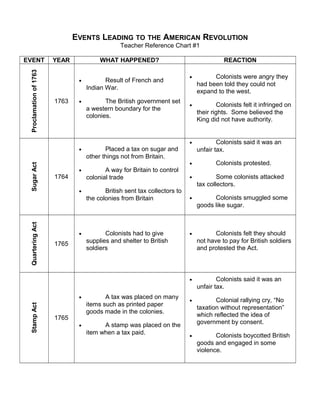
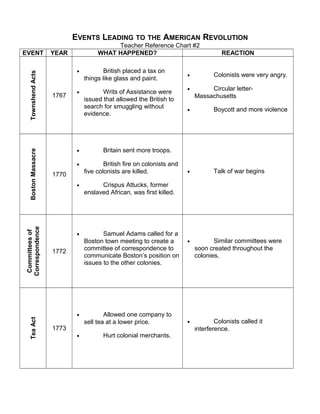
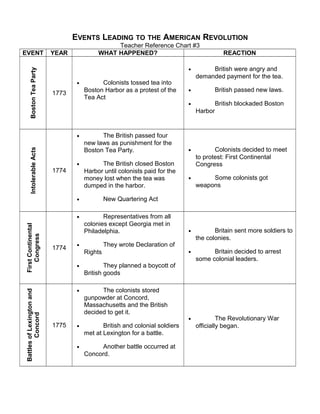
16. Give each student a copy of “Events Leading to the American Revolution Chart”, located in the 
Supplemental Materials (Unit 5, Lesson 2) and display a copy of the chart. Explain that they 
will be adding events to this chart as they progress through the unit. Using Teacher Reference 
Sheet #1, “Events Leading to the American Revolution” located in the Supplemental Materials 
(Unit 5, Lesson 2) guide students in adding the Proclamation of 1763 to their charts. Note that 
by the end of the unit, students will have completed three pages as indicated on Teacher 
Reference Sheets #1, #2 and #3. Make sure to remind students to keep the chart in a safe 
place. As an alternative method, give students small note cards and have them summarize 
important information regarding the Proclamation of 1763 on a note card. Continue this 
process throughout the unit instead of using the charts. 
17. Have students add Chief Pontiac to the “People Chart” they began in Lesson 1. 
18.PIMP #7 Watch Video on Chief Pontiac and rebellion. Note Mention of Fort Detroit! 
http://www.youtube.com/watch?v=KVx0Is3XKu0&spfreload=10 
19. Pass out “Effects of the French and Indian War” charts, used previously in Step 4. Have 
students complete the last column on the chart by using the knowledge they have acquired 
from this lesson. Use the chart with possible answers to help you evaluate student learning. 
PIMP #8 For excitement and review, pick groups in the class to do a show. With a little 
guidance by the teacher, and using the Effects of the French and Indian War charts each group 
could represent a different group The British, French, Natives and the Colonists would each get 
their time to shine. Half of each group would perform what they thought would happen as a 
result of the war, the other would perform what actually happened. The students are actively 
involved with the ambitions of each group and then acting out the actual mood of each group 
after the result of the war. After each skit, students can add to their chart things they learned 
and haven’t previously added. 
Assessment 
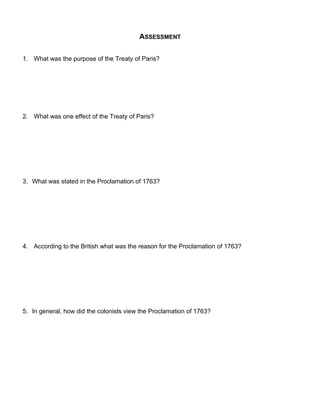
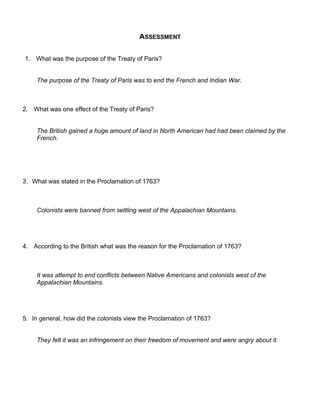
An assessment in which students complete five constructed response items has been included in 
the Supplemental Materials (Unit 5, Lesson 2). Note that a sheet showing possible answers has 
also been included. If desired, the chart used in Steps 4 and 18 can also be used as an 
assessment.
Lesson 3: Sugar and Stamps - Governing without Consent 
Big Ideas of the Lesson 
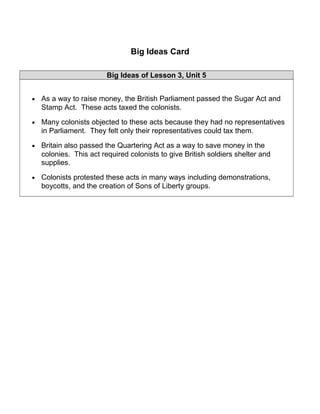
· As a way to raise money, the British Parliament passed the Sugar Act and 
Stamp Act. These acts taxed the colonists. 
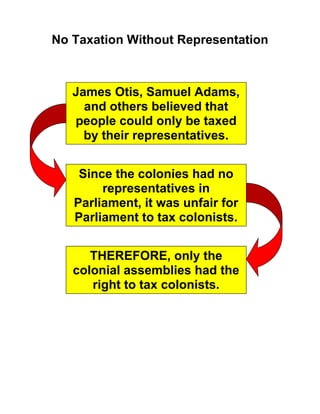
· Many colonists objected to these acts because they had no representatives 
in Parliament. They felt only their representatives could tax them. 
· Britain also passed the Quartering Act as a way to save money in the 
colonies. This act required colonists to give British soldiers shelter and supplies. 
· Colonists protested these acts in many ways including demonstrations, 
boycotts, and the creation of Sons of Liberty groups. 
Lesson Abstract: 
In this lesson, students examine the growing tension between the colonies and Britain by exploring 
Writs of Assistance, the Sugar Act, the Quartering Act, and the Stamp Act. They examine different 
perspectives relating to these laws the issues of liberty, taxation, representative government, and 
trade. In addition, students gather information regarding different colonial reactions to the laws as 
well as significant people of the time period in exploring why the colonists wanted to limit the power 
of government. 
Content Expectations 
5 – U3.1.1: Describe the role of the French and Indian War, how British policy toward the 
colonies in America changed from 1763 to 1775, and colonial dissatisfaction with the 
new policy. 
5 – U3.1.2: Describe the causes and effects of events such as the Stamp Act, Boston Tea Party, 
the Intolerable Acts, and the Boston Massacre. 
5 – U3.1.3: Using an event from the Revolutionary era (e.g., Boston Tea Party, quartering of 
soldiers, writs of assistance, closing of colonial legislatures), explain how British and 
colonial views on authority and the use of power without authority differed (views on 
representative government). 
5 – U3.1.6: Identify the role that key individuals played in leading the colonists to revolution, 
including George Washington, Thomas Jefferson, Benjamin Franklin, Patrick Henry, 
Samuel Adams, John Adams, and Thomas Paine. 
Common Core State Standards 
5 – RI.6: Analyze multiple accounts of the same event or topic, noting important similarities 
and difference in the point of view they represent. 
5 – RI.9: Integrate information from several texts on the same topic in order to write or speak 
about the subject knowledgeably.
5 – W.1: Write opinion pieces on topics or texts, supporting a point of view with reasons and 
information. 
a. Introduce a topic or text clearly, state an opinion, and create an organizational 
structure in which ideas are logically grouped to support the writer’s purpose. 
b. Provide logically ordered reasons that are supported by facts and details. 
c. Link opinion and reasons using words and phrases and clauses (e.g., 
consequently, specifically). 
d. Provide a concluding statement or section related to the opinion presented. 
Key Concepts 
authority / power 
cause and effect 
liberty 
representative government 
taxation 
Instructional Resources 
Equipment/Manipulative 
Chart paper 
Overhead projector or document camera/projector 
Student Resource 
Bower, Burt, et al. America’s Past, Social Studies Alive Program. Palo Alto, CA: Teacher’s 
Curriculum Institute, 2010 or a similar fifth grade social studies textbook. Pages 134-137. 
Teacher Resource 
Egbo, Carol. Supplemental Materials (Unit 5, Lesson 3). Teacher-made material. Michigan 
Citizenship Collaborative Curriculum, 2011. 
No Stamp Act Teapot. 31 January 2012 
<http://www.worldwideshoppingmall.co.uk/potteryshop/product.asp?productid=1590>. 
Examples of Stamp Act Stamps. The American Revolution Website. 31 January 2012 
<http://www.arpinphilately.com/blog/what-was-the-stamp-act-of-1765/en/>. 
Moore, Frank. American eloquence: a collection of speeches and addresses: by the most eminent 
orators of America, Volume 1. D. Appleton and Co., 1857. Page 4. 31 January 2012 
<http://books.google.com/books?id=l9gYWiLfZkgC&printsec=frontcover&dq=bibliogroup: 
%22American+Eloquence:+a+Collection+of+Speeches+and+Addresses: 
+By+the+Most+Eminent+Orators+of+America%22&hl=en&sa=X&ei=I-cUT-LxGcnF0AH9hsmLAw& 
ved=0CDIQ6AEwAA#v=onepage&q=bibliogroup%3A%22American 
%20Eloquence%3A%20a%20Collection%20of%20Speeches%20and%20Addresses%3A 
%20By%20the%20Most%20Eminent%20Orators%20of%20America%22&f=false>
Lesson Sequence 
1. Write and project the following question and ask students to answer the question in their 
journal: “What were some of the most important effects of the French and Indian War?” Allow 
time for writing and then have students share their ideas in groups of three. 
2. Have a few students share their journal ideas with the entire class and then lead a discussion 
on the following significant effects: the transfer of North American territory from France to 
Britain, Pontiac’s Rebellion, and the Proclamation of 1763. Note that these events mainly 
affected the colonies. 
3. Ask students to think of possible ways the war may have affected the economy of Britain. 
Guide students to the idea that the war was very expensive and resulted in a large debt for 
Britain. Ask students to think of ways Britain could have raised money to pay its war debts. 
Discuss student answers. Possible answers include expanding trade, selling land to another 
country, etc. Guide students to the idea that Britain decided to come up with a plan to get 
money from the colonists. Ask students to think about why the British might have come to this 
conclusion. 
4. Explain that even before the end of the French and Indian War, Britain decided one way to 
raise money was by enforcing the Navigation Acts. Remind students that these acts were 
passed beginning in the 1750’s to try and control colonial trade in a way that benefited Britain 
economically. Explain that the colonies had pretty much ignored these acts and some colonists 
even smuggled goods to get around the restrictions. 
5. Display the short text selection “What Happened Here?” located in the Supplemental Materials 
(Unit 5, Lesson 3). Read over the text with students. Then, have students do a quick journal 
entry answering the question. Give students time to write and then have them share their ideas 
with a partner. 
6. Discuss the text using the following questions to guide your discussion: 
· What were the British officials looking for? 
· Why do you think they chose Mr. Adams’ shop to search? (Note that it may be 
necessary to explain that a cooper, like Mr. Adams, made barrels.) 
· How did they treat Mr. Adams? 
· Do you think they had the right to search his shop? Why or why not? 
· Could a similar incident take place today? Why or why not? 
7. Explain that the incident described in the text was similar to those that actually happened in the 
colonies in the 1760’s. Using Word Card #9, explain that in order to crack down on smuggling, 
the British government gave authorities “Writs of Assistance” which were search warrants that 
allowed an official to search for smuggled goods without any evidence. Discuss how this differs 
from search warrant procedures today. 
8. Display “Quotation #1”, located in the Supplemental Materials (Unit 5, Lesson 3). Read the text 
out loud using a “Think Aloud” strategy. After reading, explain to students that James Otis 
made this statement in a court case where he tried to prove the Writs were illegal. He lost the 
case, but became famous for his statements and his belief that the Writs were a violation of the
colonists’ right to property. Have students add James Otis to the “People Chart” they began in 
Lesson 1. Remind them that as they gather more information about him they should add it to 
the chart. 
Pimp #9 As you add important people to the chart, play a short video about that person, so 
students can get a better visual about that person. http://www.teachertube.com:8808/video/james-otis- 
140214 
9. Explain that in addition to trying to enforce the Navigation Acts, Britain also decided to get more 
aggressive regarding raising money by taxing the colonies. (Optional Step: As an introduction 
to the Sugar Act, etc, show students the History Channel’s “Colonists Protest British Policies” 
found at http://www.history.com/videos/colonists-protest-british-policies#colonists-protest-british- 
policies, and discuss the British intent and the colonial reactions. Explain that they will be 
investigating these acts in greater detail and will refer back to this video at the end of Lesson 
6.) In 1764, Parliament passed the Sugar Act. Share the following information regarding this 
act: 
· The Sugar Act put a tax on sugar and other goods coming into the colonies from 
other places. 
· It angered many colonists like James Otis. These colonists claimed they had no 
voice in deciding on this new law. 
· James Otis and others protested that the King and Parliament had taxed the 
colonists without their consent, or agreement. 
· Many felt this violated their rights as British citizens. 
· Some colonists sent letters of protest to Britain. 
· Not all the colonists agreed with Otis. Some felt the colonists should be grateful to 
the King and Parliament for helping them defeat the French. 
PIMP # 10 Work in pairs. Write a script for a news report breaking the news about the Stamp Act 
passed by Parliament. Find quotes from colonists and add them to your report. Using an Ipad, 
record your report with your partner. Resources for your report can be found here: http://www.u-s-history. 
com/pages/h642.html and http://www.historywiz.com/stampact.htm 
10.Have students add the Sugar Act to the “Events Leading to the American Revolution” chart, 
which they began in Lesson 2. Note that information for the chart is located on Teacher 
Reference Sheet #1 from Lesson 2. 
11.Give each student a copy of “Differing Perspectives” chart, located in the Supplemental 
Materials (Unit 5, Lesson 3). Using Word Card #10 and #11, explain that these quotations 
show some of the different perspectives, or points of view, regarding the issues of liberty, 
taxation, representative government and trade. Tell students to analyze each quote and then 
describe the perspective in their own words. Note that a sheet showing possible answers has 
also been included in the Supplemental Materials (Unit 5, Lesson 3). Have them share their 
answers with a partner. 
12.Display “Differing Perspectives” chart, and have the class discuss the quotations by sharing 
what they wrote on the chart and discussed with their partners. Guide students in connecting 
the quotations to the following concepts: liberty, representative government, taxation, and
trade. Draw attention to the two Samuel Adams quotations. Explain that Samuel Adams 
became a major figure in the fight for independence. Have students add Samuel Adams to 
their “People Chart.” 
PIMP #11 As you add important people to the chart, play a short video about that person, so 
students can get a better visual about that person. Watch video: 
http://www.history.com/topics/american-revolution/samuel-adams 
13.Explain that in March of 1765, Parliament passed another act that angered many colonists, the 
Quartering Act. Using Word Card #13, explain that this act required colonists to quarter 
(provide shelter and supplies) to British soldiers. Explain that Parliament passed the 
Quartering Act as a “cost-saving” measure. Britain had many soldiers in the colonies under the 
command of General Thomas Gage and it was hoped the Quartering Act would help pay for 
these soldiers. 
14.Display “Quotation #2”, located in the Supplemental Materials (Unit 5, Lesson 3), and guide 
students in analyzing the quotation. Draw special attention to the word “authority”. Remind 
students that the issue of British authority over the colonies was addressed when they explored 
the Proclamation of 1763 in the previous lesson. Have students compare differing perspectives 
on power and authority by dividing the class in two groups. Explain that Group #1 represents 
the King and Parliament and Group #2 represents the colonists. Ask each group to explain 
their perspective on the Quartering Act. Note that the following summarizes each perspective: 
· Britain hoped to save money by having the colonists help provide food, housing, etc. 
Britain claimed this was fair because the soldiers were there to protect the colonists. 
The King and Parliament felt they had complete authority to pass the Quartering Act. 
· Many colonists felt they should not have to help pay for British soldiers and many 
protested. They also objected to having soldiers in the colonies during times of 
peace. They felt the King and Parliament did not have the right, or authority, to make 
them pay for soldiers. 
15.Have students add the Quartering Act to the “Events Leading to the American Revolution” chart 
started in the previous lesson. 
16. Display “Artifacts”, located in the Supplemental Materials (Unit 5, Lesson 3). Ask students to 
identify the artifacts. Discuss student responses. Explain that these artifacts are connected to 
another tax law passed by Parliament, the Stamp Act. Give each student a copy of “Notes on 
the Stamp Act” organizer, located in the Supplemental Materials (Unit 5, Lesson 3). Tell 
students to read about the Stamp Act in their textbook and take notes as they read using the 
chart. Note that if you are using the textbook listed in the Student Resource section, students 
will be reading page 137. A chart showing sample notes has been included in the 
Supplemental Materials (Unit 5, Lesson 3). 
17.Give students time to read and take notes on their charts. Show the “Artifacts” again and 
discuss the two artifacts in light of what students have read. Then, discuss the Stamp Act by 
discussing what they have learned from their reading as well as the information below: 
· The Stamp Act placed a tax on all kinds of paper goods made in the colonies 
including newspapers, legal documents, licenses, and even playing cards.
· People who were suspected of violating the Stamp Act were to be tried in special 
courts that had no juries. This angered many colonists. 
· The Stamp Act generated far more protest than the Sugar Act. 
18.Explain to students that one of the first responses to the Stamp Act came from the House of 
Burgesses in Virginia. Share the following information regarding this: 
· In May of 1765, Patrick Henry introduced a series of resolutions in the House of 
Burgesses that stated Parliament had no power to levy the Stamp tax. 
· He gave a speech in which he said the House of Burgesses alone could decide what 
taxes Virginians would pay. 
· He called for resistance to the tax. Another member of the legislature, however, 
shouted that resistance would be a type of treason. Patrick Henry is supposed to 
have answered back “If this be treason, make the most of it.” (Use Word Card #14 to 
explain the term ‘treason’.) 
19.Have students add Patrick Henry to the “People Chart” they are constructing. 
PIMP #12 As you add important people to the chart, play a short video about that person, so 
students can get a better visual about that person. Watch Video on Patrick Henry: 
http://www.biography.com/people/patrick-henry-9335512. 
20.Display “The Virginia Resolves on the Stamp Act”, located in the Supplemental Materials (Unit 
5, Lesson 3). Guide students in getting the gist of this primary source by identifying words and 
phrases they know with a highlighter. The critical ideas include: 
· The people who first settled in the Virginia colony brought with them all the rights 
they had in Britain. 
· The colonists living in the colonies still have those rights. They have the same rights 
and privileges as people living in Britain. 
· People can only be taxed by their representatives or themselves. 
· By choosing representatives, they consent to be governed and taxed by them. 
Explain to students that most colonists believed they could do nothing but complain about the 
stamps and buy them until the Virginia House of Burgesses adopted Patrick Henry's Stamp Act 
Resolves. Virginia Governor Fauquier did not approve of the resolutions, and he dissolved the 
House of Burgesses in response to their passage. 
21.Explain that soon after the Virginia Resolves were passed, other resolutions followed. This was 
especially true in Massachusetts. Other forms of protest were also seen. For example, in 
Boston, an effigy, (a type of dummy) was made of a stamp commissioner and hung in a tree. 
Later a group gathered shouting “Liberty, property, and no stamps.” They took the effigy and 
burned it near the commissioner’s home. 
22.Using Word Card #15, explain that the “Sons of Liberty” was a network of secret organizations 
formed to protest the Stamp Act. They began in New York and Massachusetts and then 
spread to other colonies. Explain that Samuel Adams was a leader in the Massachusetts 
group. These groups staged protests, but not all of the protests were peaceful. Sometimes 
customs officials were attacked. Explain that the formation of the Sons of Liberty was another 
way colonists reacted to the Stamp Act.
23.Display the phrase “No Taxation without Representation”. Explain that this was a common 
phrase heard in 1765 in the colonies. Historians attribute the phrase to James Otis. Ask 
students to write an explanation of what they think this term means in their social studies 
journal. Give them time to write and then have them share ideas with a partner. Then, discuss 
the phrase with the entire class. Guide students in understanding that James Otis, Samuel 
Adams, and many others believed that people could only be taxed by their representatives. 
Therefore, only colonial assemblies had the right to tax colonists. Since the colonies had no 
representatives in Parliament, they believed it was unfair for Parliament to tax colonists. Use 
the “No Taxation without Representation” graphic organizer, included in the Supplemental 
Materials (Unit 5, Lesson 3) to help students understand these ideas. 
24.Guide students in adding the Stamp Act to their “Events Leading to the American Revolution” 
charts. 
PIMP #13: Working in a small group, create a 2 minute skit about one of the following laws 
passed by Great Britain during the pre-revolutionary time period. Each skit must show the 
viewpoint of the colonists and why the colonists would not like the law. You will be given a 
background story as a starting point but you can create any number of characters, narrators or 
changes in the plot. Your skits should be serious in tone as if you were truly experiencing the 
harshness imposed by Great Britain. Link: http://emssocialstudies.com/documents/Unit_1/The 
%20Intolerable%20King%20Skit%20Assignment.pdf 
25.Ask students to predict what they think will happen next in the colonies. Record their ideas and 
keep them for the next lesson. 
Assessment 
As an assessment, have students write a letter to King George or Parliament in protest of the 
Sugar Act, Quartering Act, or Stamp Act. Criteria for the letter should include the following: 
· Description of the Act; 
· an explanation of why you, as a colonist, think it is unfair; and 
· a connection to one of the following concepts: liberty, taxation, representative government. 
Note that a “Writing Plan”, designed to guide students in drafting their letter has been included in 
the Supplemental Materials (Unit 5, Lesson 3).
The Anthem Project 
Grade 5 Social Studies Lesson 
Assignment 
The most popular song of the Road to the Revolution, "Yankee Doodle," has roots that trace back at least as 
far back as the era of the English Civil War in the sixteenth century. During the Seven Years' War, British 
soldiers sang the song to deride (mock) the colonists, who were fighting alongside of them. In the 
Revolution, the colonists turned the song into a patriotic anthem against the British. 
Imagine that you are a colonist soldier in George Washington’s army fighting with the British soldiers from 
England. Write lyrics you would rather sing. 
Create one stanza about the French and Indian war. Lyrics should be sung to the tune of Yankee Doodle. 
Lyrics 
In this column, write your group’s lyrics to the 
tune of Yankee Doodle 
Historical Connections 
In this column, list and define any person, place, 
or event that you included in your lyrics.
Graphic Organizer 
Both the French and the British became interested 
in the Ohio River Valley. 
The French began to build forts in the Ohio River Valley. 
The British demanded that the French leave the Valley 
but the French refused. 
A war began between the French and the British. 
Many Native Americans became allies of the French. 
In the beginning the French won most of the battles. 
The British sent new generals and soldiers to North America 
in an effort to win the war. 
The British began capturing French forts. 
The war ended in 1760 when the British captured Montreal. 
The French and the British signed the Treaty of Paris to end the conflict.
Big Ideas Card 
Big Ideas of Lesson 1, Unit 5 
· Both the French and the British were interested in the land known as the 
Ohio River Valley. 
· In 1750, the French began building forts in this region. This led to a conflict 
between the French and the British called the French and Indian War. It was 
called this because many Native Americans became allies of the French. 
· George Washington and Benjamin Franklin were important historical figures 
during this time period. 
· Eventually the British defeated the French. They signed a peace treaty in 
Paris that ended the conflict.
Word Cards 
1 
the French and Indian War 
a war in the mid 1700’s 
between France and Britain. 
Example: As a result of the French and 
Indian War, France lost its territory in 
North America to Britain. 
2 fort 
buildings and land 
protected by a tall wall and 
often lookout towers 
Example: The French began building 
forts in the Ohio River valley. 
(SS050501) 
3 
allies 
people who work together 
to help each other solve 
problems or fight against another group. 
Example: Many Native Americans 
became allies of the French in the 
French and Indian War. 
(SS050501) 
4t 
reaty 
a signed agreement 
between two countries 
Example: A peace treaty between 
France and Britain ended the French 
and Indian War. 
Primary Source #1 Analysis
Before the lesson 
What do you think this is? 
What do think it means? 
After the lesson 
What is this? 
What did it mean?
Comparing Historical Maps
Source: The French and Indian War of the 1750s.<http://www.mccordfamilyassn.com/french.htm>.
Exploring Text Features 
Directions: Use the chart below to explain the relationship between maps and/or images in your 
textbook and the assigned reading. Complete the chart below, based on your selections. 
Selection #1 Selection #2 
Description of Map 
or Image 
What does it tell 
you? 
How does the image 
help you 
understand the 
reading? 
How does the 
reading help you 
understand the 
image?
Primary Source #2 
Major GEORGE WASHINGTON's Journal to the 
River OHIO, etc 
Wednesday, October 31, 1753 
I was commissioned and appointed by the 
Honourable Robert Dinwiddie, Esq, Governor, 
Etc. of Virginia, to visit and deliver a Letter to 
the Commandant of the French Forces on the 
Ohio, and set out on the intended Journey the 
same Day; the next, I arrived Fredericksburg, 
and engaged Mr. Jacob Van Braam, to be my 
French Interpreter; and proceeded with him to 
Alexandria, where we provided Necessaries; 
from whence we went to Winchester, and got 
luggage, Horse, Etc. and from thence we 
pursued the new Road to Wills Creek, where we 
arrived the 14th of November. 
Source: George Washington’s Journal. Archiving Early America. 31 January 2012 
<http://www.earlyamerica.com/earlyamerica/milestones/journal/journaltext.html>. 
The French and Indian War
The War Begins 
Following the French refusal to leave the Ohio Valley, Governor Dinwiddie of Virginia 
sent a small group of soldiers to the Forks in the Ohio River where Pittsburg, Pennsylvania 
is today. They were supposed to build a small fort there. Just after the fort was finished 
the French attacked. They drove off the Virginian soldiers and built a larger fort on the site. 
They named the fort, Fort Duquesne (doo-KAYN). 
Not knowing about the attack, Governor Dinwiddie decided to send George Washington 
to the area to reinforce the Virginia fort. In April, 1754 Washington left for the region with a 
group of 150 soldiers. A long the way they surprised a small group of French soldiers with 
an attack. Fearing there would be many more French soldiers nearby, Washington and his 
men built a small fort in the area they named Fort Necessity. 
A few days later, a large force of French soldiers and some Native American allies 
attacked Fort Necessity. Washington and the other Virginians were very out-numbered 
and were forced to surrender. This turned out to be the first battle in the French and Indian 
War. The French allowed Washington and his men to return to Virginia. 
The Albany Congress 
Since the French had enlisted the assistance of many Native American allies in the war, 
the British decided they needed to seek help from Native Americans also. In June and July 
of 1754 leaders from seven colonies met with Iroquois leaders in Albany, New York. At this 
meeting, the Iroquois reluctantly agreed to be allies of the British and fight the French. 
However, Ben Franklin, who represented Pennsylvania, explained that he felt it would 
take more than Native American allies to defeat the French. He believed it was necessary 
for the colonies to be united. 
Franklin presented a plan for unity which he 
called the Albany Plan of Union. His plan united all 
of the colonies under one government. To get 
support for his plan, he published a cartoon titled 
“Join, or die.” 
Main Events of the War
· In 1755, Parliament sent an army to the colonies under the 
leadership of General Edward Braddock. George Washington 
became his advisor. 
· In April of 1755, Braddock, with a group of British and 
colonial soldiers headed to Fort Duquesne to try and take it 
over. 
· They battled the French near where Fort Necessity had 
been built. The French overpowered them and Braddock 
along with many of his soldiers were killed. 
· For the next two years, the French won battle after battle. 
· In 1757, William Pitt became leader of Parliament. He set 
out to win the war in North America. He began by sending his 
best generals to the colonies to lead the fight against the 
French. 
· In 1758, the British captured three French forts including 
Fort Duquesne. 
· In 1759, the British captured more forts including Fort 
Ticonderoga in New York. The same year they captured 
Quebec. 
· In 1760, the British captured Montreal and the French gave 
up fighting in North America.
Important People on the Road to Revolution 
Person Important Information
Lesson Assessment: The French and Indian War 
What 
happened? 
Who was 
involved? 
When did it 
happen? 
How and 
why did it 
happen?
The French and Indian War 
Lesson Assessment – Sample Answers 
What 
happened? 
A war broke out between the British and the French. Many Native American 
groups allied themselves with the French. The British won the war. 
Who was 
involved? 
· Native American groups that joined the French including the 
Algonquin and the Huron. 
· The Iroquois, who reluctantly helped the British 
· George Washington was an officer during the beginning of the 
war for the British. 
· Ben Franklin tried to unite the colonies under one government. 
· British Generals like Braddock. 
· French troops and British troops 
· The Spanish who sided with the French 
When did it 
happen? 
The war began in 1754 and lasted until 1763. The French and British met in 
Paris to sign a peace treaty. 
How and 
why did it 
happen? 
The conflict began over the Ohio River Valley, which both the French and 
British claimed. The French began to build forts in the area.
Graphic Organizer: Chain of Events 
The British gain a lot of 
new land in North 
America. 
American Indians try to 
get their land back from 
the British. 
Britain is concerned 
about continued conflicts 
between settlers and 
American Indians in the 
newly gained territory. 
King George issues the 
Proclamation of 1763, 
which bans settlement 
beyond the Appalachian 
Mountains. 
Colonists are angry and 
feel the Proclamation 
limits their freedom of 
movement. 
EFFECT OF 
TREATY OF PARIS 
EFFECT OF 
BRITISH GAINING 
NEW LAND 
EFFECT OF 
AMERICAN INDIAN 
ACTIONS 
EFFECT OF 
BRITISH 
CONCERNS 
EFFECT OF 
PROCLAMATION 
OF 1763
Big Ideas Card 
Big Ideas of Lesson 2, Unit 5 
· As a result of losing the French and Indian War, France lost its territory in 
North America. Britain took over this territory. 
· Native Americans, under the leadership of Chief Pontiac, attempted to push 
the British out of their lands. 
· British leaders worried about continued conflict between Native Americans 
and colonists in the newly gained territory. 
· King George issued the Proclamation of 1763. This banned settlers from 
settling west of the Appalachian Mountains. The King hoped this would end 
these conflicts. 
· Colonists were angry that they were no longer free to settle in the western 
areas.
Word Cards 
Word Cards from previous lessons needed for this lesson: 
· Treaty – Word Card #4 from Lesson 1 
5 
power 
the ability to control or 
influence others 
Example: A principal has the power to 
control many things in a school. 
(SS050502) 
6 authority 
the right to use power or to 
influence or control others. 
Example: A principal has authority to 
use power in a school. 
7 independence 
gaining freedom from 
another country and becoming your own 
country 
Example: The Colonies fought against 
Britain to win their independence. 
(SS050502) 
8 
proclamation 
an order from a leader 
Example: King 
George issued the Proclamation of 
1763. 
(SS050502)
Effects of the French and Indian War 
Who? 
What do you think they were 
hoping would happen after the 
French and Indian War? 
What really happened? 
Native Americans ColonistsThe American The British The French
Effects of the French and Indian War – Possible Answers 
Who? 
What do you think they were 
hoping would happen after the 
French and Indian War? 
What really happened? 
The French 
· They would be able to hold on to 
some of their land in North America. 
· They lost their claims to land in North 
America. 
The British 
· They would take over all the French 
land in North America. 
· Conflicts between settlers and Native 
Americans would end. 
· They took over French land and 
greatly added to their territory in North 
America. 
· Conflicts with Native Americans 
increased and led to Pontiac’s 
Rebellion. 
ColonistsThe American 
· They would be able to expand and 
settle in the land west of the 
Appalachian Mountains. 
· Britain would continue to let them 
govern themselves. 
· At first they were allowed to settle in 
the newly claimed lands. 
· Then the Proclamation of 1763 
banned settlement or exploration of 
the land west of the Appalachians. 
· Britain was exerting more power and 
authority over the colonies. 
Native Americans 
· They could somehow get their hunting 
lands back. 
· Settlers would not move westward. 
· Settlers began to settle in the Ohio 
River Valley. 
· Under Pontiac’s leadership they 
decided to try and force the British out.
QUOTATION 
“You think yourselves Masters of 
this Country, because You have 
taken it from the French, who, 
You know, had no Right to it, as 
it is the Property of us.”
THE PROCLAMATION OF 1763 
Source: National Park Service. 31 January 2012 
<http://www.cr.nps.gov/history/online_books/colonials-patriots/introf.htm>.
EVENTS LEADING TO THE AMERICAN REVOLUTION 
EVENT YEAR WHAT HAPPENED? REACTION
EVENTS LEADING TO THE AMERICAN REVOLUTION 
Teacher Reference Chart #1 
EVENT YEAR WHAT HAPPENED? REACTION 
Proclamation of 1763 
1763 
· Result of French and 
Indian War. 
· The British government set 
a western boundary for the 
colonies. 
· Colonists were angry they 
had been told they could not 
expand to the west. 
· Colonists felt it infringed on 
their rights. Some believed the 
King did not have authority. 
Sugar Act 
1764 
· Placed a tax on sugar and 
other things not from Britain. 
· A way for Britain to control 
colonial trade 
· British sent tax collectors to 
the colonies from Britain 
· Colonists said it was an 
unfair tax. 
· Colonists protested. 
· Some colonists attacked 
tax collectors. 
· Colonists smuggled some 
goods like sugar. 
Quartering Act 
1765 
· Colonists had to give 
supplies and shelter to British 
soldiers 
· Colonists felt they should 
not have to pay for British soldiers 
and protested the Act. 
Stamp Act 
1765 
· A tax was placed on many 
items such as printed paper 
goods made in the colonies. 
· A stamp was placed on the 
item when a tax paid. 
· Colonists said it was an 
unfair tax. 
· Colonial rallying cry, “No 
taxation without representation” 
which reflected the idea of 
government by consent. 
· Colonists boycotted British 
goods and engaged in some 
violence.
EVENTS LEADING TO THE AMERICAN REVOLUTION 
Teacher Reference Chart #2 
EVENT YEAR WHAT HAPPENED? REACTION 
Townshend Acts 
1767 
· British placed a tax on 
things like glass and paint. 
· Writs of Assistance were 
issued that allowed the British to 
search for smuggling without 
evidence. 
· Colonists were very angry. 
· Circular letter- 
Massachusetts 
· Boycott and more violence 
Boston Massacre 
1770 
· Britain sent more troops. 
· British fire on colonists and 
five colonists are killed. 
· Crispus Attucks, former 
enslaved African, was first killed. 
· Talk of war begins 
Committees of 
Correspondence 
1772 
· Samuel Adams called for a 
Boston town meeting to create a 
committee of correspondence to 
communicate Boston’s position on 
issues to the other colonies. 
· Similar committees were 
soon created throughout the 
colonies. 
Tea Act 
1773 
· Allowed one company to 
sell tea at a lower price. 
· Hurt colonial merchants. 
· Colonists called it 
interference.
EVENTS LEADING TO THE AMERICAN REVOLUTION 
Teacher Reference Chart #3 
EVENT YEAR WHAT HAPPENED? REACTION 
Boston Tea Party 
1773 
· Colonists tossed tea into 
Boston Harbor as a protest of the 
Tea Act 
· British were angry and 
demanded payment for the tea. 
· British passed new laws. 
· British blockaded Boston 
Harbor 
Intolerable Acts 
1774 
· The British passed four 
new laws as punishment for the 
Boston Tea Party. 
· The British closed Boston 
Harbor until colonists paid for the 
money lost when the tea was 
dumped in the harbor. 
· New Quartering Act 
· Colonists decided to meet 
to protest: First Continental 
Congress 
· Some colonists got 
weapons 
First Continental 
Congress 
1774 
· Representatives from all 
colonies except Georgia met in 
Philadelphia. 
· They wrote Declaration of 
Rights 
· They planned a boycott of 
British goods 
· Britain sent more soldiers to 
the colonies. 
· Britain decided to arrest 
some colonial leaders. 
Battles of Lexington and 
Concord 
1775 
· The colonists stored 
gunpowder at Concord, 
Massachusetts and the British 
decided to get it. 
· British and colonial soldiers 
met at Lexington for a battle. 
· Another battle occurred at 
Concord. 
· The Revolutionary War 
officially began.
ASSESSMENT 
1. What was the purpose of the Treaty of Paris? 
2. What was one effect of the Treaty of Paris? 
3. What was stated in the Proclamation of 1763? 
4. According to the British what was the reason for the Proclamation of 1763? 
5. In general, how did the colonists view the Proclamation of 1763?
ASSESSMENT 
1. What was the purpose of the Treaty of Paris? 
The purpose of the Treaty of Paris was to end the French and Indian War. 
2. What was one effect of the Treaty of Paris? 
The British gained a huge amount of land in North American had had been claimed by the 
French. 
3. What was stated in the Proclamation of 1763? 
Colonists were banned from settling west of the Appalachian Mountains. 
4. According to the British what was the reason for the Proclamation of 1763? 
It was attempt to end conflicts between Native Americans and colonists west of the 
Appalachian Mountains. 
5. In general, how did the colonists view the Proclamation of 1763? 
They felt it was an infringement on their freedom of movement and were angry about it.
Graphic Organizer 
Writs of 
Assistance 
The 
Quartering 
Act 
The Stamp 
Act 
The 
Sugar Act British 
Actions
Big Ideas Card 
Big Ideas of Lesson 3, Unit 5 
· As a way to raise money, the British Parliament passed the Sugar Act and 
Stamp Act. These acts taxed the colonists. 
· Many colonists objected to these acts because they had no representatives 
in Parliament. They felt only their representatives could tax them. 
· Britain also passed the Quartering Act as a way to save money in the 
colonies. This act required colonists to give British soldiers shelter and 
supplies. 
· Colonists protested these acts in many ways including demonstrations, 
boycotts, and the creation of Sons of Liberty groups.
Word Cards 
Word Cards from previous lessons needed for this lesson: 
· French and Indian War – Word Card #1 from Lesson 1 
· Authority – Word Card #6 from Lesson 2 
9 
writs of assistance 
search warrants that 
allowed someone to search for 
smuggled goods without any evidence 
Example: Many colonists objected to 
the use of writs of assistance. 
(SS050503) 
10 
perspective 
how a person looks 
at a problem or an event 
Example: People can have different 
perspectives, or points of view, because 
their ages or backgrounds are different. 
(SS050503) 
11 
representative 
government 
a form of democracy where people 
choose representatives to make 
decisions for them 
Example: The House of Burgesses 
was an example of representative 
government. 
(SS050503) 
12 
quarter 
to provide 
shelter and supplies to 
soldiers 
Example: Many colonists objected to 
having to quarter British soldiers. 
(SS050503)
13 
liberty 
another word for 
freedom 
Example: Liberty was an important 
right to colonists. 
(SS050503) 
14 
treason 
betraying one’s country 
Example: The British and the colonists 
had different points of view regarding 
who was guilty of treason. 
(SS050503) 
15 
Sons of 
Liberty 
a network of 
secret organizations formed to protest 
the Stamp Act 
Example: The Sons of Liberty 
protested in a variety of ways.
What Happened Here? 
It was a quiet night. Henry Adams was 
working in his small cooper’s shop by 
himself. Suddenly, there was a bang on the 
door. Mr. Adams opened the door to find two 
British officials. They pushed past him and 
started searching through his shop. They 
pushed over barrels and broke a small stool. 
Mr. Adams tried to protest but they told 
him angrily to be quiet. They announced they 
were searching for smuggled goods. After a 
few more minutes of rummaging through his 
shop, they stormed out, slamming the door 
behind them.
Quotation #1 
James Otis: Against Writs of Assistance 
February 1761 
A man’s house is his castle; and whilst he 
is quiet, he is as well guarded as a prince 
in his castle. This writ, if it should be 
declared legal, would totally annihilate 
this privilege. Custom-house officers may 
enter our houses when they please; we 
are commanded to permit their entry. 
Their menial servants may enter, may 
break locks, bars, and everything in their 
way; and whether they break through 
malice or revenge, no man, no court may 
inquire. 
Source: Moore, Frank. American eloquence: a collection of speeches and addresses: by the most eminent orators of America, Volume 1. D. 
Appleton and Co., 1857. Page 4. <http://books.google.com/books?id=l9gYWiLfZkgC&printsec=frontcover&dq=bibliogroup: 
%22American+Eloquence:+a+Collection+of+Speeches+and+Addresses:+By+the+Most+Eminent+Orators+of+America%22&hl=en&sa=X&ei=I-cUT-LxGcnF0AH9hsmLAw& 
ved=0CDIQ6AEwAA#v=onepage&q=bibliogroup%3A%22American%20Eloquence%3A%20a%20Collection%20of 
%20Speeches%20and%20Addresses%3A%20By%20the%20Most%20Eminent%20Orators%20of%20America%22&f=false> 31 January 2012.
Different Perspectives – Sample Answers 
Quotation Describe the perspective in your own words. 
“The colonies were acquired with no 
other view than to be a convenience to 
us, and therefore it can never be 
imagined that we are to consult their 
interest.” 
– The London Chronicle, 1764 
"If taxes are laid upon us without our 
having a legal representation where 
they are laid, we are reduced from the 
character of free subjects to the state of 
tributary slaves." 
- Samuel Adams, 1764 
“If our Trade be taxed, why not our 
Lands, or Produce…in short, everything 
we possess? They tax us without 
having legal representation.” 
– Samuel Adams, 1765 
“We are not yet recovered from a War 
undertaken…for their (the colonists’) 
Protection…and no time was ever so 
seasonable for claiming their 
Assistance. The Distribution is too 
unequal, of Benefits only to the 
colonies, and all of the Burdens upon 
the Mother Country” 
- Thomas Whately, a member of the 
British Parliament
Different Perspectives – Sample Answers 
Quotation Describe the perspective in your own words. 
“The colonies were acquired with no 
other view than to be a convenience to 
us, and therefore it can never be 
imagined that we are to consult their 
interest.” 
– The London Chronicle, 1764 
The colonies exist for the benefit of Britain so why 
should we be concerned about their interests. If 
we need money, we’ll tax the colonies. 
(Taxation) 
"If taxes are laid upon us without our 
having a legal representation where 
they are laid, we are reduced from the 
character of free subjects to the state of 
tributary slaves." 
- Samuel Adams, 1764 
We have no representatives in the group that is 
taxing us. Therefore, we are not subjects of 
Britain we are slaves. 
(Liberty and representative government) 
“If our Trade be taxed, why not our 
Lands, or Produce…in short, everything 
we possess? They tax us without 
having legal representation.” 
– Samuel Adams, 1765 
If trade items are taxed, what will be next? Maybe 
our land will be taxed or our houses or what we 
make? 
(Trade, taxation, representative government, and 
liberty) 
“We are not yet recovered from a War 
undertaken…for their (the colonists’) 
Protection…and no time was ever so 
seasonable for claiming their 
Assistance. The Distribution is too 
unequal, of Benefits only to the 
colonies, and all of the Burdens upon 
the Mother Country” 
- Thomas Whately, a member of the 
British Parliament 
We fought the war to protect the colonists. Now 
is the best time for them to help pay for it. The 
colonies seem to be getting all the benefits and 
Britain is getting all the burdens. 
(Taxation)
Quotation #2 
“So it is only right and just that the 
colonists help to pay for the protection we 
are giving them. Clearly, Parliament and 
the King have authority over the colonies. 
It is in the name of that authority that we 
suggest new rules which will make the 
colonists pay taxes to the English 
government.” 
- Prime Minister George Grenville
Artifacts 
Source: http://www.arpinphilately.com/blog/what-was-the-stamp-act-of-1765/en/ 
Source: <http://www.worldwideshoppingmall.co.uk/potteryshop/product.asp?productid=1590>.
Notes on The Stamp Act 
Year it was 
passed 
Why was it 
passed? 
What did it 
do? 
How did 
colonists 
react to the 
Act? 
What is a 
question 
you have 
after 
reading?
Notes on The Stamp Act – Possible Answers 
Year it was 
passed 1765 
Why was it 
passed? Britain was still hoping to raise money by taxing the colonies. 
What did it 
do? 
Put a tax on most paper goods such as newspapers, legal 
documents, even playing cards. 
How did 
colonists 
react to the 
Act? 
Protests were much stronger than for the Sugar Act. People 
started a boycott, resolutions were passed in colonial legislatures 
and the Stamp Act Congress was held. 
What is a 
question you 
have after 
reading? 
Answers will vary.
The Virginia Resolves on the Stamp Act 
May 29, 1765 
Resolved, that the first adventurers and settlers of His Majesty's colony 
and dominion of Virginia brought with them and transmitted to their 
posterity, and all other His Majesty's subjects since inhabiting in this His 
Majesty's said colony, all the liberties, privileges, franchises, and 
immunities that have at any time been held, enjoyed, and possessed by 
the people of Great Britain. 
Resolved, that by two royal charters, granted by King James I, the 
colonists aforesaid are declared entitled to all liberties, privileges, and 
immunities of denizens and natural subjects to all intents and purposes as 
if they had been abiding and born within the Realm of England. 
Resolved, that the taxation of the people by themselves, or by persons 
chosen by themselves to represent them, who can only know what taxes 
the people are able to bear, or the easiest method of raising them, and 
must themselves be affected by every tax laid on the people, is the only 
security against a burdensome taxation, and the distinguishing 
characteristic of British freedom, without which the ancient constitution 
cannot exist. 
Resolved, that His Majesty's . . . people of this his most ancient and loyal 
colony have without interruption enjoyed the inestimable right of being 
governed by such laws, respecting their internal policy and taxation, as 
are derived from their own consent, with the approbation of their 
sovereign, or his substitute; and that the same has never been forfeited or 
yielded up, but has been constantly recognized by the kings and people of 
Great Britain.
No Taxation Without Representation 
James Otis, Samuel Adams, 
and others believed that 
people could only be taxed 
by their representatives. 
Since the colonies had no 
representatives in 
Parliament, it was unfair for 
Parliament to tax colonists. 
THEREFORE, only the 
colonial assemblies had the 
right to tax colonists.
Writing Plan for Lesson 3 Assessment 
Your Task: Write a letter to King George in protest of one of the following: The 
Sugar Act, the Quartering Act, or the Stamp Act. 
Which Act have you chosen? _______________________________________ 
Describe the Act: 
_________________________________________________________________ 
_________________________________________________________________ 
_________________________________________________________________ 
_________________________________________________________________ 
Explain why you, as a colonist, think the act is unfair: 
_________________________________________________________________ 
_________________________________________________________________ 
_________________________________________________________________ 
_________________________________________________________________ 
Explain how one of the following ideas is connected to why you think it is 
unfair: liberty, taxation, representative government 
________________________________________________________________ 
________________________________________________________________ 
________________________________________________________________

Pimp mylesson oseboldt

  • 1.
    Tim Osebold PimpMy Unit: Grade 5 Road to the Revolution PIMP #1 - Teaching 5th grade history, a timeline should be observable to every student at all time, because this section is so condensed, an addition time line would be added to expand the focus of time and add important details easier to the time line. Doing this, you can prompt the students to pull out their personal timeline sheets and do this together. PIMP #2 (If Possible) Connection to place outside of local community, (Field Trip): Educational Program: Three Cultures in Conflict at Fort Necessity - http://www.nps.gov/fone/forteachers/upload/FONE-4th-Grade-FandI-SiteB_NBl_pc2012.pdf “Three very different cultures came into conflict over trade and land, sparking the Battle at Fort Necessity which had important ramifications on our nation’s history. This half-day program helps students learn about the French, the British and the American Indians; and the circumstances that led to war. The program includes a workshop in the learning lab where students learn about the three cultures through hands-on activities, a guided tour of the reconstructed fort, a tour of the exhibits, viewing the 20- minute film, visiting the bookstore and access to picnic tables for lunch.” PIMP #3 – 22.5. Tell students that they will write a parody using a familiar tune: Yankee Doodle. Listen to the song: http://www.youtube.com/watch?v=IzRhFH5OyHo Distribute the lyrics to Yankee Doodle: http://lcweb2.loc.gov/diglib/ihas/loc.rbc.hc.00037b/enlarge.html?page=1&from=pageturner Sing the song with the students to remind them of the melody. Organize students into small groups and assign each group the responsibility to rewrite one stanza of Yankee Doodle. Possible topics for individual stanzas can include: Causes of the war, Colonies, George Washington’s mission that led to the first battle, the first battle, Fort Necessity, The French and Indian War (7 Years War). PIMP #4 – As you add important people to the chart, play a short video about that person, so students can get a better visual about that person. Washington: http://www.history.com/topics/us-presidents/george-washington/videos#george-washington Ben Franklin: http://www.earlyamerica.com/videos/ben-franklin-story/ PIMP #5 (If Possible) Connection to place outside of local community, (Field Trip): Colonial Michilimackinac /Fort Mackinac. Being that Pontiac’s Rebellion effect Michigan, what better way to enhance the excitement then to check out our states very own fort: http://www.mackinacparks.com/ If a fieldtrip is out of the question, students can explore and learn about the fort online at: According to http://www.mightymac.org/michilimackinac.htm, the French garrison departed the Mackinac Straits at the conclusion of the French and Indian War and British troops arrived 1761. The French civilian community remained and encouraged the Native Americans to drive out the English. During Pontiac's Uprising in 1763, Native Americans defeated the British garrison, using the subterfuge of a bagataway (lacrosse) game to take the British unexpectedly. Many of the British were killed with some taken prisoner.
  • 2.
    PIMP #6 –Social/Political Action Activity: Divide the class to have a debate on the results of the Proclamation of 1763. Consider both the British Reason and the Colonists. Have at least 3 reasons why it is either fair or unfair for your side. PIMP #7- As you add important people to the chart, play a short video about that person, so students can get a better visual about that person. Watch Video on Chief Pontiac and rebellion. Note Mention of Fort Detroit! http://www.youtube.com/watch?v=KVx0Is3XKu0&spfreload=10 PIMP #8 – Art Connection - For excitement and review, pick groups in the class to do a show. With a little guidance by the teacher, and using the Effects of the French and Indian War each group could represent a different group The British, French, Natives and the Colonists would each get their time to shine. Half of each group would perform what they thought would happen as a result of the war, the other would perform what actually happened. The students are actively involved with the ambitions of each group and then acting out the actual mood of each group after the result of the war. After each skit, students can add to their chart things they learned and haven’t previously added. PIMP #9 - As you add important people to the chart, play a short video about that person, so students can get a better visual about that person. http://www.teachertube.com:8808/video/james-otis- 140214 PIMP #10 Work in pairs. Write a script for a news report breaking the news about the Stamp Act passed by Parliament. Find quotes from colonists and add them to your report. Using an Ipad, record your report with your partner. Resources for your report can be found here: http://www.u-s-history. com/pages/h642.html and http://www.historywiz.com/stampact.htm PIMP #11 As you add important people to the chart, play a short video about that person, so students can get a better visual about that person. Watch video: http://www.history.com/topics/american-revolution/samuel-adams PIMP #12 As you add important people to the chart, play a short video about that person, so students can get a better visual about that person. Watch Video on Patrick Henry: http://www.biography.com/people/patrick-henry-9335512. PIMP #13 : Working in a small group, create a 2 minute skit about one of the following laws passed by Great Britain during the pre-revolutionary time period. Each skit must show the viewpoint of the colonists and why the colonists would not like the law. You will be given a background story as a starting point but you can create any number of characters, narrators or changes in the plot. Your skits should be serious in tone as if you were truly experiencing the harshness imposed by Great Britain. Link: http://emssocialstudies.com/documents/Unit_1/The %20Intolerable%20King%20Skit%20Assignment.pdf Books Fritz, Jean. Why Don’t You Get a Horse, Sam Adams? New York: Putnam Juvenile Press, 1996. (optional) Maestro, Betsy, and Giulio Maestro - Liberty or death: the American Revolution, 1763- 1783 - New York - HarperCollins - 2005
  • 3.
    Maestro, Betsy, andGiulio Maestro. Struugle for a Continent the French and Indian Wars. N.p.: Harper Collins, 2000. Print. Moore, Kay, and Daniel O'Leary. --if You Lived at the Time of the American Revolution. New York: Scholastic, 1997. Print. Schanzer, Rosalyn, George Vs. George: The American Revolution As Seen By Both Sides. Washington, DC: National Geographic, 2004. Woodruff, Elvira, George Washington's Socks. New York: Scholastic, 2010. NCSS Books Brown, Don. Henry and the Cannons: An Extraordinary True Story of the American Revolution. N.p.: Roaring Brook, n.d. Print. Delano, Marfe Ferguson., and Lori Epstein. Master George's People: George Washington, His Slaves, and His Revolutionary Transformation. N.p.: n.p., n.d. Print. Freedman, Russell. Becoming Ben Franklin: How a Candle-maker's Son Helped Light the Flame of Liberty. N.p.: n.p., n.d. Print. Kidd, Ronald, Karen Zacarías, La Puma Deborah Wicks, and Ard Hoyt.Chasing George Washington. New York: Simon & Schuster for Young Readers, 2009. Print. Images British Soldiers
  • 4.
    French and IndianWar in Pennsylvania Example of a Stamp Act stamp Fort Macilimackinac
  • 5.
    British Parliament: QuarteringAct Marching into battle playing Yankee Doodle? French and Indian War
  • 6.
  • 8.
    Reference Page (inorder of use) "Atlas - Unit 5: Road to Revolution." Atlas - Unit 5: Road to Revolution. Rubicon International, 2014. Web. 10 Nov. 2014. < http://oaklandk12-public.rubiconatlas.org/Atlas/Browse/UnitMap/View/Default? BackLink=291493&strkeys=social+studies&UnitID=13492&YearID=2015&CurriculumMapID=112& SourceSiteID=2599> Education Program for 4th, 5th & 6th Grade Classes. (n.d.). Retrieved November 7, 2014. < http://www.nps.gov/fone/forteachers/upload/FONE-4th-Grade-FandI-SiteB_NBl_pc2012.pdf> Digital History. (n.d.). Retrieved November 7, 2014. < http://www.digitalhistory.uh.edu/era.cfm?eraID=3&smtID=6> Yankee Doodle ( American Patriotic Song ). (n.d.). Retrieved November 7, 2014. < http://www.youtube.com/watch?v=IzRhFH5OyHo> Yankee Doodle. [song sheet]:Song Sheet Enlargement: Performing Arts Encyclopedia, Library of Congress. (n.d.). Retrieved November 7, 2014. <http://lcweb2.loc.gov/diglib/ihas/loc.rbc.hc.00037b/enlarge.html?page=1&from=pageturner> The Ben Franklin Story - Archiving Early America. (n.d.). Retrieved November 7, 2014. <http://www.earlyamerica.com/videos/ben-franklin-story/> Colonial Fort Michilimackinac - Mackinaw City, Michigan. (n.d.). Retrieved November 8, 2014. <http://www.mightymac.org/michilimackinac.htm> Pontiac's Rebellion.wmv. (n.d.). Retrieved November 8, 2014. < http://www.youtube.com/watch?v=KVx0Is3XKu0&spfreload=10> Stamp Act. (n.d.). Retrieved November 7, 2014. <http://www.u-s-history.com/pages/h642.html> The Stamp Act - HistoryWiz American Revolution. (n.d.). Retrieved November 7, 2014. < http://www.historywiz.com/stampact.htm> Samuel Adams. (n.d.). Retrieved November 8, 2014. <http://www.history.com/topics/american-revolution/samuel-adams> Patrick Henry. (2014). The Biography.com website. Retrieved Nov 08, 2014. <http://www.biography.com/people/patrick-henry-9335512> EMS Social Studies (n.d.). Retrieved November 8, 2014. http://emssocialstudies.com/documents/Unit_1/The%20Intolerable%20King%20Skit %20Assignment.pdf
  • 9.
    Images Colonial FortMichilimackinac - Mackinaw City, Michigan. (n.d.). Retrieved November 8, 2014. http://www.mightymac.org/michilimackinac04.jpg *The French and Indian War of the 1750s. 31 January 2012 <http://www.mccordfamilyassn.com/FrIndnWar100.jpg> Examples of Stamp Act Stamps. The American Revolution Website. 31 January 2012<http://blog.arpinphilately.com/wp-content/uploads/taxstamp.jpg> Colonial Fort Michilimackinac - Mackinaw City, Michigan. (n.d.). Retrieved November 8, 2014. http://www.mightymac.org/michilimackinac01.jpg "Quartering Act." Of 1774 ***. N.p., n.d. Web. 10 Nov. 2014. < http://1- ps.googleusercontent.com/h/www.landofthebrave.info/images/parliament- 1700,27s.jpg.pagespeed.ce.ZAZe1niIFM.jpg> "The Revolutionary Period." The Rutherford Institute. The Rutherford Institute, n.d. Web. 10 Nov. 2014. <https://www.rutherford.org/files_images/general/Spirit-of-76.jpg> Important People of the American Revolution. The American Revolution. 31 January 2012 <http://www.theamericanrevolution.org/img/people/1_a.jpg> Important People of the American Revolution. The American Revolution. 31 January 2012 http://www.theamericanrevolution.org/img/people/6_a.jpg http://www3.gettysburg.edu/~tshannon/hist106web/site5/bushy_run.jpg "Flintlock and Tomahawk: September 2013." Flintlock and Tomahawk: September 2013. N.p., n.d. Web. 10 Nov. 2014. <http://4.bp.blogspot.com/-W6W9_-C07Rk/UjoU-z-10bI/AAAAAAAARrU/- cnNI19wkyg/s1600/loes3.jpg> "Flintlock and Tomahawk: September 2013." Flintlock and Tomahawk: September 2013. N.p., n.d. Web. 10 Nov. 2014. <http://3.bp.blogspot.com/- ZufkPCIueD0/UjoVE_GbE9I/AAAAAAAARrc/ZEj8mrKxMLk/s1600/koes8.jpg> "Flintlock and Tomahawk: September 2013." Flintlock and Tomahawk: September 2013. N.p., n.d. Web. 10 Nov. 2014. http://3.bp.blogspot.com/- <http://4.bp.blogspot.com/- hk8QyyoilOk/UjoU29qNS6I/AAAAAAAARrE/4dfQr-FdTEw/s320/loes59.jpg *The French and Indian War of the 1750s. 31 January 2012 <http://www.mccordfamilyassn.com/Ft.Detroit55.jpg>
  • 10.
    Fifth Grade SocialStudies: Integrated Early American History Unit 5: Road to Revolution Big Picture Graphic Overarching Question: Why did some colonists from different regions join to create an independent nation? Previous Unit: Life in Colonial America This Unit: Road to Revolution Next Unit: The American Revolution Questions To Focus Assessment and Instruction: 1. How did economic issues and political experiences and ideas affect the relationship between Great Britain and the colonies? 2. Why were some colonists unhappy with British rule after the French and Indian War? 3. How and why did some people in different colonial regions unite against Great Britain?
  • 11.
  • 12.
    Middle School Foundations(see Grade 8, F1.1) Describe the ideas, experiences, and interactions that influenced the colonists’ decision to declare independence by analyzing · colonial ideas about government (e.g., limited government, republicanism, protecting individual rights and promoting the common good, representative government, natural rights) · experiences with self-government (e.g., House of Burgesses and town meetings) · changing interactions with the royal government of Great Britain after the French and Indian War. Historical Overview Well into the 1750s, most American colonists considered themselves loyal British citizens, perfectly content to remain part of the British Empire. By 1775, however, when the “shots heard round the world” rang out in Lexington, enough Americans were committed to the cause of independence to push the movement forward. How so much changed in such a relatively short span of time is, at first glance, remarkable. What one must keep in mind, though, is that American colonists, despite all of their regional differences, had basically been governing themselves for generations. It was through the momentous French and Indian War that the American colonists started down the irrevocable road toward independence. As American colonists fought against stout French and indigenous foes in the hinterlands of British North America, the British hardly sent any troops to aid the Americans for roughly the first two years of the struggle. It was during this crucial time that the Americans not only staved off defeat, but also forged the stirrings of a common American identity. The blood shed on the battlefields confirmed what the American colonists had vaguely felt through many years of self-government and liberty: they were different from their British cousins, and that distinction would soon translate into a movement for independence. Feeling a separate and distinct American identity and actually going to war with the world’s strongest nation to achieve political independence are two very different things. Thus, it would be the American colonists’ reactions to postwar British policy that would ignite the true fire of revolution. After nearly a century of neglect, Britain started paying much more attention to its North American colonies. Stricter enforcement of the Navigation Acts, coupled with the infamous Proclamation of 1763, were two early signs of greater British involvement. The Sugar Act and, most harmful of all to colonial American sensibilities of liberty, the Stamp Act, further inflamed American public opinion. They had lived for generations in relative isolation from the British, all the while cultivating notions of self-government and quasi-political independence. They had even participated valiantly in a great war for control of North America. It is no wonder, then, that they felt they had earned and deserved certain basic rights of self-government afforded to all British citizens, and that they bristled under each successive British measure meant to exact greater control over their collective political destinies. A collection of extraordinary events, individuals, and political developments emerged to finally galvanize the still disparate American colonists and deliver them to Lexington and Concord by 1775. Chafing under increased British supervision, American colonists were a restless bunch, waiting for someone or something to drive them together toward war. One such catalyst occurred on the wintry streets of Boston in March 1770. As a scuffle between British troops and Boston laborers escalated, shots were fired into a crowd, killing five people. American Patriot leaders, especially Paul Revere and Samuel Adams, immediately sensationalized the event and made martyrs out of its victims. The Boston Massacre, as it would become known, served as a powerful
  • 13.
    motivating force forthe Americans for the remainder of the 1770’s. In fact, Samuel Adams used this event to help him create a committee of correspondence in Boston as a kind of clearinghouse for American Patriots’ information and grievances against the British. Adams’s committee in turn spurred the creation of other similar committees throughout the colonies, thus serving as a key unifying force for the Patriots. Not even three years later Boston was again home to a signal event in the process of American colonial unification. In response to the Tea Act, mass boycotts involving thousands broke out across the colonies. The greatest moment, however, occurred on a cold December night in 1773 when roughly 150 men posing as Mohawks broke into ships belonging to the East India Company and dumped chests of the loathsome British tea into the harbor. When Lord North and the British crown responded with the most hated measures to date, the Coercive Acts (known in America as the Intolerable Acts), American Patriots grew ever closer and more unified. The First Continental Congress, convened in Philadelphia in 1774 partly in response to the Intolerable Acts, proved a great example of what many Americans had been increasingly feeling over the past decade: the time for independence had come. Thus, when the shots heard round the world rang out in Lexington on April 19, 1775, enough Americans at least felt ready for independence; beating seemingly insurmountable odds and actually slaying their Goliath on the battlefield, however, would be a different story entirely. Challenges for Students: Students might face a range of challenges as they engage in this unit. Many students at this level “see the past as fixed,” and they often conceptualize history as a series of discrete, disconnected events.1 This view of the past as isolated events may be a crucial factor in preventing students from developing a more organized and usable “big picture” of the past”.2 Other scholars have found that students who are learning history tend to favor more personal explanations of that past and see actors from the past as making deliberate decisions on their own. In doing so, students ignore the larger historical context or societal forces affecting events.3 In addition, students often bring a range of preconceptions, sometimes developed from narratives and images in popular culture, to their interpretation of historical events without realizing it. These preconceptions can be misleading and even erroneous. For example, some research describes how young people brought their “Disney” narrative around Pocahantas to their study of Jamestown.4 Historical thinking then, in particular the consideration of diverse points of view as well as complex causal models of events, needs to be clearly modeled and taught to students, particularly at the upper levels of elementary school. Reviews of the literature on historical learning found that students’ struggles with developing cohesive historical explanations appeared to stem from: 1) a lack of necessary historical knowledge, 2) failure to consider the reliability of sources, 3) presentist ways of thinking, and 4) a 1 Lee, P. (2004). Historical literacy: Theory and research. Paper presented at the History Education International Research Network Conference. Ambleside: UK. p. 4. 2 Ibid. p. 6. 3 Carretero, M., López-Manjón, A., & Jacott, L. (1997). Explaining historical events. International Journal of Educational Research 27(3): 245–254. 4 Afflerbach, P. & VanSledright, B. (2001, May). Hath! Doth! What? Middle graders reading innovative history text. Journal of Adolescent and Adult Literacy, vol. 44, no. 8, pp. 696-707.
  • 14.
    lack of considerationof multiple causes for historical events.5 The complexity of historical texts and the abstract concepts represented in these texts are challenging for students, so teachers need to model and make visible the interpretation of historical language and texts. One of the biggest misconceptions students have from studying this period of history is the notion that all colonists wanted to fight for independence from Britain. This period thus provides ample opportunity to explore competing perspectives of people about the same event. Another challenge for students (and teachers) is to understand the importance of the ideas behind the revolution. Oftentimes students study this period with a complete focus on cause-event relationships, which are important; however, the American Revolution’s uniqueness rests in the political ideas behind the revolution. It is important for teachers to be aware of some common misconceptions that people have about this period of history when teaching. The following are a list of commonly identified misconceptions and why historians believe these to be erroneous: · Colonists were upset about being taxed. The colonists had always paid taxes to Britain. The increase in frustration was in the lack of representation in determining the taxes; not the taxes themselves. · Taxes were the reason for independence. While taxes were a part of the cause of discontent among colonists, this common rallying cry “No taxation without representation” misconstrues its importance. In reality, the colonists were upset about the mercantilist policies that Britain used to control almost every aspect of the colonial economy. In fact, taxes were number 17 in the list of grievances in the Declaration of Independence. · The Boston Massacre caused the Revolutionary War. This event was not called the “Boston Massacre” until many years after it occurred in 1773. The first popular name popularized by Paul Revere was “The Bloody Massacre in King Street,” and some historians today call the event the King Street Riot. By the early 1800's it was also called the State Street Massacre. Textbooks tend to describe the shooting as the spark that ignited the Revolutionary War. In reality there were several other historic milestones although less dramatic, that moved Boston towards the revolution. Townshend Acts, Stamp Act, and Boston Tea Party were some of them. · Independence preceded the war. In fact, the war preceded independence by more than a year (April 1775 to July 1776). In that period, towns and community groups throughout the American colonies released their own local "declarations of independence" from Britain. The grievances most commonly cited in the documents related to the war. Unit Abstract: In this unit, students explore the causes of the American Revolution. Focusing on the period from the Seven Years’ War6 to the battles at Lexington and Concord (1756 to 1775), students trace the disputes between the British government and her colonies. They examine the British Parliament’s attempts to tighten control from the early Navigation Acts and the Proclamation of 1763 to the Sugar Act, Stamp Act, the Townsend Acts, the Tea Act, and the Intolerable Acts. Students explore 5 Van Drie and van Boxtel (2008) van Drie, J. & van Boxtel, C. (2008). Historical reasoning: Towards a framework for analyzing students’ reasoning about the past. Educational Psychology Review. 20(2): 87-110. 6 Historians generally refer to the French and Indian War as the Seven Years’ War.
  • 15.
    how colonists respondedto the increasing control by Britain and analyze conflicting accounts of a variety of events such as the Boston Massacre and the Boston Tea Party. In doing so, students analyze how colonial and British views on authority and the use of power without authority differed. They read biographies of significant colonial leaders and compare their contributions during the Revolutionary War era. Students also focus on the role of political ideas, such as liberty (unalienable rights), representative government, and consent of the governed (social compact) as they analyze colonial disputes with Great Britain. They assess how colonial experiences with self-government, including the Committees of Correspondence and the First Continental Congress united many colonists from different colonial regions. Students also explore loyalist and patriot perspectives as the colonies moved closer towards declaring independence. The unit culminates with students constructing a chronology of events. Students then analyze the causes and effects of these events and assess their significance in leading to armed conflict at Lexington and Concord. Focus Questions 1. How did economic issues and political experiences and ideas affect the relationship between Great Britain and the colonies? 2. Why were some colonists unhappy with British rule after the French and Indian War? 3. How and why did some people in different colonial regions unite against Great Britain? Content Expectations 5 – U3.1.1: Describe the role of the French and Indian War, how British policy toward the colonies in America changed from 1763 to 1775, and colonial dissatisfaction with the new policy. 5 – U3.1.2: Describe the causes and effects of events such as the Stamp Act, Boston Tea Party, the Intolerable Acts, and the Boston Massacre. 5 – U3.1.3: Using an event from the Revolutionary era (e.g., Boston Tea Party, quartering of soldiers, writs of assistance, closing of colonial legislatures), explain how British and colonial views on authority and the use of power without authority differed (views on representative government).345 5 – U3.1.4: Describe the role of the First and Second Continental Congress in unifying the colonies (addressing the Intolerable Acts, declaring independence, drafting the Articles of Confederation). 5 – U3.1.6: Identify the role that key individuals played in leading the colonists to revolution, including George Washington, Thomas Jefferson, Benjamin Franklin, Patrick Henry, Samuel Adams, John Adams, and Thomas Paine. 5 – U3.1.8: Identify a problem confronting people in the colonies, identify alternative choices for addressing the problem with possible consequences, and describe the course of action taken.
  • 16.
    Common Core StateStandards 5 – RL.2: Determine a theme of a story, drama, or poem from details in the text, including how characters in a story or drama respond to challenges or how the speaker in a poem reflects upon a topic; summarize the text. 7 5 – RL.3: Compare and contrast two or more characters, settings, or events in a story or drama, drawing on specific details in the text (e.g., how characters interact). 5 -RI.1: Quote accurately from a text when explaining what the text says explicitly and when drawing inferences from the text. 5 – RI.3: Explain the relationships or interactions between two or more individuals, events, ideas, or concepts in a historical, scientific, or technical text based on specific information in the text.2 5 – RI.4: Determine the meaning of general academic and domain-specific words and phrases in a text relevant to a grade 5 topic or subject area.2 5 – RI.6: Analyze multiple accounts of the same event or topic, noting important similarities and difference in the point of view they represent.3 5 - RI.7: Draw on information from multiple print or digital sources, demonstrating the ability to locate an answer to a question quickly or to solve a problem efficiently. 1 5 – RI.9: Integrate information from several texts on the same topic in order to write or speak about the subject knowledgeably. 178 5 – RF.3: Know and apply grade-level phonics and word analysis skills in decoding words. a. Use combined knowledge of all letter-sound correspondences, syllabication patterns, and morphology (e.g., roots and affixes) to read accurately unfamiliar multisyllabic words in context and out of context.7 5 – RF.4: Read with sufficient accuracy and fluency to support comprehension c. Use context to confirm or self-correct word recognition and understanding, rereading as necessary. 7 5 – W.1: Write opinion pieces on topics or texts, supporting a point of view with reasons and information. a. Introduce a topic or text clearly, state an opinion, and create an organizational structure in which ideas are logically grouped to support the writer’s purpose. b. Provide logically ordered reasons that are supported by facts and details. c. Link opinion and reasons using words and phrases and clauses (e.g., consequently, specifically). d. Provide a concluding statement or section related to the opinion presented. 3 5 – W.4: Produce clear and coherent writing in which the development and organization are appropriate to task, purpose, and audience.8
  • 17.
    5 – W.9:Draw evidence from literary or informational texts to support analysis, reflection, and research.8 5 – SL.1: Engage effectively in a range of collaborative discussions (one-on-one, in groups, and teacher led) with diverse partners on grade 5 topics and texts, building on others’ ideas and expressing their own clearly.4 Key Concepts authority / power cause and effect chronology conflict imperialism liberty limited government patriot/loyalist perspective representative government self-government taxation trade policies Duration 6 weeks Lesson Sequence Lesson 1: The French and Indian War Lesson 2: British Control of North America Lesson 3: Sugar and Stamps - Governing without Consent Assessment Selected Response Items Constructed Response Items Extended Response Items Performance Assessments Resources Equipment/Manipulative Chart paper Document Camera or Projector Map of the United States
  • 18.
    Markers or crayons Tissue boxes, one per student Student Resource *Abigail Adams. Early American Primary Sources Kit. Teacher Created Materials. CA: Huntington Beach, 2005. American Revolution. Kid Info website. 31 January 2012 <http://www.kidinfo.com/American_History/American_Revolution.html>. *Archiving Early America. 31 January 2012 <http://www.earlyamerica.com/>. Bower, Burt, et al. America’s Past, Social Studies Alive Program. Palo Alto, CA: Teacher’s Curriculum Institute, 2010. pp. 133-59, or a similar fifth grade social studies textbook. Fort Necessity. National Park Service. 31 January 2012 <http://www.nps.gov/fone/index.htm> *Berson, Michael J. Horizons: United States History: Beginnings. Orlando: Harcourt School Publishers, 2005 (or similar 5th grade Early American History textbook). Fradin, Dennis Brindell. Let It Begin Here! Lexington and Concord: First Battles of the American Revolution. New York: Walker Books for Young Readers, 2005. *The French and Indian War of the 1750s. 31 January 2012 <http://www.mccordfamilyassn.com/french.htm>. Fritz, Jean. Why Don’t You Get a Horse, Sam Adams? New York: Putnam Juvenile Press, 1996. (optional) *George Washington’s Journal. 31 January 2012 <http://www.earlyamerica.com/earlyamerica/milestones/journal/journaltext.html>. History Makers of the American Revolution. History Central. 31 January 2012 <http://www.historycentral.com/bio/RevoltBIOS/INDEX.html>. Important People of the American Revolution. The American Revolution. 31 January 2012 <http://www.theamericanrevolution.org/ipeople.asp>. Intolerable Acts and The First Continental Congress. The American Revolution. University of San Fransisco. 1999. 31 January 2012 <http://www.usfca.edu/fac_staff/conwell/revolution/congress.htm>. People of the Revolution. ThinkQuest USA. 2003. 26 December 2011 <http://library.thinkquest.org/TQ0312848/>.  Although not specifically cited in the lessons for this unit, this resource has been included to provide meaningful options for teachers.
  • 19.
    Phillis Wheatley. EarlyAmerican Primary Sources Kit. Teacher Created Materials. CA: Huntington Beach, 2005. (optional) *Quigley, Charles N. and Ken Rodriguez. We the People. Calabasas, CA: Center for Civic Education. 2003. 21-24. Turner, Ann. Katie’s Trunk. New York: Aladdin Paperbacks, 1997. (optional) Teacher Resource After the Treaty of Paris Map. National Park Services. 31 January 2012 <http://www.cr.nps.gov/history/online_books/colonials-patriots/introf.htm>. *Authority: Foundations of Democracy. Calabasas, CA: Center for Civic Education, 1997. 5-11. Causes of the American Revolution. Discovery School.com. 31 January 2012 <http://school.discovery.com/lessonplans/programs/revwar1/>. Colonial Government and the Crown. Eagleton Institute of Politics. Rutgers, the State University of New Jersey. 31 January 2012 <http://www.revolutionary-war-and-beyond. com/massachusetts-circular-letter-february-11-1768.html>. Egbo, Carol. Supplemental Materials (Unit 5, Lessons 1-8). Teacher-made material. Michigan Citizenship Collaborative, 2011. Examples of Stamp Act Stamps. The American Revolution Website. 31 January 2012 <http://www.arpinphilately.com/blog/what-was-the-stamp-act-of-1765/en/>. Eyewitness Accounts of the Boston Massacre. Historywiz.com. 31 January 2012 <http://www.historywiz.com/primarysources/eyewit-boston.htm>. The First Continental Congress. Architect of the Capitol. 31 January 2012 <http://www.aoc.gov/cc/art/cox_corr/g_exp/first_continental.cfm?closeup=1>. The French and Indian War of the 1750s. McCord Family Association. 31 January 2012 <http://www.mccordfamilyassn.com/french.htm>. George Washington’s Journal. Archiving Early America. 31 January 2012 <http://www.earlyamerica.com/earlyamerica/milestones/journal/journaltext.html>. Glorious News. The American Revolution, 1763-1783. The Learning Page. Library of Congress. 31 January 2012 <http://www.loc.gov/teachers/classroommaterials/presentationsandactivities/presentations/ti meline/amrev/britref/news.html>. Illustrations of the Boston Massacre. 31 January 2012 <http://www.archives.gov/research/arc/>.  Although not specifically cited in the lessons for this unit, this resource has been included to provide meaningful options for teachers.
  • 20.
    Illustration of PhillisWheatley Book. Africans in America. PBS/WGBH. 31 January 2012 <http://www.pbs.org/wgbh/aia/part2/2h7b.html>. Join or Die Cartoon. Archiving Early America. 31 January 2012 <http://www.earlyamerica.com/earlyamerica/firsts/cartoon/snake.html>. Map of Boston Area. American Experience. PBS/WGBH. 31 January 2012 <http://www.pbs.org/wgbh/amex/patriotsday/maps/index.html#info1>. Moore, Frank. American eloquence: a collection of speeches and addresses: by the most eminent orators of America, Volume 1. D. Appleton and Co., 1857. Page 4. 31 January 2012 http://books.google.com/books?id=l9gYWiLfZkgC&printsec=frontcover&dq=bibliogroup: %22American+Eloquence:+a+Collection+of+Speeches+and+Addresses: +By+the+Most+Eminent+Orators+of+America%22&hl=en&sa=X&ei=I-cUT-LxGcnF0AH9hsmLAw& ved=0CDIQ6AEwAA#v=onepage&q=bibliogroup%3A%22American %20Eloquence%3A%20a%20Collection%20of%20Speeches%20and%20Addresses%3A %20By%20the%20Most%20Eminent%20Orators%20of%20America%22&f=false> No Stamp Act Teapot. 31 January 2012 <http://www.worldwideshoppingmall.co.uk/potteryshop/product.asp?productid=1590>. Patrick Henry Speech. Colonial Williamsburg. 31 January 2012 <http://www.history.org/almanack/people/bios/pathenryspeech_short.html>. *Paul Revere’s Engraving. Archiving America. 31 January 2012 <http://www.earlyamerica.com/review/winter96/enlargement.html>. Winters, Jay. Colonial Voices: Hear Them Speak. New York: Dutton Juvenile, 2008. Resources for Further Professional Knowledge American History Websites. Discovery Education. 31 January 2012 <http://school.discoveryeducation.com/schrockguide/history/hista.html>. Digital History. 31 January 2012 <http://www.digitalhistory.uh.edu/>. Foner, Eric. The Story of American Freedom. New York: WW Norton & Co., Inc., 1998. The Gilder Lehrman Institute of American History. 31 January 2012 <http://www.gilderlehrman.org/>. History Cooperative. 31 January 2012 <http://www.historycooperative.org/>. The History Place. 31 January 2012 <http://www.historyplace.com/>. A Hypertext on American History. 31 January 2012 < http://odur.let.rug.nl/~usa/usa.htm>.  Although not specifically cited in the lessons for this unit, this resource has been included to provide meaningful options for teachers.
  • 21.
    Kruman, Marc W.Between Authority and Liberty: State Constitution Making in Revolutionary America. Chapel Hill: University of North Carolina Press, 1997. Making of America. 31 January 2012 <http://quod.lib.umich.edu/m/moagrp/>. National Council for History Education. 31 January 2012 <http://www.nche.net/>. National History Education Clearinghouse. 31 January 2012 <http://teachinghistory.org/>. National History Standards: Era I. 31 January 2012 <http://nchs.ucla.edu/standards/era1-5- 12.html>. Lesson 1: The French and Indian War
  • 22.
    Big Ideas ofthe Lesson · Both the French and the British were interested in the land known as the Ohio River Valley. · In 1750, the French began building forts in this region. This led to a conflict between the French and the British called the French and Indian War. It was called this because many Native Americans became allies of the French. · George Washington and Benjamin Franklin were important historical figures during this time period. · Eventually the British defeated the French. They signed a peace treaty in Paris that ended the conflict. Lesson Abstract: In this lesson, students explore the causes and major events of the French and Indian War. They begin by analyzing a primary source and comparing two historical maps. Next, they analyze a section of George Washington’s 1753 journal and chronological information about the beginnings of the conflict. Early attempts at unifying the colonies are explored through a discussion of Benjamin Franklin’s Albany Plan of Union. Finally, students explore the expansion and end of the conflict and predict effects of the war. Content Expectations 5 – U3.1.1: Describe the role of the French and Indian War, how British policy toward the colonies in America changed from 1763 to 1775, and colonial dissatisfaction with the new policy. 5 – U3.1.6: Identify the role that key individuals played in leading the colonists to revolution, including George Washington, Thomas Jefferson, Benjamin Franklin, Patrick Henry, Samuel Adams, John Adams, and Thomas Paine. 5 – U3.1.8: Identify a problem confronting people in the colonies, identify alternative choices for addressing the problem with possible consequences, and describe the course of action taken. Common Core State Standards 5 - RI.7: Draw on information from multiple print or digital sources, demonstrating the ability to locate an answer to a question quickly or to solve a problem efficiently 5 – RI.9: Integrate information from several texts on the same topic in order to write or speak about the subject knowledgeably. Key Concepts cause and effect conflict Instructional Resources
  • 23.
    Equipment/Manipulative Chart paper Map of the United States Overhead projector or document camera/projector Student Resource Bower, Burt, et al. America’s Past, Social Studies Alive Program. Palo Alto, CA: Teacher’s Curriculum Institute, 2010. pp. 133-34, or a similar fifth grade social studies textbook. Fort Necessity. National Park Service. 31 January 2012 <http://www.nps.gov/fone/index.htm> Teacher Resource Egbo, Carol. Supplemental Materials (Unit 5, Lesson 1). Teacher-made material. Michigan Citizenship Collaborative, 2012. The French and Indian War of the 1750s. McCord Family Association. 31 January 2012 <http://www.mccordfamilyassn.com/french.htm>. George Washington’s Journal. Archiving Early America. 31 January 2012 <http://www.earlyamerica.com/earlyamerica/milestones/journal/journaltext.html>. Join or Die Cartoon. Archiving Early America. 31 January 2012 <http://www.earlyamerica.com/earlyamerica/firsts/cartoon/snake.html>. Lesson Sequence 1. To engage students in this lesson, give each student a copy of the “Primary Source #1 Analysis” located in the Supplemental Materials (Unit 5, Lesson 1). Have students examine the primary source and then answer the two questions in the section marked “Before the Lesson.” When students have completed the activity, briefly discuss their answers to the questions and then collect the sheets, which will be used again at the end of the lesson. 2. Ask students to think about what they have already learned about the Thirteen Colonies in the previous unit. Then, have them write an entry in their social studies journal that describes what the Thirteen Colonies were like in 1750. Encourage them to include ideas that relate to government and the economy in the colonies. Give students time to write. (This technique is also called “stop and jot” or a “quick write” wherein students stop to think about something and write their thoughts.) 3. Have students share their journal entries with a partner and compare and contrast their descriptions. Next, create a class list of descriptive statements about the Thirteen Colonies by having students share ideas from their journals. Possible statements include: · The 13 Colonies formed three distinct regions. · Each colony had its own government. This included an appointed governor, an appointed council, and an elected assembly. · Different economic activities had developed in the three regions. These included things like ship-building in New England, growing of grain in the Middle Colonies, and the growing of rice and tobacco on large plantations in the Southern Colonies.
  • 24.
    · The coloniesexported raw materials to Britain and imported manufactured goods from Britain. · Except for the Navigation Acts, Britain had not interfered much in the colonies. 4. Display the “Road to the American Revolution” graphic located in the Supplemental Materials (Unit 5, Lesson 1) to students and provide students with a copy of the graphic. Explain that at the beginning of this period, Britain and her colonies were on the same side in a war against the French and Indians (French and Indian War). However, soon the colonies would start a war against Britain. Explain that the words “Battles of Lexington and Concord” are the first battles in this conflict. Explain to students that between 1750 and 1775, a chain of events took place that led to the colonies rebelling against Britain and fighting a war for independence that led to the creation of a new country the United States of America. Explain these events as well as the important political ideas connected to them will be explored in this unit. Also explain that the “stop signs” on the graphic represent different forces that stopped cooperation between Britain and her colonies. At this point, just generally describe each stop sign in simple terms: economic issues have to do with the control of resources; political issues have to do with power; and that certain people played important roles in the colonies moving toward independence. Teacher Note: Although direct reference to the unit graphic “Road to the Revolution” is not made in the lessons, it is recommended that teachers use the graphic throughout the lessons of the unit to remind students about what the events they studied that led to the conflict between Great Britain and her colonies. This is important so that students see how what they are learning in a particular lesson connects to the big picture of the unit. Students can add information to the “Road to the American Revolution” graphic from Lesson 1 throughout the subsequent lessons so that they will build the unit graphic organizer as they progress through the lessons of the unit. 5. P IMP #1 - Teaching 5 th grade history, a timeline should be observable to every student at all time, because this section is so condensed, an addition time line would be added to expand the focus of time and add important details easier to the time line. Doing this, you can prompt the students to pull out their personal timeline sheets and do this together. 6. Display the maps on the “Comparing Historical Maps”, located in the Supplemental Materials (Unit 5, Lesson 1). If possible, make copies for students. Have students examine the maps and discuss with a partner what the maps tell them. Ask students to share their insights with the entire class. Prompt students by asking them to explain their answers using the following kinds of questions: How do you know? What evidence leads you to think so? Guide students to understand that historians, like detectives, look for evidence. Explain that often, some evidence leads to more questions. Model how a historian might look at the two maps by identifying the dates on both first. Ask students the following question: “According to these two maps, what changes took place between 1700 and 1763 in North America?” Discuss student ideas. Possible responses include: · France lost its territory in North America. · The English took over some of the French territory. · English territory in North America greatly expanded. · Spain lost Florida but gained other territory. 7. Ask students to think of more questions that come to mind as they look at the two maps. Have students work in small groups of three or four students each to identify some questions that
  • 25.
    they have basedon their exploration of the maps. Reconvene the class and list students’ questions on the board or overhead transparency. 8. Ask students how they think such dramatic changes came about. Discuss student responses. Guide students to the idea that France, Britain, and Spain were involved in a conflict that led to major changes in North America. Using Word Card #1, explain that this war was known as the French and Indian War in North America, but was part of a bigger conflict known as the Seven Years War in Europe. 9. Have students analyze the text features of the section from their textbook on the French and Indian War. If you are using the text listed in the student resources this would include pages 133-134. Have students work with a partner to make a list describing the text features they find. Note that common text features relating to the French and Indian war include: · A photograph of a re-creation of a fort called Fort Necessity · A map of North America in 1754 · An illustration or sidebar relating to George Washington · An illustration of Ben Franklin · A painting of a general and a battle · A map of forts and battles 10.Ask students to make predictions about the French and Indian War based on the text features they have analyzed. Possible predictions include: · Benjamin Franklin and George Washington have something to do with the war. · Battles took place in the Great Lakes region and near the Ohio River. · Forts played an important role in the war. · Native Americans were involved in the war also. Assign students to read the section in their text relating to the French and Indian War for homework. To focus students reading, have them explain how two or three text features identified in Step 8 assist in understanding the text. Distribute copies of “Exploring Text Features” located in the Supplemental Materials (Unit 5, Lesson 1) to guide students’ reading and analysis. Have students review their work with a partner and then discuss as a whole class. 11.Using a physical map of the United States, point out the Ohio River Valley. Explain that conflicts over this area of land led to the French and Indian War. Share the following information about this region: · The Ohio Valley is a region about 1000 miles wide along the Ohio River from the Appalachian Mountains to the Mississippi River. · Native Americans had lived in this region for a very long time. In the 1750s, between 3000 and 4000 Native Americans were living in the valley. · Both the French and the British claimed this region. · The French claimed the region because it was an important link between French land in Canada and Louisiana, another French territory. · The British claimed the region because it offered an area for growth and trade.
  • 26.
    12.Using Word Card#2, explain that around 1750 the French began to make moves to strengthen their claim to the Ohio River Valley. They sent soldiers into the region to drive out British traders and also began to build a line of forts in the eastern end of the valley. Ask students how they think the British reacted to these actions. Discuss student responses and guide students to the idea that the British considered these actions “acts of war.” 13.Display “Primary Source #2”, located in the Supplemental Materials (Unit 5, Lesson 1). Read the text out loud and ask students what they can infer from this primary source. Possible answers include: · George Washington kept a journal in the 1750’s. · In 1753, he was sent to the Ohio River valley region by the Governor of Virginia to deliver a letter to the French. 14.Ask students what they think the letter carried by George Washington to the French was about. Discuss student responses and guide them to the idea that the letter demanded that the French leave the Ohio River Valley. Explain that the French responded that they intended to stay in the region. Ask students to predict what they think happened next. 15.Give each student a copy of the informational text article, “The French and Indian War” located in the Supplemental Materials (Unit 5, Lesson 1). Ask students to read the first section entitled “The War Begins.” Use the following questions to discuss this section: · Did the French have a right to build forts in the Ohio River Valley? Why or why not? · How do you think Native Americans viewed the building of French forts? · Did the British have a right to protest the building of French forts? Why or why not? 16.Ask students why they think the war was called the French and Indian War not the French and British War. Discuss student responses. Then, using Word Card #3, explain that many Native Americans sided with the French during the war and that is where the name came from. Explain that two important Native American groups helping the French were the Algonquin and the Huron. 17.Ask students why they think most Native Americans chose to side with the French. Discuss student responses and guide students to the idea that Native Americans felt the French were less a threat than the British. Guide students to recall what they learned about the relationship between the Native Americans and French that they learned in the previous units and lessons. Remind students that the French were mainly traders. Most French people respected Native American ways and some even married Native American women. The British, however, were mainly farmers who took Native American hunting grounds and were less respectful of Native Americans. 18.Ask students to read the section entitled “The Albany Congress” in the informational text selection they began in Step 14. Then, explain that the British government did try to get Native American allies. British leaders in London encouraged colonial leaders to meet with the Iroquois who had been allies of the British in the past. The groups met in Albany, New York in June and July of 1754. This became known as the Albany Congress.
  • 27.
    19.Point out theBen Franklin cartoon at the bottom of the informational text selection. Note that this is the primary source students were asked to analyze in Step 1 of this lesson. Explain that Ben Franklin got the idea for the cartoon from an old folk tale about snakes that said a snake cut into pieces would come back to life if it were put together before sunset. Franklin felt the colonies had to come together in order to survive. Explain that the colonies were not ready to come together in 1754 so Franklin’s plan was never put into action. 20.Display “Main Events of the War”, located in the Supplemental Materials (Unit 5, Lesson 1). Use the information to conclude a discussion about the French and Indian War. Then, share the following information with students: · Although the fighting stopped around 1760 in North America, fighting continued in Europe. · In 1762 the Spanish joined with the French hoping to defeat their old enemy the British. · The powerful British navy defeated the Spanish forces, however. · To compensate for Spanish losses, the French gave Spain most of Louisiana and part of what is now Florida. · In 1763, the French and British met in Paris to try and come up with a peace treaty. (Use Word Card #4 for this section.) 21.Ask students to predict what the peace treaty signed in Paris said. Explain that they will learn about the actual details in the next lesson. 22.PIMP #2 Connection to place outside of local community, (Field Trip): Educational Program: Three Cultures in Conflict at Fort Necessity - http://www.nps.gov/fone/forteachers/upload/FONE-4th-Grade-FandI-SiteB_NBl_pc2012.pdf 23.For enrichment activities to supplement the lesson consider the following: · Have students visit the site of Fort Necessity at the following website: www.nps.gov/fone/home.htm>. · Have students read more sections of George Washington’s journal at the following website: http://www.earlyamerica.com/earlyamerica/milestones/journal/journaltext.html · Have students explore library books, websites, etc. to find more information about the early life of George Washington. PIMP #3 – 22.5. Tell students that they will write a parody using a familiar tune: Yankee Doodle. Listen to the song: http://www.youtube.com/watch?v=IzRhFH5OyHo Distribute the lyrics to Yankee Doodle: http://lcweb2.loc.gov/diglib/ihas/loc.rbc.hc.00037b/enlarge.html?page=1&from=pageturner Sing the song with the students to remind them of the melody. Organize students into small groups and assign each group the responsibility to rewrite one stanza of Yankee Doodle. Possible topics for individual stanzas can include: Causes of the war, Colonies, George Washington’s mission that led to the first battle, the first battle, Fort Necessity, The French and Indian War (7 Years War).
  • 28.
    24.Give each persona copy of “Important People on the Road to Revolution”, located in the Supplemental Materials (Unit 5, Lesson 1). Explain that students will be adding people to the chart in each lesson of this unit. When they complete four people, they will begin a new chart. Have them add George Washington and Benjamin Franklin to the chart and write a brief explanation of what they learned about each person in this lesson. Explain that they will add further information about each of these two people in subsequent lessons. Possible entries would be: · George Washington built Fort Necessity and was involved in the first battle of the French and Indian War. · Ben Franklin came up with a plan to unite the colonies called the Albany Plan of Union. 25. PIMP #4 – As you add important people to the chart, play a short video about that person, so students can get a better visual about that person. Washington: http://www.history.com/topics/us-presidents/george-washington/videos#george-washington Ben Franklin: http://www.earlyamerica.com/videos/ben-franklin-story/ 26.Pass out “Primary Source #1 Analysis Sheet”, used in Step 1 of the lesson and have students complete the bottom section: “After the lesson.” 27. Assessment An assessment has been included in the Supplemental Materials (Unit 5, Lesson 1) in which students complete a chart containing questions about the French and Indian War. A completed chart of possible answers has also been included as a guide in evaluating student charts.
  • 29.
    Lesson 2: BritishControl of North America Big Ideas of the Lesson · As a result of losing the French and Indian War, France lost its territory in North America. Britain took over this territory. · Native Americans, under the leadership of Chief Pontiac, attempted to push the British out of their lands. · British leaders worried about continued conflict between Native Americans and colonists in the newly gained territory. · King George issued the Proclamation of 1763. This banned settlers from settling west of the Appalachian Mountains. The King hoped this would end these conflicts. · Colonists were angry that they were no longer free to settle in the western areas. Lesson Abstract: In this lesson, students explore examples of authority and the use of power without authority by examining several interactions between the British government, colonists, and Native Americans. They begin by reviewing the French and Indian War and explore the Treaty of Paris, predicting possible effects of the treaty. Next, they examine the effects of the French and Indian War, and causes and effects of Pontiac’s Rebellion. Finally, they analyze the Proclamation of 1763 and colonial reactions to the proclamation in terms of power and authority. They also begin gathering notes for a timeline to be constructed at the end of the unit. Content Expectations 5 – U3.1.1: Describe the role of the French and Indian War, how British policy toward the colonies in America changed from 1763 to 1775, and colonial dissatisfaction with the new policy. 5 – U3.1.3: Using an event from the Revolutionary era (e.g., Boston Tea Party, quartering of soldiers, writs of assistance, closing of colonial legislatures), explain how British and colonial views on authority and the use of power without authority differed (views on representative government). 5 – U3.1.8: Identify a problem confronting people in the colonies, identify alternative choices for addressing the problem with possible consequences, and describe the course of action taken. Common Core State Standards 5 – RI.3: Explain the relationships or interactions between two or more individuals, events, ideas, or concepts in a historical, scientific, or technical text based on specific information in the text. 5 – RI.4: Determine the meaning of general academic and domain-specific words and phrases in a text relevant to a grade 5 topic or subject area.
  • 30.
    Key Concepts authority/power conflict imperialism Instructional Resources Equipment/Manipulative Chart paper Map of the United States Overhead projector or document camera/projector Student Resource Bower, Burt, et al. America’s Past, Social Studies Alive Program. Palo Alto, CA: Teacher’s Curriculum Institute, 2010. Pp. 134-35, or a similar fifth grade social studies textbook. Teacher Resource After the Treaty of Paris Map. National Park Services. 31 January 2012 <http://www.cr.nps.gov/history/online_books/colonials-patriots/introf.htm>. Egbo, Carol. Supplemental Materials (Unit 5, Lesson 2). Teacher-made material. Michigan Citizenship Collaborative, 2012. Lesson Sequence 1. Write the words “power” and “authority” on the board. Explain that these two words mean different things. Instruct students to turn and talk to a partner about how they might be different. Then, using Word Cards #5 and #6, engage the whole class in a discussion of how these two terms might be different. Guide students to think about power and authority by using the following questions: · When do you have a right to tell others what to do? · When does someone else have a right to tell you what to do? · Do your parents have a right to make you go to bed at a certain time? · Do you have a right to make a friend give you something they own? 2. Explain that authority is “the right to use power to influence or control the behavior of others.” Power is defined as “the ability to control or influence others.” Have students work with a partner to identify an example of someone using power without authority and one example of someone using power with authority. Then have students share their examples with the entire class. The following scenarios will help students distinguish between power and authority: · Robert is a bully. Using threats, he exerts power on the playground. When he wants to swing, he tells another student to get off and let him swing. Students are afraid of him so they give up their swing. He is using power without authority. · Sometimes a teacher asks a student to get off a swing because it is muddy underneath or he/she is swinging unsafely. The teacher has the authority to do this. The teacher is using power with authority.
  • 31.
    3. Using WordCard #7, explain to students that they are going to be learning about the events and ideas that led to our country’s fight for independence. As they learn about these different events, they should be thinking about how the ideas of authority and the use of power without authority played a role in how the British and colonists reacted to different events and to each other. 4. Briefly review the causes and main events of the French and Indian War. Give each student a copy of “Effects of the French and Indian War” chart, located in the Supplemental Materials (Unit 5, Lesson 2) and display a copy of the chart. Explain that students should think carefully about each of the four groups listed on the chart and then describe what they think each group was hoping would happen after the end of the war (the middle column). If necessary, model the process by talking about the French with the entire group. Have students complete the middle column of the chart and then share their ideas with a partner or small group. Collect the charts and explain that students will complete the rest of the chart at the conclusion of the lesson. Note that a chart showing possible answers has been included in the Supplemental Materials (Unit 5, Lesson 2). 5. Write the word “treaty” on the board and ask students to define the term in their own words. Guide students to the idea that a treaty is a written agreement between two or more nations. Explain that following the French and Indian War, France and Britain met in Paris to negotiate a peace treaty that also involved Spain. Ask students to predict what some of the provisions of the treaty were. Then, share the following information about land provisions in the treaty and agreements between France, Britain, and Spain: · France gave up all land in North America with the exception of New Orleans. · Britain was given Canada and the land from the Appalachians to the Mississippi River. · Britain was given Florida by Spain. · The French gave Spain New Orleans and the lands west of the Mississippi. 6. Display the “Quotation” located in the Supplemental Materials (Unit 5, Lesson 2). Ask students to make inferences regarding who may have said these words and why. If desired, have students write their ideas as a journal prompt. 7. Explain that the quotation comes from Nimwha, a Shawnee diplomat. He made the statement following the French and Indian War. Reread the quotation to the class. Ask students to explain how their understanding of the quotation changed once they knew who said it. Remind students that it is important for historians to think like a detective. Knowing who made a statement and when it was made, provides vital clues to understanding what the quotation meant. Ask students to think about what additional questions this quotation might raise. Guide students to think about whether other Native American leaders feared what would happen as the British took over French territory. 8. Ask students to predict what they think happened in the Ohio River Valley following the Treaty of Paris. Discuss student responses and guide students to the idea that colonial settlers began to move into the region. Ask students how they think Native Americans reacted to these new settlers. Discuss student responses and guide students to the idea that Native Americans were very angry over the potential loss of land and hunting grounds.
  • 32.
    9. Write theword “Pontiac” on the board or an overhead transparency. Have students “stop and jot” down what they know about it. After a few minutes, elicit students’ responses. Then add the word “Chief” so that “Chief Pontiac” is displayed on the board or an overhead transparency. Ask students to share any information they might know about Chief Pontiac. Guide students to understand that this Native American leader tried to unite several Native American tribes in order to fight against the British. Note that Chief Pontiac is covered in Unit 3 of third grade. Share the following information about Chief Pontiac: · Chief Pontiac was an Ottawa leader who wanted to stop the loss of Native American hunting grounds. · He united the tribes of the Great Lakes region and the Ohio River Valley region to fight against the settlers in those areas. · Starting in May of 1763, Pontiac and his united tribes began attacks on British forts in Pennsylvania, Ohio, Michigan, and Indiana. Most were destroyed except Fort Detroit and Fort Pitt, which had formerly been Fort Duquesne. · In Michigan, Fort St. Joseph, located where Niles is today, was captured on May 25, 1763. Fort Michilimackinac was taken by surprise on June 4, 1763. · By the end of 1763, Pontiac and other Native American leaders were short of supplies including ammunition. Some tribes signed treaties with the British. Pontiac eventually gave up control of the British forts. · These historical events became known as Pontiac’s Rebellion or Pontiac’s War. PIMP #5 (If Possible) Connection to place outside of local community, (Field Trip): Colonial Michilimackinac /Fort Mackinac. Being that Pontiac’s Rebellion effect Michigan, what better way to enhance the excitement then to check out our states very own fort: http://www.mackinacparks.com/ If a fieldtrip is out of the question, students can explore and learn about the fort online at: According to http://www.mightymac.org/michilimackinac.htm, the French garrison departed the Mackinac Straits at the conclusion of the French and Indian War and British troops arrived 1761. The French civilian community remained and encouraged the Native Americans to drive out the English. During Pontiac's Uprising in 1763, Native Americans defeated the British garrison, using the subterfuge of a bagataway (lacrosse) game to take the British unexpectedly. Many of the British were killed with some taken prisoner. 10. Explain that Pontiac’s War caused a lot of concern in Britain. Many British leaders blamed colonial settlers for the conflict and stated that they had no right to claim land in the Ohio River Valley region. These leaders worried about more trouble and fighting. Ask students the following question: “What could Britain do to prevent further conflict between Native Americans and colonists who wanted to settle in the newly won regions?” Discuss student responses. 11. Display the map entitled “Proclamation of 1763”, located in the Supplemental Materials (Unit 5, Lesson 2). Use Word Card #8 to explain that a proclamation is an order from a leader. Ask students to examine the map carefully and draw a conclusion as to what the British king did in 1763 to try to prevent further conflict. If necessary, draw attention to the Proclamation Line of 1763 and the term “Indian Reserve.” Discuss student ideas. 12. Using the map, explain that the British king, King George III, issued a proclamation stating colonists could not claim or buy land west of the Appalachian Mountains. They could not
  • 33.
    explore it orhunt on it either. He stated that the land in this region was to be used by Native Americans only. Ask students to predict how colonists would feel about this proclamation. Discuss the King’s decision to issue the proclamation in terms of power and authority which were explored in Steps 1 and 2, using the following questions: · Did the King have authority to issue the Proclamation? Why or why not? · Do you think the colonists thought the King had authority to issue the Proclamation? Why or why not? · Do you think the King had the power to enforce the proclamation? Why or why not? As an alternative method, place a paper crown on your head and announce that you are King George III and students are colonists. Using the map announce your royal proclamation and ask the “colonists” how they feel about your ruling. Counter their arguments by responding with statements such as the following: · I am your king and you must do as I say. · You have plenty of land east of the Appalachians. · I am trying to prevent further conflict. · You are under my authority and control. Therefore, you must obey my proclamation. 13. Explain that the colonists were angry over “The Proclamation of 1763.” Share the following regarding their anger: · Colonists were supposed to have the same rights as British citizens in Britain. These rights had been stated in the English Bill of Rights of 1689. · Colonists felt the Proclamation of 1763 took away their right as British citizens to move where they wanted. · Colonists had hoped to gain more authority to govern themselves, but the opposite seemed to be happening. 14. Explain that colonists became even angrier when King George ordered British soldiers to stay in North America to protect the newly won lands. Their anger increased again when the King gave his colonial governors more authority over the colonists. Explain that the colonists felt the King did not have the authority to do these things. The colonists were used to governing themselves. They felt the King was now exerting power without the authority to do so. PIMP #6 – Social/Political Action Activity: Divide the class to have a debate on the results of the Proclamation of 1763. Consider both the British Reason and the Colonists. Have at least 3 reasons why it is either fair or unfair for your side. 15. As an optional enrichment activity, ask students to work with a small group to come up with a skit demonstrating the use of power without authority in the context of American history. What were some examples of the colonists having power to do something, but not the authority to do so? What are some examples of the use of power with authority? Again, guide students to think about the different players – King, Parliament, colonists, Native Americans, etc. Give students time to create and practice. Then, have them perform their skits for each other. Note that the students’ skits will probably reflect a perspective of colonists or British. Use these perspectives to point out how both sides saw the other as using power without authority. Explain that the issues of infringement of rights, the use of power without authority, and limitations on government will be important ideas in the upcoming lessons of this unit.
  • 34.
    16. Give eachstudent a copy of “Events Leading to the American Revolution Chart”, located in the Supplemental Materials (Unit 5, Lesson 2) and display a copy of the chart. Explain that they will be adding events to this chart as they progress through the unit. Using Teacher Reference Sheet #1, “Events Leading to the American Revolution” located in the Supplemental Materials (Unit 5, Lesson 2) guide students in adding the Proclamation of 1763 to their charts. Note that by the end of the unit, students will have completed three pages as indicated on Teacher Reference Sheets #1, #2 and #3. Make sure to remind students to keep the chart in a safe place. As an alternative method, give students small note cards and have them summarize important information regarding the Proclamation of 1763 on a note card. Continue this process throughout the unit instead of using the charts. 17. Have students add Chief Pontiac to the “People Chart” they began in Lesson 1. 18.PIMP #7 Watch Video on Chief Pontiac and rebellion. Note Mention of Fort Detroit! http://www.youtube.com/watch?v=KVx0Is3XKu0&spfreload=10 19. Pass out “Effects of the French and Indian War” charts, used previously in Step 4. Have students complete the last column on the chart by using the knowledge they have acquired from this lesson. Use the chart with possible answers to help you evaluate student learning. PIMP #8 For excitement and review, pick groups in the class to do a show. With a little guidance by the teacher, and using the Effects of the French and Indian War charts each group could represent a different group The British, French, Natives and the Colonists would each get their time to shine. Half of each group would perform what they thought would happen as a result of the war, the other would perform what actually happened. The students are actively involved with the ambitions of each group and then acting out the actual mood of each group after the result of the war. After each skit, students can add to their chart things they learned and haven’t previously added. Assessment An assessment in which students complete five constructed response items has been included in the Supplemental Materials (Unit 5, Lesson 2). Note that a sheet showing possible answers has also been included. If desired, the chart used in Steps 4 and 18 can also be used as an assessment.
  • 35.
    Lesson 3: Sugarand Stamps - Governing without Consent Big Ideas of the Lesson · As a way to raise money, the British Parliament passed the Sugar Act and Stamp Act. These acts taxed the colonists. · Many colonists objected to these acts because they had no representatives in Parliament. They felt only their representatives could tax them. · Britain also passed the Quartering Act as a way to save money in the colonies. This act required colonists to give British soldiers shelter and supplies. · Colonists protested these acts in many ways including demonstrations, boycotts, and the creation of Sons of Liberty groups. Lesson Abstract: In this lesson, students examine the growing tension between the colonies and Britain by exploring Writs of Assistance, the Sugar Act, the Quartering Act, and the Stamp Act. They examine different perspectives relating to these laws the issues of liberty, taxation, representative government, and trade. In addition, students gather information regarding different colonial reactions to the laws as well as significant people of the time period in exploring why the colonists wanted to limit the power of government. Content Expectations 5 – U3.1.1: Describe the role of the French and Indian War, how British policy toward the colonies in America changed from 1763 to 1775, and colonial dissatisfaction with the new policy. 5 – U3.1.2: Describe the causes and effects of events such as the Stamp Act, Boston Tea Party, the Intolerable Acts, and the Boston Massacre. 5 – U3.1.3: Using an event from the Revolutionary era (e.g., Boston Tea Party, quartering of soldiers, writs of assistance, closing of colonial legislatures), explain how British and colonial views on authority and the use of power without authority differed (views on representative government). 5 – U3.1.6: Identify the role that key individuals played in leading the colonists to revolution, including George Washington, Thomas Jefferson, Benjamin Franklin, Patrick Henry, Samuel Adams, John Adams, and Thomas Paine. Common Core State Standards 5 – RI.6: Analyze multiple accounts of the same event or topic, noting important similarities and difference in the point of view they represent. 5 – RI.9: Integrate information from several texts on the same topic in order to write or speak about the subject knowledgeably.
  • 36.
    5 – W.1:Write opinion pieces on topics or texts, supporting a point of view with reasons and information. a. Introduce a topic or text clearly, state an opinion, and create an organizational structure in which ideas are logically grouped to support the writer’s purpose. b. Provide logically ordered reasons that are supported by facts and details. c. Link opinion and reasons using words and phrases and clauses (e.g., consequently, specifically). d. Provide a concluding statement or section related to the opinion presented. Key Concepts authority / power cause and effect liberty representative government taxation Instructional Resources Equipment/Manipulative Chart paper Overhead projector or document camera/projector Student Resource Bower, Burt, et al. America’s Past, Social Studies Alive Program. Palo Alto, CA: Teacher’s Curriculum Institute, 2010 or a similar fifth grade social studies textbook. Pages 134-137. Teacher Resource Egbo, Carol. Supplemental Materials (Unit 5, Lesson 3). Teacher-made material. Michigan Citizenship Collaborative Curriculum, 2011. No Stamp Act Teapot. 31 January 2012 <http://www.worldwideshoppingmall.co.uk/potteryshop/product.asp?productid=1590>. Examples of Stamp Act Stamps. The American Revolution Website. 31 January 2012 <http://www.arpinphilately.com/blog/what-was-the-stamp-act-of-1765/en/>. Moore, Frank. American eloquence: a collection of speeches and addresses: by the most eminent orators of America, Volume 1. D. Appleton and Co., 1857. Page 4. 31 January 2012 <http://books.google.com/books?id=l9gYWiLfZkgC&printsec=frontcover&dq=bibliogroup: %22American+Eloquence:+a+Collection+of+Speeches+and+Addresses: +By+the+Most+Eminent+Orators+of+America%22&hl=en&sa=X&ei=I-cUT-LxGcnF0AH9hsmLAw& ved=0CDIQ6AEwAA#v=onepage&q=bibliogroup%3A%22American %20Eloquence%3A%20a%20Collection%20of%20Speeches%20and%20Addresses%3A %20By%20the%20Most%20Eminent%20Orators%20of%20America%22&f=false>
  • 37.
    Lesson Sequence 1.Write and project the following question and ask students to answer the question in their journal: “What were some of the most important effects of the French and Indian War?” Allow time for writing and then have students share their ideas in groups of three. 2. Have a few students share their journal ideas with the entire class and then lead a discussion on the following significant effects: the transfer of North American territory from France to Britain, Pontiac’s Rebellion, and the Proclamation of 1763. Note that these events mainly affected the colonies. 3. Ask students to think of possible ways the war may have affected the economy of Britain. Guide students to the idea that the war was very expensive and resulted in a large debt for Britain. Ask students to think of ways Britain could have raised money to pay its war debts. Discuss student answers. Possible answers include expanding trade, selling land to another country, etc. Guide students to the idea that Britain decided to come up with a plan to get money from the colonists. Ask students to think about why the British might have come to this conclusion. 4. Explain that even before the end of the French and Indian War, Britain decided one way to raise money was by enforcing the Navigation Acts. Remind students that these acts were passed beginning in the 1750’s to try and control colonial trade in a way that benefited Britain economically. Explain that the colonies had pretty much ignored these acts and some colonists even smuggled goods to get around the restrictions. 5. Display the short text selection “What Happened Here?” located in the Supplemental Materials (Unit 5, Lesson 3). Read over the text with students. Then, have students do a quick journal entry answering the question. Give students time to write and then have them share their ideas with a partner. 6. Discuss the text using the following questions to guide your discussion: · What were the British officials looking for? · Why do you think they chose Mr. Adams’ shop to search? (Note that it may be necessary to explain that a cooper, like Mr. Adams, made barrels.) · How did they treat Mr. Adams? · Do you think they had the right to search his shop? Why or why not? · Could a similar incident take place today? Why or why not? 7. Explain that the incident described in the text was similar to those that actually happened in the colonies in the 1760’s. Using Word Card #9, explain that in order to crack down on smuggling, the British government gave authorities “Writs of Assistance” which were search warrants that allowed an official to search for smuggled goods without any evidence. Discuss how this differs from search warrant procedures today. 8. Display “Quotation #1”, located in the Supplemental Materials (Unit 5, Lesson 3). Read the text out loud using a “Think Aloud” strategy. After reading, explain to students that James Otis made this statement in a court case where he tried to prove the Writs were illegal. He lost the case, but became famous for his statements and his belief that the Writs were a violation of the
  • 38.
    colonists’ right toproperty. Have students add James Otis to the “People Chart” they began in Lesson 1. Remind them that as they gather more information about him they should add it to the chart. Pimp #9 As you add important people to the chart, play a short video about that person, so students can get a better visual about that person. http://www.teachertube.com:8808/video/james-otis- 140214 9. Explain that in addition to trying to enforce the Navigation Acts, Britain also decided to get more aggressive regarding raising money by taxing the colonies. (Optional Step: As an introduction to the Sugar Act, etc, show students the History Channel’s “Colonists Protest British Policies” found at http://www.history.com/videos/colonists-protest-british-policies#colonists-protest-british- policies, and discuss the British intent and the colonial reactions. Explain that they will be investigating these acts in greater detail and will refer back to this video at the end of Lesson 6.) In 1764, Parliament passed the Sugar Act. Share the following information regarding this act: · The Sugar Act put a tax on sugar and other goods coming into the colonies from other places. · It angered many colonists like James Otis. These colonists claimed they had no voice in deciding on this new law. · James Otis and others protested that the King and Parliament had taxed the colonists without their consent, or agreement. · Many felt this violated their rights as British citizens. · Some colonists sent letters of protest to Britain. · Not all the colonists agreed with Otis. Some felt the colonists should be grateful to the King and Parliament for helping them defeat the French. PIMP # 10 Work in pairs. Write a script for a news report breaking the news about the Stamp Act passed by Parliament. Find quotes from colonists and add them to your report. Using an Ipad, record your report with your partner. Resources for your report can be found here: http://www.u-s-history. com/pages/h642.html and http://www.historywiz.com/stampact.htm 10.Have students add the Sugar Act to the “Events Leading to the American Revolution” chart, which they began in Lesson 2. Note that information for the chart is located on Teacher Reference Sheet #1 from Lesson 2. 11.Give each student a copy of “Differing Perspectives” chart, located in the Supplemental Materials (Unit 5, Lesson 3). Using Word Card #10 and #11, explain that these quotations show some of the different perspectives, or points of view, regarding the issues of liberty, taxation, representative government and trade. Tell students to analyze each quote and then describe the perspective in their own words. Note that a sheet showing possible answers has also been included in the Supplemental Materials (Unit 5, Lesson 3). Have them share their answers with a partner. 12.Display “Differing Perspectives” chart, and have the class discuss the quotations by sharing what they wrote on the chart and discussed with their partners. Guide students in connecting the quotations to the following concepts: liberty, representative government, taxation, and
  • 39.
    trade. Draw attentionto the two Samuel Adams quotations. Explain that Samuel Adams became a major figure in the fight for independence. Have students add Samuel Adams to their “People Chart.” PIMP #11 As you add important people to the chart, play a short video about that person, so students can get a better visual about that person. Watch video: http://www.history.com/topics/american-revolution/samuel-adams 13.Explain that in March of 1765, Parliament passed another act that angered many colonists, the Quartering Act. Using Word Card #13, explain that this act required colonists to quarter (provide shelter and supplies) to British soldiers. Explain that Parliament passed the Quartering Act as a “cost-saving” measure. Britain had many soldiers in the colonies under the command of General Thomas Gage and it was hoped the Quartering Act would help pay for these soldiers. 14.Display “Quotation #2”, located in the Supplemental Materials (Unit 5, Lesson 3), and guide students in analyzing the quotation. Draw special attention to the word “authority”. Remind students that the issue of British authority over the colonies was addressed when they explored the Proclamation of 1763 in the previous lesson. Have students compare differing perspectives on power and authority by dividing the class in two groups. Explain that Group #1 represents the King and Parliament and Group #2 represents the colonists. Ask each group to explain their perspective on the Quartering Act. Note that the following summarizes each perspective: · Britain hoped to save money by having the colonists help provide food, housing, etc. Britain claimed this was fair because the soldiers were there to protect the colonists. The King and Parliament felt they had complete authority to pass the Quartering Act. · Many colonists felt they should not have to help pay for British soldiers and many protested. They also objected to having soldiers in the colonies during times of peace. They felt the King and Parliament did not have the right, or authority, to make them pay for soldiers. 15.Have students add the Quartering Act to the “Events Leading to the American Revolution” chart started in the previous lesson. 16. Display “Artifacts”, located in the Supplemental Materials (Unit 5, Lesson 3). Ask students to identify the artifacts. Discuss student responses. Explain that these artifacts are connected to another tax law passed by Parliament, the Stamp Act. Give each student a copy of “Notes on the Stamp Act” organizer, located in the Supplemental Materials (Unit 5, Lesson 3). Tell students to read about the Stamp Act in their textbook and take notes as they read using the chart. Note that if you are using the textbook listed in the Student Resource section, students will be reading page 137. A chart showing sample notes has been included in the Supplemental Materials (Unit 5, Lesson 3). 17.Give students time to read and take notes on their charts. Show the “Artifacts” again and discuss the two artifacts in light of what students have read. Then, discuss the Stamp Act by discussing what they have learned from their reading as well as the information below: · The Stamp Act placed a tax on all kinds of paper goods made in the colonies including newspapers, legal documents, licenses, and even playing cards.
  • 40.
    · People whowere suspected of violating the Stamp Act were to be tried in special courts that had no juries. This angered many colonists. · The Stamp Act generated far more protest than the Sugar Act. 18.Explain to students that one of the first responses to the Stamp Act came from the House of Burgesses in Virginia. Share the following information regarding this: · In May of 1765, Patrick Henry introduced a series of resolutions in the House of Burgesses that stated Parliament had no power to levy the Stamp tax. · He gave a speech in which he said the House of Burgesses alone could decide what taxes Virginians would pay. · He called for resistance to the tax. Another member of the legislature, however, shouted that resistance would be a type of treason. Patrick Henry is supposed to have answered back “If this be treason, make the most of it.” (Use Word Card #14 to explain the term ‘treason’.) 19.Have students add Patrick Henry to the “People Chart” they are constructing. PIMP #12 As you add important people to the chart, play a short video about that person, so students can get a better visual about that person. Watch Video on Patrick Henry: http://www.biography.com/people/patrick-henry-9335512. 20.Display “The Virginia Resolves on the Stamp Act”, located in the Supplemental Materials (Unit 5, Lesson 3). Guide students in getting the gist of this primary source by identifying words and phrases they know with a highlighter. The critical ideas include: · The people who first settled in the Virginia colony brought with them all the rights they had in Britain. · The colonists living in the colonies still have those rights. They have the same rights and privileges as people living in Britain. · People can only be taxed by their representatives or themselves. · By choosing representatives, they consent to be governed and taxed by them. Explain to students that most colonists believed they could do nothing but complain about the stamps and buy them until the Virginia House of Burgesses adopted Patrick Henry's Stamp Act Resolves. Virginia Governor Fauquier did not approve of the resolutions, and he dissolved the House of Burgesses in response to their passage. 21.Explain that soon after the Virginia Resolves were passed, other resolutions followed. This was especially true in Massachusetts. Other forms of protest were also seen. For example, in Boston, an effigy, (a type of dummy) was made of a stamp commissioner and hung in a tree. Later a group gathered shouting “Liberty, property, and no stamps.” They took the effigy and burned it near the commissioner’s home. 22.Using Word Card #15, explain that the “Sons of Liberty” was a network of secret organizations formed to protest the Stamp Act. They began in New York and Massachusetts and then spread to other colonies. Explain that Samuel Adams was a leader in the Massachusetts group. These groups staged protests, but not all of the protests were peaceful. Sometimes customs officials were attacked. Explain that the formation of the Sons of Liberty was another way colonists reacted to the Stamp Act.
  • 41.
    23.Display the phrase“No Taxation without Representation”. Explain that this was a common phrase heard in 1765 in the colonies. Historians attribute the phrase to James Otis. Ask students to write an explanation of what they think this term means in their social studies journal. Give them time to write and then have them share ideas with a partner. Then, discuss the phrase with the entire class. Guide students in understanding that James Otis, Samuel Adams, and many others believed that people could only be taxed by their representatives. Therefore, only colonial assemblies had the right to tax colonists. Since the colonies had no representatives in Parliament, they believed it was unfair for Parliament to tax colonists. Use the “No Taxation without Representation” graphic organizer, included in the Supplemental Materials (Unit 5, Lesson 3) to help students understand these ideas. 24.Guide students in adding the Stamp Act to their “Events Leading to the American Revolution” charts. PIMP #13: Working in a small group, create a 2 minute skit about one of the following laws passed by Great Britain during the pre-revolutionary time period. Each skit must show the viewpoint of the colonists and why the colonists would not like the law. You will be given a background story as a starting point but you can create any number of characters, narrators or changes in the plot. Your skits should be serious in tone as if you were truly experiencing the harshness imposed by Great Britain. Link: http://emssocialstudies.com/documents/Unit_1/The %20Intolerable%20King%20Skit%20Assignment.pdf 25.Ask students to predict what they think will happen next in the colonies. Record their ideas and keep them for the next lesson. Assessment As an assessment, have students write a letter to King George or Parliament in protest of the Sugar Act, Quartering Act, or Stamp Act. Criteria for the letter should include the following: · Description of the Act; · an explanation of why you, as a colonist, think it is unfair; and · a connection to one of the following concepts: liberty, taxation, representative government. Note that a “Writing Plan”, designed to guide students in drafting their letter has been included in the Supplemental Materials (Unit 5, Lesson 3).
  • 42.
    The Anthem Project Grade 5 Social Studies Lesson Assignment The most popular song of the Road to the Revolution, "Yankee Doodle," has roots that trace back at least as far back as the era of the English Civil War in the sixteenth century. During the Seven Years' War, British soldiers sang the song to deride (mock) the colonists, who were fighting alongside of them. In the Revolution, the colonists turned the song into a patriotic anthem against the British. Imagine that you are a colonist soldier in George Washington’s army fighting with the British soldiers from England. Write lyrics you would rather sing. Create one stanza about the French and Indian war. Lyrics should be sung to the tune of Yankee Doodle. Lyrics In this column, write your group’s lyrics to the tune of Yankee Doodle Historical Connections In this column, list and define any person, place, or event that you included in your lyrics.
  • 43.
    Graphic Organizer Boththe French and the British became interested in the Ohio River Valley. The French began to build forts in the Ohio River Valley. The British demanded that the French leave the Valley but the French refused. A war began between the French and the British. Many Native Americans became allies of the French. In the beginning the French won most of the battles. The British sent new generals and soldiers to North America in an effort to win the war. The British began capturing French forts. The war ended in 1760 when the British captured Montreal. The French and the British signed the Treaty of Paris to end the conflict.
  • 44.
    Big Ideas Card Big Ideas of Lesson 1, Unit 5 · Both the French and the British were interested in the land known as the Ohio River Valley. · In 1750, the French began building forts in this region. This led to a conflict between the French and the British called the French and Indian War. It was called this because many Native Americans became allies of the French. · George Washington and Benjamin Franklin were important historical figures during this time period. · Eventually the British defeated the French. They signed a peace treaty in Paris that ended the conflict.
  • 45.
    Word Cards 1 the French and Indian War a war in the mid 1700’s between France and Britain. Example: As a result of the French and Indian War, France lost its territory in North America to Britain. 2 fort buildings and land protected by a tall wall and often lookout towers Example: The French began building forts in the Ohio River valley. (SS050501) 3 allies people who work together to help each other solve problems or fight against another group. Example: Many Native Americans became allies of the French in the French and Indian War. (SS050501) 4t reaty a signed agreement between two countries Example: A peace treaty between France and Britain ended the French and Indian War. Primary Source #1 Analysis
  • 46.
    Before the lesson What do you think this is? What do think it means? After the lesson What is this? What did it mean?
  • 47.
  • 48.
    Source: The Frenchand Indian War of the 1750s.<http://www.mccordfamilyassn.com/french.htm>.
  • 49.
    Exploring Text Features Directions: Use the chart below to explain the relationship between maps and/or images in your textbook and the assigned reading. Complete the chart below, based on your selections. Selection #1 Selection #2 Description of Map or Image What does it tell you? How does the image help you understand the reading? How does the reading help you understand the image?
  • 50.
    Primary Source #2 Major GEORGE WASHINGTON's Journal to the River OHIO, etc Wednesday, October 31, 1753 I was commissioned and appointed by the Honourable Robert Dinwiddie, Esq, Governor, Etc. of Virginia, to visit and deliver a Letter to the Commandant of the French Forces on the Ohio, and set out on the intended Journey the same Day; the next, I arrived Fredericksburg, and engaged Mr. Jacob Van Braam, to be my French Interpreter; and proceeded with him to Alexandria, where we provided Necessaries; from whence we went to Winchester, and got luggage, Horse, Etc. and from thence we pursued the new Road to Wills Creek, where we arrived the 14th of November. Source: George Washington’s Journal. Archiving Early America. 31 January 2012 <http://www.earlyamerica.com/earlyamerica/milestones/journal/journaltext.html>. The French and Indian War
  • 51.
    The War Begins Following the French refusal to leave the Ohio Valley, Governor Dinwiddie of Virginia sent a small group of soldiers to the Forks in the Ohio River where Pittsburg, Pennsylvania is today. They were supposed to build a small fort there. Just after the fort was finished the French attacked. They drove off the Virginian soldiers and built a larger fort on the site. They named the fort, Fort Duquesne (doo-KAYN). Not knowing about the attack, Governor Dinwiddie decided to send George Washington to the area to reinforce the Virginia fort. In April, 1754 Washington left for the region with a group of 150 soldiers. A long the way they surprised a small group of French soldiers with an attack. Fearing there would be many more French soldiers nearby, Washington and his men built a small fort in the area they named Fort Necessity. A few days later, a large force of French soldiers and some Native American allies attacked Fort Necessity. Washington and the other Virginians were very out-numbered and were forced to surrender. This turned out to be the first battle in the French and Indian War. The French allowed Washington and his men to return to Virginia. The Albany Congress Since the French had enlisted the assistance of many Native American allies in the war, the British decided they needed to seek help from Native Americans also. In June and July of 1754 leaders from seven colonies met with Iroquois leaders in Albany, New York. At this meeting, the Iroquois reluctantly agreed to be allies of the British and fight the French. However, Ben Franklin, who represented Pennsylvania, explained that he felt it would take more than Native American allies to defeat the French. He believed it was necessary for the colonies to be united. Franklin presented a plan for unity which he called the Albany Plan of Union. His plan united all of the colonies under one government. To get support for his plan, he published a cartoon titled “Join, or die.” Main Events of the War
  • 52.
    · In 1755,Parliament sent an army to the colonies under the leadership of General Edward Braddock. George Washington became his advisor. · In April of 1755, Braddock, with a group of British and colonial soldiers headed to Fort Duquesne to try and take it over. · They battled the French near where Fort Necessity had been built. The French overpowered them and Braddock along with many of his soldiers were killed. · For the next two years, the French won battle after battle. · In 1757, William Pitt became leader of Parliament. He set out to win the war in North America. He began by sending his best generals to the colonies to lead the fight against the French. · In 1758, the British captured three French forts including Fort Duquesne. · In 1759, the British captured more forts including Fort Ticonderoga in New York. The same year they captured Quebec. · In 1760, the British captured Montreal and the French gave up fighting in North America.
  • 53.
    Important People onthe Road to Revolution Person Important Information
  • 54.
    Lesson Assessment: TheFrench and Indian War What happened? Who was involved? When did it happen? How and why did it happen?
  • 55.
    The French andIndian War Lesson Assessment – Sample Answers What happened? A war broke out between the British and the French. Many Native American groups allied themselves with the French. The British won the war. Who was involved? · Native American groups that joined the French including the Algonquin and the Huron. · The Iroquois, who reluctantly helped the British · George Washington was an officer during the beginning of the war for the British. · Ben Franklin tried to unite the colonies under one government. · British Generals like Braddock. · French troops and British troops · The Spanish who sided with the French When did it happen? The war began in 1754 and lasted until 1763. The French and British met in Paris to sign a peace treaty. How and why did it happen? The conflict began over the Ohio River Valley, which both the French and British claimed. The French began to build forts in the area.
  • 56.
    Graphic Organizer: Chainof Events The British gain a lot of new land in North America. American Indians try to get their land back from the British. Britain is concerned about continued conflicts between settlers and American Indians in the newly gained territory. King George issues the Proclamation of 1763, which bans settlement beyond the Appalachian Mountains. Colonists are angry and feel the Proclamation limits their freedom of movement. EFFECT OF TREATY OF PARIS EFFECT OF BRITISH GAINING NEW LAND EFFECT OF AMERICAN INDIAN ACTIONS EFFECT OF BRITISH CONCERNS EFFECT OF PROCLAMATION OF 1763
  • 57.
    Big Ideas Card Big Ideas of Lesson 2, Unit 5 · As a result of losing the French and Indian War, France lost its territory in North America. Britain took over this territory. · Native Americans, under the leadership of Chief Pontiac, attempted to push the British out of their lands. · British leaders worried about continued conflict between Native Americans and colonists in the newly gained territory. · King George issued the Proclamation of 1763. This banned settlers from settling west of the Appalachian Mountains. The King hoped this would end these conflicts. · Colonists were angry that they were no longer free to settle in the western areas.
  • 58.
    Word Cards WordCards from previous lessons needed for this lesson: · Treaty – Word Card #4 from Lesson 1 5 power the ability to control or influence others Example: A principal has the power to control many things in a school. (SS050502) 6 authority the right to use power or to influence or control others. Example: A principal has authority to use power in a school. 7 independence gaining freedom from another country and becoming your own country Example: The Colonies fought against Britain to win their independence. (SS050502) 8 proclamation an order from a leader Example: King George issued the Proclamation of 1763. (SS050502)
  • 59.
    Effects of theFrench and Indian War Who? What do you think they were hoping would happen after the French and Indian War? What really happened? Native Americans ColonistsThe American The British The French
  • 60.
    Effects of theFrench and Indian War – Possible Answers Who? What do you think they were hoping would happen after the French and Indian War? What really happened? The French · They would be able to hold on to some of their land in North America. · They lost their claims to land in North America. The British · They would take over all the French land in North America. · Conflicts between settlers and Native Americans would end. · They took over French land and greatly added to their territory in North America. · Conflicts with Native Americans increased and led to Pontiac’s Rebellion. ColonistsThe American · They would be able to expand and settle in the land west of the Appalachian Mountains. · Britain would continue to let them govern themselves. · At first they were allowed to settle in the newly claimed lands. · Then the Proclamation of 1763 banned settlement or exploration of the land west of the Appalachians. · Britain was exerting more power and authority over the colonies. Native Americans · They could somehow get their hunting lands back. · Settlers would not move westward. · Settlers began to settle in the Ohio River Valley. · Under Pontiac’s leadership they decided to try and force the British out.
  • 61.
    QUOTATION “You thinkyourselves Masters of this Country, because You have taken it from the French, who, You know, had no Right to it, as it is the Property of us.”
  • 62.
    THE PROCLAMATION OF1763 Source: National Park Service. 31 January 2012 <http://www.cr.nps.gov/history/online_books/colonials-patriots/introf.htm>.
  • 63.
    EVENTS LEADING TOTHE AMERICAN REVOLUTION EVENT YEAR WHAT HAPPENED? REACTION
  • 64.
    EVENTS LEADING TOTHE AMERICAN REVOLUTION Teacher Reference Chart #1 EVENT YEAR WHAT HAPPENED? REACTION Proclamation of 1763 1763 · Result of French and Indian War. · The British government set a western boundary for the colonies. · Colonists were angry they had been told they could not expand to the west. · Colonists felt it infringed on their rights. Some believed the King did not have authority. Sugar Act 1764 · Placed a tax on sugar and other things not from Britain. · A way for Britain to control colonial trade · British sent tax collectors to the colonies from Britain · Colonists said it was an unfair tax. · Colonists protested. · Some colonists attacked tax collectors. · Colonists smuggled some goods like sugar. Quartering Act 1765 · Colonists had to give supplies and shelter to British soldiers · Colonists felt they should not have to pay for British soldiers and protested the Act. Stamp Act 1765 · A tax was placed on many items such as printed paper goods made in the colonies. · A stamp was placed on the item when a tax paid. · Colonists said it was an unfair tax. · Colonial rallying cry, “No taxation without representation” which reflected the idea of government by consent. · Colonists boycotted British goods and engaged in some violence.
  • 65.
    EVENTS LEADING TOTHE AMERICAN REVOLUTION Teacher Reference Chart #2 EVENT YEAR WHAT HAPPENED? REACTION Townshend Acts 1767 · British placed a tax on things like glass and paint. · Writs of Assistance were issued that allowed the British to search for smuggling without evidence. · Colonists were very angry. · Circular letter- Massachusetts · Boycott and more violence Boston Massacre 1770 · Britain sent more troops. · British fire on colonists and five colonists are killed. · Crispus Attucks, former enslaved African, was first killed. · Talk of war begins Committees of Correspondence 1772 · Samuel Adams called for a Boston town meeting to create a committee of correspondence to communicate Boston’s position on issues to the other colonies. · Similar committees were soon created throughout the colonies. Tea Act 1773 · Allowed one company to sell tea at a lower price. · Hurt colonial merchants. · Colonists called it interference.
  • 66.
    EVENTS LEADING TOTHE AMERICAN REVOLUTION Teacher Reference Chart #3 EVENT YEAR WHAT HAPPENED? REACTION Boston Tea Party 1773 · Colonists tossed tea into Boston Harbor as a protest of the Tea Act · British were angry and demanded payment for the tea. · British passed new laws. · British blockaded Boston Harbor Intolerable Acts 1774 · The British passed four new laws as punishment for the Boston Tea Party. · The British closed Boston Harbor until colonists paid for the money lost when the tea was dumped in the harbor. · New Quartering Act · Colonists decided to meet to protest: First Continental Congress · Some colonists got weapons First Continental Congress 1774 · Representatives from all colonies except Georgia met in Philadelphia. · They wrote Declaration of Rights · They planned a boycott of British goods · Britain sent more soldiers to the colonies. · Britain decided to arrest some colonial leaders. Battles of Lexington and Concord 1775 · The colonists stored gunpowder at Concord, Massachusetts and the British decided to get it. · British and colonial soldiers met at Lexington for a battle. · Another battle occurred at Concord. · The Revolutionary War officially began.
  • 67.
    ASSESSMENT 1. Whatwas the purpose of the Treaty of Paris? 2. What was one effect of the Treaty of Paris? 3. What was stated in the Proclamation of 1763? 4. According to the British what was the reason for the Proclamation of 1763? 5. In general, how did the colonists view the Proclamation of 1763?
  • 68.
    ASSESSMENT 1. Whatwas the purpose of the Treaty of Paris? The purpose of the Treaty of Paris was to end the French and Indian War. 2. What was one effect of the Treaty of Paris? The British gained a huge amount of land in North American had had been claimed by the French. 3. What was stated in the Proclamation of 1763? Colonists were banned from settling west of the Appalachian Mountains. 4. According to the British what was the reason for the Proclamation of 1763? It was attempt to end conflicts between Native Americans and colonists west of the Appalachian Mountains. 5. In general, how did the colonists view the Proclamation of 1763? They felt it was an infringement on their freedom of movement and were angry about it.
  • 69.
    Graphic Organizer Writsof Assistance The Quartering Act The Stamp Act The Sugar Act British Actions
  • 70.
    Big Ideas Card Big Ideas of Lesson 3, Unit 5 · As a way to raise money, the British Parliament passed the Sugar Act and Stamp Act. These acts taxed the colonists. · Many colonists objected to these acts because they had no representatives in Parliament. They felt only their representatives could tax them. · Britain also passed the Quartering Act as a way to save money in the colonies. This act required colonists to give British soldiers shelter and supplies. · Colonists protested these acts in many ways including demonstrations, boycotts, and the creation of Sons of Liberty groups.
  • 71.
    Word Cards WordCards from previous lessons needed for this lesson: · French and Indian War – Word Card #1 from Lesson 1 · Authority – Word Card #6 from Lesson 2 9 writs of assistance search warrants that allowed someone to search for smuggled goods without any evidence Example: Many colonists objected to the use of writs of assistance. (SS050503) 10 perspective how a person looks at a problem or an event Example: People can have different perspectives, or points of view, because their ages or backgrounds are different. (SS050503) 11 representative government a form of democracy where people choose representatives to make decisions for them Example: The House of Burgesses was an example of representative government. (SS050503) 12 quarter to provide shelter and supplies to soldiers Example: Many colonists objected to having to quarter British soldiers. (SS050503)
  • 72.
    13 liberty anotherword for freedom Example: Liberty was an important right to colonists. (SS050503) 14 treason betraying one’s country Example: The British and the colonists had different points of view regarding who was guilty of treason. (SS050503) 15 Sons of Liberty a network of secret organizations formed to protest the Stamp Act Example: The Sons of Liberty protested in a variety of ways.
  • 73.
    What Happened Here? It was a quiet night. Henry Adams was working in his small cooper’s shop by himself. Suddenly, there was a bang on the door. Mr. Adams opened the door to find two British officials. They pushed past him and started searching through his shop. They pushed over barrels and broke a small stool. Mr. Adams tried to protest but they told him angrily to be quiet. They announced they were searching for smuggled goods. After a few more minutes of rummaging through his shop, they stormed out, slamming the door behind them.
  • 74.
    Quotation #1 JamesOtis: Against Writs of Assistance February 1761 A man’s house is his castle; and whilst he is quiet, he is as well guarded as a prince in his castle. This writ, if it should be declared legal, would totally annihilate this privilege. Custom-house officers may enter our houses when they please; we are commanded to permit their entry. Their menial servants may enter, may break locks, bars, and everything in their way; and whether they break through malice or revenge, no man, no court may inquire. Source: Moore, Frank. American eloquence: a collection of speeches and addresses: by the most eminent orators of America, Volume 1. D. Appleton and Co., 1857. Page 4. <http://books.google.com/books?id=l9gYWiLfZkgC&printsec=frontcover&dq=bibliogroup: %22American+Eloquence:+a+Collection+of+Speeches+and+Addresses:+By+the+Most+Eminent+Orators+of+America%22&hl=en&sa=X&ei=I-cUT-LxGcnF0AH9hsmLAw& ved=0CDIQ6AEwAA#v=onepage&q=bibliogroup%3A%22American%20Eloquence%3A%20a%20Collection%20of %20Speeches%20and%20Addresses%3A%20By%20the%20Most%20Eminent%20Orators%20of%20America%22&f=false> 31 January 2012.
  • 75.
    Different Perspectives –Sample Answers Quotation Describe the perspective in your own words. “The colonies were acquired with no other view than to be a convenience to us, and therefore it can never be imagined that we are to consult their interest.” – The London Chronicle, 1764 "If taxes are laid upon us without our having a legal representation where they are laid, we are reduced from the character of free subjects to the state of tributary slaves." - Samuel Adams, 1764 “If our Trade be taxed, why not our Lands, or Produce…in short, everything we possess? They tax us without having legal representation.” – Samuel Adams, 1765 “We are not yet recovered from a War undertaken…for their (the colonists’) Protection…and no time was ever so seasonable for claiming their Assistance. The Distribution is too unequal, of Benefits only to the colonies, and all of the Burdens upon the Mother Country” - Thomas Whately, a member of the British Parliament
  • 76.
    Different Perspectives –Sample Answers Quotation Describe the perspective in your own words. “The colonies were acquired with no other view than to be a convenience to us, and therefore it can never be imagined that we are to consult their interest.” – The London Chronicle, 1764 The colonies exist for the benefit of Britain so why should we be concerned about their interests. If we need money, we’ll tax the colonies. (Taxation) "If taxes are laid upon us without our having a legal representation where they are laid, we are reduced from the character of free subjects to the state of tributary slaves." - Samuel Adams, 1764 We have no representatives in the group that is taxing us. Therefore, we are not subjects of Britain we are slaves. (Liberty and representative government) “If our Trade be taxed, why not our Lands, or Produce…in short, everything we possess? They tax us without having legal representation.” – Samuel Adams, 1765 If trade items are taxed, what will be next? Maybe our land will be taxed or our houses or what we make? (Trade, taxation, representative government, and liberty) “We are not yet recovered from a War undertaken…for their (the colonists’) Protection…and no time was ever so seasonable for claiming their Assistance. The Distribution is too unequal, of Benefits only to the colonies, and all of the Burdens upon the Mother Country” - Thomas Whately, a member of the British Parliament We fought the war to protect the colonists. Now is the best time for them to help pay for it. The colonies seem to be getting all the benefits and Britain is getting all the burdens. (Taxation)
  • 77.
    Quotation #2 “Soit is only right and just that the colonists help to pay for the protection we are giving them. Clearly, Parliament and the King have authority over the colonies. It is in the name of that authority that we suggest new rules which will make the colonists pay taxes to the English government.” - Prime Minister George Grenville
  • 78.
    Artifacts Source: http://www.arpinphilately.com/blog/what-was-the-stamp-act-of-1765/en/ Source: <http://www.worldwideshoppingmall.co.uk/potteryshop/product.asp?productid=1590>.
  • 79.
    Notes on TheStamp Act Year it was passed Why was it passed? What did it do? How did colonists react to the Act? What is a question you have after reading?
  • 80.
    Notes on TheStamp Act – Possible Answers Year it was passed 1765 Why was it passed? Britain was still hoping to raise money by taxing the colonies. What did it do? Put a tax on most paper goods such as newspapers, legal documents, even playing cards. How did colonists react to the Act? Protests were much stronger than for the Sugar Act. People started a boycott, resolutions were passed in colonial legislatures and the Stamp Act Congress was held. What is a question you have after reading? Answers will vary.
  • 81.
    The Virginia Resolveson the Stamp Act May 29, 1765 Resolved, that the first adventurers and settlers of His Majesty's colony and dominion of Virginia brought with them and transmitted to their posterity, and all other His Majesty's subjects since inhabiting in this His Majesty's said colony, all the liberties, privileges, franchises, and immunities that have at any time been held, enjoyed, and possessed by the people of Great Britain. Resolved, that by two royal charters, granted by King James I, the colonists aforesaid are declared entitled to all liberties, privileges, and immunities of denizens and natural subjects to all intents and purposes as if they had been abiding and born within the Realm of England. Resolved, that the taxation of the people by themselves, or by persons chosen by themselves to represent them, who can only know what taxes the people are able to bear, or the easiest method of raising them, and must themselves be affected by every tax laid on the people, is the only security against a burdensome taxation, and the distinguishing characteristic of British freedom, without which the ancient constitution cannot exist. Resolved, that His Majesty's . . . people of this his most ancient and loyal colony have without interruption enjoyed the inestimable right of being governed by such laws, respecting their internal policy and taxation, as are derived from their own consent, with the approbation of their sovereign, or his substitute; and that the same has never been forfeited or yielded up, but has been constantly recognized by the kings and people of Great Britain.
  • 82.
    No Taxation WithoutRepresentation James Otis, Samuel Adams, and others believed that people could only be taxed by their representatives. Since the colonies had no representatives in Parliament, it was unfair for Parliament to tax colonists. THEREFORE, only the colonial assemblies had the right to tax colonists.
  • 83.
    Writing Plan forLesson 3 Assessment Your Task: Write a letter to King George in protest of one of the following: The Sugar Act, the Quartering Act, or the Stamp Act. Which Act have you chosen? _______________________________________ Describe the Act: _________________________________________________________________ _________________________________________________________________ _________________________________________________________________ _________________________________________________________________ Explain why you, as a colonist, think the act is unfair: _________________________________________________________________ _________________________________________________________________ _________________________________________________________________ _________________________________________________________________ Explain how one of the following ideas is connected to why you think it is unfair: liberty, taxation, representative government ________________________________________________________________ ________________________________________________________________ ________________________________________________________________