StudyMafia.Org
Submitted To: Submitted By:
Studymafia.org Studymafia.org
Pilot Study
Table Contents
Definition
Introduction
Key-Points of Pilot Study
About Pilot Study
Advantages of Pilot Study
Limitations of Pilot Study
Conclusion
2
Definition
A pilot study, also called a 'feasibility' study, is
a small scale preliminary study conducted
before any large-scale quantitative research in
order to evaluate the potential for a future,
full-scale project.
3
Introduction
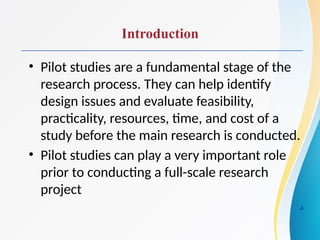
• Pilot studies are a fundamental stage of the
research process. They can help identify
design issues and evaluate feasibility,
practicality, resources, time, and cost of a
study before the main research is conducted.
• Pilot studies can play a very important role
prior to conducting a full-scale research
project
4
5
Key-Points of Pilot Study
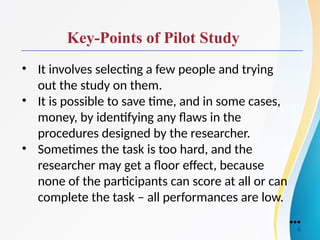
• It involves selecting a few people and trying
out the study on them.
• It is possible to save time, and in some cases,
money, by identifying any flaws in the
procedures designed by the researcher.
• Sometimes the task is too hard, and the
researcher may get a floor effect, because
none of the participants can score at all or can
complete the task – all performances are low.
●●●
6
Key-Points of Pilot Study
• A pilot study can help the researcher spot
any ambiguities (i.e. unusual things) or
confusion in the information given to
participants or problems with the task
devised.
• The opposite effect is a ceiling effect, when
the task is so easy that all achieve virtually
full marks or top performances and are
“hitting the ceiling”.
7
About Pilot Study
• Pilot studies also provide researchers with
preliminary data so they can gain insight into
the potential results of their proposed
experiment.
• However, pilot studies should not be used to
test hypotheses since the appropriate power
and sample size are not calculated.
• Rather, pilot studies should be used to assess
the feasibility of participant recruitment or
study design.
●●●
8
About Pilot Study
• By conducting a pilot study, researchers will
be better prepared to face the challenges that
might arise in the larger study, and they will
be more confident with the instruments they
will use for data collection.
• In some studies, multiple pilot studies may be
needed and qualitative and/or quantitative
methods may be used.
9
10
Advantages of Pilot Studies
• Increasing research quality
• Assessing the practicality and feasibility of
the main study
• Testing the efficacy of research instruments
• Identifying and addressing any weaknesses
or logistical problems
• Collecting preliminary data
• Estimating the time and costs required for
the project
●●●
11
Advantages of Pilot Studies
• Determining what resources are needed for
the study
• Identifying the necessity to modify procedures
that do not elicit useful data
• Adding credibility and dependability to the
study
• Pretesting the interview format
• Enabling researchers to develop consistent
practices and familiarize themselves with the
procedures in the protocol.
12
Limitations of Pilot Studies
• Require extra costs, time, and resources.
• Do not guarantee the success of the main
study.
• Contamination (ie: if data from the pilot
study or pilot participants are included in the
main study results).
• Funding bodies may be reluctant to fund a
further study if the pilot study results are
published.
13
14
Conclusion
 A pilot study can be used to evaluate the
feasibility of recruitment, randomization,
retention, assessment procedures, new methods,
and implementation of the novel intervention.
 A pilot study is not a hypothesis testing study.
Safety, efficacy and effectiveness are not
evaluated in a pilot.
15
References
• Google.com
• Wikipedia.org
• Studymafia.org
• Slidespanda.com
Thanks
To
StudyMafia.org

pilot-study.pptxbjknbb hjnnbh hjnnnnnvvv

  • 1.
    StudyMafia.Org Submitted To: SubmittedBy: Studymafia.org Studymafia.org Pilot Study
  • 2.
    Table Contents Definition Introduction Key-Points ofPilot Study About Pilot Study Advantages of Pilot Study Limitations of Pilot Study Conclusion 2
  • 3.
    Definition A pilot study,also called a 'feasibility' study, is a small scale preliminary study conducted before any large-scale quantitative research in order to evaluate the potential for a future, full-scale project. 3
  • 4.
    Introduction • Pilot studiesare a fundamental stage of the research process. They can help identify design issues and evaluate feasibility, practicality, resources, time, and cost of a study before the main research is conducted. • Pilot studies can play a very important role prior to conducting a full-scale research project 4
  • 5.
  • 6.
    Key-Points of PilotStudy • It involves selecting a few people and trying out the study on them. • It is possible to save time, and in some cases, money, by identifying any flaws in the procedures designed by the researcher. • Sometimes the task is too hard, and the researcher may get a floor effect, because none of the participants can score at all or can complete the task – all performances are low. ●●● 6
  • 7.
    Key-Points of PilotStudy • A pilot study can help the researcher spot any ambiguities (i.e. unusual things) or confusion in the information given to participants or problems with the task devised. • The opposite effect is a ceiling effect, when the task is so easy that all achieve virtually full marks or top performances and are “hitting the ceiling”. 7
  • 8.
    About Pilot Study •Pilot studies also provide researchers with preliminary data so they can gain insight into the potential results of their proposed experiment. • However, pilot studies should not be used to test hypotheses since the appropriate power and sample size are not calculated. • Rather, pilot studies should be used to assess the feasibility of participant recruitment or study design. ●●● 8
  • 9.
    About Pilot Study •By conducting a pilot study, researchers will be better prepared to face the challenges that might arise in the larger study, and they will be more confident with the instruments they will use for data collection. • In some studies, multiple pilot studies may be needed and qualitative and/or quantitative methods may be used. 9
  • 10.
  • 11.
    Advantages of PilotStudies • Increasing research quality • Assessing the practicality and feasibility of the main study • Testing the efficacy of research instruments • Identifying and addressing any weaknesses or logistical problems • Collecting preliminary data • Estimating the time and costs required for the project ●●● 11
  • 12.
    Advantages of PilotStudies • Determining what resources are needed for the study • Identifying the necessity to modify procedures that do not elicit useful data • Adding credibility and dependability to the study • Pretesting the interview format • Enabling researchers to develop consistent practices and familiarize themselves with the procedures in the protocol. 12
  • 13.
    Limitations of PilotStudies • Require extra costs, time, and resources. • Do not guarantee the success of the main study. • Contamination (ie: if data from the pilot study or pilot participants are included in the main study results). • Funding bodies may be reluctant to fund a further study if the pilot study results are published. 13
  • 14.
  • 15.
    Conclusion  A pilotstudy can be used to evaluate the feasibility of recruitment, randomization, retention, assessment procedures, new methods, and implementation of the novel intervention.  A pilot study is not a hypothesis testing study. Safety, efficacy and effectiveness are not evaluated in a pilot. 15
  • 16.
    References • Google.com • Wikipedia.org •Studymafia.org • Slidespanda.com
  • 17.

Editor's Notes

  • #2 SAY: Before we wrap up the course, let’s review what we have learned today. During this course, we have <READ the bullets from the slide.> GO to next slide.
  • #3 SAY: Before we wrap up the course, let’s review what we have learned today. During this course, we have <READ the bullets from the slide.> GO to next slide.
  • #4 SAY: Before we wrap up the course, let’s review what we have learned today. During this course, we have <READ the bullets from the slide.> GO to next slide.
  • #5 SAY: The purpose of epidemiology in public health practice is to discover the agent, host, and environmental factors that affect health; determine the relative importance of causes of illness, disability, and death; identify those segments of the population that have the greatest risk from specific causes of ill health; and evaluate the effectiveness of health programs and services in improving population health. GO to next slide.
  • #6 SAY: The purpose of epidemiology in public health practice is to discover the agent, host, and environmental factors that affect health; determine the relative importance of causes of illness, disability, and death; identify those segments of the population that have the greatest risk from specific causes of ill health; and evaluate the effectiveness of health programs and services in improving population health. GO to next slide.
  • #7 SAY: The purpose of epidemiology in public health practice is to discover the agent, host, and environmental factors that affect health; determine the relative importance of causes of illness, disability, and death; identify those segments of the population that have the greatest risk from specific causes of ill health; and evaluate the effectiveness of health programs and services in improving population health. GO to next slide.
  • #8 SAY: The purpose of epidemiology in public health practice is to discover the agent, host, and environmental factors that affect health; determine the relative importance of causes of illness, disability, and death; identify those segments of the population that have the greatest risk from specific causes of ill health; and evaluate the effectiveness of health programs and services in improving population health. GO to next slide.
  • #9 SAY: The purpose of epidemiology in public health practice is to discover the agent, host, and environmental factors that affect health; determine the relative importance of causes of illness, disability, and death; identify those segments of the population that have the greatest risk from specific causes of ill health; and evaluate the effectiveness of health programs and services in improving population health. GO to next slide.
  • #11 SAY: The purpose of epidemiology in public health practice is to discover the agent, host, and environmental factors that affect health; determine the relative importance of causes of illness, disability, and death; identify those segments of the population that have the greatest risk from specific causes of ill health; and evaluate the effectiveness of health programs and services in improving population health. GO to next slide.
  • #12 SAY: The purpose of epidemiology in public health practice is to discover the agent, host, and environmental factors that affect health; determine the relative importance of causes of illness, disability, and death; identify those segments of the population that have the greatest risk from specific causes of ill health; and evaluate the effectiveness of health programs and services in improving population health. GO to next slide.
  • #13 SAY: The purpose of epidemiology in public health practice is to discover the agent, host, and environmental factors that affect health; determine the relative importance of causes of illness, disability, and death; identify those segments of the population that have the greatest risk from specific causes of ill health; and evaluate the effectiveness of health programs and services in improving population health. GO to next slide.
  • #15 SAY: The purpose of epidemiology in public health practice is to discover the agent, host, and environmental factors that affect health; determine the relative importance of causes of illness, disability, and death; identify those segments of the population that have the greatest risk from specific causes of ill health; and evaluate the effectiveness of health programs and services in improving population health. GO to next slide.