GEORGE COLLEGE OF MANAGEMENT
AND SCIENCE
NAME: ALMAAZ AHMED
STREAM: B.OPTM
SEMESTER: 2nd SEM.
ROLL NO.: 16401719005
SUBJECT: PHYSIOLOGY(OCOLAR)
SUBMISSION DATE: 13th JAN’ 20
TOPIC
INTERNAL STRUCTURE OF
EYE BALL
INTRODUCTION
1. The human eye is an organ that reacts to light and
allows vision.
2. Rod and cone cells in the retina allow conscious
light perception and vision including color
differentiation and the perception of depth.
3. The human eye can differentiate between about
10 million colors and is possibly capable of
detecting a single photon.
4. The eye is part of the sensory nervous system.
STRUCTURE OF EYE
1. The eye is not shaped like a perfect sphere.
2. It is a fused two-piece unit, composed of the
anterior segment and the posterior segment.
3. The anterior segment is made up of the cornea,
iris and lens.
4. The cornea is transparent and more curved, and
is linked to the larger posterior segment,
5. It is composed of the vitreous, retina, choroid
and the outer white shell called the sclera.
6. Light energy enters the eye through the
cornea, through the pupil and then through the
lens.
7. The lens shape is changed for near focus and is
controlled by the ciliary muscle.
8. Photons of light falling on the light-sensitive
cells of the retina (photoreceptor cones and rods)
9. They are converted into electrical signals that
are transmitted to the brain by the optic nerve
and interpreted as sight and vision.
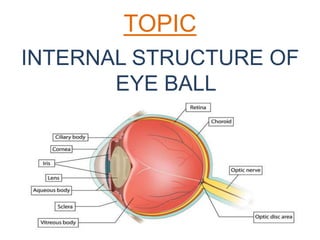
INTERNAL STRUCTURE OF EYE
BALL
1. Lens
2. Retina
3. Optic nerve
4. Aqueous humour
5. Vitreous humour
LENS
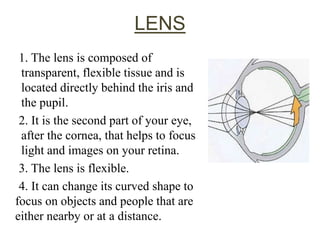
1. The lens is composed of
transparent, flexible tissue and is
located directly behind the iris and
the pupil.
2. It is the second part of your eye,
after the cornea, that helps to focus
light and images on your retina.
3. The lens is flexible.
4. It can change its curved shape to
focus on objects and people that are
either nearby or at a distance.
RETINA
1. The retina is the light-sensitive
tissue lining the back of our eye.
2. Light rays are focused onto
the retina through our cornea,
pupil and lens.
3.The retina converts the light
rays into impulses that travel
through the optic nerve to our
brain, where they are interpreted
as the images we see.
OPTIC NERVE
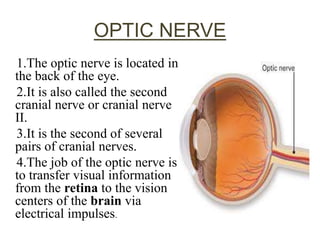
1.The optic nerve is located in
the back of the eye.
2.It is also called the second
cranial nerve or cranial nerve
II.
3.It is the second of several
pairs of cranial nerves.
4.The job of the optic nerve is
to transfer visual information
from the retina to the vision
centers of the brain via
electrical impulses.
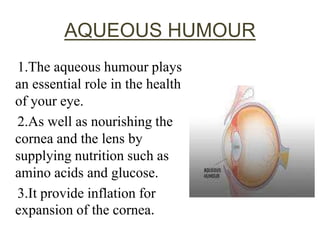
AQUEOUS HUMOUR
1.The aqueous humour plays
an essential role in the health
of your eye.
2.As well as nourishing the
cornea and the lens by
supplying nutrition such as
amino acids and glucose.
3.It provide inflation for
expansion of the cornea.
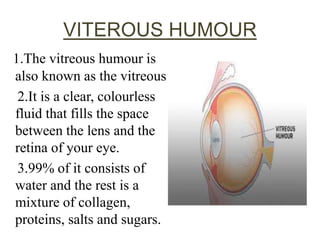
VITEROUS HUMOUR
1.The vitreous humour is
also known as the vitreous
2.It is a clear, colourless
fluid that fills the space
between the lens and the
retina of your eye.
3.99% of it consists of
water and the rest is a
mixture of collagen,
proteins, salts and sugars.
PHYSIOLOGY(OCULAR) PPT.pptx

PHYSIOLOGY(OCULAR) PPT.pptx

  • 1.
    GEORGE COLLEGE OFMANAGEMENT AND SCIENCE NAME: ALMAAZ AHMED STREAM: B.OPTM SEMESTER: 2nd SEM. ROLL NO.: 16401719005 SUBJECT: PHYSIOLOGY(OCOLAR) SUBMISSION DATE: 13th JAN’ 20
  • 2.
  • 3.
    INTRODUCTION 1. The humaneye is an organ that reacts to light and allows vision. 2. Rod and cone cells in the retina allow conscious light perception and vision including color differentiation and the perception of depth. 3. The human eye can differentiate between about 10 million colors and is possibly capable of detecting a single photon. 4. The eye is part of the sensory nervous system.
  • 4.
    STRUCTURE OF EYE 1.The eye is not shaped like a perfect sphere. 2. It is a fused two-piece unit, composed of the anterior segment and the posterior segment. 3. The anterior segment is made up of the cornea, iris and lens. 4. The cornea is transparent and more curved, and is linked to the larger posterior segment, 5. It is composed of the vitreous, retina, choroid and the outer white shell called the sclera.
  • 5.
    6. Light energyenters the eye through the cornea, through the pupil and then through the lens. 7. The lens shape is changed for near focus and is controlled by the ciliary muscle. 8. Photons of light falling on the light-sensitive cells of the retina (photoreceptor cones and rods) 9. They are converted into electrical signals that are transmitted to the brain by the optic nerve and interpreted as sight and vision.
  • 6.
    INTERNAL STRUCTURE OFEYE BALL 1. Lens 2. Retina 3. Optic nerve 4. Aqueous humour 5. Vitreous humour
  • 7.
    LENS 1. The lensis composed of transparent, flexible tissue and is located directly behind the iris and the pupil. 2. It is the second part of your eye, after the cornea, that helps to focus light and images on your retina. 3. The lens is flexible. 4. It can change its curved shape to focus on objects and people that are either nearby or at a distance.
  • 8.
    RETINA 1. The retinais the light-sensitive tissue lining the back of our eye. 2. Light rays are focused onto the retina through our cornea, pupil and lens. 3.The retina converts the light rays into impulses that travel through the optic nerve to our brain, where they are interpreted as the images we see.
  • 9.
    OPTIC NERVE 1.The opticnerve is located in the back of the eye. 2.It is also called the second cranial nerve or cranial nerve II. 3.It is the second of several pairs of cranial nerves. 4.The job of the optic nerve is to transfer visual information from the retina to the vision centers of the brain via electrical impulses.
  • 10.
    AQUEOUS HUMOUR 1.The aqueoushumour plays an essential role in the health of your eye. 2.As well as nourishing the cornea and the lens by supplying nutrition such as amino acids and glucose. 3.It provide inflation for expansion of the cornea.
  • 11.
    VITEROUS HUMOUR 1.The vitreoushumour is also known as the vitreous 2.It is a clear, colourless fluid that fills the space between the lens and the retina of your eye. 3.99% of it consists of water and the rest is a mixture of collagen, proteins, salts and sugars.