Physiology of
Menstruation
Done by : Najiya
Introduction
• The menstrual cycle is a series of natural changes in hormone
production and the structures of the uterus and ovaries of the
female reproductive system.
• The duration of each cycle varies between 20 and 45 days and
the average duration of each cycle is 28days.
• Cyclic changes occur in sex organs like ovary, uterus and
vagina.
Phases of menstrual cycle are :
a) Ovarian cycle
b)Uterine cycle
A. OVARIAN CYCLE
• The changes in the ovary depend on the gonadotropin secretion [FSH ,LH]
from anterior pituitary.
• During childhood there is no gonadotropin hence primordial follicle
remains inactive.
• Between the age of 11 and 15 , there is a cyclic secretion of FSH and LH
which produces changes in the ovary.
• Phases in ovarian cycle is divided into 3.
- Follicular phase
- ovulation phase
- Luteal phase.
I. FOLLICULAR PHASE
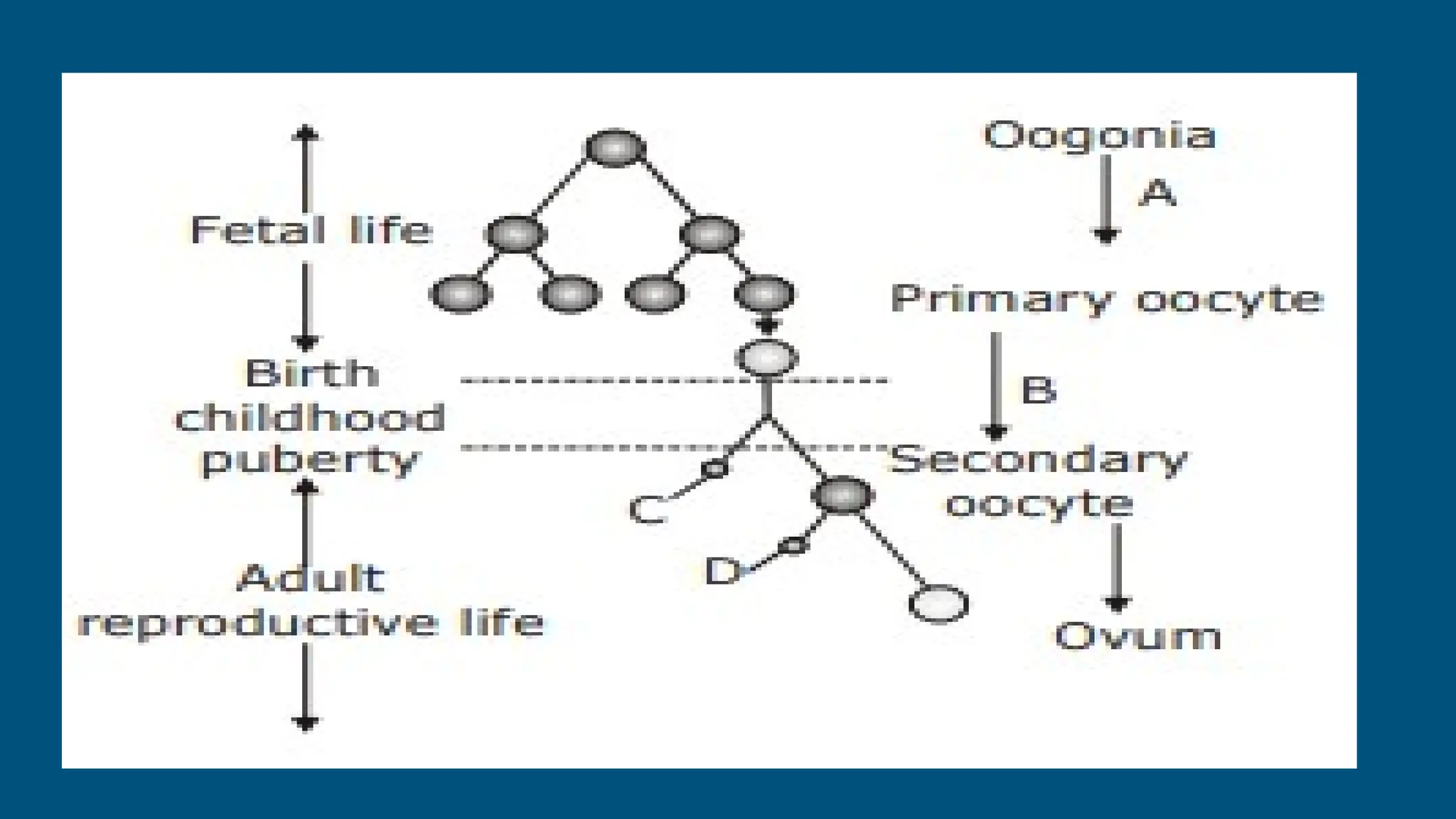
• At the time of puberty ovaries contain 3-4lakh of primordial follicles.
• FSH and LH secretion causes the growth of entire ovary along with the
follicles
• Action of FSH on the primordial follicle makes it 2-3times enlarged and
the spindle shaped cell gets converted into cuboidal cells. This is called a
primary follicle.
• By the action of FSH 6-12 primary follicles begins to enlarge each month
the cuboidal cells multiply and forms granulosa cells.
Around the oocyte a mucopolysaccharide layer is
formed known as the zonal pellucida.
• Theca interna and external will be formed by
condensation of ovarian stroma.
After the formation of antrum, the resulting
follicle is called the graafian follicle.
II . OVULATION
Ovulation is the process by which the secondary oocyte
extrudes from the ovary, due to rupture of a
mature graafian follicle.
• Usually, only one follicle ruptures in each cycle ;
however with the use of ovulation inducing drugs,
multifollicular recruitment is possible
.Ovulation usually occurs on the 14th day of a 28- day cycle, but
this is variable.
● It is the post ovulatory or secretory phase that is constant, I.e,
menstruation will occur 14 days after ovulation.
● Ovulation does not occur during pregnancy and lactation .
● Changes during ovulation can be :
a) Follicular changes
b) Endocrinologist changes
FOLLICULAR CHANGES
At puberty , the follicles begin to grow.
• Each month , 15-20 follicles are selected, but only one becomes the
dominant follicle and ovulates .
The follicles go through the following stages :
a ) Primary ( preantral) follicle
b) Secondary(antral,vesicular,Graafian)follicle
c) Preovulatory (mature Graafian) follicle
1. Primary follicle or pre antral follicle
ØThe primary oocyte grows and along with this , the
follicular cells become cuboidal, and from a single layer they
become stratified. These are the granulosa Cells.
ØThe granulosa cells rest on a basement membrane , which
separates it from the ovarian stroma.
ØThe granulosa cells and the primary oocyte now form a proper
glycoprotein coat for the oocyte called the ZONA PELLUCIDA.
2. Secondary follicle or Antral follicle
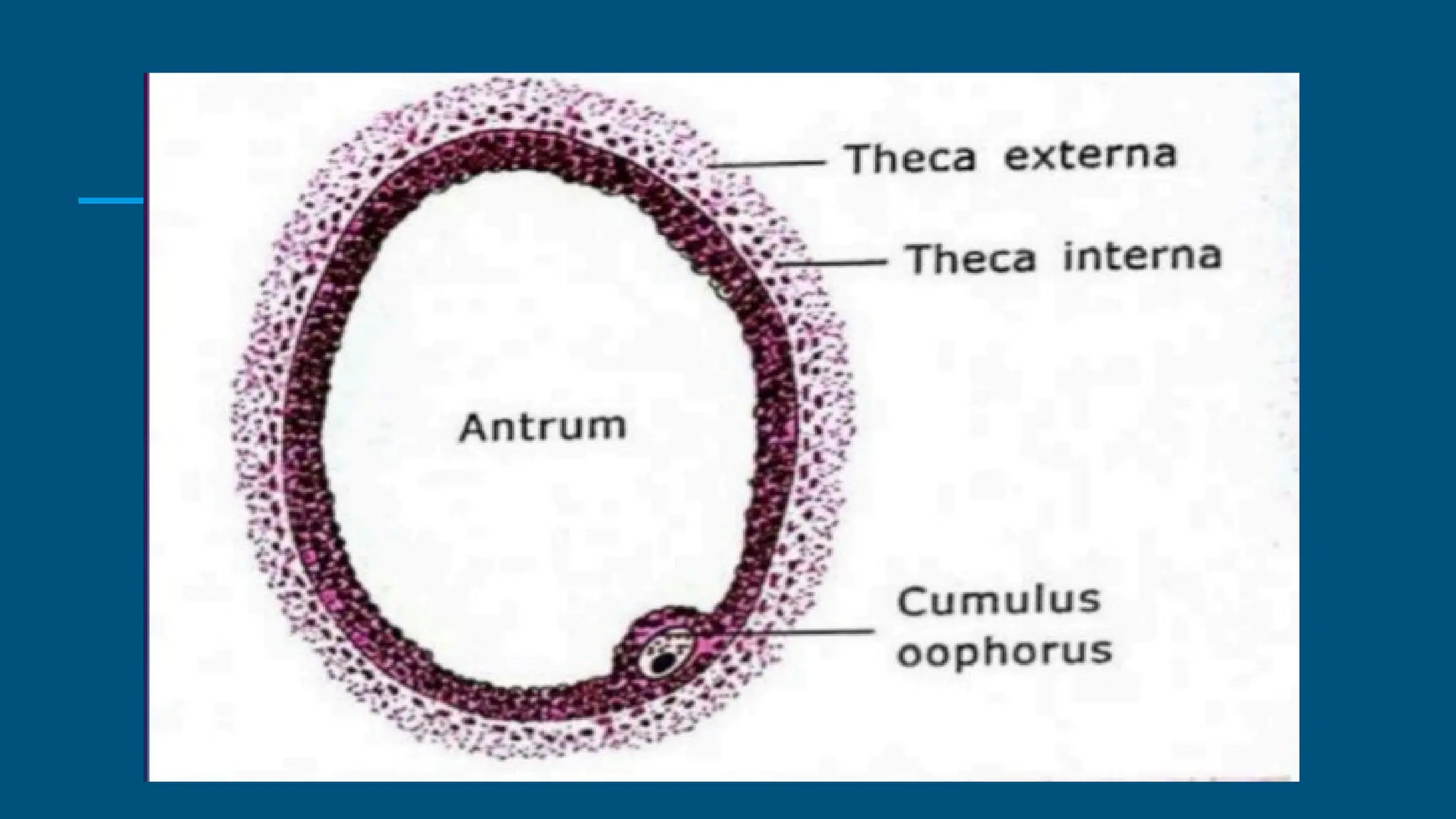
•As the follicle grows ,the surrounding ovarian stroma
called
the Theca folliculi organises itself into
Outer fibrous capsule - THECA EXTERNA
Inner secretory layer - THECA INTERNA
● A cavity appears in the mass of granulosa cells called ANTRUM.
● It gets filled with a fluid called LIQUOR FOLLICULI.
3. Graafian follicle
● The crescent shaped antrum enlarges to fill most of the follicle
and it enlarges to about 20 mm or more.
● The granulosa cells surrounding the primary oocyte are called
CUMULUS OOPHORUS.
● Theca interna at this stage is vascularised and is capable of
steroid genesis.
LH SURGE
● High estrogen levels in late follicular phase exerts a positive effect on LH
secretion
● The LH surge stimulates the resumption of the First Meiotic Division,
and formation of Secondary oocyte and first pollar body .
● With the LH surge , progesteron levels in the follicles rise and
progesterone serves to increase the distensibility in the follicular wall.
● FSH , LH ,and Progesterone stimulates the release of proteolytic
enzymes , which result in digestion of Collagen in the follicular wall.
● The preovulatory follicle moves to the surface ofthe ovary .
● This area of follicular wall is termed as Stigma .
•The cumulus oophorus separates from the granulosa, and
floats in the antrum.
• With the proteolytic digestion of stigma , the secondary
oocyte extrudes out, along with antral fluid and cumulus.
• The stigma soon closes.
III. LUTEAL PHASE
After the ovulation, the walls of the follicles collapse and blood
accumulates in the cavity of follicle. This is called corpus haemorhagicum.
• Under the influence of LH luteal cells gets filled which forms a lutein.
This is called CORPUS LUTEUM.
• 15-28 days is considered as luteal phase.
• If fertilisation doesn't occur, corpus luteun reached its maximum
development by 9 days post ovulation.
• It later shrinks and forms CORPUS ALBICANS.
B. UTERINE CYCLE
• It’s also called endometrial cycle.
• Endometrium of uterus contains 2 layer :- stratum basale and stratum
functoinale.
• Phases of uterine cycle are :
- Menstrual phase (1-4 days)
- Proliferative phase (5-14 days)
- Secretory phase (15-28 days)
Menstrual phase
• It is the phase where the stratum functionale is desquamated and
lasts for 4-5 days.
Proliferative phase
• The endometrium increases rapidly in thickness from the 5th to
14th
days of the cycle.
• It is mainly due to estrogen from the ovarian follicle and hence this
phase is called estrogenic phase or follicular phase.
Secretory phase
• This phase corresponds to the luteal phase of ovarian cycle.
• The endometrium becomes highly vascular and the glands
secretes a clear fluid in this phase.
• This phase represent the preparation of endometrium for
implantation.
Hormonal changes during menstruation
Follicular phase
• FSH and LH levels is high during the follicular phase. Both these are
necessary for the maturation of follicle to graafian follicle. The theca cells
produce estrogen in response to LH and progesterone in response to FSH.
Ovulation phase
• Estrogen level peaks towards the end of follicular phase. This exerts a
negative feedback on FSH secretion hence it decreases.
• Due to positive feedback of estrogen LH secretion increases 2 days before
the ovulation. This is called LH surge. This is very important in the process of
ovulation.
Luteal phase
• Formation and maintenance of corpus luteum is by LH
• After LH surge granulosa cells express new LH receptors and its
affinity for LH increases and FSH decreases. As a result there will be
high progesterone synthesis in granulosa cells.
• Hence progesterone becomes dominant in the luteal phase.

Physiology of Menstruation.pptx obstetrics

  • 1.
  • 2.
    Introduction • The menstrualcycle is a series of natural changes in hormone production and the structures of the uterus and ovaries of the female reproductive system. • The duration of each cycle varies between 20 and 45 days and the average duration of each cycle is 28days. • Cyclic changes occur in sex organs like ovary, uterus and vagina.
  • 3.
    Phases of menstrualcycle are : a) Ovarian cycle b)Uterine cycle
  • 4.
    A. OVARIAN CYCLE •The changes in the ovary depend on the gonadotropin secretion [FSH ,LH] from anterior pituitary. • During childhood there is no gonadotropin hence primordial follicle remains inactive. • Between the age of 11 and 15 , there is a cyclic secretion of FSH and LH which produces changes in the ovary. • Phases in ovarian cycle is divided into 3. - Follicular phase - ovulation phase - Luteal phase.
  • 5.
    I. FOLLICULAR PHASE •At the time of puberty ovaries contain 3-4lakh of primordial follicles. • FSH and LH secretion causes the growth of entire ovary along with the follicles • Action of FSH on the primordial follicle makes it 2-3times enlarged and the spindle shaped cell gets converted into cuboidal cells. This is called a primary follicle. • By the action of FSH 6-12 primary follicles begins to enlarge each month the cuboidal cells multiply and forms granulosa cells.
  • 6.
    Around the oocytea mucopolysaccharide layer is formed known as the zonal pellucida. • Theca interna and external will be formed by condensation of ovarian stroma. After the formation of antrum, the resulting follicle is called the graafian follicle.
  • 8.
    II . OVULATION Ovulationis the process by which the secondary oocyte extrudes from the ovary, due to rupture of a mature graafian follicle. • Usually, only one follicle ruptures in each cycle ; however with the use of ovulation inducing drugs, multifollicular recruitment is possible .Ovulation usually occurs on the 14th day of a 28- day cycle, but this is variable.
  • 9.
    ● It isthe post ovulatory or secretory phase that is constant, I.e, menstruation will occur 14 days after ovulation. ● Ovulation does not occur during pregnancy and lactation . ● Changes during ovulation can be : a) Follicular changes b) Endocrinologist changes
  • 11.
    FOLLICULAR CHANGES At puberty, the follicles begin to grow. • Each month , 15-20 follicles are selected, but only one becomes the dominant follicle and ovulates . The follicles go through the following stages : a ) Primary ( preantral) follicle b) Secondary(antral,vesicular,Graafian)follicle c) Preovulatory (mature Graafian) follicle
  • 12.
    1. Primary follicleor pre antral follicle ØThe primary oocyte grows and along with this , the follicular cells become cuboidal, and from a single layer they become stratified. These are the granulosa Cells. ØThe granulosa cells rest on a basement membrane , which separates it from the ovarian stroma. ØThe granulosa cells and the primary oocyte now form a proper glycoprotein coat for the oocyte called the ZONA PELLUCIDA.
  • 14.
    2. Secondary follicleor Antral follicle •As the follicle grows ,the surrounding ovarian stroma called the Theca folliculi organises itself into Outer fibrous capsule - THECA EXTERNA Inner secretory layer - THECA INTERNA ● A cavity appears in the mass of granulosa cells called ANTRUM. ● It gets filled with a fluid called LIQUOR FOLLICULI.
  • 16.
    3. Graafian follicle ●The crescent shaped antrum enlarges to fill most of the follicle and it enlarges to about 20 mm or more. ● The granulosa cells surrounding the primary oocyte are called CUMULUS OOPHORUS. ● Theca interna at this stage is vascularised and is capable of steroid genesis.
  • 18.
    LH SURGE ● Highestrogen levels in late follicular phase exerts a positive effect on LH secretion ● The LH surge stimulates the resumption of the First Meiotic Division, and formation of Secondary oocyte and first pollar body . ● With the LH surge , progesteron levels in the follicles rise and progesterone serves to increase the distensibility in the follicular wall. ● FSH , LH ,and Progesterone stimulates the release of proteolytic enzymes , which result in digestion of Collagen in the follicular wall. ● The preovulatory follicle moves to the surface ofthe ovary . ● This area of follicular wall is termed as Stigma .
  • 19.
    •The cumulus oophorusseparates from the granulosa, and floats in the antrum. • With the proteolytic digestion of stigma , the secondary oocyte extrudes out, along with antral fluid and cumulus. • The stigma soon closes.
  • 20.
    III. LUTEAL PHASE Afterthe ovulation, the walls of the follicles collapse and blood accumulates in the cavity of follicle. This is called corpus haemorhagicum. • Under the influence of LH luteal cells gets filled which forms a lutein. This is called CORPUS LUTEUM. • 15-28 days is considered as luteal phase. • If fertilisation doesn't occur, corpus luteun reached its maximum development by 9 days post ovulation. • It later shrinks and forms CORPUS ALBICANS.
  • 21.
    B. UTERINE CYCLE •It’s also called endometrial cycle. • Endometrium of uterus contains 2 layer :- stratum basale and stratum functoinale. • Phases of uterine cycle are : - Menstrual phase (1-4 days) - Proliferative phase (5-14 days) - Secretory phase (15-28 days)
  • 22.
    Menstrual phase • Itis the phase where the stratum functionale is desquamated and lasts for 4-5 days. Proliferative phase • The endometrium increases rapidly in thickness from the 5th to 14th days of the cycle. • It is mainly due to estrogen from the ovarian follicle and hence this phase is called estrogenic phase or follicular phase.
  • 23.
    Secretory phase • Thisphase corresponds to the luteal phase of ovarian cycle. • The endometrium becomes highly vascular and the glands secretes a clear fluid in this phase. • This phase represent the preparation of endometrium for implantation.
  • 25.
    Hormonal changes duringmenstruation Follicular phase • FSH and LH levels is high during the follicular phase. Both these are necessary for the maturation of follicle to graafian follicle. The theca cells produce estrogen in response to LH and progesterone in response to FSH. Ovulation phase • Estrogen level peaks towards the end of follicular phase. This exerts a negative feedback on FSH secretion hence it decreases. • Due to positive feedback of estrogen LH secretion increases 2 days before the ovulation. This is called LH surge. This is very important in the process of ovulation.
  • 26.
    Luteal phase • Formationand maintenance of corpus luteum is by LH • After LH surge granulosa cells express new LH receptors and its affinity for LH increases and FSH decreases. As a result there will be high progesterone synthesis in granulosa cells. • Hence progesterone becomes dominant in the luteal phase.