MODULE 1
CLASSICAL MECHANICS
INTRODUCTION
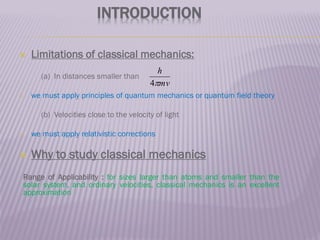
 Limitations of classical mechanics:
(a) In distances smaller than
 we must apply principles of quantum mechanics or quantum field theory
(b) Velocities close to the velocity of light
 we must apply relativistic corrections
 Why to study classical mechanics
Range of Applicability : for sizes larger than atoms and smaller than the
solar system, and ordinary velocities, classical mechanics is an excellent
approximation
mv
h

4
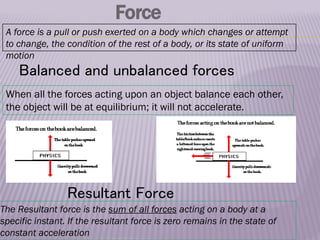
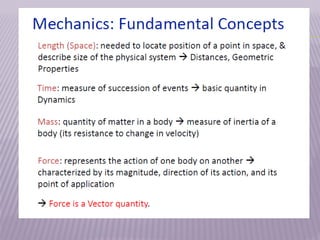
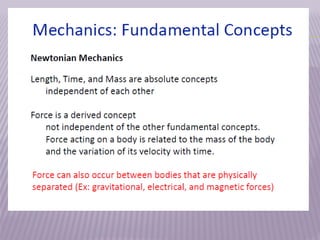
Force
A force is a pull or push exerted on a body which changes or attempt
to change, the condition of the rest of a body, or its state of uniform
motion
When all the forces acting upon an object balance each other,
the object will be at equilibrium; it will not accelerate.

Resultant Force
The Resultant force is the sum of all forces acting on a body at a
specific instant. If the resultant force is zero remains in the state of
constant acceleration
Balanced and unbalanced forces
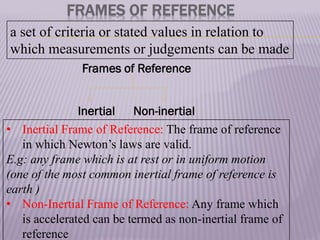
a set of criteria or stated values in relation to
which measurements or judgements can be made
FRAMES OF REFERENCE
Frames of Reference
Inertial Non-inertial
• Inertial Frame of Reference: The frame of reference
in which Newton’s laws are valid.
E.g: any frame which is at rest or in uniform motion
(one of the most common inertial frame of reference is
earth )
• Non-Inertial Frame of Reference: Any frame which
is accelerated can be termed as non-inertial frame of
reference
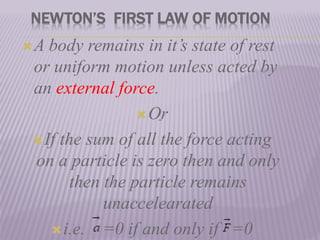
NEWTON’S FIRST LAW OF MOTION
A body remains in it’s state of rest
or uniform motion unless acted by
an external force.
Or
If the sum of all the force acting
on a particle is zero then and only
then the particle remains
unaccelearated
i.e. =0 if and only if =0

.
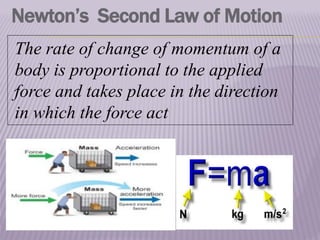
Newton’s Second Law of Motion
The rate of change of momentum of a
body is proportional to the applied
force and takes place in the direction
in which the force act
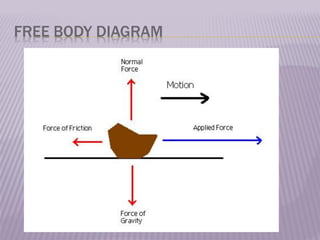
FREE BODY DIAGRAM
.
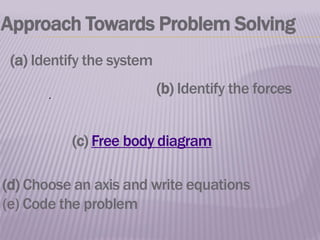
Approach Towards Problem Solving
(a) Identify the system
(b) Identify the forces
(c) Free body diagram
(d) Choose an axis and write equations
(e) Code the problem
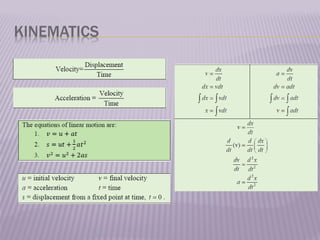
KINEMATICS
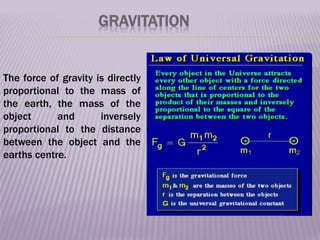
GRAVITATION
The force of gravity is directly
proportional to the mass of
the earth, the mass of the
object and inversely
proportional to the distance
between the object and the
earths centre.
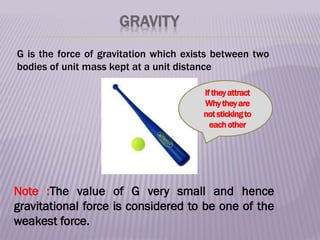
GRAVITY
G is the force of gravitation which exists between two
bodies of unit mass kept at a unit distance
Note :The value of G very small and hence
gravitational force is considered to be one of the
weakest force.
Iftheyattract
Whytheyare
notstickingto
eachother
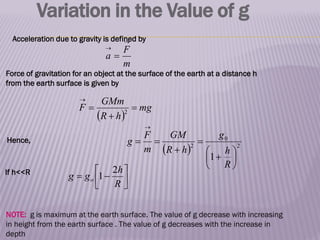
Acceleration due to gravity is defined by
Variation in the Value of g
m
F
a



Force of gravitation for an object at the surface of the earth at a distance h
from the earth surface is given by
 
mg
h
R
GMm
F 



2
  2
0
2
1 











R
h
g
h
R
GM
m
F
g
Hence,
If h<<R








R
h
g
g o
2
1
NOTE: g is maximum at the earth surface. The value of g decrease with increasing
in height from the earth surface . The value of g decreases with the increase in
depth
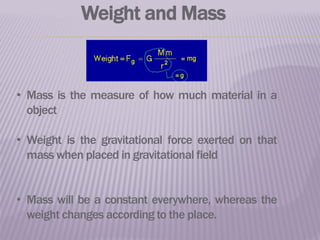
• Mass is the measure of how much material in a
object
• Weight is the gravitational force exerted on that
mass when placed in gravitational field
• Mass will be a constant everywhere, whereas the
weight changes according to the place.
Weight and Mass
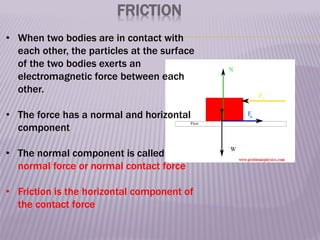
FRICTION
• When two bodies are in contact with
each other, the particles at the surface
of the two bodies exerts an
electromagnetic force between each
other.
• The force has a normal and horizontal
component
• The normal component is called
normal force or normal contact force
• Friction is the horizontal component of
the contact force
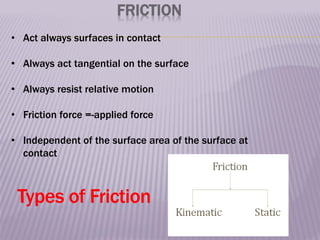
FRICTION
• Act always surfaces in contact
• Always act tangential on the surface
• Always resist relative motion
• Friction force =-applied force
• Independent of the surface area of the surface at
contact
Types of Friction
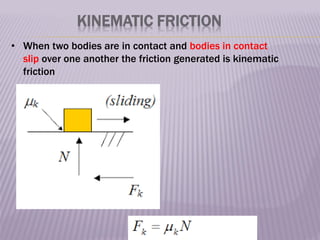
KINEMATIC FRICTION
• When two bodies are in contact and bodies in contact
slip over one another the friction generated is kinematic
friction
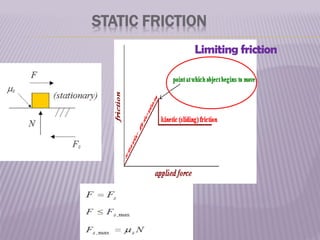
STATIC FRICTION
Limiting friction
WORK AND ENERGY
Energy is the capacity of a physical system to do
work
Work, energy transferred by a force
Or
Force multiplied by displacement of point of the
application of force in the direction of force.
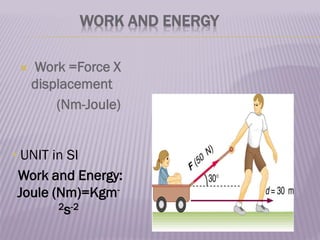
WORK AND ENERGY
 Work =Force X
displacement
(Nm-Joule)
• UNIT in SI
Work and Energy:
Joule (Nm)=Kgm-
2s-2
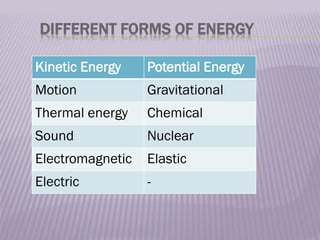
DIFFERENT FORMS OF ENERGY
Kinetic Energy Potential Energy
Motion Gravitational
Thermal energy Chemical
Sound Nuclear
Electromagnetic Elastic
Electric -
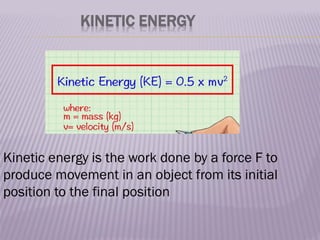
KINETIC ENERGY
Kinetic energy is the work done by a force F to
produce movement in an object from its initial
position to the final position
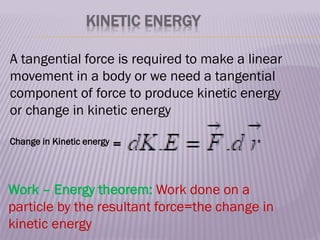
KINETIC ENERGY
A tangential force is required to make a linear
movement in a body or we need a tangential
component of force to produce kinetic energy
or change in kinetic energy
Change in Kinetic energy =
Work – Energy theorem: Work done on a
particle by the resultant force=the change in
kinetic energy
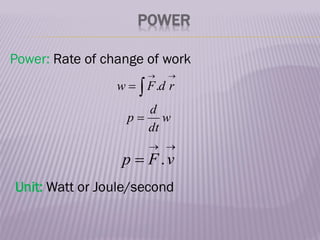
POWER
Power: Rate of change of work
Unit: Watt or Joule/second



 r
d
F
w .
w
dt
d
p 


 v
F
p .
CONSERVATIVE &
NON-CONSERVATIVE FORCE
If the work done by a force depends only on
the initial and final state and not on the path
taken, then it is called a conservative force.
Example of conservative force: Gravity and
coulomb force
Example of non-conservative force : force of
friction
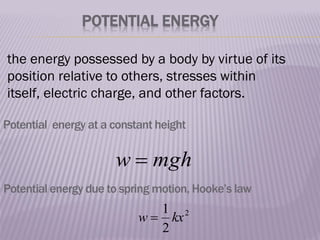
POTENTIAL ENERGY
the energy possessed by a body by virtue of its
position relative to others, stresses within
itself, electric charge, and other factors.
Potential energy at a constant height
mgh
w 
Potential energy due to spring motion, Hooke’s law
2
2
1
kx
w 
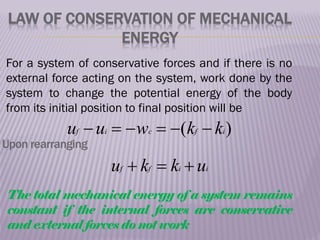
LAW OF CONSERVATION OF MECHANICAL
ENERGY
For a system of conservative forces and if there is no
external force acting on the system, work done by the
system to change the potential energy of the body
from its initial position to final position will be
)
( i
f
c
i
f k
k
w
u
u 





i
i
f
f u
k
k
u 


Upon rearranging
The total mechanical energy of a system remains
constant if the internal forces are conservative
and external forces do not work
ROTATIONAL MOTION
Axis of rotation: If each particle in a rigid body moves in a
circle and the centre of the circles lies in a straight line, then
the plane of all the circles traced by the particles are
perpendicular to the straight line. Then the body is said to be
rotating about a line and this line is called the axis of rotation.
E.g. Fan, Gas stove nob etc.
For all the particles exhibit circular motion . The particles near
to the line move less faster as compared to the particles away
from the straight line. Hence all the particles covers one
rotation at the same time
ROTATIONAL MOTION
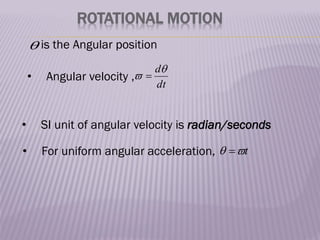
 is the Angular position
• Angular velocity ,
dt
d
 
• SI unit of angular velocity is radian/seconds
• For uniform angular acceleration, t

 
ROTATIONAL MOTION
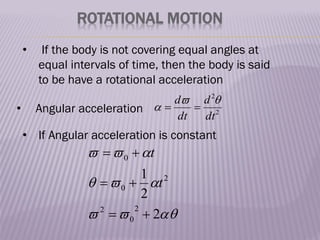
• If the body is not covering equal angles at
equal intervals of time, then the body is said
to be have a rotational acceleration
2
2
dt
d
dt
d 

 

• Angular acceleration
• If Angular acceleration is constant









2
2
1
2
0
2
2
0
0






t
t
ROTATIONAL MOTION
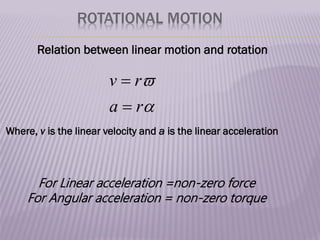
Relation between linear motion and rotation


r
a
r
v


Where, v is the linear velocity and a is the linear acceleration
For Linear acceleration =non-zero force
For Angular acceleration = non-zero torque
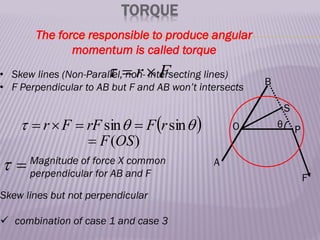
TORQUE
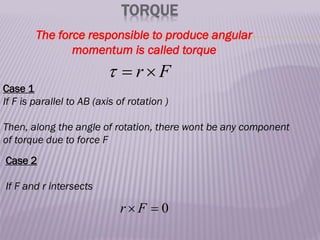
The force responsible to produce angular
momentum is called torque
F
r 


Case 1
If F is parallel to AB (axis of rotation )
Then, along the angle of rotation, there wont be any component
of torque due to force F
Case 2
If F and r intersects
0

 F
r
TORQUE
The force responsible to produce angular
momentum is called torque
F
r 


• Skew lines (Non-Parallel, non- intersecting lines)
• F Perpendicular to AB but F and AB won’t intersects
A
B
O
S
P
F
θ
 


 sin
sin r
F
rF
F
r 



)
(OS
F


 Magnitude of force X common
perpendicular for AB and F
Skew lines but not perpendicular
 combination of case 1 and case 3
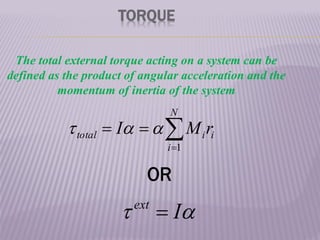
TORQUE




N
i
i
i
total r
M
I
1



The total external torque acting on a system can be
defined as the product of angular acceleration and the
momentum of inertia of the system

 I
ext

OR
 1.39 1.40 2.8 2.9 2.22

Physics Module 1.pdf on classical mechanics.

  • 1.
  • 3.
    INTRODUCTION  Limitations ofclassical mechanics: (a) In distances smaller than  we must apply principles of quantum mechanics or quantum field theory (b) Velocities close to the velocity of light  we must apply relativistic corrections  Why to study classical mechanics Range of Applicability : for sizes larger than atoms and smaller than the solar system, and ordinary velocities, classical mechanics is an excellent approximation mv h  4
  • 4.
    Force A force isa pull or push exerted on a body which changes or attempt to change, the condition of the rest of a body, or its state of uniform motion When all the forces acting upon an object balance each other, the object will be at equilibrium; it will not accelerate. Resultant Force The Resultant force is the sum of all forces acting on a body at a specific instant. If the resultant force is zero remains in the state of constant acceleration Balanced and unbalanced forces
  • 5.
    a set ofcriteria or stated values in relation to which measurements or judgements can be made FRAMES OF REFERENCE Frames of Reference Inertial Non-inertial • Inertial Frame of Reference: The frame of reference in which Newton’s laws are valid. E.g: any frame which is at rest or in uniform motion (one of the most common inertial frame of reference is earth ) • Non-Inertial Frame of Reference: Any frame which is accelerated can be termed as non-inertial frame of reference
  • 6.
    NEWTON’S FIRST LAWOF MOTION A body remains in it’s state of rest or uniform motion unless acted by an external force. Or If the sum of all the force acting on a particle is zero then and only then the particle remains unaccelearated i.e. =0 if and only if =0 
  • 7.
    . Newton’s Second Lawof Motion The rate of change of momentum of a body is proportional to the applied force and takes place in the direction in which the force act
  • 11.
  • 12.
    . Approach Towards ProblemSolving (a) Identify the system (b) Identify the forces (c) Free body diagram (d) Choose an axis and write equations (e) Code the problem
  • 13.
  • 14.
    GRAVITATION The force ofgravity is directly proportional to the mass of the earth, the mass of the object and inversely proportional to the distance between the object and the earths centre.
  • 15.
    GRAVITY G is theforce of gravitation which exists between two bodies of unit mass kept at a unit distance Note :The value of G very small and hence gravitational force is considered to be one of the weakest force. Iftheyattract Whytheyare notstickingto eachother
  • 16.
    Acceleration due togravity is defined by Variation in the Value of g m F a    Force of gravitation for an object at the surface of the earth at a distance h from the earth surface is given by   mg h R GMm F     2   2 0 2 1             R h g h R GM m F g Hence, If h<<R         R h g g o 2 1 NOTE: g is maximum at the earth surface. The value of g decrease with increasing in height from the earth surface . The value of g decreases with the increase in depth
  • 17.
    • Mass isthe measure of how much material in a object • Weight is the gravitational force exerted on that mass when placed in gravitational field • Mass will be a constant everywhere, whereas the weight changes according to the place. Weight and Mass
  • 18.
    FRICTION • When twobodies are in contact with each other, the particles at the surface of the two bodies exerts an electromagnetic force between each other. • The force has a normal and horizontal component • The normal component is called normal force or normal contact force • Friction is the horizontal component of the contact force
  • 19.
    FRICTION • Act alwayssurfaces in contact • Always act tangential on the surface • Always resist relative motion • Friction force =-applied force • Independent of the surface area of the surface at contact Types of Friction
  • 20.
    KINEMATIC FRICTION • Whentwo bodies are in contact and bodies in contact slip over one another the friction generated is kinematic friction
  • 21.
  • 22.
    WORK AND ENERGY Energyis the capacity of a physical system to do work Work, energy transferred by a force Or Force multiplied by displacement of point of the application of force in the direction of force.
  • 23.
    WORK AND ENERGY Work =Force X displacement (Nm-Joule) • UNIT in SI Work and Energy: Joule (Nm)=Kgm- 2s-2
  • 24.
    DIFFERENT FORMS OFENERGY Kinetic Energy Potential Energy Motion Gravitational Thermal energy Chemical Sound Nuclear Electromagnetic Elastic Electric -
  • 25.
    KINETIC ENERGY Kinetic energyis the work done by a force F to produce movement in an object from its initial position to the final position
  • 26.
    KINETIC ENERGY A tangentialforce is required to make a linear movement in a body or we need a tangential component of force to produce kinetic energy or change in kinetic energy Change in Kinetic energy = Work – Energy theorem: Work done on a particle by the resultant force=the change in kinetic energy
  • 27.
    POWER Power: Rate ofchange of work Unit: Watt or Joule/second     r d F w . w dt d p     v F p .
  • 28.
    CONSERVATIVE & NON-CONSERVATIVE FORCE Ifthe work done by a force depends only on the initial and final state and not on the path taken, then it is called a conservative force. Example of conservative force: Gravity and coulomb force Example of non-conservative force : force of friction
  • 29.
    POTENTIAL ENERGY the energypossessed by a body by virtue of its position relative to others, stresses within itself, electric charge, and other factors. Potential energy at a constant height mgh w  Potential energy due to spring motion, Hooke’s law 2 2 1 kx w 
  • 30.
    LAW OF CONSERVATIONOF MECHANICAL ENERGY For a system of conservative forces and if there is no external force acting on the system, work done by the system to change the potential energy of the body from its initial position to final position will be ) ( i f c i f k k w u u       i i f f u k k u    Upon rearranging The total mechanical energy of a system remains constant if the internal forces are conservative and external forces do not work
  • 31.
    ROTATIONAL MOTION Axis ofrotation: If each particle in a rigid body moves in a circle and the centre of the circles lies in a straight line, then the plane of all the circles traced by the particles are perpendicular to the straight line. Then the body is said to be rotating about a line and this line is called the axis of rotation. E.g. Fan, Gas stove nob etc. For all the particles exhibit circular motion . The particles near to the line move less faster as compared to the particles away from the straight line. Hence all the particles covers one rotation at the same time
  • 32.
    ROTATIONAL MOTION  isthe Angular position • Angular velocity , dt d   • SI unit of angular velocity is radian/seconds • For uniform angular acceleration, t   
  • 33.
    ROTATIONAL MOTION • Ifthe body is not covering equal angles at equal intervals of time, then the body is said to be have a rotational acceleration 2 2 dt d dt d      • Angular acceleration • If Angular acceleration is constant          2 2 1 2 0 2 2 0 0       t t
  • 34.
    ROTATIONAL MOTION Relation betweenlinear motion and rotation   r a r v   Where, v is the linear velocity and a is the linear acceleration For Linear acceleration =non-zero force For Angular acceleration = non-zero torque
  • 35.
    TORQUE The force responsibleto produce angular momentum is called torque F r    Case 1 If F is parallel to AB (axis of rotation ) Then, along the angle of rotation, there wont be any component of torque due to force F Case 2 If F and r intersects 0   F r
  • 36.
    TORQUE The force responsibleto produce angular momentum is called torque F r    • Skew lines (Non-Parallel, non- intersecting lines) • F Perpendicular to AB but F and AB won’t intersects A B O S P F θ      sin sin r F rF F r     ) (OS F    Magnitude of force X common perpendicular for AB and F Skew lines but not perpendicular  combination of case 1 and case 3
  • 37.
    TORQUE     N i i i total r M I 1    The totalexternal torque acting on a system can be defined as the product of angular acceleration and the momentum of inertia of the system   I ext  OR
  • 38.
     1.39 1.402.8 2.9 2.22