Fraud Awareness Training
CORPORATE STATEMENT Fraudulent, abusive and wasteful health care billing drains billions of dollars from the nation’s health care system.  This price is too steep—higher costs for all society as well as cutbacks in access to essential care.  Premier Healthcare Exchange is committed to protect and preserve the integrity and availability of health care resources to our recipients, our healthcare partners and the general community.  Premier Healthcare Exchange will perform these activities by employing a Special Investigations Unit (SIU) to detect, prevent and eliminate fraud, abuse and waste at the provider, recipient and Health Plan level.
CORPORATE STATEMENT (Con’t) Premier Healthcare Exchange will utilize electronic systems and thorough training of our employees to identify possible acts of fraud, waste and abuse.  When such acts are identified, we will seek effective remedies to identify overpaid amounts; prevent future occurrences of fraud, abuse and waste; and report such offenses to the proper authorities.
Fraud Contacts Special Investigations Unit Laura Kanthal-Cubides   Manager   S pecial Investigations Unit   Premier Healthcare Exchange 2 Crossroads Drive Bedminster, NJ 07921 908.658.3535 ext: 264
Fraud Contacts Fraud Hotline 1-877-PHX-TIPS  E-mail [email_address] Correspondence Premier Healthcare Exchange 2 Crossroads Drive Bedminster, NJ 07921
Fraud Awareness Definitions FRAUD is an intentional representation that an individual knows to be false or does not believe to be true and makes, knowing that the representation could result in some unauthorized benefit to himself/herself or some other person.  ABUSE is generally defined as activities that unjustly enrich a person through the receipt of benefit payments but where the intent to deceive is not present or an attempt by an individual to unjustly obtain a benefit payment.  WASTE   is generally defined as activities involving payment or the attempt to obtain payment for items or services where there was no intent to deceive or misrepresent but that the outcome of poor or inefficient methods results in unnecessary costs.
Fraud Awareness Healthcare Fraud An intentional deception or misrepresentation that the individual or entity makes knowing that the misrepresentation could result in some unauthorized benefit to the individual, the entity, or some other party. Examples include:  Upcoding   When a provider submits a claim using an incorrect code for the service(s) actually provided.  The code used is actually for a similar service provided but is reimbursed at a higher level. Unbundling   The improper submission of separate claims for services that should be billed together as one combined service.  
Fraud Awareness Services not rendered   When a provider bills for services that were not performed.  This fraud can be committed by any type of provider.  The elderly are very likely to be victimized in this way.   Medical necessity issues  An example would be when a provider exaggerates, misrepresents or falsifies a  diagnosis or symptoms to  obtain coverage for services which would otherwise be limited or denied.  This type of fraud poses a particular problem by exhausting benefits for services which are already restricted, such as physical therapy or psychiatric services.   Disguised Services   An example would be billing routine prophylactic dental cleaning as deep scaling, or collagen injections billed as acne surgery.
Fraud Awareness Self-referral   This occurs when a physician has an interest in a home health agency, supply company or pharmacy.  In and of itself, self-referral is not a crime.  However, unusually high utilization or referrals from the physician with such an interest may indicate potential fraud and abuse.   Falsified diagnosis   This type of fraud is used to obtain payment for services which are specific contract exclusions.   Masked provider   This type of fraud is used to obtain payment for services which might otherwise be denied.  For example, a clinical social worker provides the service, but a psychologist submits the claims as if he/she provided the service.  Another scenario might be a chiropractor providing manipulation, but a medical doctor submits a claim for physical therapy.
Fraud Awareness False Claims This occurs when a physician submits a claim for reimbursement for medical  services provided to an insured when in fact the services were not  performed.   Claim Fraud This type of fraud occurs when a consumer makes a misrepresentation in order to receive a benefit payment or higher payment that they are not entitled to.    Application Fraud  This exists when a party makes material misrepresentations on an application for insurance with the intent to defraud the insurance company.   Eligibility Fraud   This occurs when a party makes misrepresentations so that benefits are received  by persons who are not eligible for those benefits.
Fraud Awareness Most Common Types of Fraud Provider Fraud: Billing false claims Billing Schemes (Upcoding, Unbundling) Billing that appears to be a deliberate application for duplicate payment of services Billing of non-covered services as covered items Performing medically unnecessary services in order to obtain insurance reimbursement Incorrect reporting of diagnoses or procedures to maximize insurance reimbursement Misrepresentation of dates, descriptions of services, or subscribers/providers
Fraud Awareness Most Common Types of Fraud Consumer Fraud: Claim Fraud—a party submits a claim that contains false, exaggerated or deliberately misleading information designed to result in an undeserved payment. Application Fraud—a party makes material misrepresentations on an application for insurance with the intent to defraud the insurance company. Identity Fraud: Obtaining service or coverage by using a false identity. Allowing someone else to use an insurance card to obtain a service.
Red Flags A  “ Red Flag ”  is only an indicator of possible fraudulent activity, not proof of any actual wrongdoing.  Most claims honestly reflect the services that were provided and fraud indicators are often due to honest error.  Common sense and the context in which a Red Flag appears on a claim should be considered before referring the claim for investigation.   Patient states service was not provided after receiving EOB    Provider states service was not provided after receiving remittance advice    Previously rejected claim is resubmitted with different diagnosis or procedure code Services are not documented in medical record     
Red Flags Medical record does not substantiate submitted services Claim form contains different inks or handwritings    Claim form contains erasures, strikeovers or whiteouts    Handwritten and printed information is mixed on claim form    Claim forms are completely hand-written    Medical terms are misspelled    Medical credentials are not known
Red Flags Unusually long time lapse between date  of procedure and receipt of claim  Provider letterhead is typed, not printed,  or are missing telephone number, address or logo Medical records are all typed, no handwritten observations  Provider ’ s medical credentials are omitted from claim form — Dr  John Smith instead of John Smith,  MD — or title and credentials are both used — Dr  John Smith, MD  Provider ’ s signature is missing from claim form or medical record  Frequent telephone inquiries by patient or provider for payment  Provider ’ s medical credentials do not match type of service provided
Red Flags Excessive pressure by patient, provider or attorney to pay a particular claim quickly   Excessive number of treatments for single date of service Information is not in date sequence on claim form or in medical record    A series of claims from same provider contain overlapping dates of treatment   Routine medical services are excessively priced    Hospital claim is received but no corresponding claims for professional treatment are submitted  Surgery claim is received but no record of hospitalization is on record   
Red Flags Receipts are printed on white bond paper without letterhead   Receipts are inconsistent with standard styles   Provider advertises for  “ free ”  services  Provider and patient share same address    Same treatments are provided to multiple family members on same date of service    Routine procedures are performed on Sundays or holidays    Claimant or provider refuses to release medical record. Claims are submitted with photocopied receipts instead of originals
Red Flags Organized Schemes   Provider address consists of a post office box number followed by a three-letter code such as  “ SJO ”  or  “ PTY ”   Routine medical services are performed by providers located in states other than where patient resides  Durable medical equipment claims submitted by providers located in states other than where patient resides    
Red Flags Remember! A  “ Red Flag ”  is only an indicator of possible fraudulent activity, not proof of any actual wrongdoing.  Most claims honestly reflect the services that were provided and fraud indicators are often due to honest error.  Common sense and the context in which a Red Flag appears on a claim should be considered before referring the claim for investigation.
Health Care Cost Trends In 2008, total national health expenditures were expected to rise 6.9 percent -- two times the rate of inflation. Total spending was $2.4 TRILLION in 2007, or $7900 per person. Over the time period (2008-2018), average annual health spending growth is anticipated outpace average annual growth in the overall economy (4.1 percent) by 2.1 percentage points per year. By 2018, national health spending is expected comprise just over one-fifth (20.3 percent) of Gross Domestic Product (GDP).  By 2018, total hospital spending is expected to reach nearly $1.4 trillion, up from a projected $746.4 billion in 2008. Prescription drug expenditures are another major driver  of healthcare costs. They are projected to compose a  growing portion of total costs over  the next decade. Sources:  Medical Cost Reference Guide, Blue Cross Blue Shield Association, June 2003; Data Bulletin #27, Center for Studying Health System Change, June 2004.
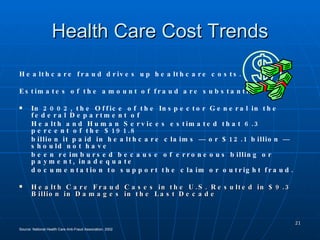
Health Care Cost Trends Healthcare fraud drives up healthcare costs.  Estimates of the amount of fraud are substantial. In 2002, the Office of the Inspector General in the federal Department of Health and Human Services estimated that 6.3 percent of the $191.8 billion it paid in healthcare claims  —  or $12.1 billion  —  should not have been reimbursed because of erroneous billing or payment, inadequate documentation to support the claim or outright fraud. Health Care Fraud Cases in the U.S. Resulted in $9.3 Billion in Damages in the Last Decade  Source: National Health Care Anti-Fraud Association, 2002
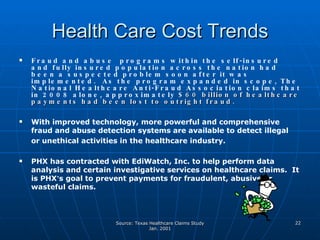
Health Care Cost Trends Fraud and abuse  programs within the self-insured and fully insured population across the nation had been a suspected problem soon after it was implemented.  As the program expanded in scope, The National Healthcare Anti-Fraud Association claims that in 2008 alone, approximately  $60 billion of healthcare payments had been lost to outright fraud. With improved technology, more powerful and comprehensive fraud and abuse detection systems are available to detect illegal  or unethical activities in the healthcare industry. PHX has contracted with EdiWatch, Inc. to help perform data analysis and certain investigative services on healthcare claims.  It is PHX ’ s goal to prevent payments for fraudulent, abusive or wasteful claims. Source: Texas Healthcare Claims Study Jan. 2001
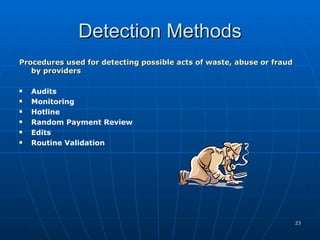
Detection Methods Procedures used for detecting possible acts of waste, abuse or fraud by providers Audits Monitoring Hotline Random Payment Review Edits Routine Validation    
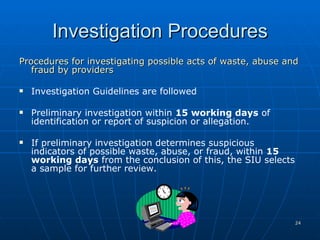
Investigation Procedures Procedures for investigating possible acts of waste, abuse and fraud by providers Investigation Guidelines are followed Preliminary investigation within  15 working days  of identification or report of suspicion or allegation. If preliminary investigation determines suspicious indicators of possible waste, abuse, or fraud, within  15 working days  from the conclusion of this, the SIU selects a sample for further review.   
Investigation Procedures Procedures for investigating possible acts of waste, abuse and fraud by providers (con’t) Within  15 working days  of the selection of the sample, the MCO requests medical records and encounter data for sample recipients. Within  45 working days  of the receipt of the requested medical records, the SIU reviews the data. If the review of additional records is necessary, the SIU conducts such a review within  30 calendar days .    
Investigation Procedures Case Generation   Fraud investigations are generated by  referral  or  analysis .   Referral   A referral is information provided to the SIU from an outside source alleging an occurrence of fraud or abuse or stating a suspicion of fraud or abuse. Outside sources can include callers to the hotline, company claims processors and other employees, media reports, law enforcement and regulatory agency representatives, investigators from other insurers, website visitors and other persons.     
Investigation Procedures Case Generation (cont ’ d) The SIU supports and encourages the generation of referrals by the maintenance of a toll-free hotline and the printing of the hotline number on Explanation of Benefit forms; training on a regular basis of company employees; networking  with investigators from other insurers and law enforcement and regulatory agency representatives, subscribing to publications and other material related to healthcare fraud; maintaining an anti-fraud website, and publicizing anti-fraud efforts. The unit maintains a standardized Special Investigations Referral Form to assist company employees  in referring information regarding fraud and abuse.  (Please see training manual provided to your plan).
Investigation Procedures Case Generation (cont ’ d) Analysis Analysis is information developed internally by the SIU that discloses an occurrence of fraud or abuse or indicates the potential of fraud or abuse.  Analysis is based on data review, data mining, or electronic manipulation of data conducted by the SIU.
The False Claims Act The False Claims Act makes it illegal for anyone to: Knowingly present, or cause to be presented to the Government a false claim for payment;  Knowingly make, use, or cause to be made or used, a false record or statement to get a false claim paid or approved by the government;  Conspire to defraud the Government by getting a false claim allowed or paid.  In the past, the False Claims Act was usually applied against suppliers of equipment to the military and other government agencies.  Today, health care fraud  accounts for more than half of all False Claim Act cases.
What You Can Do To Help What YOU can do to help prevent  and stop Health Care Fraud   Report suspected fraud to the toll free fraud hotline at  1-877-PHX-TIPS . Follow procedures in the training manual provided to your plan for referrals and reporting. Inform your subscribers, providers and employees that your company actively pursues fraud and needs their help.  Make your customers aware!!!! Implement system edits once a need has been identified by the SIU to help save money for your company. Encourage your employees to participate in ongoing Fraud Awareness training.  Informational communications should be provided to your subscriber and provider populations.
On Line Resources and Links   PHX ’ s SIU establishes and maintains a catalog of on line resources related to fraud detection, investigation and reporting responsibilities.     Coalition Against Insurance Fraud:  http://www.insurancefraud.org   Federation of State Medical Boards http://www.fsmb.org   National Association of Insurance Commissioners, state links:  http://www.naic.org/state_contacts/sid_websites.htm NHCAA—National Healthcare Anti-Fraud Association www.nhcaa.org/  
THE END THANK YOU! END OF DOCUMENT DJAM

Phx Fraud And Abuse Training Module

  • 1.
  • 2.
    CORPORATE STATEMENT Fraudulent,abusive and wasteful health care billing drains billions of dollars from the nation’s health care system. This price is too steep—higher costs for all society as well as cutbacks in access to essential care. Premier Healthcare Exchange is committed to protect and preserve the integrity and availability of health care resources to our recipients, our healthcare partners and the general community. Premier Healthcare Exchange will perform these activities by employing a Special Investigations Unit (SIU) to detect, prevent and eliminate fraud, abuse and waste at the provider, recipient and Health Plan level.
  • 3.
    CORPORATE STATEMENT (Con’t)Premier Healthcare Exchange will utilize electronic systems and thorough training of our employees to identify possible acts of fraud, waste and abuse. When such acts are identified, we will seek effective remedies to identify overpaid amounts; prevent future occurrences of fraud, abuse and waste; and report such offenses to the proper authorities.
  • 4.
    Fraud Contacts SpecialInvestigations Unit Laura Kanthal-Cubides Manager S pecial Investigations Unit Premier Healthcare Exchange 2 Crossroads Drive Bedminster, NJ 07921 908.658.3535 ext: 264
  • 5.
    Fraud Contacts FraudHotline 1-877-PHX-TIPS E-mail [email_address] Correspondence Premier Healthcare Exchange 2 Crossroads Drive Bedminster, NJ 07921
  • 6.
    Fraud Awareness DefinitionsFRAUD is an intentional representation that an individual knows to be false or does not believe to be true and makes, knowing that the representation could result in some unauthorized benefit to himself/herself or some other person. ABUSE is generally defined as activities that unjustly enrich a person through the receipt of benefit payments but where the intent to deceive is not present or an attempt by an individual to unjustly obtain a benefit payment. WASTE is generally defined as activities involving payment or the attempt to obtain payment for items or services where there was no intent to deceive or misrepresent but that the outcome of poor or inefficient methods results in unnecessary costs.
  • 7.
    Fraud Awareness HealthcareFraud An intentional deception or misrepresentation that the individual or entity makes knowing that the misrepresentation could result in some unauthorized benefit to the individual, the entity, or some other party. Examples include: Upcoding When a provider submits a claim using an incorrect code for the service(s) actually provided. The code used is actually for a similar service provided but is reimbursed at a higher level. Unbundling The improper submission of separate claims for services that should be billed together as one combined service.  
  • 8.
    Fraud Awareness Servicesnot rendered When a provider bills for services that were not performed. This fraud can be committed by any type of provider. The elderly are very likely to be victimized in this way.   Medical necessity issues An example would be when a provider exaggerates, misrepresents or falsifies a diagnosis or symptoms to obtain coverage for services which would otherwise be limited or denied. This type of fraud poses a particular problem by exhausting benefits for services which are already restricted, such as physical therapy or psychiatric services.   Disguised Services An example would be billing routine prophylactic dental cleaning as deep scaling, or collagen injections billed as acne surgery.
  • 9.
    Fraud Awareness Self-referral This occurs when a physician has an interest in a home health agency, supply company or pharmacy. In and of itself, self-referral is not a crime. However, unusually high utilization or referrals from the physician with such an interest may indicate potential fraud and abuse.   Falsified diagnosis This type of fraud is used to obtain payment for services which are specific contract exclusions.   Masked provider This type of fraud is used to obtain payment for services which might otherwise be denied. For example, a clinical social worker provides the service, but a psychologist submits the claims as if he/she provided the service. Another scenario might be a chiropractor providing manipulation, but a medical doctor submits a claim for physical therapy.
  • 10.
    Fraud Awareness FalseClaims This occurs when a physician submits a claim for reimbursement for medical services provided to an insured when in fact the services were not performed.   Claim Fraud This type of fraud occurs when a consumer makes a misrepresentation in order to receive a benefit payment or higher payment that they are not entitled to.   Application Fraud This exists when a party makes material misrepresentations on an application for insurance with the intent to defraud the insurance company. Eligibility Fraud This occurs when a party makes misrepresentations so that benefits are received by persons who are not eligible for those benefits.
  • 11.
    Fraud Awareness MostCommon Types of Fraud Provider Fraud: Billing false claims Billing Schemes (Upcoding, Unbundling) Billing that appears to be a deliberate application for duplicate payment of services Billing of non-covered services as covered items Performing medically unnecessary services in order to obtain insurance reimbursement Incorrect reporting of diagnoses or procedures to maximize insurance reimbursement Misrepresentation of dates, descriptions of services, or subscribers/providers
  • 12.
    Fraud Awareness MostCommon Types of Fraud Consumer Fraud: Claim Fraud—a party submits a claim that contains false, exaggerated or deliberately misleading information designed to result in an undeserved payment. Application Fraud—a party makes material misrepresentations on an application for insurance with the intent to defraud the insurance company. Identity Fraud: Obtaining service or coverage by using a false identity. Allowing someone else to use an insurance card to obtain a service.
  • 13.
    Red Flags A “ Red Flag ” is only an indicator of possible fraudulent activity, not proof of any actual wrongdoing. Most claims honestly reflect the services that were provided and fraud indicators are often due to honest error. Common sense and the context in which a Red Flag appears on a claim should be considered before referring the claim for investigation. Patient states service was not provided after receiving EOB   Provider states service was not provided after receiving remittance advice   Previously rejected claim is resubmitted with different diagnosis or procedure code Services are not documented in medical record    
  • 14.
    Red Flags Medicalrecord does not substantiate submitted services Claim form contains different inks or handwritings   Claim form contains erasures, strikeovers or whiteouts   Handwritten and printed information is mixed on claim form   Claim forms are completely hand-written   Medical terms are misspelled   Medical credentials are not known
  • 15.
    Red Flags Unusuallylong time lapse between date of procedure and receipt of claim Provider letterhead is typed, not printed, or are missing telephone number, address or logo Medical records are all typed, no handwritten observations Provider ’ s medical credentials are omitted from claim form — Dr John Smith instead of John Smith, MD — or title and credentials are both used — Dr John Smith, MD Provider ’ s signature is missing from claim form or medical record Frequent telephone inquiries by patient or provider for payment Provider ’ s medical credentials do not match type of service provided
  • 16.
    Red Flags Excessivepressure by patient, provider or attorney to pay a particular claim quickly Excessive number of treatments for single date of service Information is not in date sequence on claim form or in medical record   A series of claims from same provider contain overlapping dates of treatment   Routine medical services are excessively priced   Hospital claim is received but no corresponding claims for professional treatment are submitted Surgery claim is received but no record of hospitalization is on record  
  • 17.
    Red Flags Receiptsare printed on white bond paper without letterhead   Receipts are inconsistent with standard styles   Provider advertises for “ free ” services Provider and patient share same address   Same treatments are provided to multiple family members on same date of service   Routine procedures are performed on Sundays or holidays   Claimant or provider refuses to release medical record. Claims are submitted with photocopied receipts instead of originals
  • 18.
    Red Flags OrganizedSchemes   Provider address consists of a post office box number followed by a three-letter code such as “ SJO ” or “ PTY ” Routine medical services are performed by providers located in states other than where patient resides Durable medical equipment claims submitted by providers located in states other than where patient resides  
  • 19.
    Red Flags Remember!A “ Red Flag ” is only an indicator of possible fraudulent activity, not proof of any actual wrongdoing. Most claims honestly reflect the services that were provided and fraud indicators are often due to honest error. Common sense and the context in which a Red Flag appears on a claim should be considered before referring the claim for investigation.
  • 20.
    Health Care CostTrends In 2008, total national health expenditures were expected to rise 6.9 percent -- two times the rate of inflation. Total spending was $2.4 TRILLION in 2007, or $7900 per person. Over the time period (2008-2018), average annual health spending growth is anticipated outpace average annual growth in the overall economy (4.1 percent) by 2.1 percentage points per year. By 2018, national health spending is expected comprise just over one-fifth (20.3 percent) of Gross Domestic Product (GDP). By 2018, total hospital spending is expected to reach nearly $1.4 trillion, up from a projected $746.4 billion in 2008. Prescription drug expenditures are another major driver of healthcare costs. They are projected to compose a growing portion of total costs over the next decade. Sources: Medical Cost Reference Guide, Blue Cross Blue Shield Association, June 2003; Data Bulletin #27, Center for Studying Health System Change, June 2004.
  • 21.
    Health Care CostTrends Healthcare fraud drives up healthcare costs. Estimates of the amount of fraud are substantial. In 2002, the Office of the Inspector General in the federal Department of Health and Human Services estimated that 6.3 percent of the $191.8 billion it paid in healthcare claims — or $12.1 billion — should not have been reimbursed because of erroneous billing or payment, inadequate documentation to support the claim or outright fraud. Health Care Fraud Cases in the U.S. Resulted in $9.3 Billion in Damages in the Last Decade Source: National Health Care Anti-Fraud Association, 2002
  • 22.
    Health Care CostTrends Fraud and abuse programs within the self-insured and fully insured population across the nation had been a suspected problem soon after it was implemented. As the program expanded in scope, The National Healthcare Anti-Fraud Association claims that in 2008 alone, approximately $60 billion of healthcare payments had been lost to outright fraud. With improved technology, more powerful and comprehensive fraud and abuse detection systems are available to detect illegal or unethical activities in the healthcare industry. PHX has contracted with EdiWatch, Inc. to help perform data analysis and certain investigative services on healthcare claims. It is PHX ’ s goal to prevent payments for fraudulent, abusive or wasteful claims. Source: Texas Healthcare Claims Study Jan. 2001
  • 23.
    Detection Methods Proceduresused for detecting possible acts of waste, abuse or fraud by providers Audits Monitoring Hotline Random Payment Review Edits Routine Validation    
  • 24.
    Investigation Procedures Proceduresfor investigating possible acts of waste, abuse and fraud by providers Investigation Guidelines are followed Preliminary investigation within 15 working days of identification or report of suspicion or allegation. If preliminary investigation determines suspicious indicators of possible waste, abuse, or fraud, within 15 working days from the conclusion of this, the SIU selects a sample for further review.  
  • 25.
    Investigation Procedures Proceduresfor investigating possible acts of waste, abuse and fraud by providers (con’t) Within 15 working days of the selection of the sample, the MCO requests medical records and encounter data for sample recipients. Within 45 working days of the receipt of the requested medical records, the SIU reviews the data. If the review of additional records is necessary, the SIU conducts such a review within 30 calendar days .  
  • 26.
    Investigation Procedures CaseGeneration   Fraud investigations are generated by referral or analysis .   Referral   A referral is information provided to the SIU from an outside source alleging an occurrence of fraud or abuse or stating a suspicion of fraud or abuse. Outside sources can include callers to the hotline, company claims processors and other employees, media reports, law enforcement and regulatory agency representatives, investigators from other insurers, website visitors and other persons.    
  • 27.
    Investigation Procedures CaseGeneration (cont ’ d) The SIU supports and encourages the generation of referrals by the maintenance of a toll-free hotline and the printing of the hotline number on Explanation of Benefit forms; training on a regular basis of company employees; networking with investigators from other insurers and law enforcement and regulatory agency representatives, subscribing to publications and other material related to healthcare fraud; maintaining an anti-fraud website, and publicizing anti-fraud efforts. The unit maintains a standardized Special Investigations Referral Form to assist company employees in referring information regarding fraud and abuse. (Please see training manual provided to your plan).
  • 28.
    Investigation Procedures CaseGeneration (cont ’ d) Analysis Analysis is information developed internally by the SIU that discloses an occurrence of fraud or abuse or indicates the potential of fraud or abuse. Analysis is based on data review, data mining, or electronic manipulation of data conducted by the SIU.
  • 29.
    The False ClaimsAct The False Claims Act makes it illegal for anyone to: Knowingly present, or cause to be presented to the Government a false claim for payment; Knowingly make, use, or cause to be made or used, a false record or statement to get a false claim paid or approved by the government; Conspire to defraud the Government by getting a false claim allowed or paid. In the past, the False Claims Act was usually applied against suppliers of equipment to the military and other government agencies. Today, health care fraud accounts for more than half of all False Claim Act cases.
  • 30.
    What You CanDo To Help What YOU can do to help prevent and stop Health Care Fraud Report suspected fraud to the toll free fraud hotline at 1-877-PHX-TIPS . Follow procedures in the training manual provided to your plan for referrals and reporting. Inform your subscribers, providers and employees that your company actively pursues fraud and needs their help. Make your customers aware!!!! Implement system edits once a need has been identified by the SIU to help save money for your company. Encourage your employees to participate in ongoing Fraud Awareness training. Informational communications should be provided to your subscriber and provider populations.
  • 31.
    On Line Resourcesand Links   PHX ’ s SIU establishes and maintains a catalog of on line resources related to fraud detection, investigation and reporting responsibilities.   Coalition Against Insurance Fraud: http://www.insurancefraud.org   Federation of State Medical Boards http://www.fsmb.org   National Association of Insurance Commissioners, state links: http://www.naic.org/state_contacts/sid_websites.htm NHCAA—National Healthcare Anti-Fraud Association www.nhcaa.org/  
  • 32.
    THE END THANKYOU! END OF DOCUMENT DJAM