pH-SENSITIVE (HALOCHROMIC) SMART PACKAGING FILMS
BASED ON NATURAL FOOD COLORANTS FOR THE
MONITORING OF QUALITY AND SAFETY OF FISH PRODUCTS
Prepared by
NIMAH SALALH ALNEMARI (GS55972)
Date: th
July 2021
Introduction
Consumers are getting more demanding for fresh fish high in quality to ensure proper nutrition
and a healthy diet. Fish products are major sources of complete proteins and play important role
in the human diet including provision of omega-3 among a variety of health benefits. However,
they are highly perishable due to enzymatic reactions and microbial contamination (Zhang et al.,
2019). The development of improved methods to determine food quality such as freshness,
microbial spoilage, oxidative rancidity or oxygen and/or heat-induced deterioration is extremely
important to food manufacturers. To maximize the quality and safety of foodstuffs, prediction of
shelf-life based on standard quality control procedures is normally undertaken. Intelligent
packaging, as a new technology, has been recently offered to inform real-time freshness and
monitor critical factors affecting food quality (Mohan, 2019). One mean of doing so is through
intelligent packaging incorporating gas sensor technology for sensing oxygen and CO2.
The monitoring of these gases in the package helps in maintaining the food quality (Remya et al.,
2017). Gas chromatography-mass spectrometry (GC/MS) is one of the common analytical
instrumental techniques available to monitor gas compositions in modified atmosphere packaged
(MAP) products. The technique requires breakage of package integrity and is time-consuming and
expensive. Portable headspace oxygen and/or carbon dioxide gas analysers use ‘minimally
destructive’ techniques (packages can be resealed) but tend not to apply to real-time, online control
of packaging processes or large scale usage.
An optical sensor approach offers a realistic alternative to such conventional methods. It can be
used as a leak indicator or to verify the efficiency of O2 scavenger, CO2 emitter or MAP systems
(Vermeiren et al., 1999). Films containing colorimetric indicators that are sensitive to changes in
pH and/or chemical composition are useful in the development of smart packaging materials for
fresh foods (Alizadeh-Sani et al., 2020a; Alizadeh-Sani et al., 2020b). The indicators use
commonly assume a colour change as a result of a chemical or enzymatic reaction. Considering
pH changes, which reveal great importance to notify spoilage, development of visible pH-sensitive
indicators (e.g. intelligent packaging system) has gradually expanded to recognize fish spoilage
stages. Hence, there is great potential in creating a new generation of smart and active
biodegradable films for food applications, with the ultimate aim of increasing food safety, quality,
and sustainability. To achieve the aim, many are interested in identifying natural substances that
can be used as indicators, antimicrobials and/or antioxidants with biodegradable films.
Chitin nanofibers (ChNFs) can be isolated and used as sustainable O2 barrier materials for food
packaging. These bioavailable nanomaterials are readily dispersed in water enabling spray-coated
films to be deposited at high rates onto uneven or delicate surfaces. ChNFs also exhibit a high
modulus and tensile strength and are excellent candidates for gas barrier films (Wu, 2014). In a
recent study, ChNF/CNC multilayers lead to a reduction in the O2 permeability of the final
composite film by as much as 73%. The nanocrystalline or nanofibrous forms of these biopolymers
represent promising renewable, compostable sources of materials for replacing traditional plastics
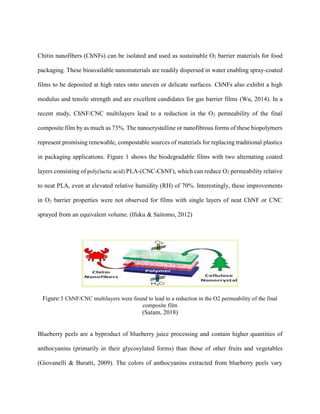
in packaging applications. Figure 1 shows the biodegradable films with two alternating coated
layers consisting of poly(lactic acid) PLA-(CNC-ChNF), which can reduce O2 permeability relative
to neat PLA, even at elevated relative humidity (RH) of 70%. Interestingly, these improvements
in O2 barrier properties were not observed for films with single layers of neat ChNF or CNC
sprayed from an equivalent volume. (Ifuku & Saitomo, 2012)
Figure:1 ChNF/CNC multilayers were found to lead to a reduction in the O2 permeability of the final
composite film
(Satam, 2018)
Blueberry peels are a byproduct of blueberry juice processing and contain higher quantities of
anthocyanins (primarily in their glycosylated forms) than those of other fruits and vegetables
(Giovanelli & Buratti, 2009). The colors of anthocyanins extracted from blueberry peels vary
widely and correspond to different pH values. Moreover, the low cost, safety and wide color range
of anthocyanins extracted from blueberry peels make them attractive for use in intelligent
packaging production. Overall, biodegradable materials are receiving more attention in packaging
applications because of their safety and unique degradation properties (Tan et al., 2013).
Active packaging using pH-sensitive (halochromic) films for shelf life prediction of fish
The spoilage of seafood occurs primarily as a result of the action of microorganisms and enzymes,
which induce chemical changes in the seafood. Fish spoilage leads to the generation of volatile
basic nitrogen compounds from microbial processes, which causes the pH of the fish to increase.
Total volatile base nitrogen (TVB-N), K-value and total aerobic counts (TACs) are of importance
in freshness evaluation. In this light, the colorimetric pH-sensing film provided significant
antioxidant and antimicrobial activity. Using fish as an example, as in situ colorimetric indicators
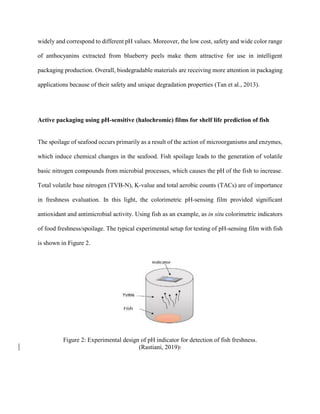
of food freshness/spoilage. The typical experimental setup for testing of pH-sensing film with fish
is shown in Figure 2.
Figure 2: Experimental design of pH indicator for detection of fish freshness.
(Rastiani, 2019):
Changes in the environment are the main cause of the formation of volatile nitrogen compounds
and an increase in the pH value. These volatile compounds include ammonia and amines, which
are formed as proteins degrade. Thus, red barberry anthocyanin (RBA)-loaded CNF films may be
used as smart indicators of fish freshness after 72 hours of storage at room temperature (Alizadeh-
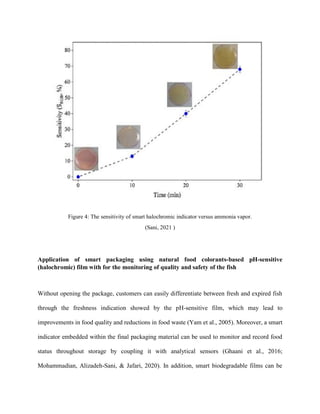
Sani et al. 2020b). During the test period (72 h), the pH values of the fish sample increased from
6.3 to 8.0. The resulting rise in pH within the films resulted in a visible color transition, with the
films going from reddish to light pink (Figure 3). The findings are consistent with those of other
researchers who have published on the use of natural pigments in biopolymer films to track food
safety and quality (Tavassoli et al., 2020; Huang et al., 2019; Kang et al., 2020).
Figure 3: Monitoring the freshness and spoilage of fish fillets using smart halochromic film.
(Sani, 2021)
It has been reported that during the spoilage process, low molecular weight substances and alkaline
compounds particularly, ammonia and trimethylamine, which are generally known as TVB-N, are
produced and correspond for sensorial rejection and off-flavors. TVB-N is a distinctive index to
assess fish spoilage. Samples with TVB-N higher than 25 mg/l00 g are considered spoiled food
(Dalgaard et al., 2006, Ghaly et al., 2010). The initial TVB-N value of fish was 13.53 mg/100 g,
indicating the freshness of samples. TVB-N subsequently increased accompanied by TPC and pH
during storage at 4 °C. The increasing trend of TVB-N value can be attributed to protein
degradation by microbial activity and autolytic enzymes resulting in deamination of amino acids
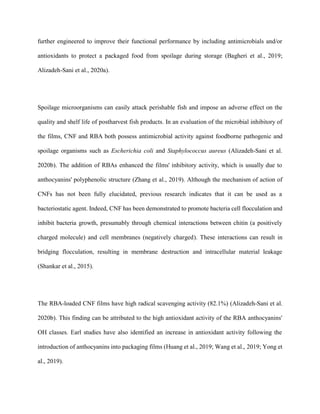
and accumulation of volatile base. Figure 4 shows the color changes of the pH-sensitive film as
the TVB-N increases.
Figure 4: The sensitivity of smart halochromic indicator versus ammonia vapor.
(Sani, 2021 )
Application of smart packaging using natural food colorants-based pH-sensitive
(halochromic) film with for the monitoring of quality and safety of the fish
Without opening the package, customers can easily differentiate between fresh and expired fish
through the freshness indication showed by the pH-sensitive film, which may lead to
improvements in food quality and reductions in food waste (Yam et al., 2005). Moreover, a smart
indicator embedded within the final packaging material can be used to monitor and record food
status throughout storage by coupling it with analytical sensors (Ghaani et al., 2016;
Mohammadian, Alizadeh-Sani, & Jafari, 2020). In addition, smart biodegradable films can be
further engineered to improve their functional performance by including antimicrobials and/or
antioxidants to protect a packaged food from spoilage during storage (Bagheri et al., 2019;
Alizadeh-Sani et al., 2020a).
Spoilage microorganisms can easily attack perishable fish and impose an adverse effect on the
quality and shelf life of postharvest fish products. In an evaluation of the microbial inhibitory of
the films, CNF and RBA both possess antimicrobial activity against foodborne pathogenic and
spoilage organisms such as Escherichia coli and Staphylococcus aureus (Alizadeh-Sani et al.
2020b). The addition of RBAs enhanced the films' inhibitory activity, which is usually due to
anthocyanins' polyphenolic structure (Zhang et al., 2019). Although the mechanism of action of
CNFs has not been fully elucidated, previous research indicates that it can be used as a
bacteriostatic agent. Indeed, CNF has been demonstrated to promote bacteria cell flocculation and
inhibit bacteria growth, presumably through chemical interactions between chitin (a positively
charged molecule) and cell membranes (negatively charged). These interactions can result in
bridging flocculation, resulting in membrane destruction and intracellular material leakage
(Shankar et al., 2015).
The RBA-loaded CNF films have high radical scavenging activity (82.1%) (Alizadeh-Sani et al.
2020b). This finding can be attributed to the high antioxidant activity of the RBA anthocyanins'
OH classes. Earl studies have also identified an increase in antioxidant activity following the
introduction of anthocyanins into packaging films (Huang et al., 2019; Wang et al., 2019; Yong et
al., 2019).
Conclusion
In order to effectively preserve the storage quality and extend the shelf-life of fresh fish, natural
pigments such as naphtoquinones and anthocyanins could be a viable alternative to synthetic dyes
for the production of smart packaging materials equipped with sensors/indicators capable of
continuously monitoring the freshness and spoilage of food products. They achieve these functions
by exhibiting quantifiable changes in their optical properties in response to changes in food
properties. These innovative packaging materials can increase food quality and safety, as well as
decrease food waste, thereby improving the food supply's healthiness and sustainability.
References
Alizadeh-Sani, M., Mohammadian, E., & McClements, D. J. (2020a). Eco-friendly active packaging
consisting of nanostructured biopolymer matrix reinforced with TiO2 and essential oil: Application for
preservation of refrigerated meat. Food chemistry, 322, 126782
Alizadeh-Sani, M., Mohammadian, E., Rhim, J. W., & Jafari, S. M. (2020b). pH-sensitive (halochromic)
smart packaging films based on natural food colorants for the monitoring of food quality. Trends in Food
Science & Technology.
Bagheri, A. R., Arabi, M., Ghaedi, M., Ostovan, A., Wang, X., Li, J., & Chen, L. (2019). Dummy
molecularly imprinted polymers based on a green synthesis strategy for magnetic solid-phase extraction of
acrylamide in food samples. Talanta, 195, 390-400
Dalgaard P, Madsen H, Samieian N & Emborg J2006. Biogenic amine formation and microbial spoilage
chilled garfish (Belone belone belone)– effect of modified atmosphere packaging and previous frozen
storage. Journal of applied microbiology. 101 (1): 80-95.
Ghaly AE, Dave D, Budge S & Brooks M 2010. Fish spoilage mechanisms and preservation techniques:
review. American journal of applied sciences. 7 (7): 8.95
Giovanelli G and Buratti S, Comparison of polyphenolic composition and antioxidant activity of wild
Italian blueberries and some cultivated varieties. Food Chem 112:903–908 (2009).
Huang, S., Xiong, Y., Zou, Y., Dong, Q., Ding, F., Liu, X., & Li, H. (2019). A novel colorimetric indicator
based on agar incorporated with Arnebia euchroma rootextracts for monitoring fish freshness. Food
Hydrocolloids, 90, 198–205.
Huang, S., Xiong, Y., Zou, Y., Dong, Q., Ding, F., Liu, X., & Li, H. (2019). A novel colorimetric indicator
based on agar incorporated with Arnebia euchroma root extracts for monitoring fish freshness. Food
Hydrocolloids, 90, 198–205.
Ifuku, S. and Saimoto, H. Chitin nanofibers: preparations, modifications, and applications. Nanoscale 2012,
4, 3308−3318
Kang, S., Wang, H., Xia, L., Chen, M., Li, L., Cheng, J., … Jiang, S. (2020). Colorimetric film based on
polyvinyl alcohol/okra mucilage polysaccharide incorporated with rose anthocyanins for shrimp freshness
monitoring. Carbohydrate Polymers, 229, Article 115402.
Rastiani F, Jebali A, Hekmatimoghaddam SH, Khalili Sadrabad E, Akrami Mohajeri F, Dehghani-Tafti A.
Monitoring the Freshness of Rainbow Trout using Intelligent PH-sensitive Indicator during Storage. Journal
of Nutrition and Food Security (JNFS), 2019; 4 (4): 225-235.
Remya S, Mohan CO, Venkateshwarlu G, Sivaraman GK, Ravishankar CN. Combined effect of O2
scavenger and antimicrobial film on shelf life of fresh cobia (Rachycentroncanadum) fish steaks stored at
2°C. Food Control. 2017;71:71-8.
Satam, C. C., Irvin, C. W., Lang, A. W., Jallorina, J. C. R., Shofner, M. L., Reynolds, J. R., & Meredith, J.
C. (2018). Spray-coated multilayer cellulose nanocrystal—chitin nanofiber films for barrier
applications. ACS Sustainable Chemistry & Engineering, 6(8), 10637-10644
Shankar, S., Teng, X., Li, G., & Rhim, J. W. (2015). Preparation, characterization, and antimicrobial
activity of gelatin/ZnO nanocomposite films. Food Hydrocolloids, 45, 264-271.
Tan L, Yu X, Wan P and Yang K, Biodegradable materials for bone repairs: a review. J Mater Sci Technol
29:503–513 (2013).
Tavassoli, M., Sani, M. A., Khezerlou, A., Ehsani, A., & McClements, D. J. (2021). Multifunctional
nanocomposite active packaging materials: Immobilization of quercetin, lactoferrin, and chitosan nanofiber
particles in gelatin films. Food Hydrocolloids, 118, 106747.
Vermeiren L, Devlieghere F, Van Beest M, De Kruijf N, Debevere J. Developments in the active packaging
of foods. Trends Food Sci Technol. 1999;10(3):77-86.
Wang, X., Yong, H., Gao, L., Li, L., Jin, M., & Liu, J. (2019). Preparation and characterization of
antioxidant and pH-sensitive films based on chitosan and black soybean seed coat extract. Food
Hydrocolloids, 89, 56–66.
Wu, J.; Zhang, K.; Girouard, N.; Meredith, J. C. Facile Route to Produce Chitin Nanofibers as Precursors
for Flexible and Transparent Gas Barrier Materials. Biomacromolecules 2014, 15 (12), 4614−4620.
Yam, K. L., Takhistov, P. T., & Miltz, J. (2005). Intelligent packaging: concepts and applications. Journal
of food science, 70(1), R1-R10.
Yong, H., Wang, X., Bai, R., Miao, Z., Zhang, X., & Liu, J. (2019). Development of antioxidant and
intelligent pH-sensing packaging films by incorporating purplefleshed sweet potato extract into chitosan
matrix. Food Hydrocolloids, 90, 216–224. Yong, H., Wang, X., Zhang, X., Liu, Y., Qin, Y., & Liu, J.
(2019). Effects of anthocyaninrich purple and black eggplant extracts on the physical, antioxidant and pH-
sensitive properties of chitosan film. Food Hydrocolloids, 94, 93–104.
Zhang, H., Hou, A., Xie, K., & Gao, A. (2019). Smart color-changing paper packaging sensors with pH
sensitive chromophores based on azo-anthraquinone reactive dyes. Sensors and Actuators B:
Chemical, 286, 362-369.
Zhang, X., Liu, Y., Yong, H., Qin, Y., Liu, J., & Liu, J. (2019). Development of multifunctional food
packaging films based on chitosan, TiO2 nanoparticles and anthocyanin-rich black plum peel extract. Food
Hydrocolloids, 94, 80–92.

pH-sensitive ASS (SS).pdf

  • 1.
    pH-SENSITIVE (HALOCHROMIC) SMARTPACKAGING FILMS BASED ON NATURAL FOOD COLORANTS FOR THE MONITORING OF QUALITY AND SAFETY OF FISH PRODUCTS Prepared by NIMAH SALALH ALNEMARI (GS55972) Date: th July 2021 Introduction Consumers are getting more demanding for fresh fish high in quality to ensure proper nutrition and a healthy diet. Fish products are major sources of complete proteins and play important role in the human diet including provision of omega-3 among a variety of health benefits. However, they are highly perishable due to enzymatic reactions and microbial contamination (Zhang et al., 2019). The development of improved methods to determine food quality such as freshness, microbial spoilage, oxidative rancidity or oxygen and/or heat-induced deterioration is extremely important to food manufacturers. To maximize the quality and safety of foodstuffs, prediction of shelf-life based on standard quality control procedures is normally undertaken. Intelligent packaging, as a new technology, has been recently offered to inform real-time freshness and
  • 2.
    monitor critical factorsaffecting food quality (Mohan, 2019). One mean of doing so is through intelligent packaging incorporating gas sensor technology for sensing oxygen and CO2. The monitoring of these gases in the package helps in maintaining the food quality (Remya et al., 2017). Gas chromatography-mass spectrometry (GC/MS) is one of the common analytical instrumental techniques available to monitor gas compositions in modified atmosphere packaged (MAP) products. The technique requires breakage of package integrity and is time-consuming and expensive. Portable headspace oxygen and/or carbon dioxide gas analysers use ‘minimally destructive’ techniques (packages can be resealed) but tend not to apply to real-time, online control of packaging processes or large scale usage. An optical sensor approach offers a realistic alternative to such conventional methods. It can be used as a leak indicator or to verify the efficiency of O2 scavenger, CO2 emitter or MAP systems (Vermeiren et al., 1999). Films containing colorimetric indicators that are sensitive to changes in pH and/or chemical composition are useful in the development of smart packaging materials for fresh foods (Alizadeh-Sani et al., 2020a; Alizadeh-Sani et al., 2020b). The indicators use commonly assume a colour change as a result of a chemical or enzymatic reaction. Considering pH changes, which reveal great importance to notify spoilage, development of visible pH-sensitive indicators (e.g. intelligent packaging system) has gradually expanded to recognize fish spoilage stages. Hence, there is great potential in creating a new generation of smart and active biodegradable films for food applications, with the ultimate aim of increasing food safety, quality, and sustainability. To achieve the aim, many are interested in identifying natural substances that can be used as indicators, antimicrobials and/or antioxidants with biodegradable films.
  • 3.
    Chitin nanofibers (ChNFs)can be isolated and used as sustainable O2 barrier materials for food packaging. These bioavailable nanomaterials are readily dispersed in water enabling spray-coated films to be deposited at high rates onto uneven or delicate surfaces. ChNFs also exhibit a high modulus and tensile strength and are excellent candidates for gas barrier films (Wu, 2014). In a recent study, ChNF/CNC multilayers lead to a reduction in the O2 permeability of the final composite film by as much as 73%. The nanocrystalline or nanofibrous forms of these biopolymers represent promising renewable, compostable sources of materials for replacing traditional plastics in packaging applications. Figure 1 shows the biodegradable films with two alternating coated layers consisting of poly(lactic acid) PLA-(CNC-ChNF), which can reduce O2 permeability relative to neat PLA, even at elevated relative humidity (RH) of 70%. Interestingly, these improvements in O2 barrier properties were not observed for films with single layers of neat ChNF or CNC sprayed from an equivalent volume. (Ifuku & Saitomo, 2012) Figure:1 ChNF/CNC multilayers were found to lead to a reduction in the O2 permeability of the final composite film (Satam, 2018) Blueberry peels are a byproduct of blueberry juice processing and contain higher quantities of anthocyanins (primarily in their glycosylated forms) than those of other fruits and vegetables (Giovanelli & Buratti, 2009). The colors of anthocyanins extracted from blueberry peels vary
  • 4.
    widely and correspondto different pH values. Moreover, the low cost, safety and wide color range of anthocyanins extracted from blueberry peels make them attractive for use in intelligent packaging production. Overall, biodegradable materials are receiving more attention in packaging applications because of their safety and unique degradation properties (Tan et al., 2013). Active packaging using pH-sensitive (halochromic) films for shelf life prediction of fish The spoilage of seafood occurs primarily as a result of the action of microorganisms and enzymes, which induce chemical changes in the seafood. Fish spoilage leads to the generation of volatile basic nitrogen compounds from microbial processes, which causes the pH of the fish to increase. Total volatile base nitrogen (TVB-N), K-value and total aerobic counts (TACs) are of importance in freshness evaluation. In this light, the colorimetric pH-sensing film provided significant antioxidant and antimicrobial activity. Using fish as an example, as in situ colorimetric indicators of food freshness/spoilage. The typical experimental setup for testing of pH-sensing film with fish is shown in Figure 2. Figure 2: Experimental design of pH indicator for detection of fish freshness. (Rastiani, 2019):
  • 5.
    Changes in theenvironment are the main cause of the formation of volatile nitrogen compounds and an increase in the pH value. These volatile compounds include ammonia and amines, which are formed as proteins degrade. Thus, red barberry anthocyanin (RBA)-loaded CNF films may be used as smart indicators of fish freshness after 72 hours of storage at room temperature (Alizadeh- Sani et al. 2020b). During the test period (72 h), the pH values of the fish sample increased from 6.3 to 8.0. The resulting rise in pH within the films resulted in a visible color transition, with the films going from reddish to light pink (Figure 3). The findings are consistent with those of other researchers who have published on the use of natural pigments in biopolymer films to track food safety and quality (Tavassoli et al., 2020; Huang et al., 2019; Kang et al., 2020). Figure 3: Monitoring the freshness and spoilage of fish fillets using smart halochromic film.
  • 6.
    (Sani, 2021) It hasbeen reported that during the spoilage process, low molecular weight substances and alkaline compounds particularly, ammonia and trimethylamine, which are generally known as TVB-N, are produced and correspond for sensorial rejection and off-flavors. TVB-N is a distinctive index to assess fish spoilage. Samples with TVB-N higher than 25 mg/l00 g are considered spoiled food (Dalgaard et al., 2006, Ghaly et al., 2010). The initial TVB-N value of fish was 13.53 mg/100 g, indicating the freshness of samples. TVB-N subsequently increased accompanied by TPC and pH during storage at 4 °C. The increasing trend of TVB-N value can be attributed to protein degradation by microbial activity and autolytic enzymes resulting in deamination of amino acids and accumulation of volatile base. Figure 4 shows the color changes of the pH-sensitive film as the TVB-N increases.
  • 7.
    Figure 4: Thesensitivity of smart halochromic indicator versus ammonia vapor. (Sani, 2021 ) Application of smart packaging using natural food colorants-based pH-sensitive (halochromic) film with for the monitoring of quality and safety of the fish Without opening the package, customers can easily differentiate between fresh and expired fish through the freshness indication showed by the pH-sensitive film, which may lead to improvements in food quality and reductions in food waste (Yam et al., 2005). Moreover, a smart indicator embedded within the final packaging material can be used to monitor and record food status throughout storage by coupling it with analytical sensors (Ghaani et al., 2016; Mohammadian, Alizadeh-Sani, & Jafari, 2020). In addition, smart biodegradable films can be
  • 8.
    further engineered toimprove their functional performance by including antimicrobials and/or antioxidants to protect a packaged food from spoilage during storage (Bagheri et al., 2019; Alizadeh-Sani et al., 2020a). Spoilage microorganisms can easily attack perishable fish and impose an adverse effect on the quality and shelf life of postharvest fish products. In an evaluation of the microbial inhibitory of the films, CNF and RBA both possess antimicrobial activity against foodborne pathogenic and spoilage organisms such as Escherichia coli and Staphylococcus aureus (Alizadeh-Sani et al. 2020b). The addition of RBAs enhanced the films' inhibitory activity, which is usually due to anthocyanins' polyphenolic structure (Zhang et al., 2019). Although the mechanism of action of CNFs has not been fully elucidated, previous research indicates that it can be used as a bacteriostatic agent. Indeed, CNF has been demonstrated to promote bacteria cell flocculation and inhibit bacteria growth, presumably through chemical interactions between chitin (a positively charged molecule) and cell membranes (negatively charged). These interactions can result in bridging flocculation, resulting in membrane destruction and intracellular material leakage (Shankar et al., 2015). The RBA-loaded CNF films have high radical scavenging activity (82.1%) (Alizadeh-Sani et al. 2020b). This finding can be attributed to the high antioxidant activity of the RBA anthocyanins' OH classes. Earl studies have also identified an increase in antioxidant activity following the introduction of anthocyanins into packaging films (Huang et al., 2019; Wang et al., 2019; Yong et al., 2019).
  • 9.
    Conclusion In order toeffectively preserve the storage quality and extend the shelf-life of fresh fish, natural pigments such as naphtoquinones and anthocyanins could be a viable alternative to synthetic dyes for the production of smart packaging materials equipped with sensors/indicators capable of continuously monitoring the freshness and spoilage of food products. They achieve these functions by exhibiting quantifiable changes in their optical properties in response to changes in food properties. These innovative packaging materials can increase food quality and safety, as well as decrease food waste, thereby improving the food supply's healthiness and sustainability. References Alizadeh-Sani, M., Mohammadian, E., & McClements, D. J. (2020a). Eco-friendly active packaging consisting of nanostructured biopolymer matrix reinforced with TiO2 and essential oil: Application for preservation of refrigerated meat. Food chemistry, 322, 126782 Alizadeh-Sani, M., Mohammadian, E., Rhim, J. W., & Jafari, S. M. (2020b). pH-sensitive (halochromic) smart packaging films based on natural food colorants for the monitoring of food quality. Trends in Food Science & Technology. Bagheri, A. R., Arabi, M., Ghaedi, M., Ostovan, A., Wang, X., Li, J., & Chen, L. (2019). Dummy molecularly imprinted polymers based on a green synthesis strategy for magnetic solid-phase extraction of acrylamide in food samples. Talanta, 195, 390-400 Dalgaard P, Madsen H, Samieian N & Emborg J2006. Biogenic amine formation and microbial spoilage chilled garfish (Belone belone belone)– effect of modified atmosphere packaging and previous frozen storage. Journal of applied microbiology. 101 (1): 80-95. Ghaly AE, Dave D, Budge S & Brooks M 2010. Fish spoilage mechanisms and preservation techniques: review. American journal of applied sciences. 7 (7): 8.95 Giovanelli G and Buratti S, Comparison of polyphenolic composition and antioxidant activity of wild Italian blueberries and some cultivated varieties. Food Chem 112:903–908 (2009).
  • 10.
    Huang, S., Xiong,Y., Zou, Y., Dong, Q., Ding, F., Liu, X., & Li, H. (2019). A novel colorimetric indicator based on agar incorporated with Arnebia euchroma rootextracts for monitoring fish freshness. Food Hydrocolloids, 90, 198–205. Huang, S., Xiong, Y., Zou, Y., Dong, Q., Ding, F., Liu, X., & Li, H. (2019). A novel colorimetric indicator based on agar incorporated with Arnebia euchroma root extracts for monitoring fish freshness. Food Hydrocolloids, 90, 198–205. Ifuku, S. and Saimoto, H. Chitin nanofibers: preparations, modifications, and applications. Nanoscale 2012, 4, 3308−3318 Kang, S., Wang, H., Xia, L., Chen, M., Li, L., Cheng, J., … Jiang, S. (2020). Colorimetric film based on polyvinyl alcohol/okra mucilage polysaccharide incorporated with rose anthocyanins for shrimp freshness monitoring. Carbohydrate Polymers, 229, Article 115402. Rastiani F, Jebali A, Hekmatimoghaddam SH, Khalili Sadrabad E, Akrami Mohajeri F, Dehghani-Tafti A. Monitoring the Freshness of Rainbow Trout using Intelligent PH-sensitive Indicator during Storage. Journal of Nutrition and Food Security (JNFS), 2019; 4 (4): 225-235. Remya S, Mohan CO, Venkateshwarlu G, Sivaraman GK, Ravishankar CN. Combined effect of O2 scavenger and antimicrobial film on shelf life of fresh cobia (Rachycentroncanadum) fish steaks stored at 2°C. Food Control. 2017;71:71-8. Satam, C. C., Irvin, C. W., Lang, A. W., Jallorina, J. C. R., Shofner, M. L., Reynolds, J. R., & Meredith, J. C. (2018). Spray-coated multilayer cellulose nanocrystal—chitin nanofiber films for barrier applications. ACS Sustainable Chemistry & Engineering, 6(8), 10637-10644 Shankar, S., Teng, X., Li, G., & Rhim, J. W. (2015). Preparation, characterization, and antimicrobial activity of gelatin/ZnO nanocomposite films. Food Hydrocolloids, 45, 264-271. Tan L, Yu X, Wan P and Yang K, Biodegradable materials for bone repairs: a review. J Mater Sci Technol 29:503–513 (2013). Tavassoli, M., Sani, M. A., Khezerlou, A., Ehsani, A., & McClements, D. J. (2021). Multifunctional nanocomposite active packaging materials: Immobilization of quercetin, lactoferrin, and chitosan nanofiber particles in gelatin films. Food Hydrocolloids, 118, 106747. Vermeiren L, Devlieghere F, Van Beest M, De Kruijf N, Debevere J. Developments in the active packaging of foods. Trends Food Sci Technol. 1999;10(3):77-86. Wang, X., Yong, H., Gao, L., Li, L., Jin, M., & Liu, J. (2019). Preparation and characterization of antioxidant and pH-sensitive films based on chitosan and black soybean seed coat extract. Food Hydrocolloids, 89, 56–66. Wu, J.; Zhang, K.; Girouard, N.; Meredith, J. C. Facile Route to Produce Chitin Nanofibers as Precursors for Flexible and Transparent Gas Barrier Materials. Biomacromolecules 2014, 15 (12), 4614−4620. Yam, K. L., Takhistov, P. T., & Miltz, J. (2005). Intelligent packaging: concepts and applications. Journal of food science, 70(1), R1-R10. Yong, H., Wang, X., Bai, R., Miao, Z., Zhang, X., & Liu, J. (2019). Development of antioxidant and intelligent pH-sensing packaging films by incorporating purplefleshed sweet potato extract into chitosan matrix. Food Hydrocolloids, 90, 216–224. Yong, H., Wang, X., Zhang, X., Liu, Y., Qin, Y., & Liu, J. (2019). Effects of anthocyaninrich purple and black eggplant extracts on the physical, antioxidant and pH- sensitive properties of chitosan film. Food Hydrocolloids, 94, 93–104. Zhang, H., Hou, A., Xie, K., & Gao, A. (2019). Smart color-changing paper packaging sensors with pH sensitive chromophores based on azo-anthraquinone reactive dyes. Sensors and Actuators B: Chemical, 286, 362-369.
  • 11.
    Zhang, X., Liu,Y., Yong, H., Qin, Y., Liu, J., & Liu, J. (2019). Development of multifunctional food packaging films based on chitosan, TiO2 nanoparticles and anthocyanin-rich black plum peel extract. Food Hydrocolloids, 94, 80–92.