Photovoltaic Systems Training
Execution & Commissioning
Module 2.1 ‐ Civil Works
www.leonardo-energy.org/
Infrastructure preparation
Rooftop projects
Usually little civil works required, other than trenches
for the connection of the inverters and meters
Ground projects
Civil works are very important
Well-planned and executed civil works could deliver
important savings to the project.
Main civil works are:
Terrain leveling
Access and internal roads or paths
Trench excavation (AC & DC)
www.leonardo-energy.org
Terrain leveling
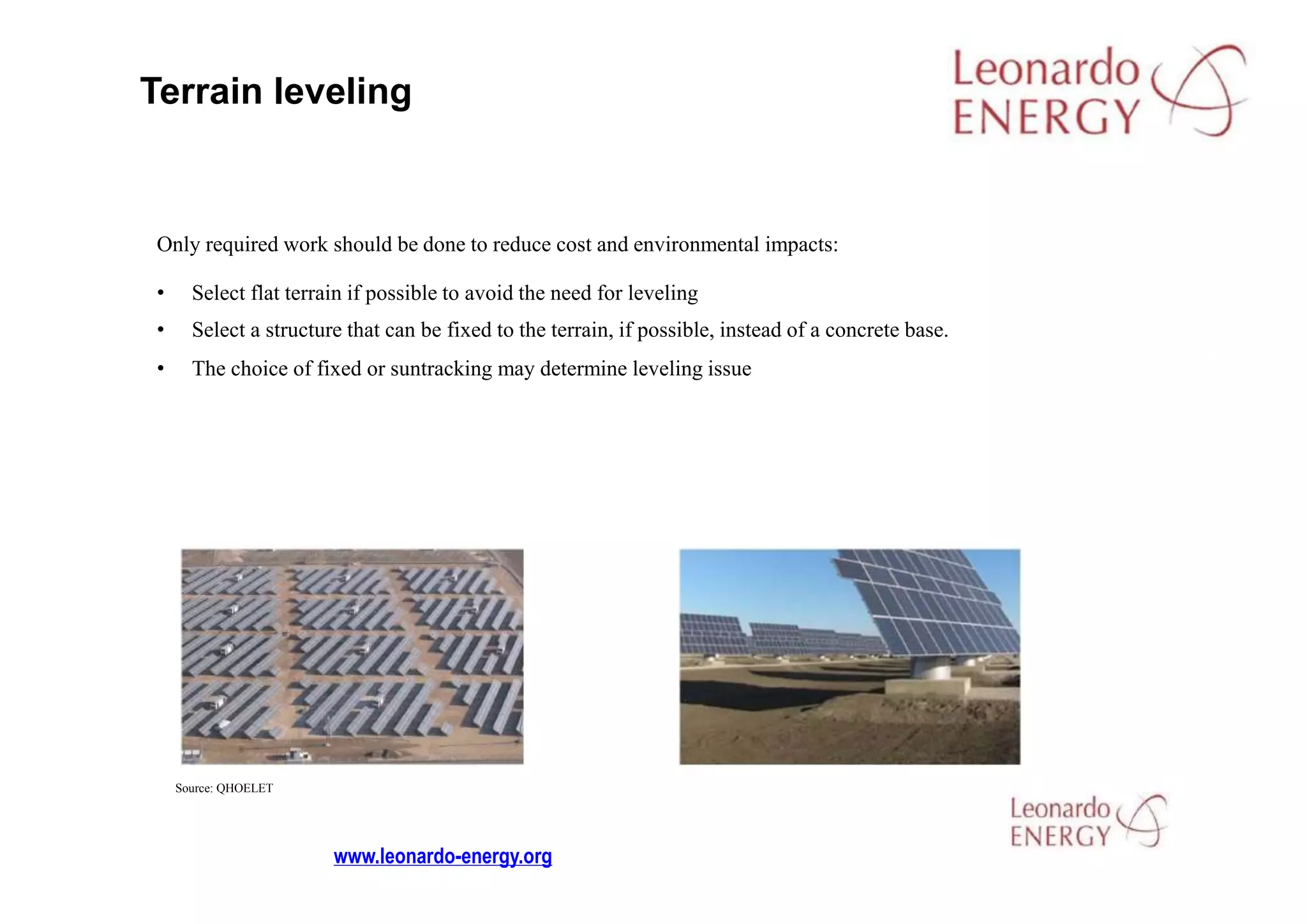
Only required work should be done to reduce cost and environmental impacts:
• Select flat terrain if possible to avoid the need for leveling
• Select a structure that can be fixed to the terrain, if possible, instead of a concrete base.
• The choice of fixed or suntracking may determine leveling issue
Source: QHOELET
www.leonardo-energy.org
Internal roads & paths
• Use existing paths if possible.
• Consider the need for the circulation of trucks.
• Consider the trucks’ turning radius:
www.leonardo-energy.org/
Vehicle Type Nomenclature Height Width Length Length
between
axles
Minimum
radius for
external
front wheel
Minimum
radius for
internal
back wheel
Light vehicle VL 1.30 2.10 5.80 3.40 7.30 4.20
2-Axle Omnibus B2 4.10 2.60 9.10 6.10 12.80 8.50
3-Axle Omnibus B3 4.10 2.60 12.10 7.60 12.80 7.40
2-Axle simple
truck
C2 4.10 2.60 9.10 6.10 12.80 8.50
3-Axle simple
truck
C3 / C4 4,10 2.60 12.20 7.60 12.80 7.40
Trailer (Semi) T2S1/ 2 / 3 4.10 * 2.60 15.20 4.00 - 7.00 12.20 5.80
Trailer (Semi) T3S1 / 2 / 3 4.10 2.60 16.70 4.90 - 7.90 13.70 5.90
2 Axle trailer + 1
Double
C2 - R2 / 3 4.10 2.60 19.90 3.80 - 6.10 13.70 6.80
3 Axle trailer + 1
Double
C3 - R2 / 3 / 4.10 2.60 19.90 6.10 – 6.40 13.70 6.80
Internal roads & paths
Once the installation has been commissioned, internal road use will be limited.
A 25 cm-deep path containing a mixture of 75% gravel to 25 % river sand, may meet ongoing needs.
Minimal turning radius for
B3/C3 vehicles
Natural terrain
www.leonardo-energy.org
Internal roads & paths
Access and internal and roads/paths detail
75% gravel, 25 % river sand
Trenches
PV project cable should be buried underground
Manhole very 40 meters, or for any direction change
Good practice to use the same section for all the trenches
www.leonardo-energy.org
Cable laying and access
Trenches
Trench layout recommendation
• A river sand base
• Well-spaced pipes of sifted soil and soft sand
• Cable caution tape
• Where vehicles are passing close by, a top-layer
of concrete
www.leonardo-energy.org
Trenches

Photovoltaic Training Course - Module 2.1 - Civil works

  • 1.
    Photovoltaic Systems Training Execution& Commissioning Module 2.1 ‐ Civil Works www.leonardo-energy.org/
  • 2.
    Infrastructure preparation Rooftop projects Usuallylittle civil works required, other than trenches for the connection of the inverters and meters Ground projects Civil works are very important Well-planned and executed civil works could deliver important savings to the project. Main civil works are: Terrain leveling Access and internal roads or paths Trench excavation (AC & DC) www.leonardo-energy.org
  • 3.
    Terrain leveling Only requiredwork should be done to reduce cost and environmental impacts: • Select flat terrain if possible to avoid the need for leveling • Select a structure that can be fixed to the terrain, if possible, instead of a concrete base. • The choice of fixed or suntracking may determine leveling issue Source: QHOELET www.leonardo-energy.org
  • 4.
    Internal roads &paths • Use existing paths if possible. • Consider the need for the circulation of trucks. • Consider the trucks’ turning radius: www.leonardo-energy.org/ Vehicle Type Nomenclature Height Width Length Length between axles Minimum radius for external front wheel Minimum radius for internal back wheel Light vehicle VL 1.30 2.10 5.80 3.40 7.30 4.20 2-Axle Omnibus B2 4.10 2.60 9.10 6.10 12.80 8.50 3-Axle Omnibus B3 4.10 2.60 12.10 7.60 12.80 7.40 2-Axle simple truck C2 4.10 2.60 9.10 6.10 12.80 8.50 3-Axle simple truck C3 / C4 4,10 2.60 12.20 7.60 12.80 7.40 Trailer (Semi) T2S1/ 2 / 3 4.10 * 2.60 15.20 4.00 - 7.00 12.20 5.80 Trailer (Semi) T3S1 / 2 / 3 4.10 2.60 16.70 4.90 - 7.90 13.70 5.90 2 Axle trailer + 1 Double C2 - R2 / 3 4.10 2.60 19.90 3.80 - 6.10 13.70 6.80 3 Axle trailer + 1 Double C3 - R2 / 3 / 4.10 2.60 19.90 6.10 – 6.40 13.70 6.80
  • 5.
    Internal roads &paths Once the installation has been commissioned, internal road use will be limited. A 25 cm-deep path containing a mixture of 75% gravel to 25 % river sand, may meet ongoing needs. Minimal turning radius for B3/C3 vehicles Natural terrain www.leonardo-energy.org Internal roads & paths Access and internal and roads/paths detail 75% gravel, 25 % river sand
  • 6.
    Trenches PV project cableshould be buried underground Manhole very 40 meters, or for any direction change Good practice to use the same section for all the trenches www.leonardo-energy.org Cable laying and access
  • 7.
    Trenches Trench layout recommendation •A river sand base • Well-spaced pipes of sifted soil and soft sand • Cable caution tape • Where vehicles are passing close by, a top-layer of concrete www.leonardo-energy.org Trenches

Editor's Notes

  • #2 This is the first module in the chapter on Project execution and Installation commissioning. The chapter starts with an overview of the civil works needed for a photovoltaic installation. The following modules in the chapter look at the mechanical & electrical works; Environmental issues; other critical issues and quality; the safety and labour risks; and finally commissioning.  
  • #3 It is important to distinguish between two types of solar PV project: Rooftop projects rarely require much civil work, other than the installation of connections for the inverter and meter and perhaps some safety devices for workers.   On the other hand, ciivil works are very important to ground projects The main civil works will be: the terrain levelling, the construction of access and internal roads and paths, as well as trench excavation for cable installation.
  • #4 In order to minimize unnecessary environmental impacts and unnecessary costs, there are certain good practices that should be followed: First, Seek out flat terrain If possible, support your solar panels with a structure that doesn’t require the construction of a concrete base, The effects on the terrain and other environmental considerations, as well as structural requirements should be taken into account when choosing between sun-tracking and fixed solar options.
  • #5 Design the roads and paths to allow the necessary circulation of trucks and make best use of the paths and features that already exist. Will entrants to the site be limited to simple two-axle trucks or should the roads accommodate the turning circles of articulated vehicles? The table on this page is a simple guide to vehicles’ turning circles that can help you calculate road requirements.
  • #6   This illustration shows the requirements for a truck to make turns of between 30º and 180º. Once commissioning of the installation has been completed, the internal paths will probably not be used much. It may be sufficient to construct internal paths from sand and gravel, as shown.
  • #7 Normally in a PV project it is recommended that all cabling is buried underground to protect it against atmospheric conditions, vandalism and other problems that may cause cable damage. By placing manholes every 40m or whenever there is a direction change access to the cable is eased.   Here are some typical designs for trenches.   It can be good practice to use a similar cross-section for all cabling.
  • #8 A typical trench will have a river sand base with sufficient space for the pipes where the cables will be placed. The trench should be back filled with sifted soil and soft sand, as well as a cable caution tape.   If there are vehicles passing close to the cabling, a concrete layer should be set at the top.