Introduction to Photosynthesis
AbhinavBaranwal
( Roll No. 202110902120035 )
Faculty of Biosciences, Institute of Biosciences and Technology, Shri
RamswaroopMemorial University, Lucknow – Deva Road, Barabanki,
UP, India, 225003
Email: baranwa9abhinav@gmail.com
Introduction
Mechanism
Pigments Involved
Photosynthesis is a light
energy trapping process in
which the energy of sunlight
is transduces to chemical
energy which is the ultimate
source of food for almost all
living organisms. The energy
rich compounds like
carbohydrates are formed
from water and carbon
dioxide using light energy
absorbed by chlorophyll from
the sunlight. Unlike
respiration, which occurs
essentially in all cells of
living organisms,
photosynthesis is unique in
that it is confined only to the
green cells of plants
(including some bacteria).
Photosynthesis is of utmost
significance as practically all
life is dependent on this
process.
Chlorophylls, the green pigments of plants, are the most
important pigments active in photosynthetic process.
Carotenes and xanthophylls are two major groups of
carotenoids. Carotenoids protect photo-oxidation of
chlorophyll and absorb and transfer light energy to
chlorophyll a molecules.
This process of photosynthesis involves two distinct steps, viz.
1. Light Reaction (Photochemical Phase)
2. Dark Reaction (Biosynthetic Phase)
The existence of light and dark reactions in photosynthesis is
confirmed by temperature coefficient studies, Warburg’s
flashing light’s experiment, induction phase, and dark pick-up
of CO2 experiments.
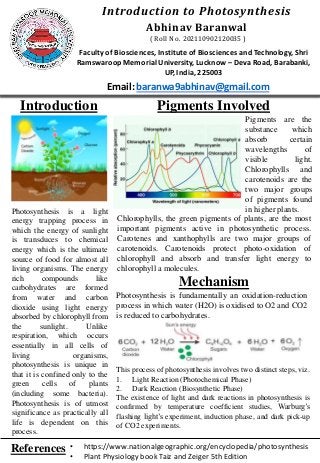
Pigments are the
substance which
absorb certain
wavelengths of
visible light.
Chlorophylls and
carotenoids are the
two major groups
of pigments found
in higher plants.
Photosynthesis is fundamentally an oxidation-reduction
process in which water (H2O) is oxidised to O2 and CO2
is reduced to carbohydrates.
References • https://www.nationalgeographic.org/encyclopedia/photosynthesis
• Plant Physiology book Taiz and Zeiger 5th Edition