Unless otherwise noted, the slides in this presentation are licensed by Mark A. Parsons under a Creative Commons Attribution-Share Alike 3.0 License
Research Data Alliance:
Philosophy, Structure, and Governance
Mark A. Parsons
0000-0002-7723-0950
Secretary General
RDA for Newcomers
Denver, CO, USA
15 September 2016
Research Data Alliance
Vision
Researchers and innovators openly share data across
technologies, disciplines, and countries to address the
grand challenges of society.
Mission
RDA builds the social and technical bridges that enable
open sharing of data.
Recommendations that make data work
“Create - Adopt - Use”
• Adopted code, policy, specifications, standards, or practices that
enable data sharing
• “Harvestable” efforts for which 12-18 months of work can eliminate
a roadblock
• Efforts that have substantive applicability to
groups within the data community but may
not apply to all
• Efforts that can start today
RDA Principles
Openness
Consensus
Balance
Harmonization
Community Driven
Non-profit
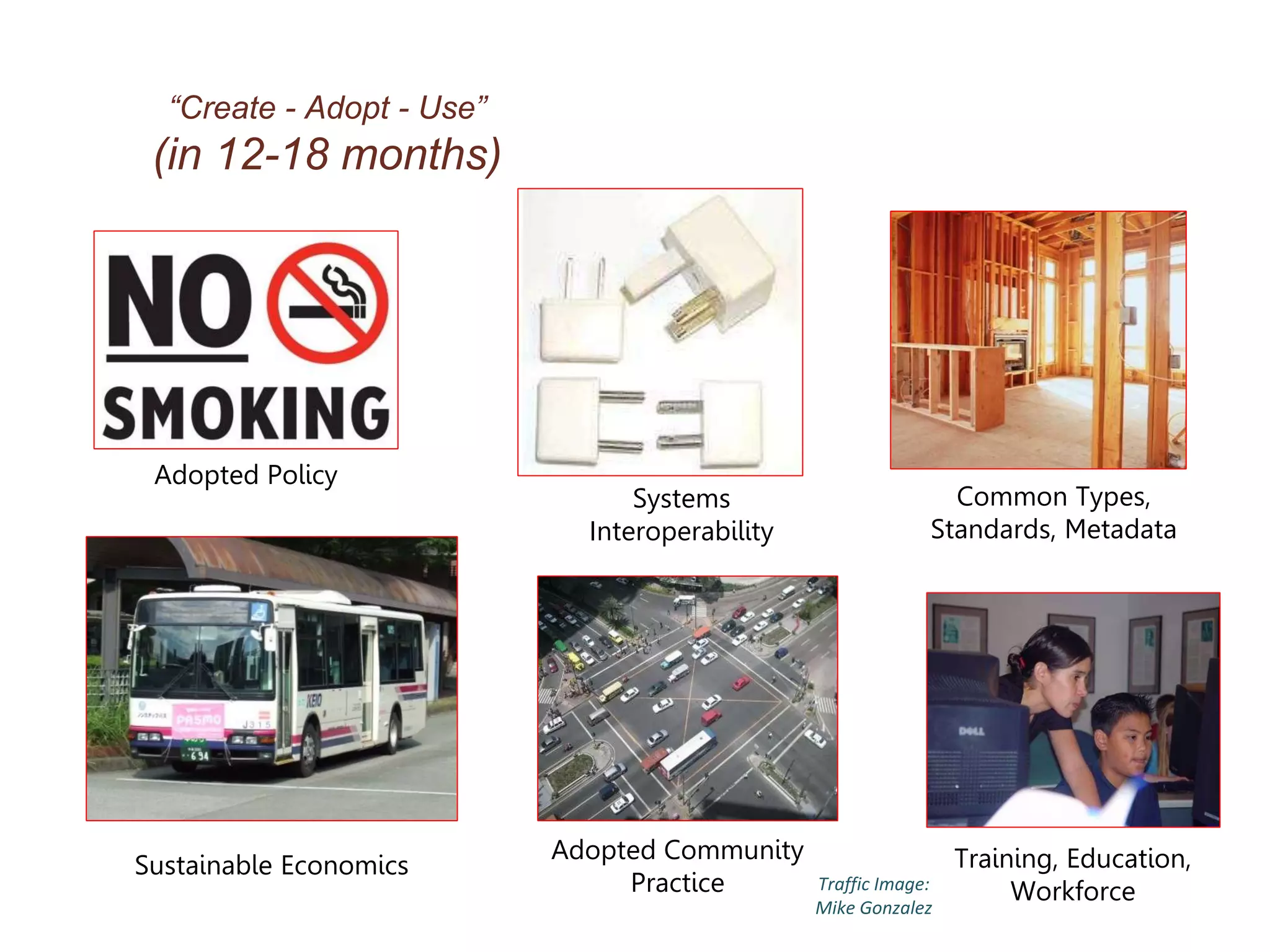
“Create - Adopt - Use”
(in 12-18 months)
Systems
Interoperability
Adopted Policy
Sustainable Economics
Common Types,
Standards, Metadata
Traffic Image:
Mike Gonzalez
Adopted Community
Practice
Training, Education,
Workforce
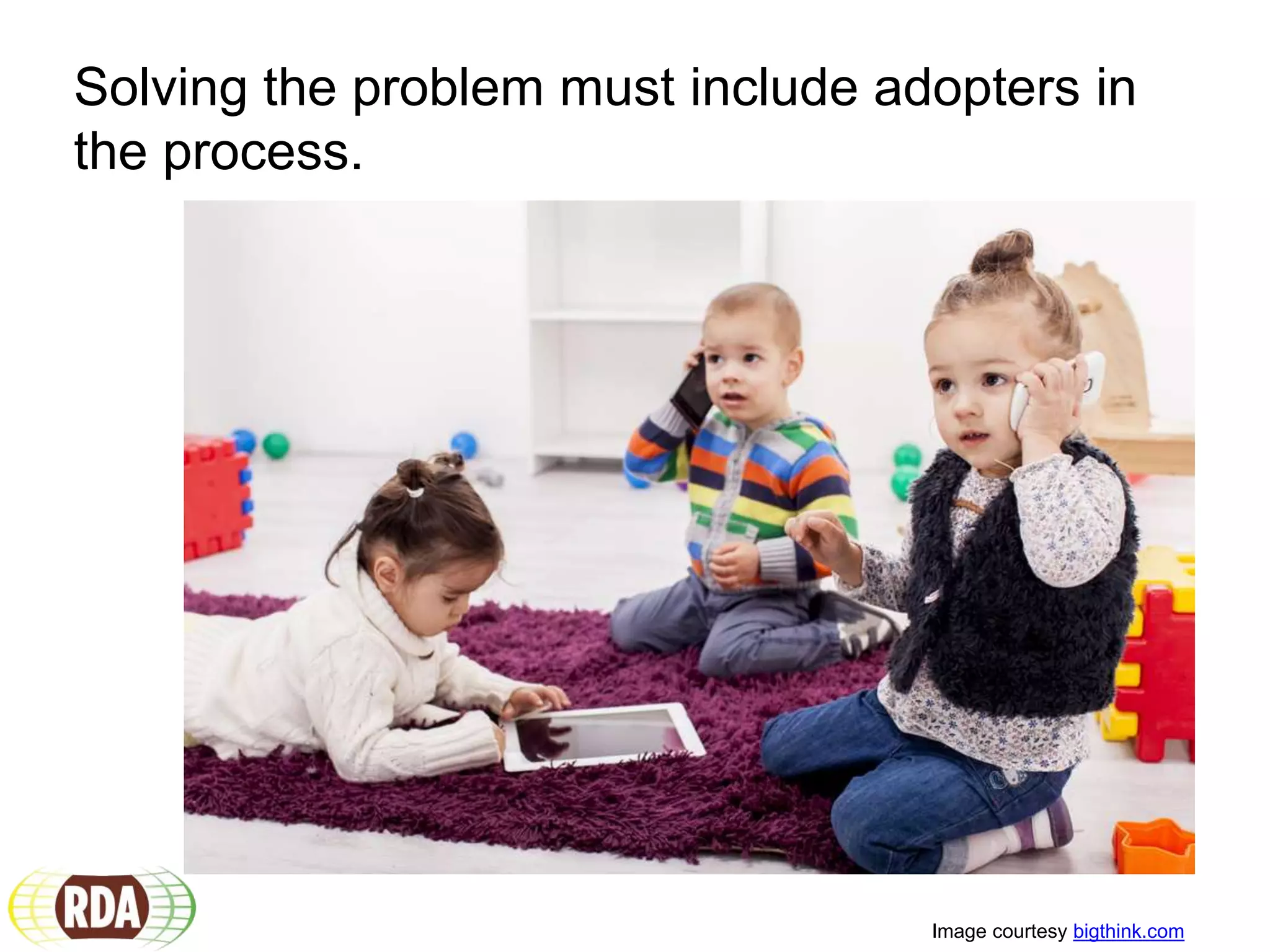
Solving the problem must include adopters in
the process.
Image courtesy bigthink.com
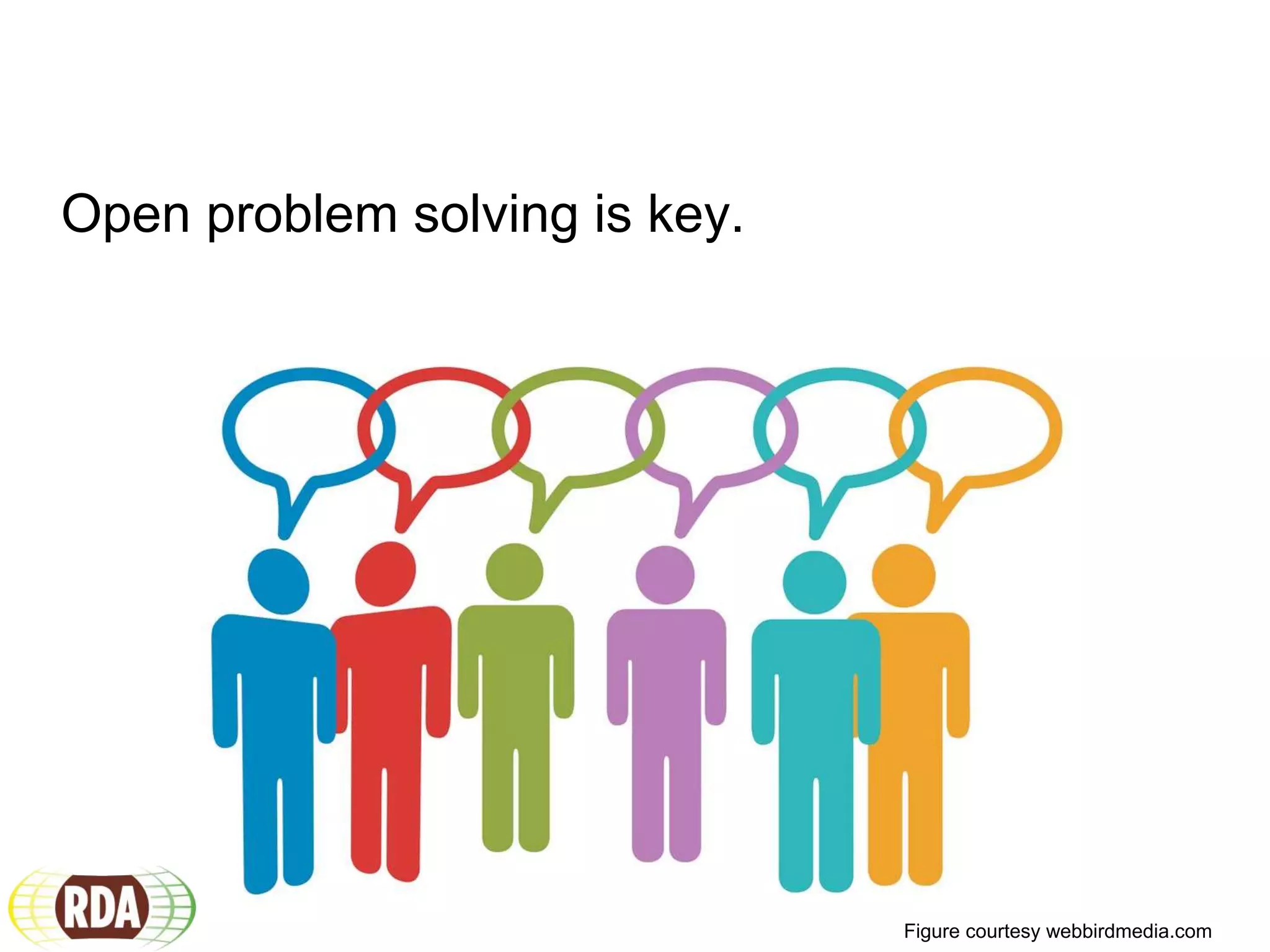
Open problem solving is key.
Figure courtesy webbirdmedia.com
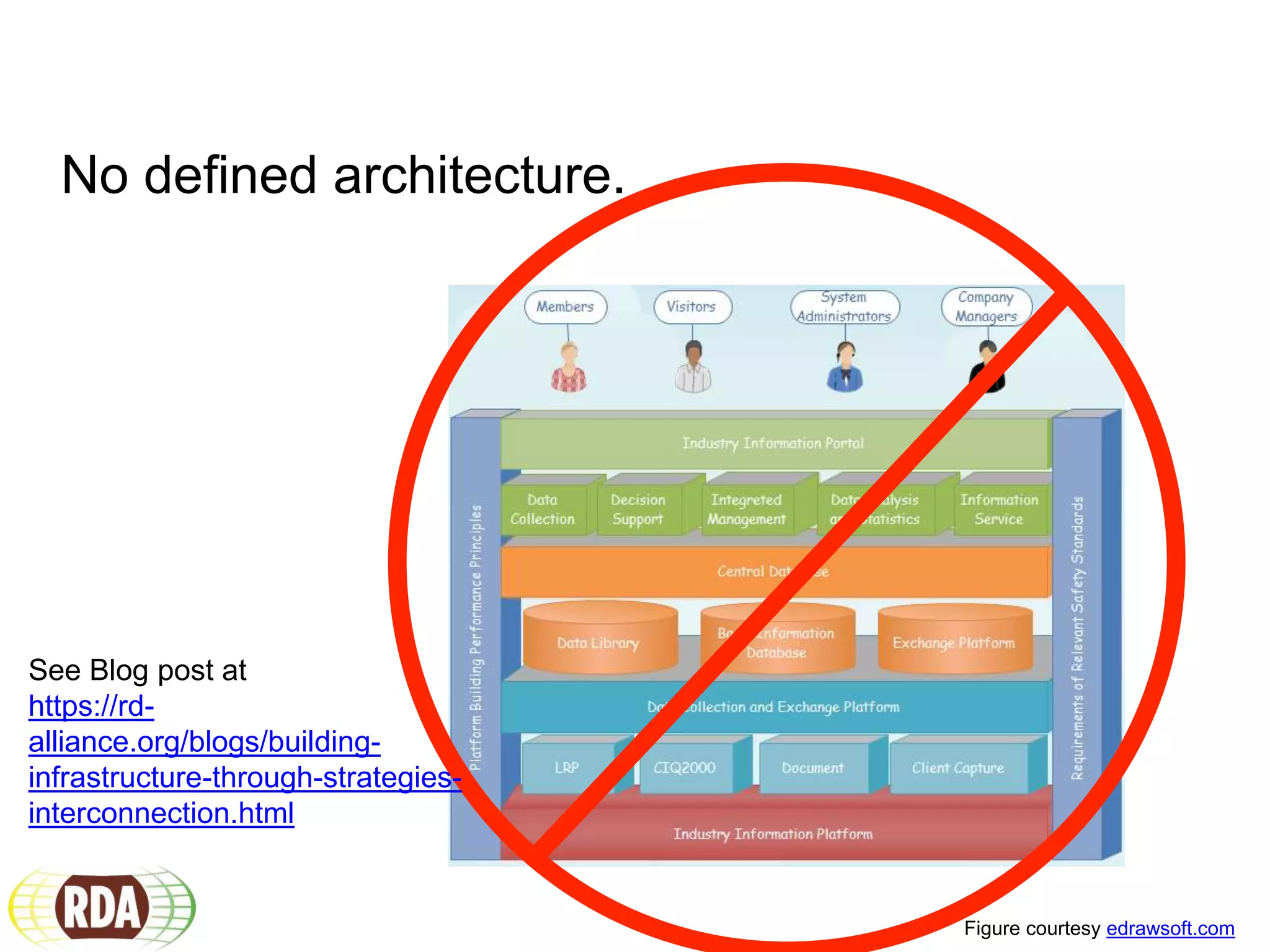
No defined architecture.
Figure courtesy edrawsoft.com
See Blog post at
https://rd-
alliance.org/blogs/building-
infrastructure-through-strategies-
interconnection.html
Map of the internet by the Opte Project [CC-BY] via Wikimedia
Commons
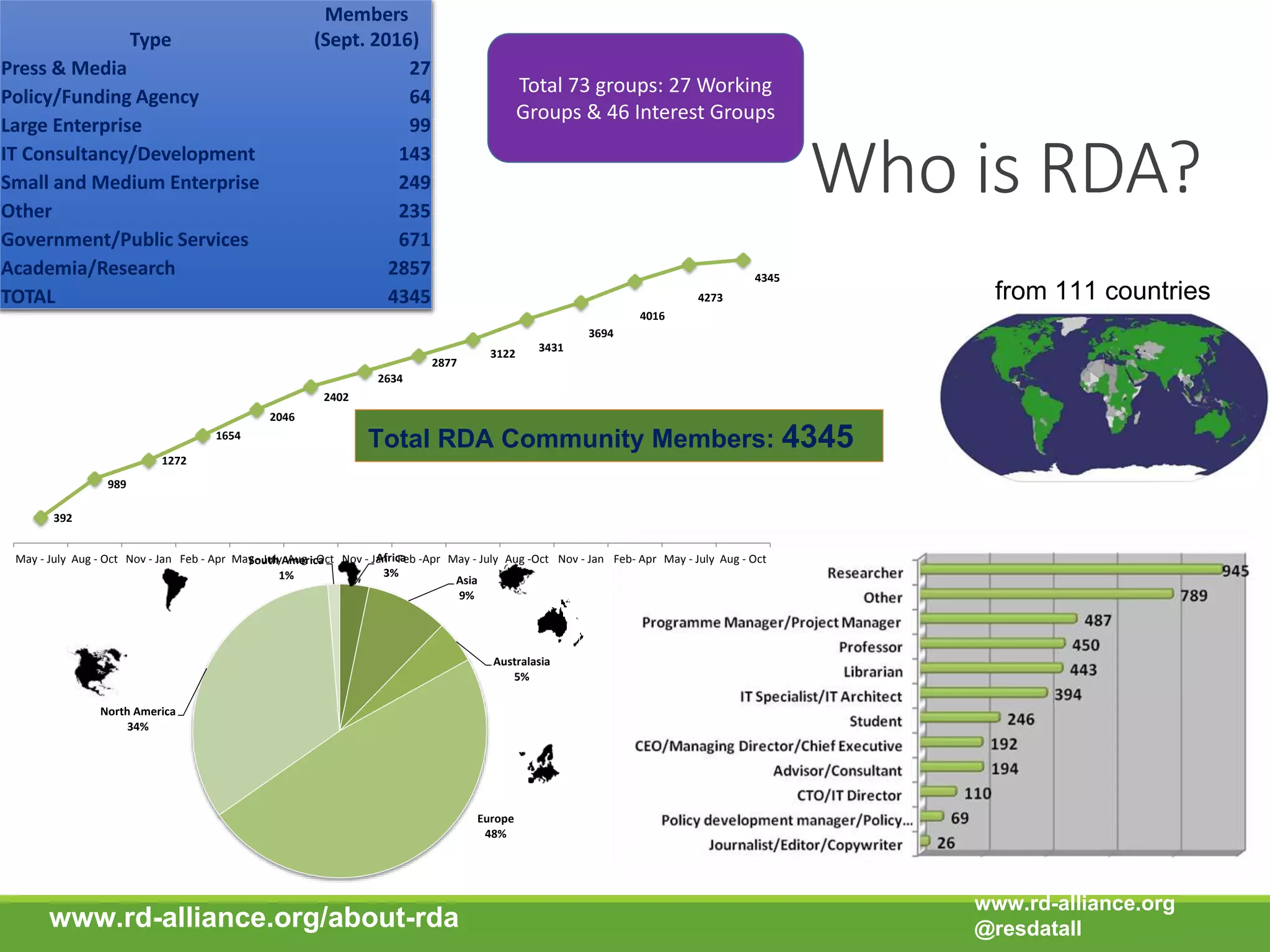
Africa
3%
Asia
9%
Australasia
5%
Europe
48%
North America
34%
South America
1%
Total RDA Community Members: 4345
from 111 countries
Who is RDA?
Type
Members
(Sept. 2016)
Press & Media 27
Policy/Funding Agency 64
Large Enterprise 99
IT Consultancy/Development 143
Small and Medium Enterprise 249
Other 235
Government/Public Services 671
Academia/Research 2857
TOTAL 4345
www.rd-alliance.org/about-rda
392
989
1272
1654
2046
2402
2634
2877
3122
3431
3694
4016
4273
4345
May - July Aug - Oct Nov - Jan Feb - Apr May - July Aug - Oct Nov - Jan Feb -Apr May - July Aug -Oct Nov - Jan Feb- Apr May - July Aug - Oct
www.rd-alliance.org
@resdatall
Total 73 groups: 27 Working
Groups & 46 Interest Groups
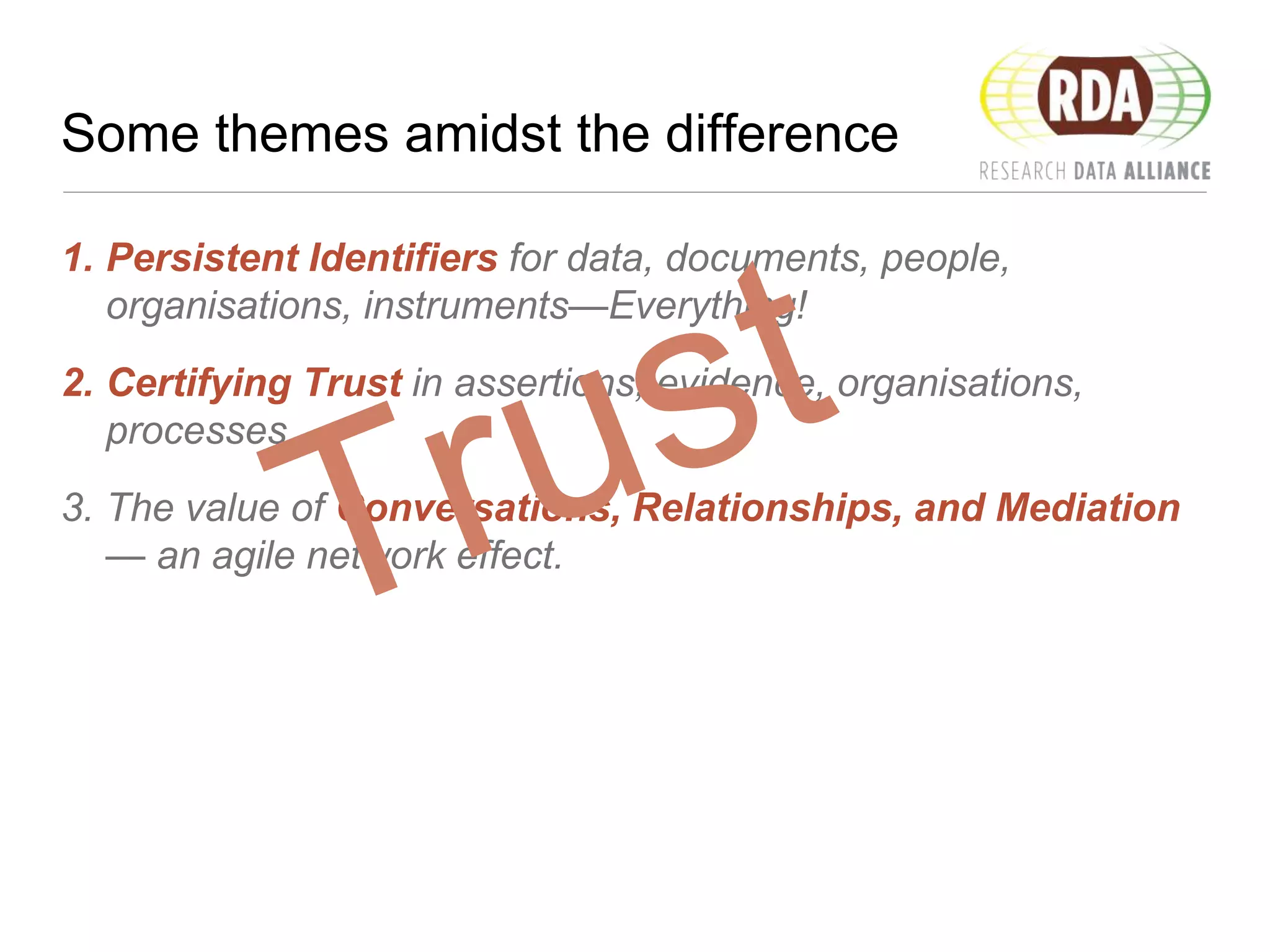
Some themes amidst the difference
1. Persistent Identifiers for data, documents, people,
organisations, instruments—Everything!
2. Certifying Trust in assertions, evidence, organisations,
processes…
3. The value of Conversations, Relationships, and Mediation
— an agile network effect.
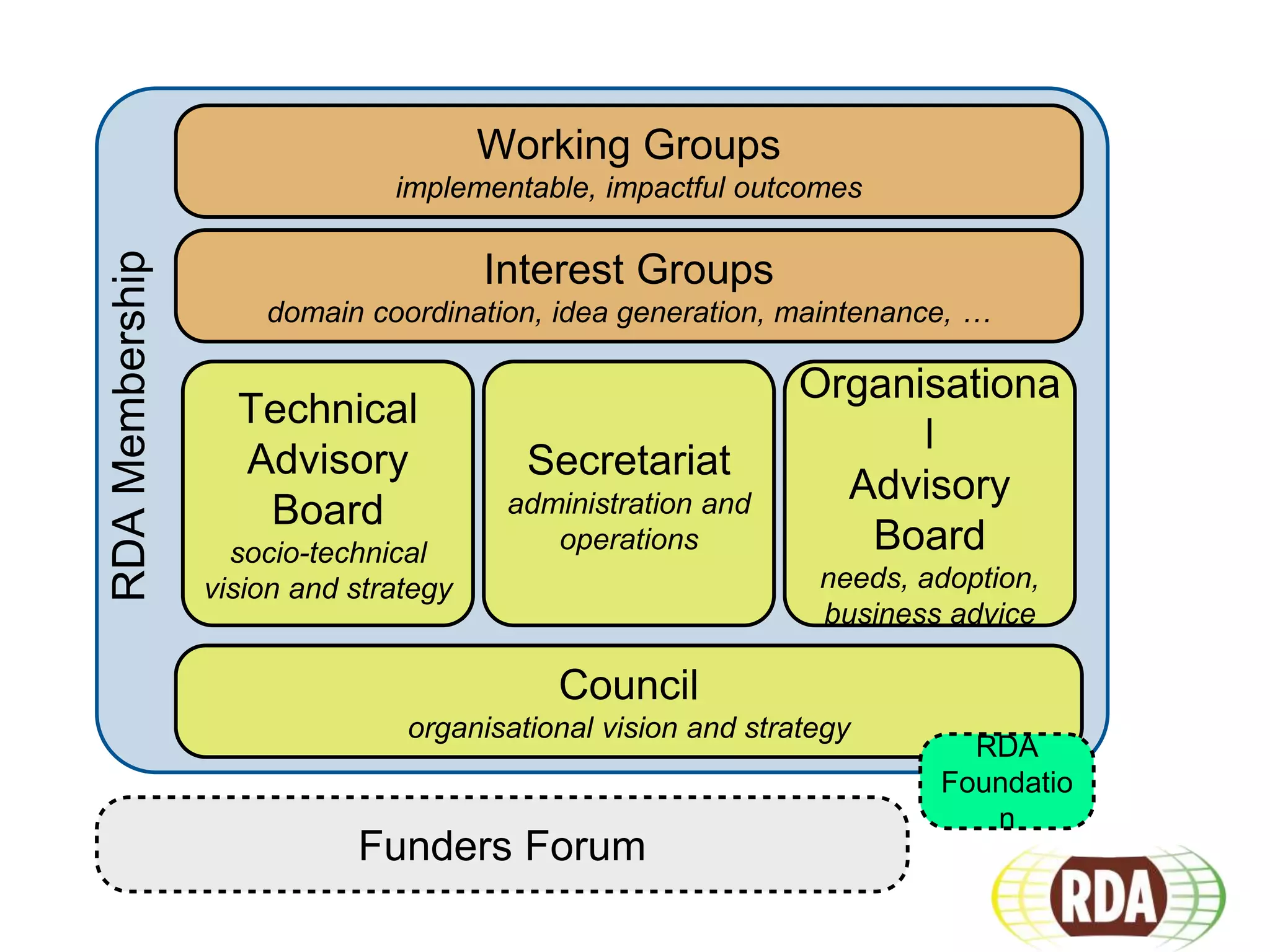
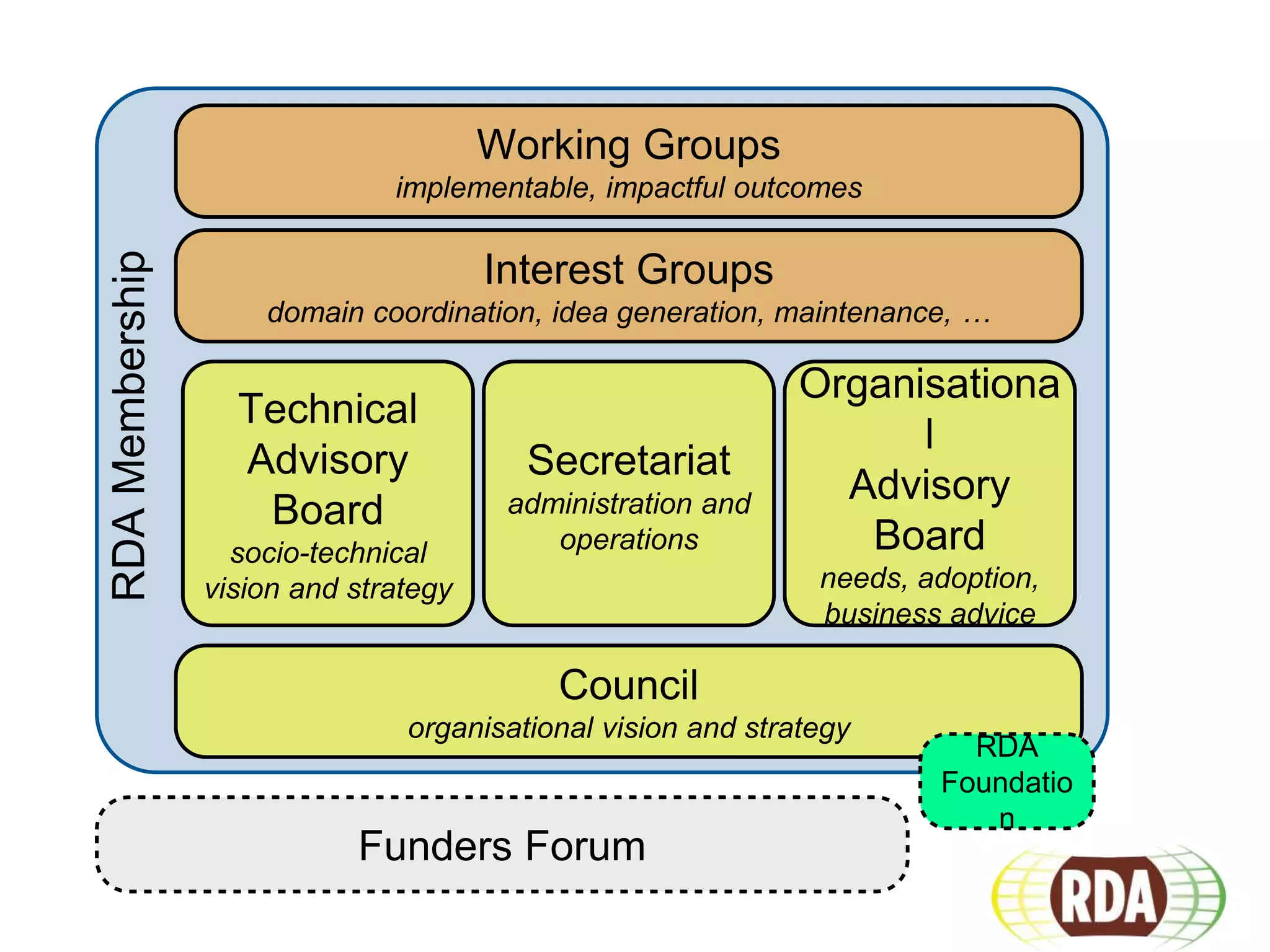
Funders Forum
Interest Groups
domain coordination, idea generation, maintenance, …
RDAMembership Working Groups
implementable, impactful outcomes
Council
organisational vision and strategy
Technical
Advisory
Board
socio-technical
vision and strategy
Secretariat
administration and
operations
Organisationa
l
Advisory
Board
needs, adoption,
business advice
RDA
Foundatio
n
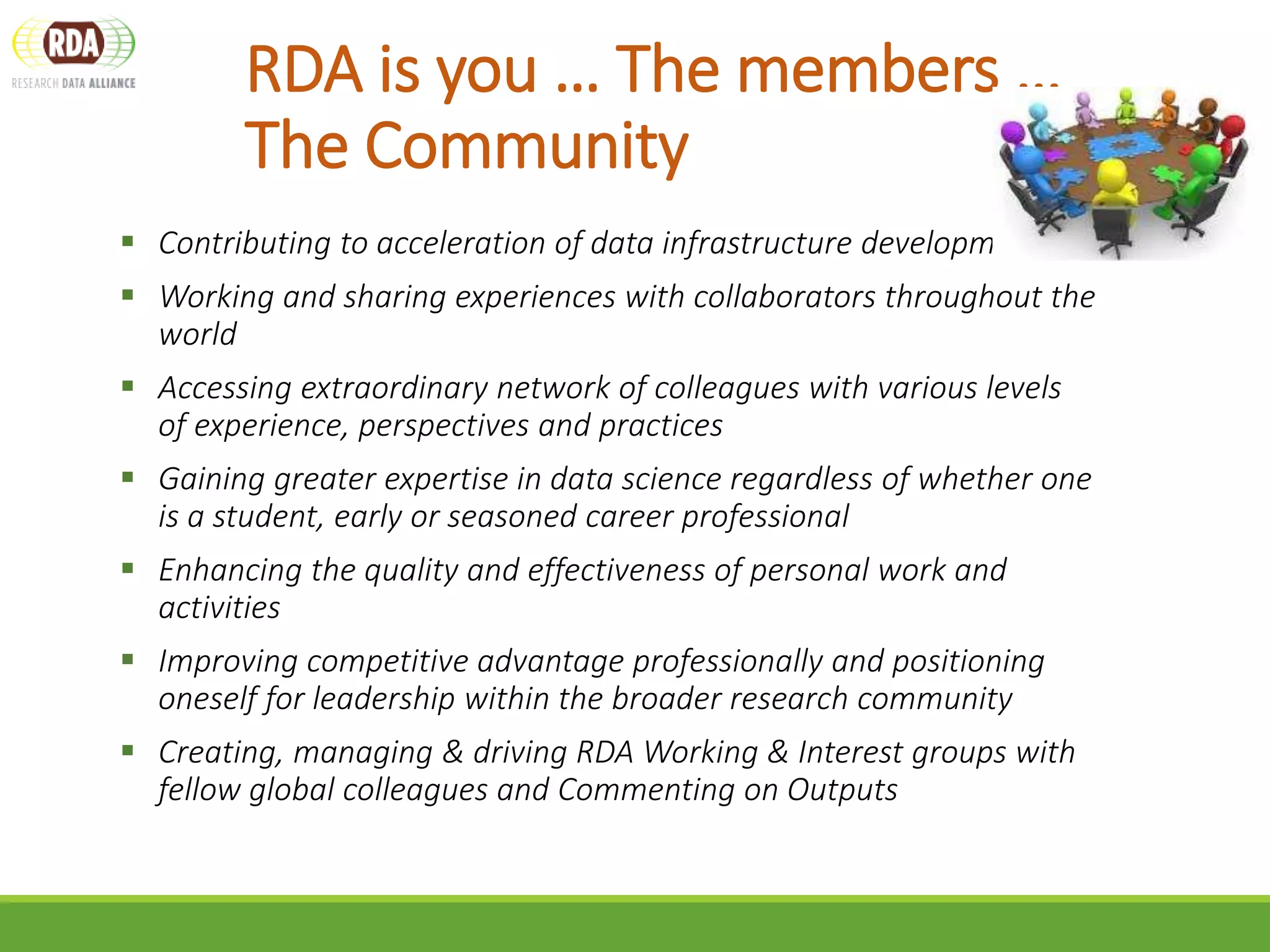
RDA is you … The members …
The Community
 Contributing to acceleration of data infrastructure development
 Working and sharing experiences with collaborators throughout the
world
 Accessing extraordinary network of colleagues with various levels
of experience, perspectives and practices
 Gaining greater expertise in data science regardless of whether one
is a student, early or seasoned career professional
 Enhancing the quality and effectiveness of personal work and
activities
 Improving competitive advantage professionally and positioning
oneself for leadership within the broader research community
 Creating, managing & driving RDA Working & Interest groups with
fellow global colleagues and Commenting on Outputs
Funders Forum
Interest Groups
domain coordination, idea generation, maintenance, …
RDAMembership Working Groups
implementable, impactful outcomes
Council
organisational vision and strategy
Technical
Advisory
Board
socio-technical
vision and strategy
Secretariat
administration and
operations
Organisationa
l
Advisory
Board
needs, adoption,
business advice
RDA
Foundatio
n
RDA Secretariat
Responsible for the administration and
daily operations.
Contact: secretariat@rda-groups.org
rd-alliance.org
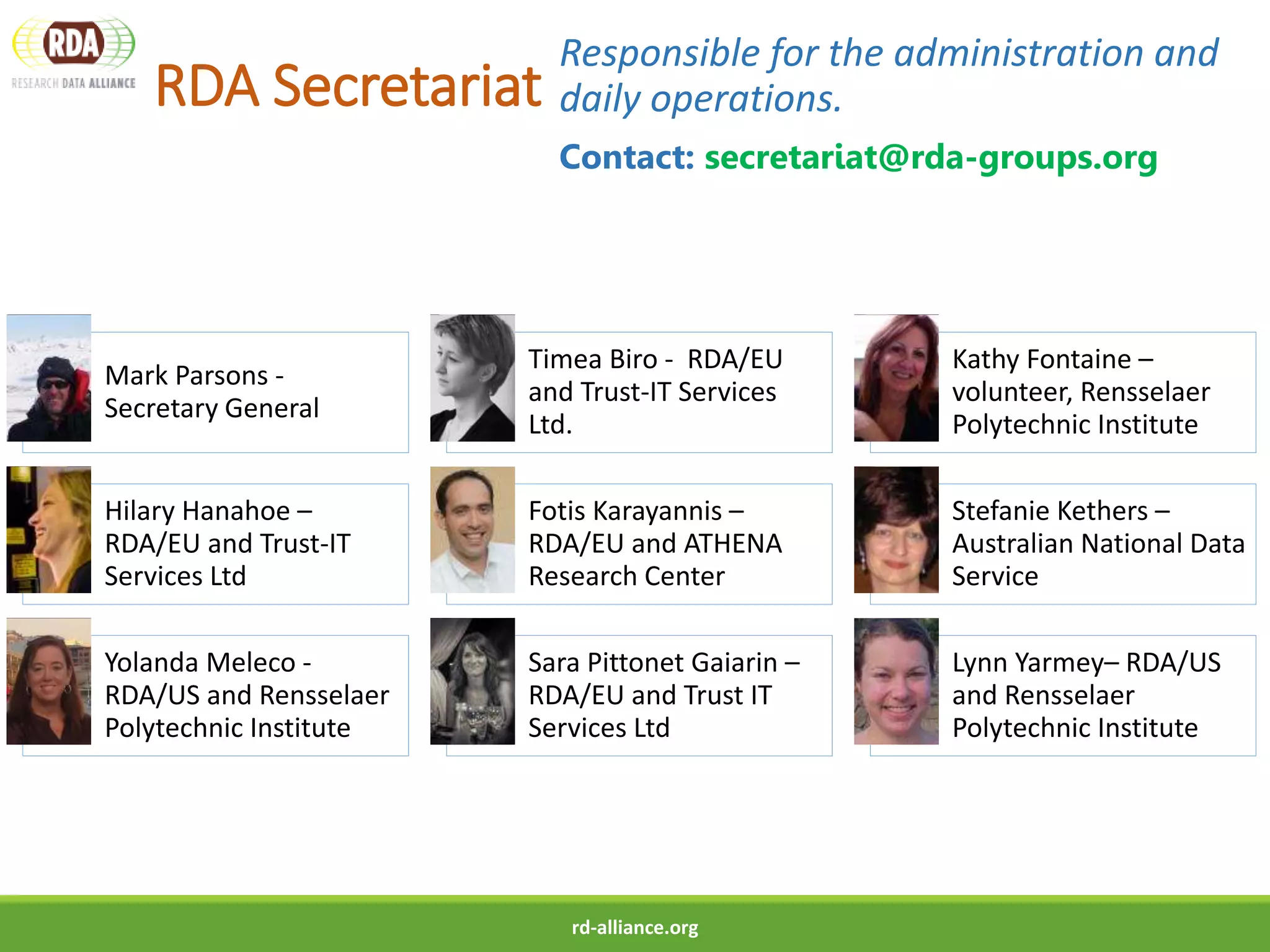
Mark Parsons -
Secretary General
Timea Biro - RDA/EU
and Trust-IT Services
Ltd.
Kathy Fontaine –
volunteer, Rensselaer
Polytechnic Institute
Hilary Hanahoe –
RDA/EU and Trust-IT
Services Ltd
Fotis Karayannis –
RDA/EU and ATHENA
Research Center
Stefanie Kethers –
Australian National Data
Service
Yolanda Meleco -
RDA/US and Rensselaer
Polytechnic Institute
Sara Pittonet Gaiarin –
RDA/EU and Trust IT
Services Ltd
Lynn Yarmey– RDA/US
and Rensselaer
Polytechnic Institute
TAB Members
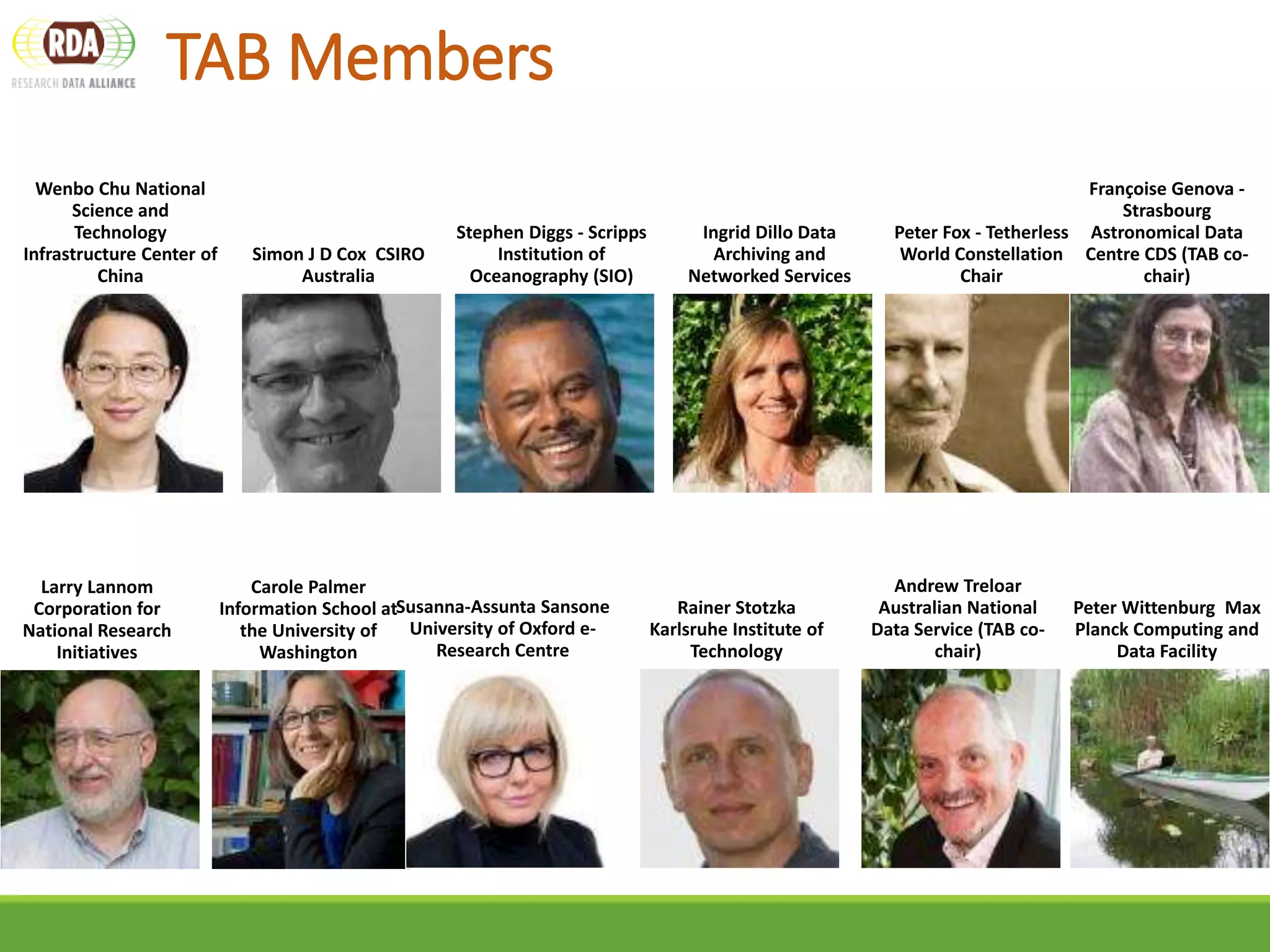
Wenbo Chu National
Science and
Technology
Infrastructure Center of
China
Simon J D Cox CSIRO
Australia
Stephen Diggs - Scripps
Institution of
Oceanography (SIO)
Ingrid Dillo Data
Archiving and
Networked Services
Peter Fox - Tetherless
World Constellation
Chair
Françoise Genova -
Strasbourg
Astronomical Data
Centre CDS (TAB co-
chair)
Larry Lannom
Corporation for
National Research
Initiatives
Carole Palmer
Information School at
the University of
Washington
Susanna-Assunta Sansone
University of Oxford e-
Research Centre
Rainer Stotzka
Karlsruhe Institute of
Technology
Andrew Treloar
Australian National
Data Service (TAB co-
chair)
Peter Wittenburg Max
Planck Computing and
Data Facility
Technical Advisory Board (TAB)
Responsible for the technical direction of the RDA
and provides technical expertise and advice to
Council, as well as helping to develop and review
RDA Working and Interest Groups to promote their
impact and effectiveness.
TAB members normally serve for a term of 3 years
and may be re-elected. Each year, approximately
one‐third of the TAB stand down and their positions
will be filled by election. TAB Representatives are
elected by RDA membership.
TAB Election: opens today!
Contact: tab@rda-groups.org
TAB Members
Wenbo Chu National
Science and
Technology
Infrastructure Center of
China
Simon J D Cox CSIRO
Australia
Stephen Diggs - Scripps
Institution of
Oceanography (SIO)
Ingrid Dillo Data
Archiving and
Networked Services
Peter Fox - Tetherless
World Constellation
Chair
Françoise Genova -
Strasbourg
Astronomical Data
Centre CDS (TAB co-
chair)
Larry Lannom
Corporation for
National Research
Initiatives
Carole Palmer
Information School at
the University of
Washington
Susanna-Assunta Sansone
University of Oxford e-
Research Centre
Rainer Stotzka
Karlsruhe Institute of
Technology
Andrew Treloar
Australian National
Data Service (TAB co-
chair)
Peter Wittenburg Max
Planck Computing and
Data Facility
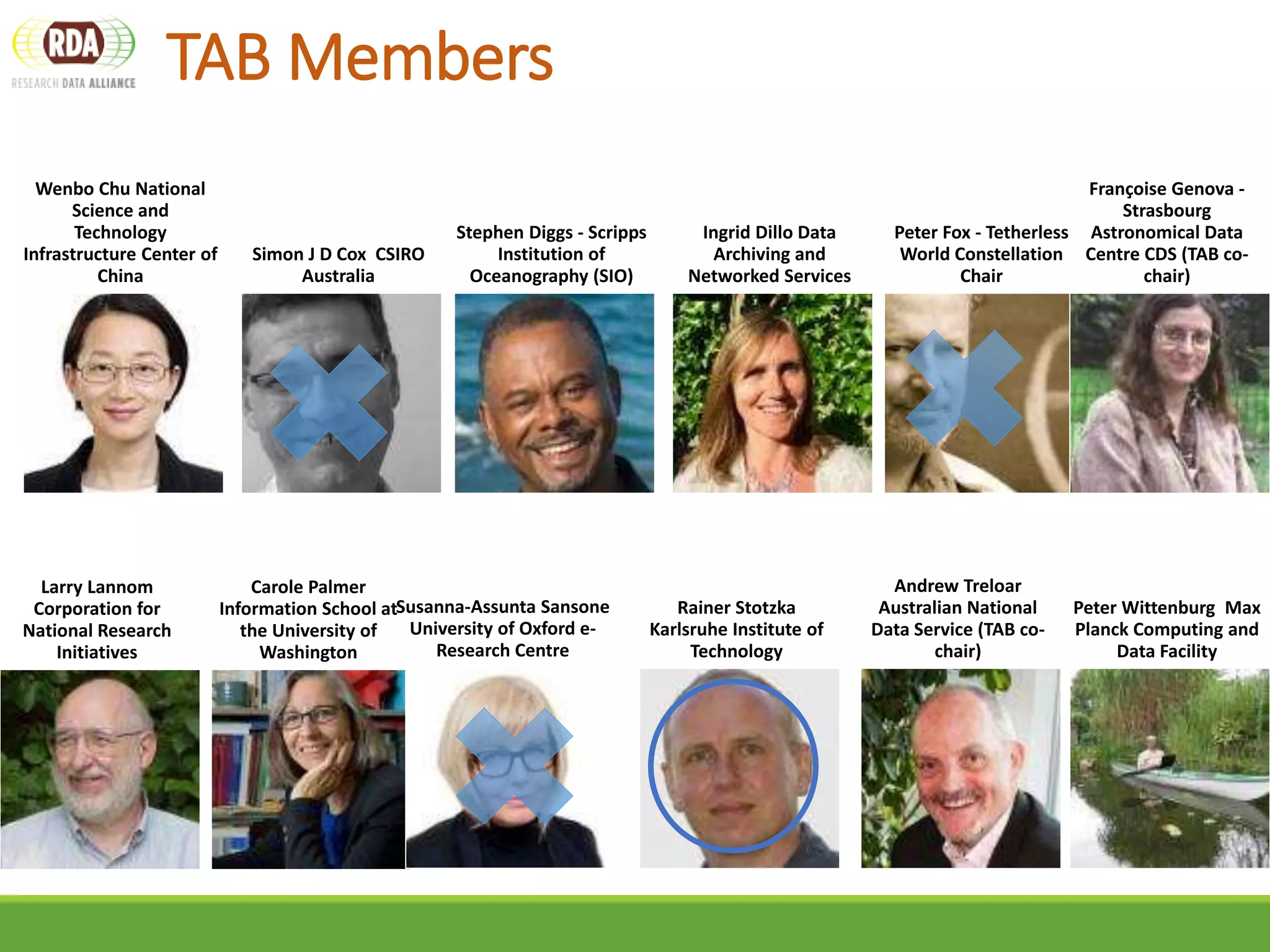
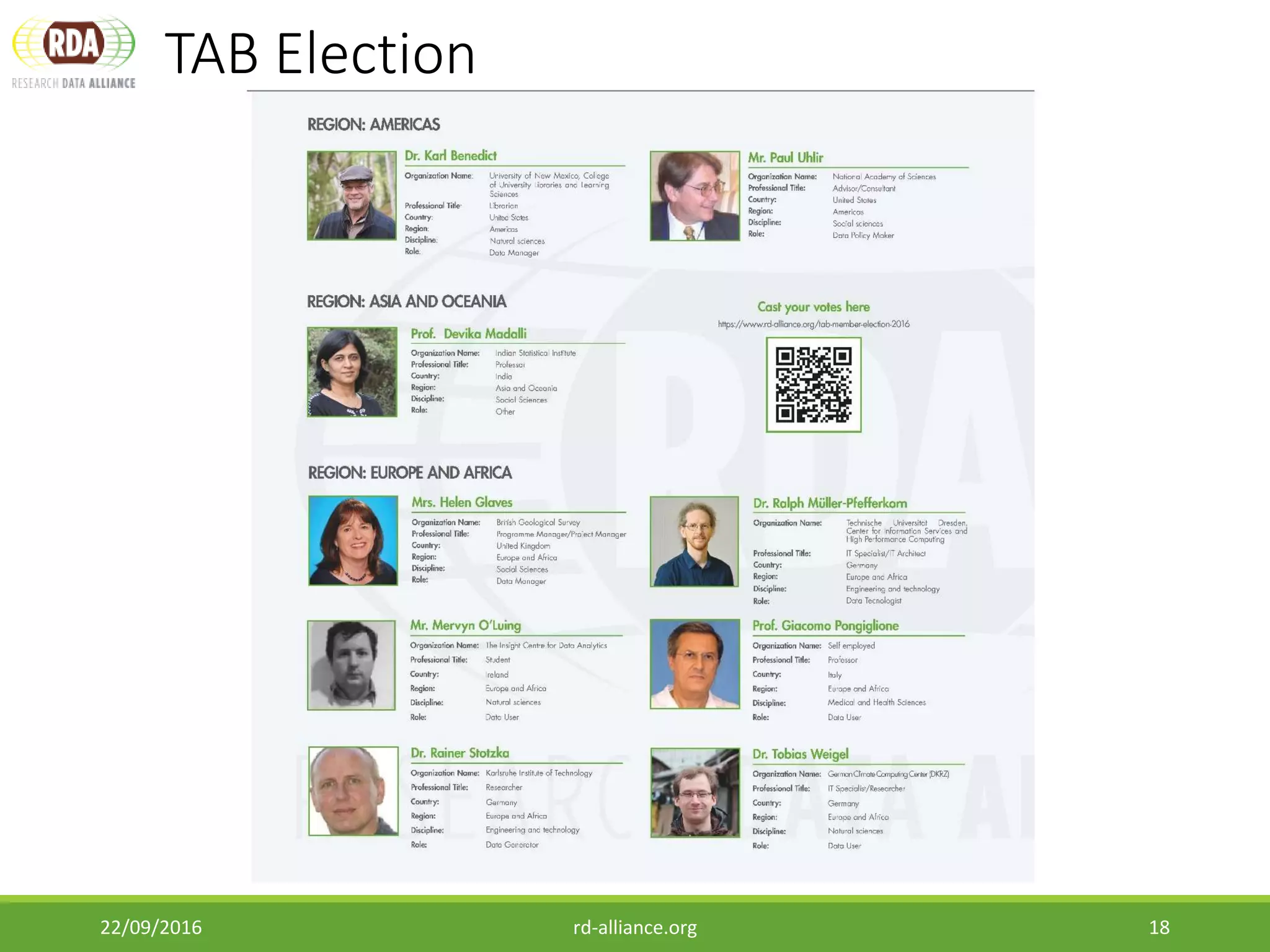
TAB Election
22/09/2016 rd-alliance.org 18
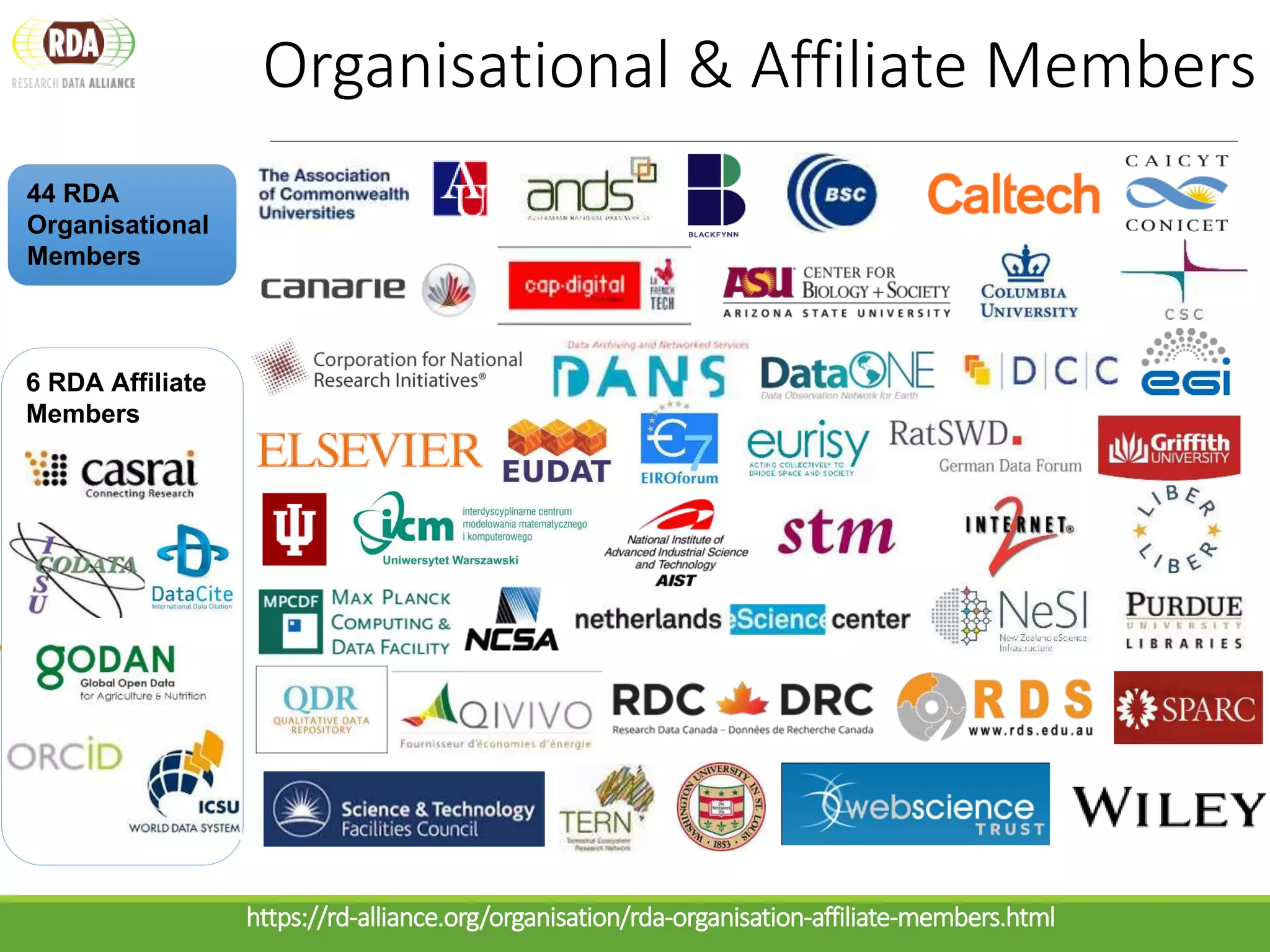
44 RDA
Organisational
Members
Organisational & Affiliate Members
6 RDA Affiliate
Members
https://rd-alliance.org/organisation/rda-organisation-affiliate-members.html
To provide an organizational perspective on the work of RDA and ability to
influence RDA’s direction
To assist in implementation of RDA Outputs
To participate in all RDA Organizational assembly meetings
To receive regular updates on the work of the RDA
To attend Organizational Assembly meetings and vote on proposed policies for
consideration by the RDA Council and for members of the Organizational
Advisory Board
To provide advice to the Council through the Organizational Advisory Board
To be recognized on the RDA Website and at RDA Meetings as a supporter of
data interoperability
Why do global organisations
join RDA?
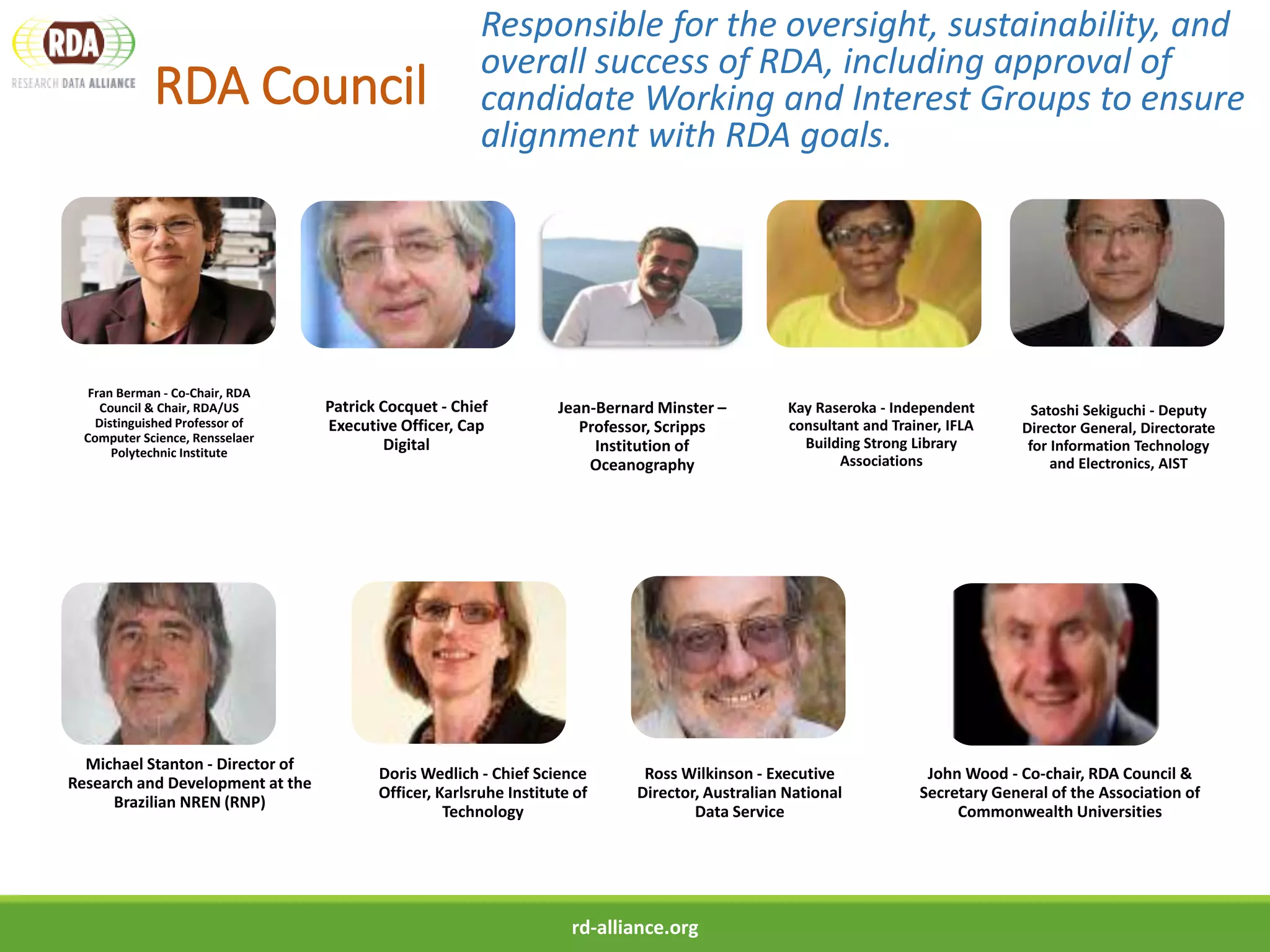
RDA Council
Responsible for the oversight, sustainability, and
overall success of RDA, including approval of
candidate Working and Interest Groups to ensure
alignment with RDA goals.
rd-alliance.org
Fran Berman - Co-Chair, RDA
Council & Chair, RDA/US
Distinguished Professor of
Computer Science, Rensselaer
Polytechnic Institute
Patrick Cocquet - Chief
Executive Officer, Cap
Digital
Jean-Bernard Minster –
Professor, Scripps
Institution of
Oceanography
Kay Raseroka - Independent
consultant and Trainer, IFLA
Building Strong Library
Associations
Satoshi Sekiguchi - Deputy
Director General, Directorate
for Information Technology
and Electronics, AIST
Michael Stanton - Director of
Research and Development at the
Brazilian NREN (RNP)
Doris Wedlich - Chief Science
Officer, Karlsruhe Institute of
Technology
Ross Wilkinson - Executive
Director, Australian National
Data Service
John Wood - Co-chair, RDA Council &
Secretary General of the Association of
Commonwealth Universities
Funders Forum
Interest Groups
domain coordination, idea generation, maintenance, …
RDAMembership Working Groups
implementable, impactful outcomes
Council
organisational vision and strategy
Technical
Advisory
Board
socio-technical
vision and strategy
Secretariat
administration and
operations
Organisationa
l
Advisory
Board
needs, adoption,
business advice
RDA
Foundatio
n
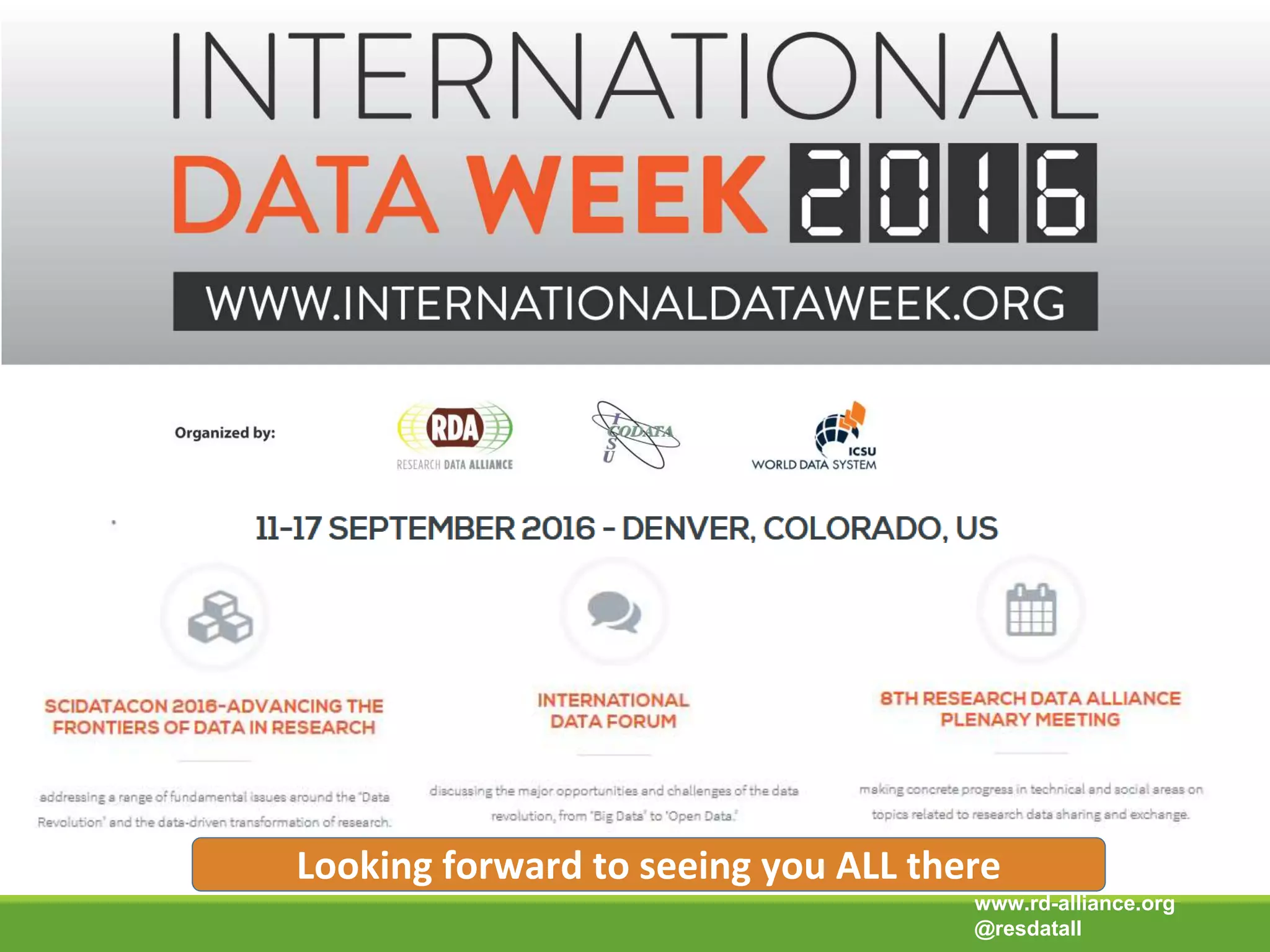
Looking forward to seeing you ALL there
www.rd-alliance.org
@resdatall
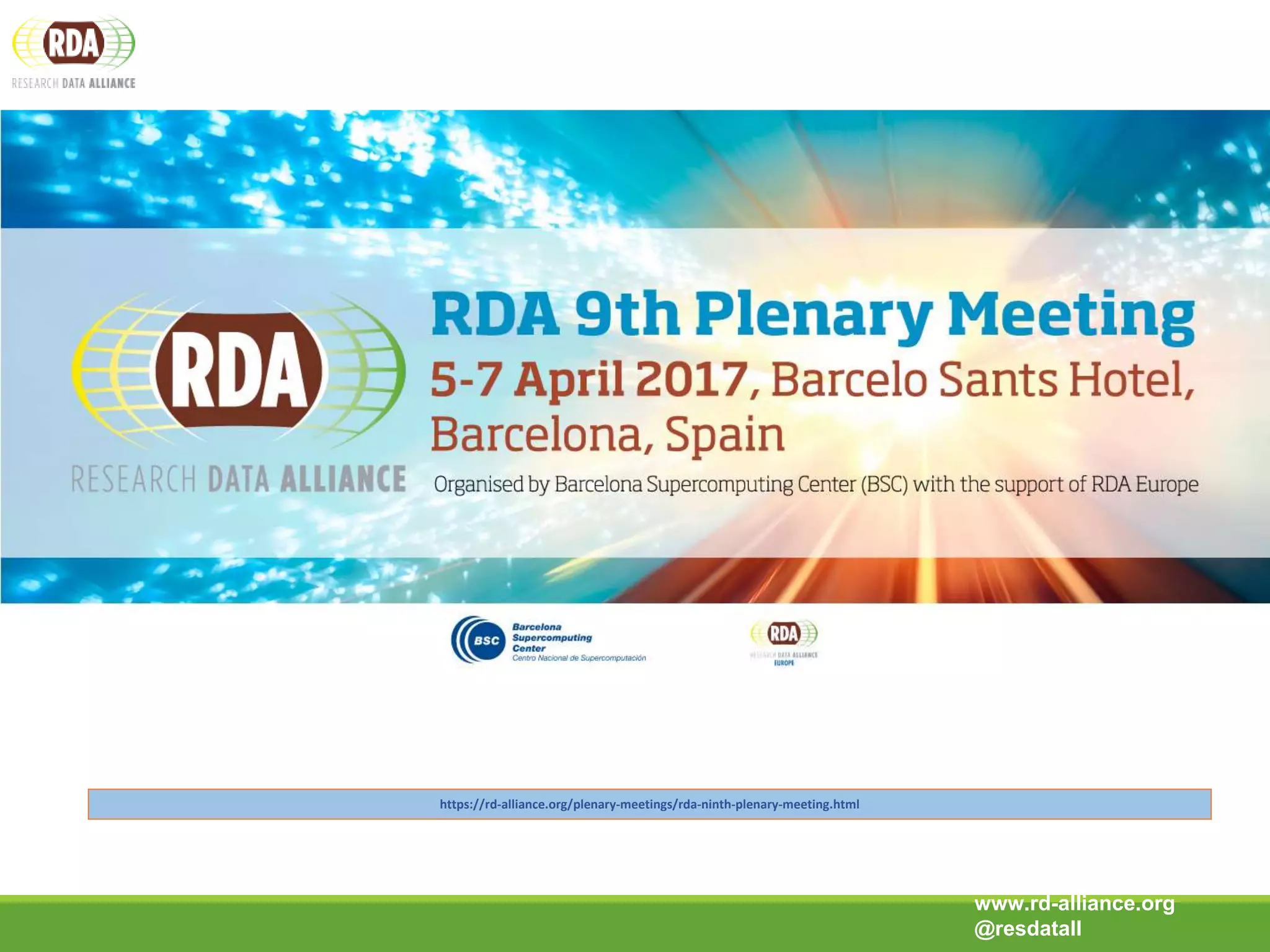
https://rd-alliance.org/plenary-meetings/rda-ninth-plenary-meeting.html
www.rd-alliance.org
@resdatall
RDA in a Nutshell
WWW.RD-ALLIANCE.ORG/
@RESDATALL
RDA Global
Email - enquiries@rd-alliance.org
Web - www.rd-alliance.org
Twitter - @resdatall
LinkedIn -
www.linkedin.com/in/ResearchDataAlliance
Slideshare -
http://www.slideshare.net/ResearchDataAlliance
Facebook -
https://www.facebook.com/pages/Research-
Data-Alliance/459608890798924
RDA Europe
Email - info@europe.rd-alliance.org
Web - europe.rd-alliance.org
Twitter - @RDA_Europe
RDA US
Twitter - @RDA_US

Philosophy, Structure, and Governance of RDA

  • 1.
    Unless otherwise noted,the slides in this presentation are licensed by Mark A. Parsons under a Creative Commons Attribution-Share Alike 3.0 License Research Data Alliance: Philosophy, Structure, and Governance Mark A. Parsons 0000-0002-7723-0950 Secretary General RDA for Newcomers Denver, CO, USA 15 September 2016
  • 2.
    Research Data Alliance Vision Researchersand innovators openly share data across technologies, disciplines, and countries to address the grand challenges of society. Mission RDA builds the social and technical bridges that enable open sharing of data.
  • 3.
    Recommendations that makedata work “Create - Adopt - Use” • Adopted code, policy, specifications, standards, or practices that enable data sharing • “Harvestable” efforts for which 12-18 months of work can eliminate a roadblock • Efforts that have substantive applicability to groups within the data community but may not apply to all • Efforts that can start today RDA Principles Openness Consensus Balance Harmonization Community Driven Non-profit
  • 4.
    “Create - Adopt- Use” (in 12-18 months) Systems Interoperability Adopted Policy Sustainable Economics Common Types, Standards, Metadata Traffic Image: Mike Gonzalez Adopted Community Practice Training, Education, Workforce
  • 5.
    Solving the problemmust include adopters in the process. Image courtesy bigthink.com
  • 6.
    Open problem solvingis key. Figure courtesy webbirdmedia.com
  • 7.
    No defined architecture. Figurecourtesy edrawsoft.com See Blog post at https://rd- alliance.org/blogs/building- infrastructure-through-strategies- interconnection.html
  • 8.
    Map of theinternet by the Opte Project [CC-BY] via Wikimedia Commons
  • 9.
    Africa 3% Asia 9% Australasia 5% Europe 48% North America 34% South America 1% TotalRDA Community Members: 4345 from 111 countries Who is RDA? Type Members (Sept. 2016) Press & Media 27 Policy/Funding Agency 64 Large Enterprise 99 IT Consultancy/Development 143 Small and Medium Enterprise 249 Other 235 Government/Public Services 671 Academia/Research 2857 TOTAL 4345 www.rd-alliance.org/about-rda 392 989 1272 1654 2046 2402 2634 2877 3122 3431 3694 4016 4273 4345 May - July Aug - Oct Nov - Jan Feb - Apr May - July Aug - Oct Nov - Jan Feb -Apr May - July Aug -Oct Nov - Jan Feb- Apr May - July Aug - Oct www.rd-alliance.org @resdatall Total 73 groups: 27 Working Groups & 46 Interest Groups
  • 10.
    Some themes amidstthe difference 1. Persistent Identifiers for data, documents, people, organisations, instruments—Everything! 2. Certifying Trust in assertions, evidence, organisations, processes… 3. The value of Conversations, Relationships, and Mediation — an agile network effect.
  • 11.
    Funders Forum Interest Groups domaincoordination, idea generation, maintenance, … RDAMembership Working Groups implementable, impactful outcomes Council organisational vision and strategy Technical Advisory Board socio-technical vision and strategy Secretariat administration and operations Organisationa l Advisory Board needs, adoption, business advice RDA Foundatio n
  • 12.
    RDA is you… The members … The Community  Contributing to acceleration of data infrastructure development  Working and sharing experiences with collaborators throughout the world  Accessing extraordinary network of colleagues with various levels of experience, perspectives and practices  Gaining greater expertise in data science regardless of whether one is a student, early or seasoned career professional  Enhancing the quality and effectiveness of personal work and activities  Improving competitive advantage professionally and positioning oneself for leadership within the broader research community  Creating, managing & driving RDA Working & Interest groups with fellow global colleagues and Commenting on Outputs
  • 13.
    Funders Forum Interest Groups domaincoordination, idea generation, maintenance, … RDAMembership Working Groups implementable, impactful outcomes Council organisational vision and strategy Technical Advisory Board socio-technical vision and strategy Secretariat administration and operations Organisationa l Advisory Board needs, adoption, business advice RDA Foundatio n
  • 14.
    RDA Secretariat Responsible forthe administration and daily operations. Contact: secretariat@rda-groups.org rd-alliance.org Mark Parsons - Secretary General Timea Biro - RDA/EU and Trust-IT Services Ltd. Kathy Fontaine – volunteer, Rensselaer Polytechnic Institute Hilary Hanahoe – RDA/EU and Trust-IT Services Ltd Fotis Karayannis – RDA/EU and ATHENA Research Center Stefanie Kethers – Australian National Data Service Yolanda Meleco - RDA/US and Rensselaer Polytechnic Institute Sara Pittonet Gaiarin – RDA/EU and Trust IT Services Ltd Lynn Yarmey– RDA/US and Rensselaer Polytechnic Institute
  • 15.
    TAB Members Wenbo ChuNational Science and Technology Infrastructure Center of China Simon J D Cox CSIRO Australia Stephen Diggs - Scripps Institution of Oceanography (SIO) Ingrid Dillo Data Archiving and Networked Services Peter Fox - Tetherless World Constellation Chair Françoise Genova - Strasbourg Astronomical Data Centre CDS (TAB co- chair) Larry Lannom Corporation for National Research Initiatives Carole Palmer Information School at the University of Washington Susanna-Assunta Sansone University of Oxford e- Research Centre Rainer Stotzka Karlsruhe Institute of Technology Andrew Treloar Australian National Data Service (TAB co- chair) Peter Wittenburg Max Planck Computing and Data Facility
  • 16.
    Technical Advisory Board(TAB) Responsible for the technical direction of the RDA and provides technical expertise and advice to Council, as well as helping to develop and review RDA Working and Interest Groups to promote their impact and effectiveness. TAB members normally serve for a term of 3 years and may be re-elected. Each year, approximately one‐third of the TAB stand down and their positions will be filled by election. TAB Representatives are elected by RDA membership. TAB Election: opens today! Contact: tab@rda-groups.org
  • 17.
    TAB Members Wenbo ChuNational Science and Technology Infrastructure Center of China Simon J D Cox CSIRO Australia Stephen Diggs - Scripps Institution of Oceanography (SIO) Ingrid Dillo Data Archiving and Networked Services Peter Fox - Tetherless World Constellation Chair Françoise Genova - Strasbourg Astronomical Data Centre CDS (TAB co- chair) Larry Lannom Corporation for National Research Initiatives Carole Palmer Information School at the University of Washington Susanna-Assunta Sansone University of Oxford e- Research Centre Rainer Stotzka Karlsruhe Institute of Technology Andrew Treloar Australian National Data Service (TAB co- chair) Peter Wittenburg Max Planck Computing and Data Facility
  • 18.
  • 19.
    44 RDA Organisational Members Organisational &Affiliate Members 6 RDA Affiliate Members https://rd-alliance.org/organisation/rda-organisation-affiliate-members.html
  • 20.
    To provide anorganizational perspective on the work of RDA and ability to influence RDA’s direction To assist in implementation of RDA Outputs To participate in all RDA Organizational assembly meetings To receive regular updates on the work of the RDA To attend Organizational Assembly meetings and vote on proposed policies for consideration by the RDA Council and for members of the Organizational Advisory Board To provide advice to the Council through the Organizational Advisory Board To be recognized on the RDA Website and at RDA Meetings as a supporter of data interoperability Why do global organisations join RDA?
  • 21.
    RDA Council Responsible forthe oversight, sustainability, and overall success of RDA, including approval of candidate Working and Interest Groups to ensure alignment with RDA goals. rd-alliance.org Fran Berman - Co-Chair, RDA Council & Chair, RDA/US Distinguished Professor of Computer Science, Rensselaer Polytechnic Institute Patrick Cocquet - Chief Executive Officer, Cap Digital Jean-Bernard Minster – Professor, Scripps Institution of Oceanography Kay Raseroka - Independent consultant and Trainer, IFLA Building Strong Library Associations Satoshi Sekiguchi - Deputy Director General, Directorate for Information Technology and Electronics, AIST Michael Stanton - Director of Research and Development at the Brazilian NREN (RNP) Doris Wedlich - Chief Science Officer, Karlsruhe Institute of Technology Ross Wilkinson - Executive Director, Australian National Data Service John Wood - Co-chair, RDA Council & Secretary General of the Association of Commonwealth Universities
  • 22.
    Funders Forum Interest Groups domaincoordination, idea generation, maintenance, … RDAMembership Working Groups implementable, impactful outcomes Council organisational vision and strategy Technical Advisory Board socio-technical vision and strategy Secretariat administration and operations Organisationa l Advisory Board needs, adoption, business advice RDA Foundatio n
  • 23.
    Looking forward toseeing you ALL there www.rd-alliance.org @resdatall
  • 24.
  • 25.
    RDA in aNutshell WWW.RD-ALLIANCE.ORG/ @RESDATALL RDA Global Email - enquiries@rd-alliance.org Web - www.rd-alliance.org Twitter - @resdatall LinkedIn - www.linkedin.com/in/ResearchDataAlliance Slideshare - http://www.slideshare.net/ResearchDataAlliance Facebook - https://www.facebook.com/pages/Research- Data-Alliance/459608890798924 RDA Europe Email - info@europe.rd-alliance.org Web - europe.rd-alliance.org Twitter - @RDA_Europe RDA US Twitter - @RDA_US

Editor's Notes

  • #4 Point here is to emphasize our principles (which influence the business model) and our implementation based philosophy which has driven our growth but also demands more coordination.
  • #5 Adoption built in!
  • #6 1st. We insist that organisations committed to adopting the solution being developed are involved. That ensures that we are addressing real problems. those early adopters are important.
  • #7 2nd. all our WGs are open. Open problem solving is key. We want to capture the enthusiasts and get all the relevant perspectives. We’re big into consensus, but we define it quite loosely. Basically we say if there is a constituency using the output developed, that’s a level of consensus. And problem solving really needs to be done in a glocal way too. The agriculture community has figured out a way to do this really well. The have established an agricultural IG in RDA which kinda acts like their network facilitator—their Willie Nelson. The IG then identifies specific issues to address and whether they need to be addressed within the ag community or whether they should be addressed in a more global forum like some of the other RDA working groups, or if they need to establish a new WG to address particular issues. They spun up a wheat interoperability WG and are now working on a soils data WG. So we know this. We know to solve problems. Be use case driven. But too often we get caught up in our own engineering concerns of building the system. This leads me to another point.
  • #8 Not only do we not believe in heavy top-down approaches we explicitly eschew developing a central “architecture.” We let our WGs work on whatever they think is important and really only unite under a set of guiding principles. We agree with my friend Øystein Godøy who said I don’t want to build a system so much as a set of tools. (social and technical tools). Furthermore we observe how these tools these bridges interconnect. We don’t define how they interconnect. And we are already beginning to see that organic interconnection in RDA. We have nearly 60 groups. and about a dozen formal recommendations plus some other important outputs. And they are finding ways to interconnect on their own.
  • #9 Second these new systems (infrastructures?) follow a similar rather organic pattern of light central control of broad and diverse local systems. It’s much like the internet. Much like ecosystems. Indeed this is how networks work. Diverse hubs connected through often very weak ties.
  • #11       PIDs, trust, and the value of Community relationships. And these themes are all closely interrelated and discussion continues Mark Bide remarks at the 20th anniversary of the DOI: "if the barriers to achieving universality of identity management are not primarily technical, if the same identifier system can equally be used to identify scholarly journal articles and Hollywood movies, where do they lie? It is often assumed by those on the outside of the standards world that standards are simply about technology. The best technical solution will always win. In reality, what those of us who have worked in standards know — one of our guilty secrets — is that standards implementation is mostly about establishing acceptable social norms to which people willingly adhere. How does that come about? The answer is primarily encapsulated in a single word, a single concept: trust. He goes on to say that "while we all talk about "neutrality" in the standards world, there is another hidden and often unacknowledged secret in standards making: no standard can ever be wholly neutral. Every standard has an unspoken "point of view", a set of assumptions that informs its entire specification. [But]  It is also important that the specification represents a consensus "point of view" among those who implement it Trust is similarly central to data sharing. Data sharing is where the friction occurs and therefore where trust is prominent and essential
  • #12 Use this to illustrate what coordination elements need support
  • #13 Guiding Principles: Openness Consensus Balance Harmonization Community-driven Non-profit and technology-neutral
  • #14 Use this to illustrate what coordination elements need support
  • #16 They’ll have ribbons. Ask them questions. TAB is having an election
  • #18 They’ll have ribbons. Ask them questions. TAB is having an election
  • #20 Guiding Principles: Openness Consensus Balance Harmonization Community-driven Non-profit and technology-neutral
  • #23 Discuss Foundation and FF