The background theory
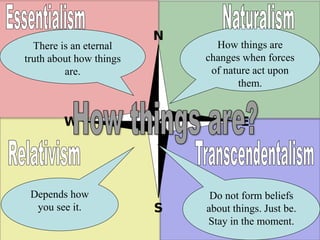
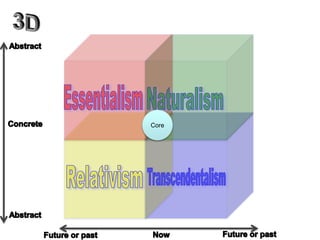
• I categorize theories about human nature
into four types.
• These types are:
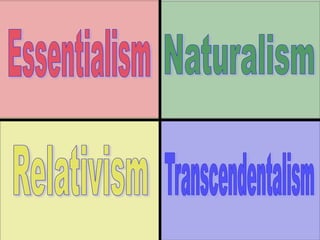
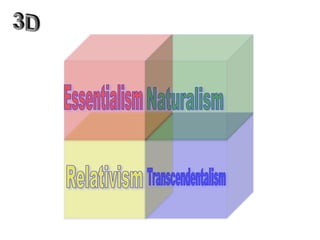
– Essentialism
– Naturalism
– Relativism (culturalism)
– Existentialism / Buddhism
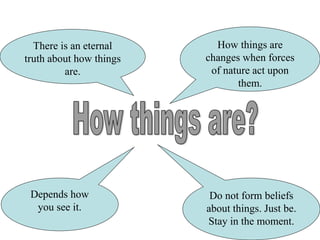
Do not form beliefs
about things. Just be.
Stay in the moment.
Depends how
you see it.
There is an eternal
truth about how things
are.
How things are
changes when forces
of nature act upon
them.
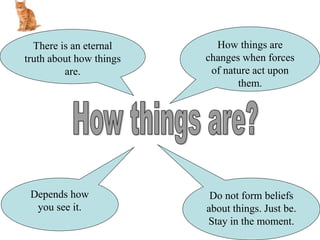
Do not form beliefs
about things. Just be.
Stay in the moment.
Depends how
you see it.
There is an eternal
truth about how things
are.
How things are
changes when forces
of nature act upon
them.
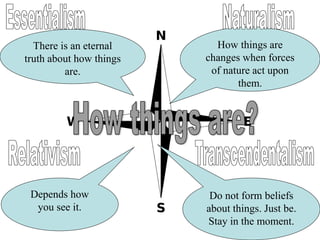
Do not form beliefs
about things. Just be.
Stay in the moment.
Depends how
you see it.
There is an eternal
truth about how things
are.
How things are
changes when forces
of nature act upon
them.
c
Do not form beliefs
about things. Just be.
Stay in the moment.
Depends how
you see it.
There is an eternal
truth about how things
are.
How things are
changes when forces
of nature act upon
them.
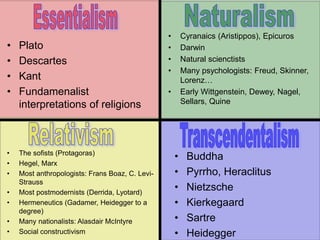
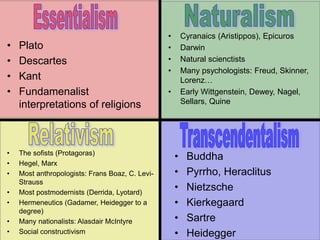
• Cyranaics (Aristippos), Epicuros
• Darwin
• Natural scienctists
• Many psychologists: Freud, Skinner,
Lorenz…
• Early Wittgenstein, Dewey, Nagel,
Sellars, Quine
• Buddha
• Pyrrho, Heraclitus
• Nietzsche
• Kierkegaard
• Sartre
• Heidegger
• The sofists (Protagoras)
• Hegel, Marx
• Most anthropologists: Frans Boaz, C. Levi-
Strauss
• Most postmodernists (Derrida, Lyotard)
• Hermeneutics (Gadamer, Heidegger to a
degree)
• Many nationalists: Alasdair McIntyre
• Social constructivism
• Plato
• Descartes
• Kant
• Fundamenalist
interpretations of religions
Core
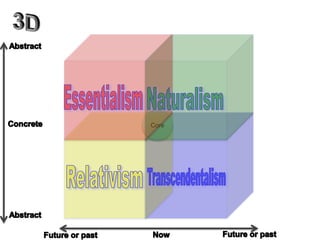
Core
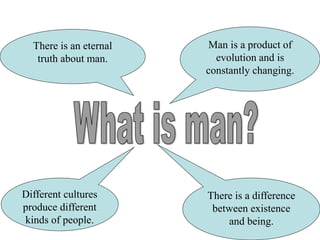
There is a difference
between existence
and being.
Different cultures
produce different
kinds of people.
There is an eternal
truth about man.
Man is a product of
evolution and is
constantly changing.
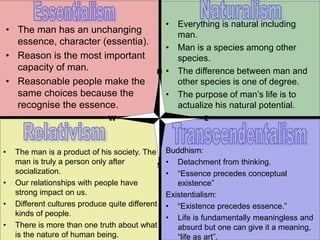
• The man has an unchanging
essence, character (essentia).
• Reason is the most important
capacity of man.
• Reasonable people make the
same choices because the
recognise the essence.
• Everything is natural including
man.
• Man is a species among other
species.
• The difference between man and
other species is one of degree.
• The purpose of man’s life is to
actualize his natural potential.
• The man is a product of his society. The
man is truly a person only after
socialization.
• Our relationships with people have
strong impact on us.
• Different cultures produce quite different
kinds of people.
• There is more than one truth about what
is the nature of human being.
Buddhism:
• Detachment from thinking.
• “Essence precedes conceptual
existence”
Existentialism:
• “Existence precedes essence.”
• Life is fundamentally meaningless and
absurd but one can give it a meaning,
“life as art”.
• Cyranaics (Aristippos), Epicuros
• Darwin
• Natural scienctists
• Many psychologists: Freud, Skinner,
Lorenz…
• Early Wittgenstein, Dewey, Nagel,
Sellars, Quine
• Buddha
• Pyrrho, Heraclitus
• Nietzsche
• Kierkegaard
• Sartre
• Heidegger
• The sofists (Protagoras)
• Hegel, Marx
• Most anthropologists: Frans Boaz, C. Levi-
Strauss
• Most postmodernists (Derrida, Lyotard)
• Hermeneutics (Gadamer, Heidegger to a
degree)
• Many nationalists: Alasdair McIntyre
• Social constructivism
• Plato
• Descartes
• Kant
• Fundamenalist
interpretations of religions
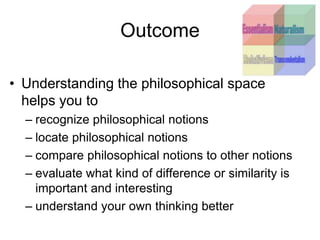
Outcome
• Understanding the philosophical space
helps you to
– recognize philosophical notions
– locate philosophical notions
– compare philosophical notions to other notions
– evaluate what kind of difference or similarity is
important and interesting
– understand your own thinking better

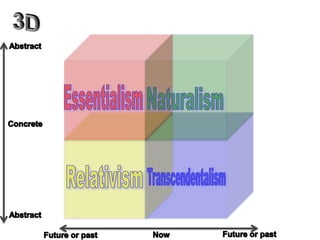
Philosophical space

  • 2.
    The background theory •I categorize theories about human nature into four types. • These types are: – Essentialism – Naturalism – Relativism (culturalism) – Existentialism / Buddhism
  • 5.
    Do not formbeliefs about things. Just be. Stay in the moment. Depends how you see it. There is an eternal truth about how things are. How things are changes when forces of nature act upon them.
  • 6.
    Do not formbeliefs about things. Just be. Stay in the moment. Depends how you see it. There is an eternal truth about how things are. How things are changes when forces of nature act upon them.
  • 7.
    Do not formbeliefs about things. Just be. Stay in the moment. Depends how you see it. There is an eternal truth about how things are. How things are changes when forces of nature act upon them.
  • 8.
    c Do not formbeliefs about things. Just be. Stay in the moment. Depends how you see it. There is an eternal truth about how things are. How things are changes when forces of nature act upon them.
  • 10.
    • Cyranaics (Aristippos),Epicuros • Darwin • Natural scienctists • Many psychologists: Freud, Skinner, Lorenz… • Early Wittgenstein, Dewey, Nagel, Sellars, Quine • Buddha • Pyrrho, Heraclitus • Nietzsche • Kierkegaard • Sartre • Heidegger • The sofists (Protagoras) • Hegel, Marx • Most anthropologists: Frans Boaz, C. Levi- Strauss • Most postmodernists (Derrida, Lyotard) • Hermeneutics (Gadamer, Heidegger to a degree) • Many nationalists: Alasdair McIntyre • Social constructivism • Plato • Descartes • Kant • Fundamenalist interpretations of religions
  • 13.
  • 14.
  • 15.
    There is adifference between existence and being. Different cultures produce different kinds of people. There is an eternal truth about man. Man is a product of evolution and is constantly changing.
  • 16.
    • The manhas an unchanging essence, character (essentia). • Reason is the most important capacity of man. • Reasonable people make the same choices because the recognise the essence. • Everything is natural including man. • Man is a species among other species. • The difference between man and other species is one of degree. • The purpose of man’s life is to actualize his natural potential. • The man is a product of his society. The man is truly a person only after socialization. • Our relationships with people have strong impact on us. • Different cultures produce quite different kinds of people. • There is more than one truth about what is the nature of human being. Buddhism: • Detachment from thinking. • “Essence precedes conceptual existence” Existentialism: • “Existence precedes essence.” • Life is fundamentally meaningless and absurd but one can give it a meaning, “life as art”.
  • 17.
    • Cyranaics (Aristippos),Epicuros • Darwin • Natural scienctists • Many psychologists: Freud, Skinner, Lorenz… • Early Wittgenstein, Dewey, Nagel, Sellars, Quine • Buddha • Pyrrho, Heraclitus • Nietzsche • Kierkegaard • Sartre • Heidegger • The sofists (Protagoras) • Hegel, Marx • Most anthropologists: Frans Boaz, C. Levi- Strauss • Most postmodernists (Derrida, Lyotard) • Hermeneutics (Gadamer, Heidegger to a degree) • Many nationalists: Alasdair McIntyre • Social constructivism • Plato • Descartes • Kant • Fundamenalist interpretations of religions
  • 18.
    Outcome • Understanding thephilosophical space helps you to – recognize philosophical notions – locate philosophical notions – compare philosophical notions to other notions – evaluate what kind of difference or similarity is important and interesting – understand your own thinking better

Editor's Notes

  • #7 Are there moral truths? What is beautiful?