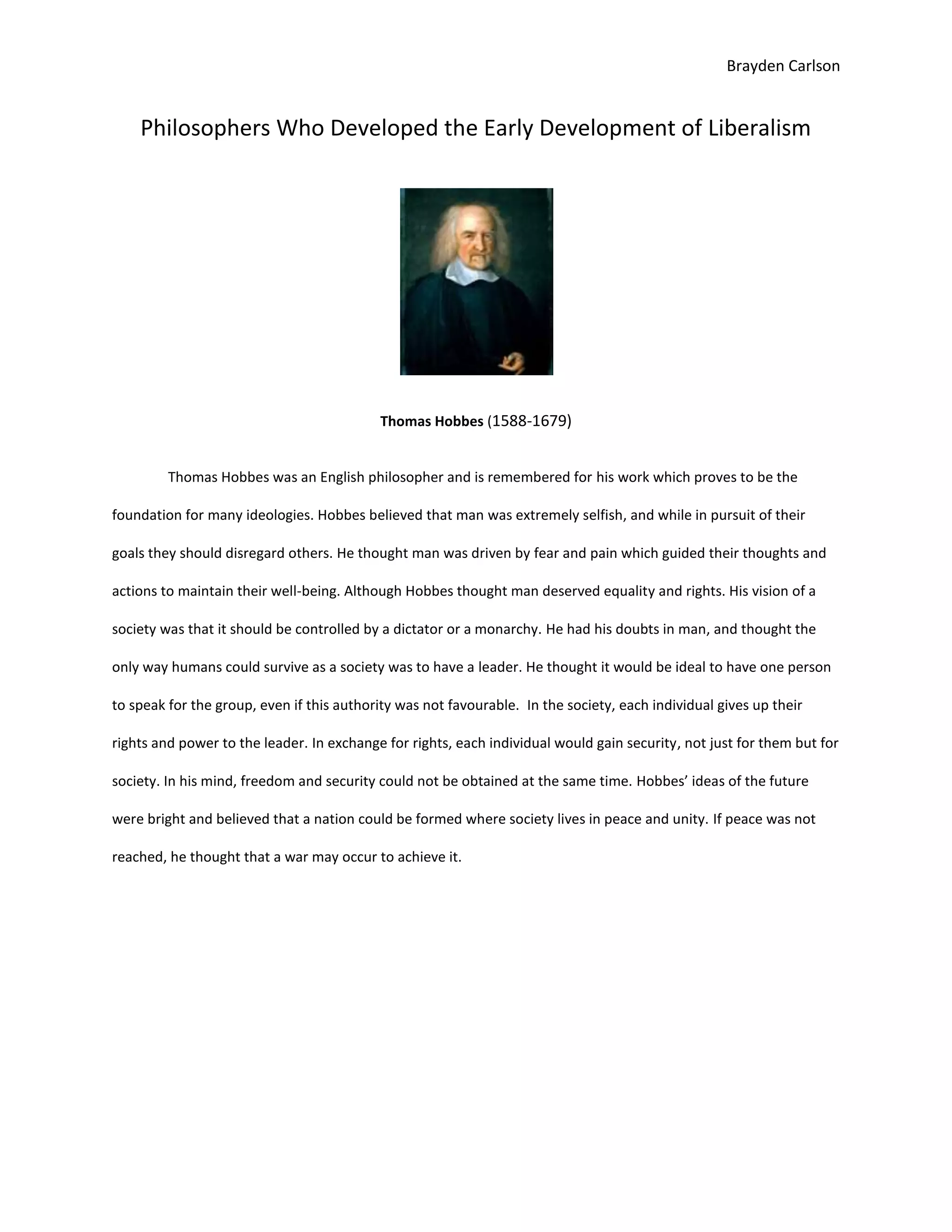
Philosophers Who Developed the Early Development of Liberalism<br />Thomas Hobbes (1588-1679)<br />Thomas Hobbes was an English philosopher and is remembered for his work which proves to be the foundation for many ideologies. Hobbes believed that man was extremely selfish, and while in pursuit of their goals they should disregard others. He thought man was driven by fear and pain which guided their thoughts and actions to maintain their well-being. Although Hobbes thought man deserved equality and rights. His vision of a society was that it should be controlled by a dictator or a monarchy. He had his doubts in man, and thought the only way humans could survive as a society was to have a leader. He thought it would be ideal to have one person to speak for the group, even if this authority was not favourable.  In the society, each individual gives up their rights and power to the leader. In exchange for rights, each individual would gain security, not just for them but for society. In his mind, freedom and security could not be obtained at the same time. Hobbes’ ideas of the future were bright and believed that a nation could be formed where society lives in peace and unity. If peace was not reached, he thought that a war may occur to achieve it.<br />John Locke (1632-1704)<br />John Locke was an English philosopher and physician, and is remembered for his ideas that helped develop political philosophy. Locke believed that the human nature of man was to be selfish, although he believed we were all reasonable and extremely intelligent. He thought everyone should be allowed to make their own decisions. Locke’s ideas opposed those of the Church’s, and thought that man was able to control and operate a balanced nation. He thought that man could create a society that was beneficial to all, and were able to resolve problems with the support of the government. He had an idea that the government should take care of its people but have no control of them. Locke thought that each person should have rights to their own property and personal items, and the government should help protect it. In the future, Locke hoped to see the government keep the people and their property safe; in return, they may have to give up some rights. He believed that each person should be equal and able to make rational decisions. He thought that people will join together as a nation, and spread across the world to live in peace.<br />Jean-Jacques Rousseau (1712-1778)<br />Jean-Jacques Rousseau was a Genevois philosopher, writer and composer of the 18th-century Romanticism. Rousseau’s philosophy on human nature was that all men were born free and every human is equal. However, he believed that a society was greater than the individuals in it. He did not believe that people were naturally selfish but it occurred because everyone tries to obtain happiness. In his mind, a society was able to succeed if each individual was to participate in it. In this society, people should join together to create a nation and give up their rights to the government thus making the society more successful and allows man to remain free. Rousseau thought any law or policy should be determined by the vote of the people.  The policies and decisions that are made should benefit the society, and not any individual. Rousseau had high hopes for the future and imagined the government will no longer control the people, and society had laws that were selected by the people. He thought that people would be free and no longer selfish so we could all obtain happiness.<br />
Philosophers
Philosophers

Philosophers

  • 1.
    Philosophers Who Developedthe Early Development of Liberalism<br />Thomas Hobbes (1588-1679)<br />Thomas Hobbes was an English philosopher and is remembered for his work which proves to be the foundation for many ideologies. Hobbes believed that man was extremely selfish, and while in pursuit of their goals they should disregard others. He thought man was driven by fear and pain which guided their thoughts and actions to maintain their well-being. Although Hobbes thought man deserved equality and rights. His vision of a society was that it should be controlled by a dictator or a monarchy. He had his doubts in man, and thought the only way humans could survive as a society was to have a leader. He thought it would be ideal to have one person to speak for the group, even if this authority was not favourable. In the society, each individual gives up their rights and power to the leader. In exchange for rights, each individual would gain security, not just for them but for society. In his mind, freedom and security could not be obtained at the same time. Hobbes’ ideas of the future were bright and believed that a nation could be formed where society lives in peace and unity. If peace was not reached, he thought that a war may occur to achieve it.<br />John Locke (1632-1704)<br />John Locke was an English philosopher and physician, and is remembered for his ideas that helped develop political philosophy. Locke believed that the human nature of man was to be selfish, although he believed we were all reasonable and extremely intelligent. He thought everyone should be allowed to make their own decisions. Locke’s ideas opposed those of the Church’s, and thought that man was able to control and operate a balanced nation. He thought that man could create a society that was beneficial to all, and were able to resolve problems with the support of the government. He had an idea that the government should take care of its people but have no control of them. Locke thought that each person should have rights to their own property and personal items, and the government should help protect it. In the future, Locke hoped to see the government keep the people and their property safe; in return, they may have to give up some rights. He believed that each person should be equal and able to make rational decisions. He thought that people will join together as a nation, and spread across the world to live in peace.<br />Jean-Jacques Rousseau (1712-1778)<br />Jean-Jacques Rousseau was a Genevois philosopher, writer and composer of the 18th-century Romanticism. Rousseau’s philosophy on human nature was that all men were born free and every human is equal. However, he believed that a society was greater than the individuals in it. He did not believe that people were naturally selfish but it occurred because everyone tries to obtain happiness. In his mind, a society was able to succeed if each individual was to participate in it. In this society, people should join together to create a nation and give up their rights to the government thus making the society more successful and allows man to remain free. Rousseau thought any law or policy should be determined by the vote of the people. The policies and decisions that are made should benefit the society, and not any individual. Rousseau had high hopes for the future and imagined the government will no longer control the people, and society had laws that were selected by the people. He thought that people would be free and no longer selfish so we could all obtain happiness.<br />