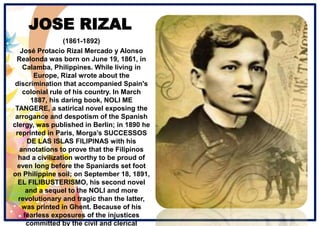
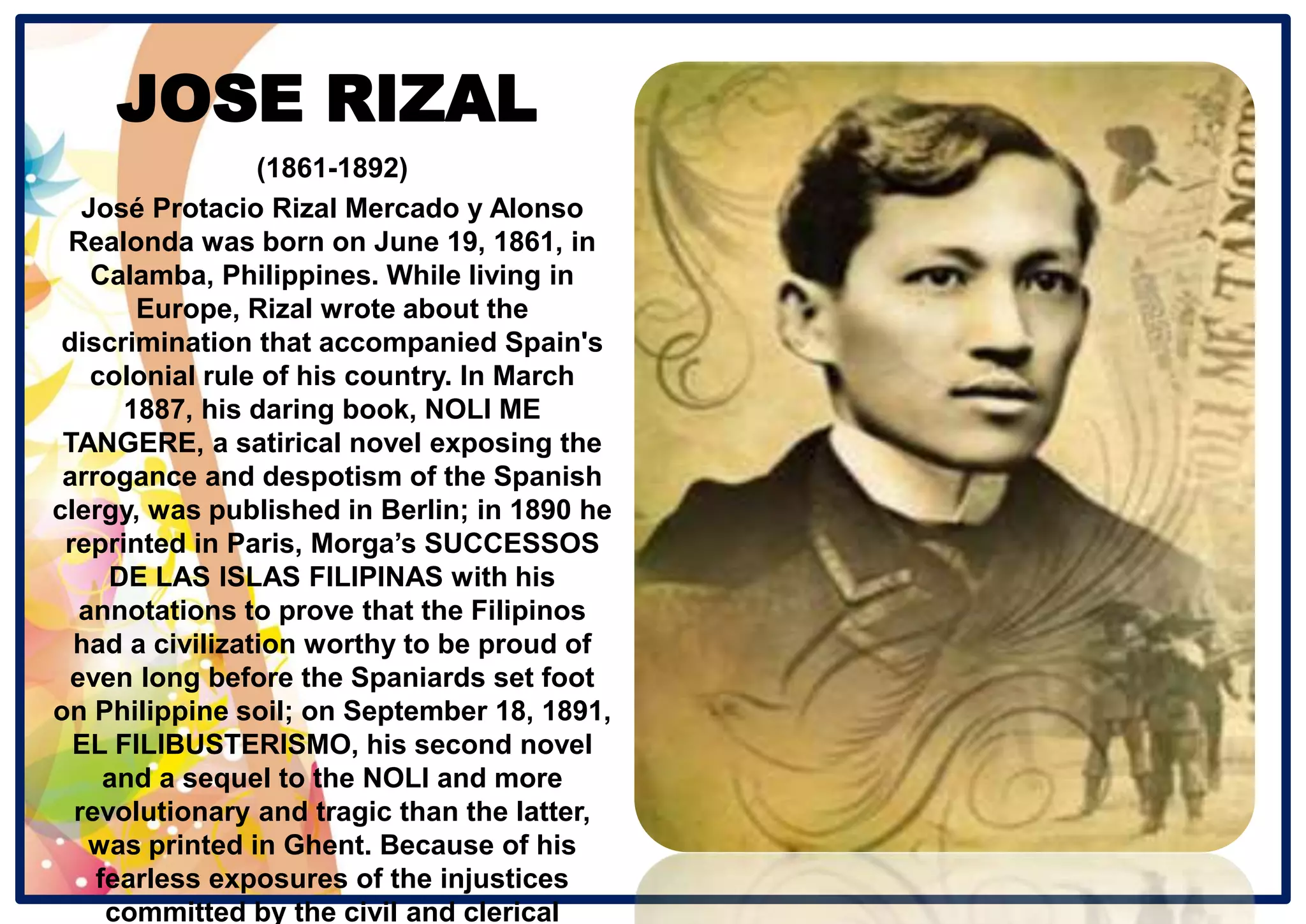
JOSE RIZAL
(1861-1892)
José Protacio Rizal Mercado y Alonso
Realonda was born on June 19, 1861, in
Calamba, Philippines. While living in
Europe, Rizal wrote about the
discrimination that accompanied Spain's
colonial rule of his country. In March
1887, his daring book, NOLI ME
TANGERE, a satirical novel exposing the
arrogance and despotism of the Spanish
clergy, was published in Berlin; in 1890 he
reprinted in Paris, Morga’s SUCCESSOS
DE LAS ISLAS FILIPINAS with his
annotations to prove that the Filipinos
had a civilization worthy to be proud of
even long before the Spaniards set foot
on Philippine soil; on September 18, 1891,
EL FILIBUSTERISMO, his second novel
and a sequel to the NOLI and more
revolutionary and tragic than the latter,
was printed in Ghent. Because of his
fearless exposures of the injustices
committed by the civil and clerical
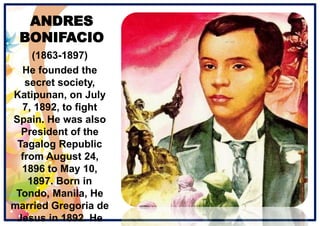
ANDRES
BONIFACIO
(1863-1897)
He founded the
secret society,
Katipunan, on July
7, 1892, to fight
Spain. He was also
President of the
Tagalog Republic
from August 24,
1896 to May 10,
1897. Born in
Tondo, Manila, He
married Gregoria de
Jesus in 1892. He
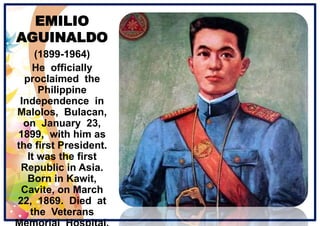
EMILIO
AGUINALDO
(1899-1964)
He officially
proclaimed the
Philippine
Independence in
Malolos, Bulacan,
on January 23,
1899, with him as
the first President.
It was the first
Republic in Asia.
Born in Kawit,
Cavite, on March
22, 1869. Died at
the Veterans
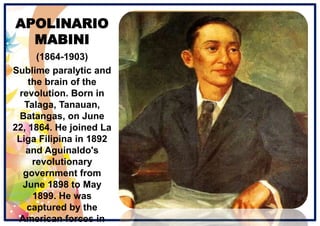
APOLINARIO
MABINI
(1864-1903)
Sublime paralytic and
the brain of the
revolution. Born in
Talaga, Tanauan,
Batangas, on June
22, 1864. He joined La
Liga Filipina in 1892
and Aguinaldo's
revolutionary
government from
June 1898 to May
1899. He was
captured by the
American forces in
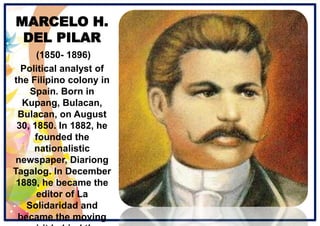
MARCELO H.
DEL PILAR
(1850- 1896)
Political analyst of
the Filipino colony in
Spain. Born in
Kupang, Bulacan,
Bulacan, on August
30, 1850. In 1882, he
founded the
nationalistic
newspaper, Diariong
Tagalog. In December
1889, he became the
editor of La
Solidaridad and
became the moving
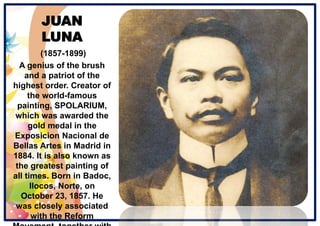
JUAN
LUNA
(1857-1899)
A genius of the brush
and a patriot of the
highest order. Creator of
the world-famous
painting, SPOLARIUM,
which was awarded the
gold medal in the
Exposicion Nacional de
Bellas Artes in Madrid in
1884. It is also known as
the greatest painting of
all times. Born in Badoc,
Ilocos, Norte, on
October 23, 1857. He
was closely associated
with the Reform
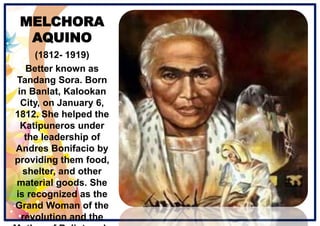
MELCHORA
AQUINO
(1812- 1919)
Better known as
Tandang Sora. Born
in Banlat, Kalookan
City, on January 6,
1812. She helped the
Katipuneros under
the leadership of
Andres Bonifacio by
providing them food,
shelter, and other
material goods. She
is recognized as the
Grand Woman of the
revolution and the
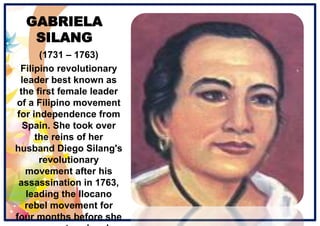
GABRIELA
SILANG
(1731 – 1763)
Filipino revolutionary
leader best known as
the first female leader
of a Filipino movement
for independence from
Spain. She took over
the reins of her
husband Diego Silang's
revolutionary
movement after his
assassination in 1763,
leading the Ilocano
rebel movement for
four months before she
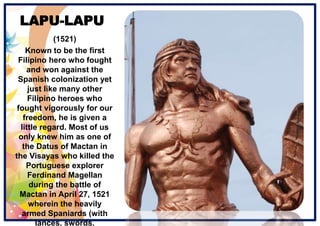
LAPU-LAPU
(1521)
Known to be the first
Filipino hero who fought
and won against the
Spanish colonization yet
just like many other
Filipino heroes who
fought vigorously for our
freedom, he is given a
little regard. Most of us
only knew him as one of
the Datus of Mactan in
the Visayas who killed the
Portuguese explorer
Ferdinand Magellan
during the battle of
Mactan in April 27, 1521
wherein the heavily
armed Spaniards (with
lances, swords,
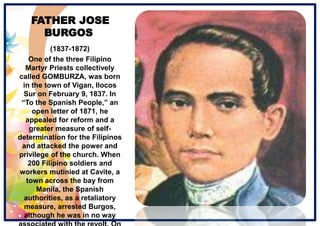
FATHER JOSE
BURGOS
(1837-1872)
One of the three Filipino
Martyr Priests collectively
called GOMBURZA, was born
in the town of Vigan, Ilocos
Sur on February 9, 1837. In
“To the Spanish People,” an
open letter of 1871, he
appealed for reform and a
greater measure of self-
determination for the Filipinos
and attacked the power and
privilege of the church. When
200 Filipino soldiers and
workers mutinied at Cavite, a
town across the bay from
Manila, the Spanish
authorities, as a retaliatory
measure, arrested Burgos,
although he was in no way
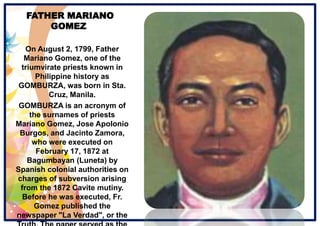
FATHER MARIANO
GOMEZ
On August 2, 1799, Father
Mariano Gomez, one of the
triumvirate priests known in
Philippine history as
GOMBURZA, was born in Sta.
Cruz, Manila.
GOMBURZA is an acronym of
the surnames of priests
Mariano Gomez, Jose Apolonio
Burgos, and Jacinto Zamora,
who were executed on
February 17, 1872 at
Bagumbayan (Luneta) by
Spanish colonial authorities on
charges of subversion arising
from the 1872 Cavite mutiny.
Before he was executed, Fr.
Gomez published the
newspaper "La Verdad", or the
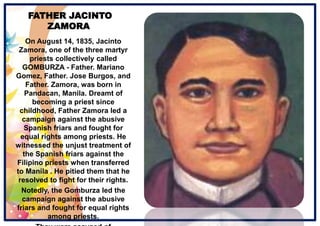
FATHER JACINTO
ZAMORA
On August 14, 1835, Jacinto
Zamora, one of the three martyr
priests collectively called
GOMBURZA - Father. Mariano
Gomez, Father. Jose Burgos, and
Father. Zamora, was born in
Pandacan, Manila. Dreamt of
becoming a priest since
childhood, Father Zamora led a
campaign against the abusive
Spanish friars and fought for
equal rights among priests. He
witnessed the unjust treatment of
the Spanish friars against the
Filipino priests when transferred
to Manila . He pitied them that he
resolved to fight for their rights.
Notedly, the Gomburza led the
campaign against the abusive
friars and fought for equal rights
among priests.
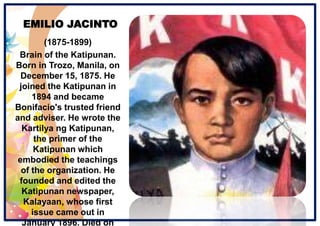
EMILIO JACINTO
(1875-1899)
Brain of the Katipunan.
Born in Trozo, Manila, on
December 15, 1875. He
joined the Katipunan in
1894 and became
Bonifacio's trusted friend
and adviser. He wrote the
Kartilya ng Katipunan,
the primer of the
Katipunan which
embodied the teachings
of the organization. He
founded and edited the
Katipunan newspaper,
Kalayaan, whose first
issue came out in
January 1896. Died on
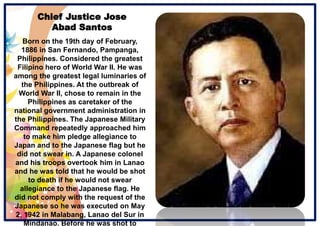
Chief Justice Jose
Abad Santos
Born on the 19th day of February,
1886 in San Fernando, Pampanga,
Philippines. Considered the greatest
Filipino hero of World War II. He was
among the greatest legal luminaries of
the Philippines. At the outbreak of
World War II, chose to remain in the
Philippines as caretaker of the
national government administration in
the Philippines. The Japanese Military
Command repeatedly approached him
to make him pledge allegiance to
Japan and to the Japanese flag but he
did not swear in. A Japanese colonel
and his troops overtook him in Lanao
and he was told that he would be shot
to death if he would not swear
allegiance to the Japanese flag. He
did not comply with the request of the
Japanese so he was executed on May
2, 1942 in Malabang, Lanao del Sur in
Mindanao. Before he was shot to

Philippine national heroes

  • 1.
    JOSE RIZAL (1861-1892) José ProtacioRizal Mercado y Alonso Realonda was born on June 19, 1861, in Calamba, Philippines. While living in Europe, Rizal wrote about the discrimination that accompanied Spain's colonial rule of his country. In March 1887, his daring book, NOLI ME TANGERE, a satirical novel exposing the arrogance and despotism of the Spanish clergy, was published in Berlin; in 1890 he reprinted in Paris, Morga’s SUCCESSOS DE LAS ISLAS FILIPINAS with his annotations to prove that the Filipinos had a civilization worthy to be proud of even long before the Spaniards set foot on Philippine soil; on September 18, 1891, EL FILIBUSTERISMO, his second novel and a sequel to the NOLI and more revolutionary and tragic than the latter, was printed in Ghent. Because of his fearless exposures of the injustices committed by the civil and clerical
  • 2.
    ANDRES BONIFACIO (1863-1897) He founded the secretsociety, Katipunan, on July 7, 1892, to fight Spain. He was also President of the Tagalog Republic from August 24, 1896 to May 10, 1897. Born in Tondo, Manila, He married Gregoria de Jesus in 1892. He
  • 3.
    EMILIO AGUINALDO (1899-1964) He officially proclaimed the Philippine Independencein Malolos, Bulacan, on January 23, 1899, with him as the first President. It was the first Republic in Asia. Born in Kawit, Cavite, on March 22, 1869. Died at the Veterans
  • 4.
    APOLINARIO MABINI (1864-1903) Sublime paralytic and thebrain of the revolution. Born in Talaga, Tanauan, Batangas, on June 22, 1864. He joined La Liga Filipina in 1892 and Aguinaldo's revolutionary government from June 1898 to May 1899. He was captured by the American forces in
  • 5.
    MARCELO H. DEL PILAR (1850-1896) Political analyst of the Filipino colony in Spain. Born in Kupang, Bulacan, Bulacan, on August 30, 1850. In 1882, he founded the nationalistic newspaper, Diariong Tagalog. In December 1889, he became the editor of La Solidaridad and became the moving
  • 6.
    JUAN LUNA (1857-1899) A genius ofthe brush and a patriot of the highest order. Creator of the world-famous painting, SPOLARIUM, which was awarded the gold medal in the Exposicion Nacional de Bellas Artes in Madrid in 1884. It is also known as the greatest painting of all times. Born in Badoc, Ilocos, Norte, on October 23, 1857. He was closely associated with the Reform
  • 7.
    MELCHORA AQUINO (1812- 1919) Better knownas Tandang Sora. Born in Banlat, Kalookan City, on January 6, 1812. She helped the Katipuneros under the leadership of Andres Bonifacio by providing them food, shelter, and other material goods. She is recognized as the Grand Woman of the revolution and the
  • 8.
    GABRIELA SILANG (1731 – 1763) Filipinorevolutionary leader best known as the first female leader of a Filipino movement for independence from Spain. She took over the reins of her husband Diego Silang's revolutionary movement after his assassination in 1763, leading the Ilocano rebel movement for four months before she
  • 9.
    LAPU-LAPU (1521) Known to bethe first Filipino hero who fought and won against the Spanish colonization yet just like many other Filipino heroes who fought vigorously for our freedom, he is given a little regard. Most of us only knew him as one of the Datus of Mactan in the Visayas who killed the Portuguese explorer Ferdinand Magellan during the battle of Mactan in April 27, 1521 wherein the heavily armed Spaniards (with lances, swords,
  • 10.
    FATHER JOSE BURGOS (1837-1872) One ofthe three Filipino Martyr Priests collectively called GOMBURZA, was born in the town of Vigan, Ilocos Sur on February 9, 1837. In “To the Spanish People,” an open letter of 1871, he appealed for reform and a greater measure of self- determination for the Filipinos and attacked the power and privilege of the church. When 200 Filipino soldiers and workers mutinied at Cavite, a town across the bay from Manila, the Spanish authorities, as a retaliatory measure, arrested Burgos, although he was in no way
  • 11.
    FATHER MARIANO GOMEZ On August2, 1799, Father Mariano Gomez, one of the triumvirate priests known in Philippine history as GOMBURZA, was born in Sta. Cruz, Manila. GOMBURZA is an acronym of the surnames of priests Mariano Gomez, Jose Apolonio Burgos, and Jacinto Zamora, who were executed on February 17, 1872 at Bagumbayan (Luneta) by Spanish colonial authorities on charges of subversion arising from the 1872 Cavite mutiny. Before he was executed, Fr. Gomez published the newspaper "La Verdad", or the
  • 12.
    FATHER JACINTO ZAMORA On August14, 1835, Jacinto Zamora, one of the three martyr priests collectively called GOMBURZA - Father. Mariano Gomez, Father. Jose Burgos, and Father. Zamora, was born in Pandacan, Manila. Dreamt of becoming a priest since childhood, Father Zamora led a campaign against the abusive Spanish friars and fought for equal rights among priests. He witnessed the unjust treatment of the Spanish friars against the Filipino priests when transferred to Manila . He pitied them that he resolved to fight for their rights. Notedly, the Gomburza led the campaign against the abusive friars and fought for equal rights among priests.
  • 13.
    EMILIO JACINTO (1875-1899) Brain ofthe Katipunan. Born in Trozo, Manila, on December 15, 1875. He joined the Katipunan in 1894 and became Bonifacio's trusted friend and adviser. He wrote the Kartilya ng Katipunan, the primer of the Katipunan which embodied the teachings of the organization. He founded and edited the Katipunan newspaper, Kalayaan, whose first issue came out in January 1896. Died on
  • 14.
    Chief Justice Jose AbadSantos Born on the 19th day of February, 1886 in San Fernando, Pampanga, Philippines. Considered the greatest Filipino hero of World War II. He was among the greatest legal luminaries of the Philippines. At the outbreak of World War II, chose to remain in the Philippines as caretaker of the national government administration in the Philippines. The Japanese Military Command repeatedly approached him to make him pledge allegiance to Japan and to the Japanese flag but he did not swear in. A Japanese colonel and his troops overtook him in Lanao and he was told that he would be shot to death if he would not swear allegiance to the Japanese flag. He did not comply with the request of the Japanese so he was executed on May 2, 1942 in Malabang, Lanao del Sur in Mindanao. Before he was shot to